From Key-Offer Apprehension to a Paced Yes Without Losing Space

Finding Clarity in the 8:47 p.m. Tube Spiral
If you’re the kind of person who can ship a clean product flow at work but will spend three hours rewriting a single text about a relationship step, this ‘key’ moment is probably living in your head rent-free—hello, commitment pacing anxiety.
Taylor (name changed for privacy) met me on a video call from her flat in London, still in her work hoodie, cheeks flushed like she’d sprinted down an escalator even though she hadn’t. Behind her, the kitchen was dim except for the strip of light under a cabinet. Somewhere off-screen, a kettle clicked as if it had an opinion.
“It’s just a key,” she said, but the words came out like she was trying to talk herself down from a ledge. “They offered it so casually. And I’m… not scared of them. I’m scared of what saying yes sets in motion.”
I could hear the city in the way she paused—like she was used to timing everything: meetings, trains, deliveries, feelings. She described the commute home on the Jubilee line: harsh fluorescent lights, the train screeching into a curve, one hand on the pole and the other warming her phone through her coat pocket. The message about the key sat on her screen like an unopened file. She drafted a reply, deleted it, drafted again, deleted again.
As she spoke, I noticed the tell in her body before she even named it: her jaw set hard enough that I could almost feel my own teeth press together in sympathy. She lifted her hand to her chest once, like she was checking whether her ribs were still there.
“You’re not overreacting—symbols hit harder when expectations stay unspoken,” I told her. “And a key is one of those symbols. It’s not metal. It’s access. It’s routine. It’s a story people think they already know.”
Her apprehension wasn’t a thought. It was physical—like trying to breathe through a scarf pulled too tight, like her body was bracing at a doorway because it couldn’t tell if stepping forward meant losing the ability to step back.
“So,” she asked, voice small but steady, “do I take it… or slow down?”
“Let’s not force a verdict tonight,” I said gently. “Let’s make a map. Our whole journey is toward clarity—clarity you can actually breathe inside.”

Choosing the Compass: The Decision Cross · Context Edition
I asked Taylor to take one slow inhale and let it land low in her belly—not as a mystical ritual, just a way to move the question from her screen and into her real nervous system. While she breathed, I shuffled my well-worn deck the way I always do: steady, unhurried, like turning soil with a spade.
In my family’s old Highland way of healing, we watch what repeats: seasons, tides, the way a storm can roll in at the same hour three days in a row. My work with tarot is the same. The cards don’t “tell” you what to do; they show you the pattern of weather you’re standing in—so you can stop arguing with the sky and start choosing what to wear.
“Today,” I said, “we’ll use the Decision Cross · Context Edition.”
For anyone reading along who’s ever Googled how tarot works at 1 a.m. after a sweet weekend turned into a Sunday-night spiral: this spread is perfect when the question is explicitly two-path—take it or slow down—and the real issue is that the symbolism is hijacking the choice. The Decision Cross puts the options side-by-side, then pulls one card specifically for what’s secretly driving the hesitation, and closes with an integrative next step—because in modern relationships, you’re rarely choosing between “love” and “freedom.” You’re choosing how to name terms without losing yourself.
“Here’s the structure,” I told her, laying the cards in a cross on my table. “The center card shows the current stalemate—how you’re stuck. The left card is Option A: taking the key. The right card is Option B: slowing down. The card above reveals what’s really driving the hesitation—fear, assumption, an old script. The card below is the grounded next step: how to blend closeness with boundaries so your pace stays self-led.”
Taylor nodded once, like she’d been waiting for someone to give her a framework that wasn’t a group chat poll.
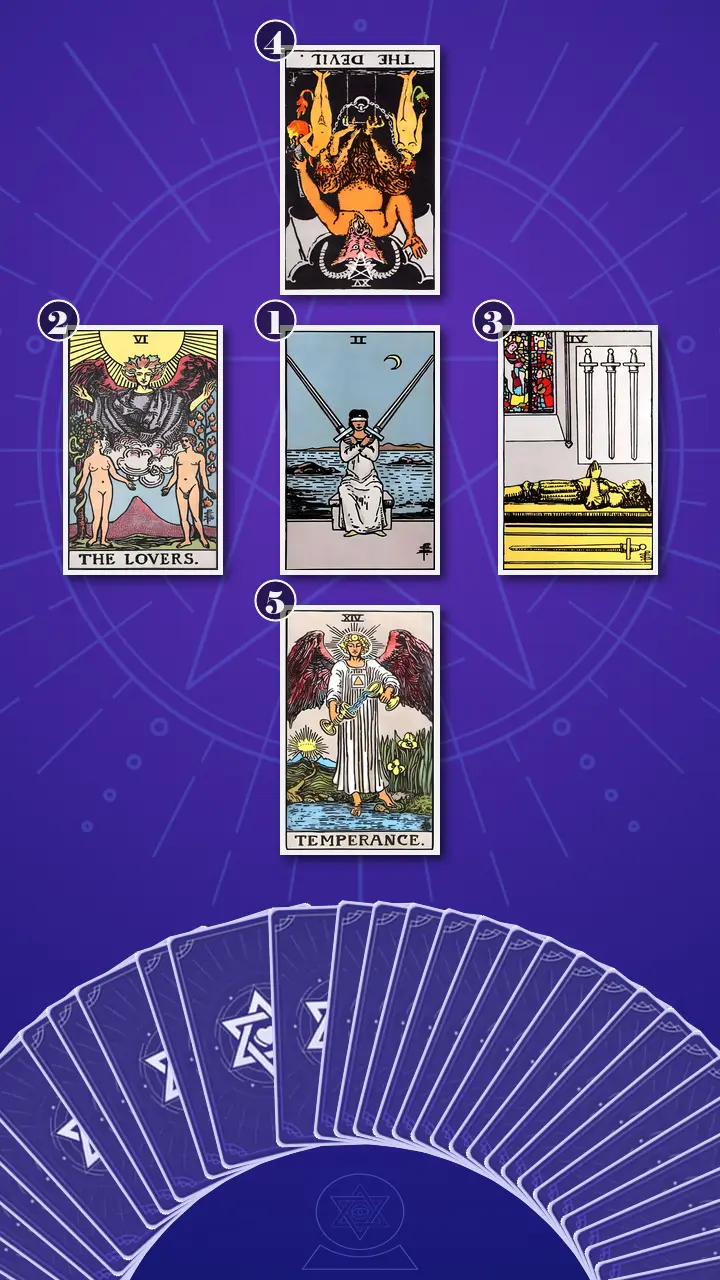
The Blindfold in Your Drafts Folder
Position 1: The current stalemate—how you’re getting stuck
“Now I’m turning over the card that represents the current stalemate: the specific way you’re getting stuck and postponing a clear response,” I said.
Two of Swords, upright.
Even over video, the image landed between us: a figure blindfolded, arms crossed, swords held over the heart. Calm water behind. A narrow moon above. The kind of calm that isn’t peace—it’s containment.
“This is the commute-home moment,” I said, using the language of her life. “You’re staring at the message about the key, drafting and deleting replies like you’re trying to solve the relationship with perfect wording. You keep it light—‘haha that’s wild’—so you don’t have to reveal how big it feels.”
I watched her throat work as she swallowed. She gave me an almost-laugh, the kind that has a bitter edge to it.
“That’s… brutal,” she said. “Like, accurate. Too accurate.”
Her reaction came in a chain, quick and human: (1) she froze her breath for half a beat, (2) her eyes went slightly unfocused as if replaying her own message drafts like CCTV footage, (3) then that small laugh escaped—half amusement, half embarrassment.
“The Two of Swords is your mind trying to keep you safe through neutrality,” I continued. “It’s a form of self-protection: If I don’t pick a side, nothing can happen to me. But notice the body cost—tight chest, clenched jaw. The energy here is contracted. Not because you’re incapable of choosing, but because you’re choosing ‘don’t look’ as a strategy.”
My Nature Empathy Technique always starts with one question: “What season is this in your body?” With Taylor, it felt like late winter—stillness, frozen ground, everything waiting for a thaw that won’t come unless warmth is invited.
“Let me name the script I’m seeing,” I told her, bringing in my Relationship Pattern Recognition. “It’s not random indecision. It’s recurring: If I say yes → I lose control. If I say no → I lose something good. So I do… nothing. The blindfold feels calmer, but it also means you can’t negotiate terms. And when terms aren’t negotiated, your imagination fills them in.”
The Fork in the Road: What Yes and Pause Actually Mean
Position 2: Option A—Take the key
“Now I’m turning over the card that represents Option A: what saying yes opens up, and what you’d be agreeing to in principle,” I said.
The Lovers, upright.
Taylor’s face softened in a way people don’t always notice in themselves—her eyebrows eased, her mouth unclenched. There was a warmth there she hadn’t given herself permission to admit.
“This isn’t ‘move in tomorrow,’” I said. “The Lovers is values-choice. Consent. Alignment. Taking the key looks like choosing closeness on purpose: accepting it because it matches your values—trust, partnership, steadiness—not because you’re being swept along by momentum.”
I saw her glance down and to the side, the way people do when they’re trying to hide how much they care. “That’s the thing,” she admitted. “It felt… sweet. Like, I felt chosen. And then my brain was like, okay but what’s the catch?”
“Two truths can exist,” I said, letting the card hold both without turning either into a diagnosis. “I want partnership and I need space. The Lovers restores dignity to desire. Wanting closeness doesn’t make you weak. It makes you human.”
She nodded slowly, like she’d just watched an Esther Perel clip where someone says the quiet part out loud and you realize you’re not uniquely broken—you’re just alive.
Position 3: Option B—Slow down
“Now I’m turning over the card that represents Option B: what pacing yourself protects, and what becomes possible if you pause,” I said.
Four of Swords, upright.
“This one is important,” I told her, “because it distinguishes pause from avoidance. The Four of Swords is the chosen container: a deliberate 24–48 hour window where you stop drafting messages, stop polling friends, and let your nervous system settle.”
I could see her shoulders drop a fraction, like just hearing the words “24–48 hours” gave her something she could actually hold.
“You know how, at work, you sometimes step away from a Figma file because your eyes are lying to you?” I asked. “You don’t step away because you don’t care—you step away because you do care, and you want to see clearly. This card says slowing down can be healthy if it’s intentional and time-bound. Otherwise it becomes that always-on app in the background, running relationship scenarios until you’re mentally exhausted.”
Taylor exhaled through her nose. “Yeah. I keep telling myself I’m being thoughtful, but I’m just… marinating.”
“Exactly,” I said. “Stillness is different from freezing.”
A Ghost Contract in the Tesco Light
Position 4: What’s really driving the hesitation
“Now I’m turning over the card that represents what’s really driving the hesitation: the core fear, attachment pattern, or assumption about what the key ‘means’,” I said.
The Devil, reversed.
Even after decades of reading, this card still changes the temperature of a room—like a cloud passing over the sun. And reversed, it does something subtler: it shows the moment the chain loosens, but the skin still remembers the pressure.
“This is the ‘terms & conditions’ feeling,” I told her. “The invisible contract your mind starts reading even though no one has written it.”
I kept it specific, because vague reassurance never dissolves this kind of fear. “The hesitation is being driven by an imagined string: you picture that accepting the key means you’ll be expected to be available, accommodating, permanently more merged than you want. So you start scanning their enthusiasm for pressure. You rehearse an exit plan before asking what the key practically means.”
Taylor’s mouth tightened again, but this time it wasn’t bracing—it was recognition. “Yes,” she said quietly. “I can already feel myself losing my week. Like my calendar stops being mine.”
This was where my Relationship Pattern Recognition becomes a lever, not a label. “Taylor, your fear isn’t necessarily about them,” I said. “It’s about an old template that equates closeness with loss of control. The Devil reversed shows you’re ready to see the chain for what it is.”
Then I gave her the reframe that often cracks the stalemate open:
A key isn’t a contract—unless you treat silence like fine print.
She blinked hard. The chain of reaction ran again, but differently this time: (1) her jaw unclenched as if she’d just realized she’d been biting down for an hour, (2) her gaze sharpened with a sudden, practical clarity, (3) and she breathed out—long, audible—like someone stepping out of a cramped lift into open air.
“I’m negotiating with a ghost contract,” she said, almost to herself.
“Yes,” I replied. “And this is where you reclaim power without becoming defensive. Devil reversed isn’t ‘run.’ It’s ‘make the invisible visible.’ Ask one direct question. Name one boundary. Let the real terms replace the imagined ones.”
Outside my window in the Highlands, the wind pushed rain against the glass in soft pulses—like someone tapping a steady reminder: you can’t calm a storm by pretending the sky is clear. You calm it by taking shelter and speaking plainly.
When Temperance Poured Between Two Cups
Position 5: The best next step for integration
I let a small silence settle before the final card. “This,” I said, “is the integration point. The part where we stop arguing with extremes.”
“Now I’m turning over the card that represents the best next step for integration: how to combine closeness with boundaries so the pace stays self-led.”
Temperance, upright.
The angel on the card pours water between two cups, patient and precise. One foot on land, one in water. A path leading to a glowing horizon that doesn’t demand speed—only direction.
“In modern life,” I said, “this is the calm kitchen-table conversation version of the key. Two people defining what it does and doesn’t mean. Check-ins. Time windows. ‘Convenience, not obligation.’”
And because this was the key card—the bridge—I slowed my voice the way I do when I’m about to offer a sentence that can actually change someone’s next phone call.
In my mind, I saw it like weather meeting landscape: her desire was the sea; her boundaries were the shoreline. Not enemies. Just needing definition.
For a moment, I could feel where Taylor was stuck: Sunday night, kettle just clicked off, staring at her phone like it’s a doorway. Her body braced. Her brain drafting the perfect response. The word “key” suddenly heavier than it should be—like one small object could decide the entire relationship timeline.
Stop treating this as ‘all in or all out’ and start blending closeness with clear pacing—like Temperance, you can pour without spilling.
I let that sit between us, un-rushed.
Her response came in layers—so physical it made my own chest loosen in empathy. First, her eyes widened just a fraction, like the idea had slipped past her defenses. Then her shoulders dropped, slow and real, the way they do after you’ve been holding tension without noticing. Her lips parted as if she was about to argue—but instead she went quiet, gaze flicking down to her hands like she was realizing she’d been gripping her phone too hard.
Then the vulnerability arrived on the heels of relief. “But if I do that,” she said, voice turning rougher, “doesn’t it mean I’ve been… making it harder than it needs to be?”
It was an unexpected reaction—not pure ease, but a flash of self-reproach. I met it gently and directly, because this is where trust is built.
“It means you’ve been trying to protect yourself with the only tool your nervous system trusted: silence,” I said. “That was never stupid. It was survival. Temperance isn’t shaming you. It’s offering you a new skill: paced agreements.”
I guided her into a tiny memory test, the way I always do to make insight actionable. “Now, with this new lens,” I asked, “look back at last week. Was there a moment—maybe that Tesco message, maybe the Tube—when this idea could’ve changed how your body felt?”
She didn’t answer right away. She touched her sternum with her fingertips, almost like checking whether the tightening was still there. “Yeah,” she said softly. “Friday. They texted, ‘I left the key on the table for you.’ And my stomach flipped—not cute. More like… ‘what are the terms.’ If I’d asked one question instead of spiraling, I think I would’ve felt… less trapped.”
“That,” I told her, “is the beginning of the transformation: from bracing and over-analysis to paced, self-led clarity with explicit boundaries. Not certainty. Ownership.”
The One Text That Turns Guesswork Into Terms
I gathered the whole spread into a single story for her, the way you’d summarize a user journey so the design problem finally becomes obvious.
“Here’s what the cards say is happening,” I said. “You’re in a Two of Swords stalemate—keeping your response neutral so you don’t have to risk being seen wanting something specific. Option A, The Lovers, shows the desire is real: you want values-based intimacy, not performative chill. Option B, the Four of Swords, says a short pause can help—if it’s a container, not an endless delay. The Devil reversed reveals the hidden driver: you’re reacting to an imagined contract, scanning for strings, negotiating against expectations that haven’t been spoken. And Temperance gives you the way through: blend closeness with boundaries through visible, practical terms.”
“The cognitive blind spot,” I added, “is that you’ve been treating this key like a permanent verdict—when it can be a negotiable agreement you define out loud. That’s the shift. That’s how you keep your pace and still accept closeness.”
I leaned in slightly, voice calm and un-dramatic. “This isn’t ‘all in or all out.’ It’s ‘what are the terms?’”
Then I gave her next steps that were small enough to do, even with a tight chest.
- Send the one-sentence practical question (within 48 hours)Text: “What would having a key mean day-to-day for you—like, when would you actually expect me to use it?” Keep it plain, not apologetic.If you start rewriting it, set a 3-minute timer. Send the first clean version, not the cleverest one.
- Add one boundary in the same threadFollow with: “I’d love to have it, and I also need my alone-time rhythm to stay intact—so I want us to be clear it doesn’t mean I’m always on call.”If it feels ‘too intense,’ shrink it. You can start with: “I’m excited, and I want to keep my solo nights too.”
- Do “Two Truths + One Boundary” (5 minutes, Notes app)Write: Truth 1 (the closeness you want). Truth 2 (the space you need). Then one concrete ask (your boundary). Use that as your script so you don’t talk yourself out of your own needs mid-conversation.If your chest tightens while writing, pause. One hand on your sternum, three slow breaths—name it like weather: “tight, cloudy, braced.” Then continue.
Because my work is also about communication—not just insight—I offered her one of my simplest interventions, the kind couples can do without feeling like they’re in a therapy session.
“Before you talk,” I said, “try a 60-second breathing sync. Not to be cheesy—just to stop the conversation from starting in a fight-or-flight state. You inhale for four, exhale for six. If you’re together, do it side-by-side for three rounds. It’s like telling your nervous system: ‘We’re safe enough to be honest.’”
And I gave her a Temperance-flavored ritual that didn’t moralize timelines. “If you want a container,” I added, “have the conversation over a shared meal—kitchen table energy. Temperance loves the ordinary. A key conversation is easier when it’s held by something grounded: tea, pasta, the extractor fan humming. If you like a little rhythm, I sometimes suggest scheduling important talks around the moon—not because the moon controls you, but because it creates a shared ‘we meant to show up for this’ moment. If moon cycles aren’t your thing, just choose a night when neither of you is depleted.”
“A paced yes is still a yes—just one you can breathe inside,” I finished.

A Week Later: The Quiet Proof
Six days later, Taylor messaged me. Not a paragraph. Just a screenshot and one line: “I sent the question. I didn’t die.”
Her text to her partner was almost exactly what we drafted—short, practical, human. And their reply was, too: they said the key was for convenience, not expectation; they didn’t want her to feel pressured; they were excited, but they wanted her pace to feel good. No hidden clauses. No trap door. Just two adults making terms visible.
She told me something else that mattered more than the partner’s response: “My jaw didn’t clench when I read their message. It was like… my week stayed mine.”
Her transformation wasn’t perfect or cinematic. It was small and real: she slept a full night, and in the morning her first thought was still, What if I’m wrong?—but this time she noticed the thought, exhaled once, and made tea anyway.
When I reflect on readings like this, I think about the Highlands in early spring: the thaw doesn’t happen because winter apologizes. It happens because warmth arrives in steady increments. That’s what Temperance offered Taylor—measured integration. Not a dramatic leap. A practice.
When someone offers closeness and your chest tightens, it’s often because part of you wants to step in—and part of you is terrified that stepping in means you don’t get to step back.
If you let the key be an agreement you can shape—not a verdict—what’s one tiny term you’d want to say out loud so your yes stays yours?