From LinkedIn-Stalking Jealousy to Self-Trust: A Gentle 7-Day Reset

Finding Clarity in the 1 a.m. Screen Glow
If you keep telling yourself it’s “just curiosity” but your chest tightens the moment you open the ex’s profile, you’re not researching—you’re trying to feel safe.
Jordan (name changed for privacy) showed up on my screen from a Toronto high-rise bedroom, lit mostly by a phone they kept flipping face-down like it was misbehaving. The streetlight outside made a pale rectangle on the wall. I could hear a charger buzz faintly through their mic, and somewhere in their building a radiator clicked like it couldn’t settle.
“I hate that I do this,” they said, hands restless, fingers picking at the edge of a sleeve. “But it’s like I have to know. I LinkedIn-stalk their ex, and then I’m… gone. Like I’m competing with someone who isn’t even in the room.”
Their jaw looked locked. Not metaphorically—like a hinge with grit in it. Their chest rose shallowly, like they’d just run up stairs, except they were sitting still. Insecurity, in this moment, wasn’t a feeling. It was a tight chest and a jaw that wouldn’t unclench, with hands that kept reaching for the phone before the mind even voted.
I leaned closer to the camera, softening my voice on purpose. “We’re not here to shame that reflex,” I told them. “We’re here to understand what it thinks it’s protecting—and then we’ll find a next step that builds real safety. A kind of clarity you can feel in your body, not just argue yourself into.”

Choosing the Compass: The Four-Layer Insight Ladder
I asked Jordan to take one slow breath with me—not as a mystical ritual, just a clean transition. “Inhale for four,” I said, watching their shoulders lift. “Exhale for six.” On the longer exhale, their hands finally stopped hovering over the phone like they were waiting for a push notification from fate.
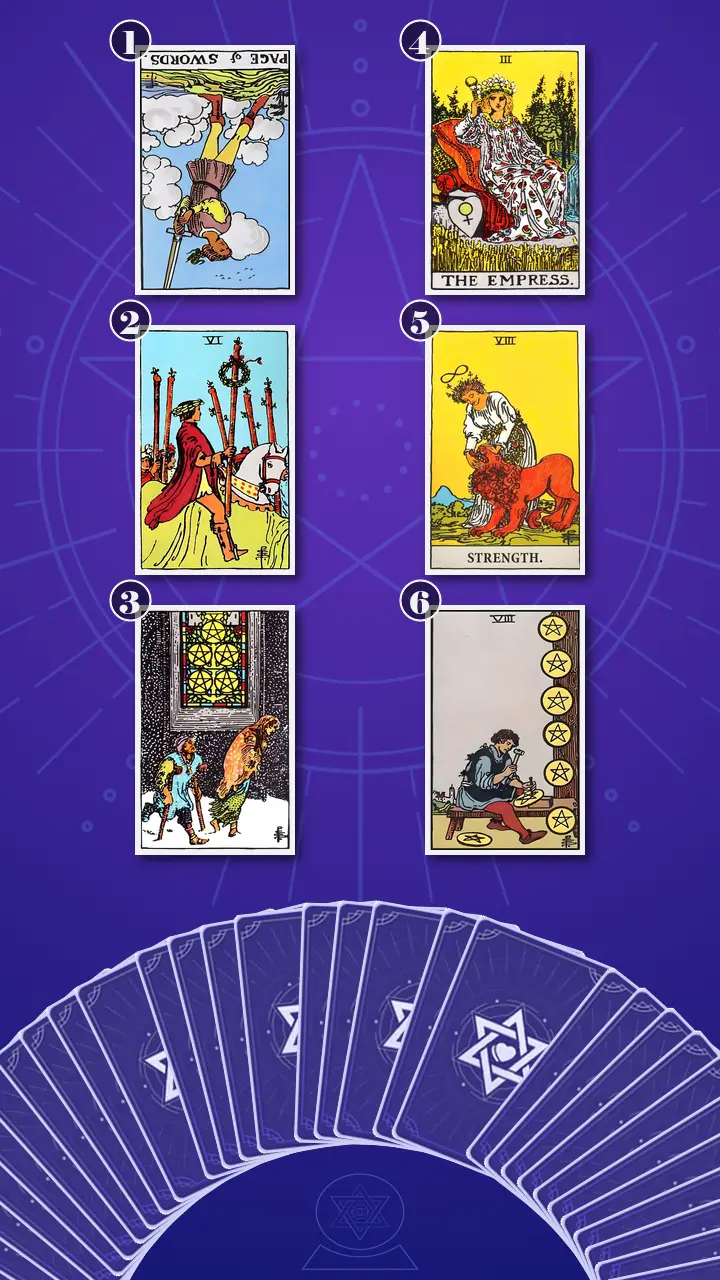
“Today I’m using a spread I love for modern relationship spirals,” I explained. “It’s called the Four-Layer Insight Ladder · Context Edition.”
For anyone reading along: this spread works because the question isn’t Will my relationship be okay? It’s Why am I stuck in this compulsive comparison loop, and how do I move past it? The Ladder is small enough to be clear, but complete enough to track the full chain: surface behavior → trigger → root fear → neglected resource → turning point → a grounded next step. It’s a practical way to show how tarot works in context: not prediction, but pattern recognition and behavior change.
“Card 1 will show the loop itself—what you do and what it does to your mind,” I said. “Card 3 drops us into the wound underneath it. And Card 5 is our turning point—the reframe that breaks the spell.”
Reading the Left Rail: The Comparison Loop in Motion
Position 1 — The surveillance reflex you call ‘research’
“Now flipping over is the card that shows the exact comparison behavior loop—what you do after stalking, and the mental posture it creates.”
Page of Swords, reversed.
I didn’t need to reach for anything mystical to make it land, because the translation is painfully modern: It’s 1:06 a.m. and you’re doing relationship ‘due diligence’ the way you’d do market research: searching the ex by name, re-reading their title history, memorizing dates, and comparing your own profile line-by-line—then feeling even less certain than before. You’re not seeking truth; you’re seeking control over uncertainty, and the control comes from surveillance.
Reversed, this isn’t curiosity in balance. This is Air energy in excess: hyper-vigilant, wind-tossed, always scanning. The Page’s sideways gaze is split attention—your body is in your relationship, but your mind is leaning out the window looking for threats on a screen.
I said it plainly, because Jordan’s brain was already doing enough poetry on its own: “Comparison is a safety strategy that stops working the moment you hit refresh.”
Jordan let out a short laugh that had no humor in it. It was more like a valve releasing pressure. “That’s… rude,” they said, and then their eyes flicked down. “But yeah. I literally close the app and re-open it two minutes later like I forgot something.”
“You’re gathering facts,” I said, keeping my tone gentle, “but your nervous system is gathering fear.”
Position 2 — The status alarm that reaches for LinkedIn
“Now flipping over is the card that identifies the specific social-proof stimulus that makes you reach for LinkedIn.”
Six of Wands, upright.
This one is the highlight reel with applause baked in. In modern terms: A single polished ‘Congrats on the promotion!’ post (or a flood of endorsements) becomes the spark: the comments, the accolades, the prestige markers. The moment you see public validation, your body reads it as: “This is what being chosen looks like—do I measure up?” and your thumb is already moving toward the search bar.
Fire energy here is in excess too—not rage, but ignition. The laurel wreath and the crowd are a nervous-system trap: visibility becomes “proof,” and proof becomes “safety.”
I watched Jordan’s face shift as recognition moved through them. Their eyes unfocused for a second, like their brain was replaying a specific moment. “It’s the comments,” they admitted. “The ‘So deserved!’ stuff. It makes it feel… official.”
“Right,” I said. “And I want you to hold this sentence like a handrail: Their ex’s LinkedIn isn’t a verdict—it’s a highlight reel your nervous system misreads as a threat. It isn’t telling you who will be chosen. It’s just triggering your status alarm.”
Position 3 — The wound beneath the scrolling
“Now flipping over is the card that names the deeper fear beneath comparison—the belonging threat that keeps the loop alive.”
Five of Pentacles, upright.
This is the root of it, and it isn’t glamorous. It’s human. Under the stalking isn’t curiosity—it’s the fear of being the outsider: that their ex ‘belongs’ in your partner’s world and you’re the risky choice. Even if your partner is kind and present, one small distance cue can flip the switch to: “I’m about to be left out.” The ex’s success becomes a symbol for exclusion.
Earth energy here is in deficiency: not enough warmth, not enough “I belong,” not enough inner shelter. The card’s image—figures outside while light glows inside—captures that particular kind of pain where nothing bad has happened, but your body feels exiled anyway.
Jordan’s reaction came in a small chain, exactly the way real insight arrives: first their breathing paused (a tiny freeze), then their gaze dropped to the corner of their desk (as if their mind was watching an old memory), then their shoulders sank on a heavy exhale. “It’s… that,” they said quietly. “When they text slow, I tell myself it’s because I’m the downgrade.”
I nodded. “That sentence is the wound talking—not a prophecy. And now that we’ve named it, we can stop feeding it with more ‘evidence.’”
I turned the spread slightly toward the right rail. “Don’t ask ‘What do they have?’ Ask ‘What am I needing?’”
When Strength Spoke: The Lion, the Phone, and Gentle Self-Leadership
Position 4 — The inner home you’ve been skipping
“Now flipping over is the card that reveals what you actually need to feel safe and whole—beyond being ‘better.’”
The Empress, upright.
The Empress is nourishment without negotiation. In modern terms: The neglected resource is an inner ‘home’—the kind that makes you stop negotiating your worth. In modern terms: actual rest, food, softness, friends who know you, creative routines, and body-level comfort. The Empress looks like choosing nourishment on purpose the moment your brain tries to make you earn safety through comparison.
Earth energy here is in balance: steady, warm, real. And because I’m an artist, I always see The Empress like a museum room with good lighting—nothing is begging to be chosen. It just is. You don’t prove a painting deserves to exist; you stand in front of it long enough to feel what it gives you.
Jordan’s mouth softened a fraction. “That sounds… nice,” they said, like they didn’t fully trust nice things to work.
“It is nice,” I said. “And it’s also tactical. You can’t think your way into belonging when your body feels locked out.”
Position 5 — The turning point that breaks the spell (Key Card)
The room went unusually quiet as I reached for the next card—like the city outside Jordan’s window held its breath with us.
“Now flipping over is the card that provides the key reframe—the mindset shift that changes the whole dynamic.”
Strength, upright.
Here’s the lived version: The turning point happens inside a 10-minute window: you feel the urge to check, you name the real fear (“I’m scared I’m replaceable”), and you choose a regulating action instead of feeding the loop. Strength is not ‘being unbothered’—it’s being bothered and still leading yourself gently.
And because this is where my work gets specific, I used one of my favorite tools—what I privately call Iconic Line Diagnosis. I’ve learned that some relationships (and some internal battles) become clearer when you find the line you keep trying to make someone else say.
“If this spiral were a classic film,” I told Jordan, “it’s not an action movie where you defeat the villain. It’s Casablanca energy—two people in a fog of fear and longing, trying to make certainty out of an impossible situation. The line your nervous system keeps demanding is: ‘Promise me I’m the winner. Promise me I’m the safest choice.’ But love doesn’t talk like LinkedIn. Love talks like presence.”
Jordan swallowed. I saw their throat bob, a small physical tell. Their hands finally came to rest on the blanket, palms down, like they were trying to anchor themselves to something solid.
Setup
You’re in bed, phone glowing, chest tight, telling yourself it’s “just one check,” even though you already know how the story ends: smaller, wired, and still not reassured.
Delivery
Stop treating comparison as ‘research’ and start practicing gentle self-leadership—like Strength, you don’t conquer the feeling, you soothe it until it stops running the show.
Reinforcement
Jordan’s reaction arrived in layers. First: a stillness, almost a freeze—eyes open a touch wider, breath caught mid-inhale. Second: the meaning seeped in; their gaze drifted past my screen toward the pale rectangle of streetlight on the wall, like they were watching themselves from the outside for the first time. Third: their face tightened, then softened, and a shaky exhale left their chest as if they’d been holding air hostage.
“But if I stop,” they said, and there was a flash of anger under the vulnerability, “doesn’t that mean I was wrong for doing it? Like I made all of this up?”
I kept my voice steady. “No. It means you were trying to survive uncertainty with the only tool that felt available. Strength doesn’t mock the lion. It just stops letting the lion drive.”
I paused, letting the quiet do some work. “Now—with this new lens—can you think of one moment last week when you felt the urge spike? A slow text, a distance cue, a ‘Congrats!’ post. Where were you, and what would it have been like to soothe first instead of scroll?”
They looked down at their phone, then deliberately placed it out of reach on the nightstand. “Sunday,” they said. “Kitchen. Fridge light. They were ‘tired and crashing early’ and I spiraled. If I’d soothed first… I think I would’ve just asked for a check-in instead of stalking.”
That was the pivot—the emotional transformation made visible: from social-proof-driven insecurity and mental scorekeeping to grounded self-trust and closeness-oriented choices. Not perfect. But real.
Position 6 — The next right step that puts you back in your lane
“Now flipping over is the card that offers a practical, one-week-level next step—something that replaces stalking with constructive self-investment.”
Eight of Pentacles, upright.
In modern terms: Your next step is a private, week-long container that builds self-respect: pick one meaningful skill or project and practice it consistently (25 minutes/day, 5 days). Not to ‘beat’ anyone—just to produce lived evidence that you can invest in yourself without spiraling. Each small repetition is a vote for your own lane.
Earth energy here is in balance: craft, repetition, quiet progress. The opposite of surveillance is not numbness—it’s attention placed where it can actually create value.
The One-Week Gentle Strength Boundary (Actionable Advice)
I wove the whole ladder back into a single story for Jordan, so it wasn’t just six separate meanings:
“Here’s why it keeps happening: your mind (Page of Swords reversed) tries to create safety through surveillance. Then the world hands you a status flare (Six of Wands)—a promotion post, applause, social proof—and your body translates it into danger. Under that is the real ache (Five of Pentacles): the fear of being left out in the cold. The antidote isn’t ‘be more impressive.’ It’s self-providing warmth (The Empress), then self-leading gently in the urge window (Strength), and putting your energy into private craft instead of public scoreboards (Eight of Pentacles).”
I named the blind spot directly, because it’s the hinge of this whole issue: “Your cognitive blind spot is believing that more information about the ex will finally produce more security. But the data you’re collecting can’t measure what you actually want: being chosen, being safe, being held.”
“The transformation direction,” I continued, “is exactly your key shift: moving from ‘I need to out-qualify the ex to feel safe’ to ‘I name the need underneath comparison and meet it directly—with self-care, boundaries, and honest communication.’”
- Set a 7-day micro-boundary (no-stalking night)From 10:30 PM–8:30 AM this week, delete LinkedIn from your home screen (or log out). Not forever—just a one-week container so your nervous system can relearn that nothing explodes when you don’t “check.”If overnight feels like too much, start with a 30-minute no-check window. Slips don’t reset the week—just label it (“that was the surveillance reflex”) and begin again at the next urge.
- Use the 30-second “What I’m actually needing right now” noteWhen the urge hits, open Notes and write one sentence: “I’m needing ____” (closeness / reassurance / rest / respect / grounding). Then do one tiny matching action before any app—water, a walk to the balcony for 60 seconds, or planning a check-in.Your brain will call this “dramatic.” That argument is part of the loop. Keep it brutally simple: one sentence only.
- Do a 90-second body reset before any checkingFeet flat, one hand on your chest, inhale 4 and exhale 6 for five rounds. This is Strength in practice: you’re not deleting the feeling—you’re choosing what gets access.If breathing feels activating, stop. Try a sensory Empress option instead (warm shower, real snack). Gentle is the point.
As a final, very “me” add-on, I offered Jordan a tiny piece of Vinyl Playlist Suggestions—not as fluff, but as a cue for regulation. “Pick one song that feels like the Empress,” I said. “Warm. Grounded. No urgency. When you do the 90 seconds, put that track on. Let your body learn a new association: urge → soothe → choose.”

A Week Later: The Quiet Proof
Six days later, Jordan messaged me: “I did the Notes sentence twice this week. Both times the word was ‘closeness.’ I didn’t open LinkedIn. I asked my partner if we could do a quick check-in tomorrow, and they said yes, immediately. I slept.”
They added one more line that felt like the bittersweet edge of real change: “Woke up and my first thought was still ‘what if I’m wrong?’—but then I was like… okay, I can be scared and still not spiral.”
That’s what I mean when I talk about a Journey to Clarity. Not certainty. Ownership. The shift from control-seeking to self-leading—one ten-minute window at a time.
And if you’re reading this with that familiar tight chest: when you’re lying in bed with your phone glowing at 1 a.m., tight-chested and scrolling their ex’s wins, it’s not that you want to compete—it’s that some part of you is terrified being ‘not the most impressive’ means being left out in the cold.
If you didn’t have to out-qualify anyone to be chosen, what would be the smallest self-respecting move you’d make in the next 10 minutes—toward comfort, closeness, or your own life?