Open Enrollment: Join Their Plan or Keep Mine? Picking 3 Priorities

The Benefits Portal at 8:41 p.m.: Open Enrollment Decision Paralysis
If you’ve built an open enrollment spreadsheet with more columns than you’d admit to your partner, and you still can’t click “Enroll,” this is probably for you (decision fatigue hits different under a deadline).
Jordan (name changed for privacy) sat across from me on a video call from her Toronto condo, angled so I could see the edge of her kitchen—range hood humming, kettle just clicked off, that slightly-too-white overhead light making everything feel like an interrogation room. She’d already reopened her benefits portal three times tonight. I could hear the laptop fan through her mic, like the machine itself was tired of being asked to solve her nervous system.
“I keep comparing premiums and deductibles side-by-side,” she said, jaw set like she was bracing against a gust. “Then I close the tab without enrolling. It’s open enrollment and I’m stuck on… join my partner’s insurance or keep my own.”
She rubbed the hinge of her jaw with two fingers and exhaled through her nose—irritated at herself, but also scared in a way she didn’t want to call fear. Worry, for her, wasn’t a thought. It was a body posture: shoulders slightly up, tongue pressed to the roof of her mouth, as if holding back a verdict.
It felt like watching someone try to fall asleep while their phone keeps flashing a calendar reminder—Enroll. Enroll. Enroll.—and every flash tightens the spiral instead of resolving it.
“You’re not ‘bad at adulting,’” I told her, keeping my voice warm and plain. “You’re stuck in an information loop that feels safer than choosing. Let’s make this less like a test you can fail and more like a map we can read together—something that leads to clarity.”

Choosing the Compass: How the Decision Cross Spread Works
I asked Jordan to take two slow breaths and, just for the length of the inhale, let her eyes soften away from the screen—no mysticism, just a nervous-system handoff from panic-brain to observing-brain. While she breathed, I shuffled.
“For this,” I said, “I’m using a spread called the Decision Cross.”
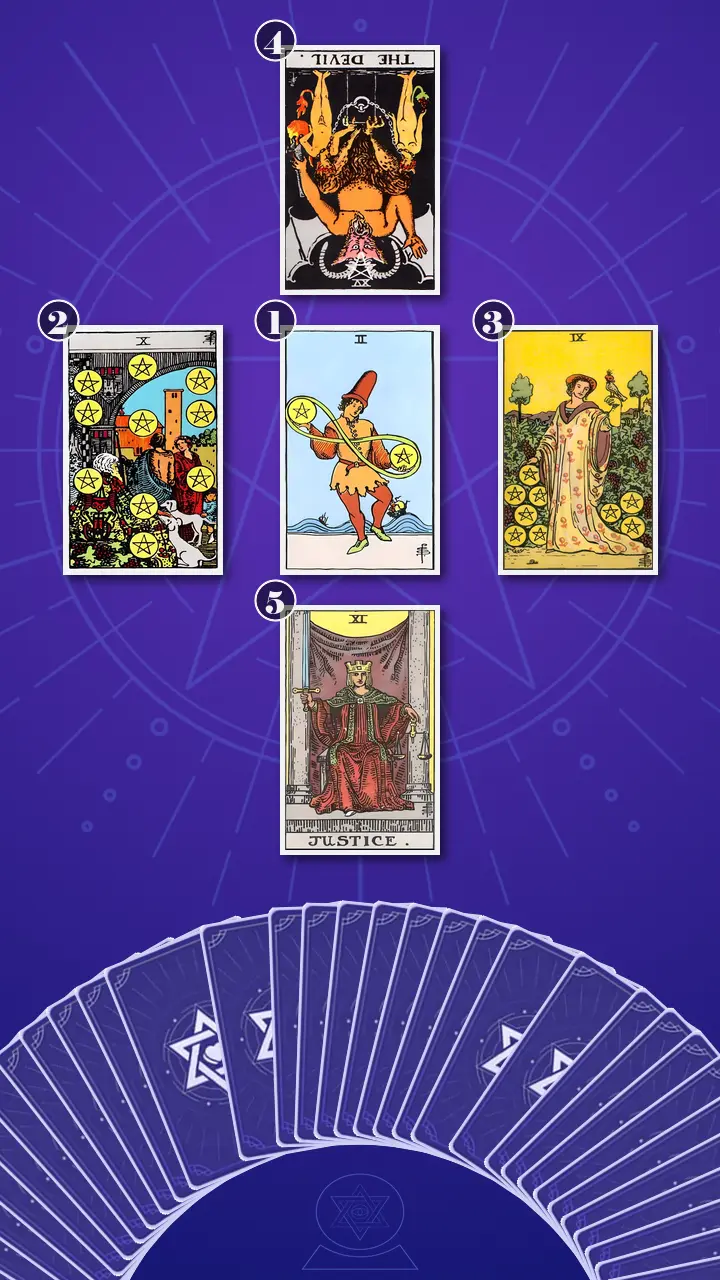
For anyone reading along: I like this spread when someone’s dealing with a clean binary choice—join their plan or keep mine—but the stress has grown claws. The Decision Cross keeps the card count minimal while still separating what matters: (1) what the indecision looks like in real life, (2–3) the felt meaning of each option, (4) the hidden psychological hook that makes it feel high-stakes, and (5) a grounded decision principle that restores agency without pretending we can predict every future medical bill.
I gestured to where each card would land. “The center shows the pressure pattern you’re living inside. Left is Option A—joining their insurance. Right is Option B—keeping yours. Above is what’s really running the show under the spreadsheets. And below is the method—the decision rule that lets you choose and then stop re-litigating it at midnight.”
Reading the Map: Partner Plan vs My Own Plan
Position 1 — The current decision pressure (what’s on repeat)
“Now flipping over,” I said, “is the card representing the current decision pressure and the observable way the choice is showing up day-to-day.”
Two of Pentacles, upright.
It was almost too on-the-nose: a figure juggling two coins with an infinity loop wrapped around them, waves behind like a life that won’t stop moving just because you’re trying to decide.
“This is you at your kitchen table after dinner,” I said, making sure I anchored it in her actual routine. “Two plan PDFs open side-by-side, a half-finished spreadsheet, the HR deadline email pinned. You bounce between premiums, deductibles, out-of-network rules, telling yourself you’re being responsible—while your body stays keyed up because all the motion isn’t producing clarity.”
Energetically, this is excess—too much adaptation, too much juggling, not enough landing. It’s a nervous system performing competence. Tab-switching can look like progress. But it’s the infinity loop: movement without resolution.
Jordan let out a small laugh that landed bitter. “Yeah,” she said. “That’s… brutal. Like, accurate in a way that’s kind of rude.”
I nodded. “It’s honest, not rude. And it’s fixable. The card isn’t shaming you. It’s showing the pattern: the loop makes you busy, but not safer.”
Position 2 — Option A: joining their insurance (what it offers)
“Now the card in this position represents Option A: joining their insurance, including what it offers emotionally and practically in your life.”
Ten of Pentacles, upright.
“This one feels like stepping under an invisible archway into we logistics,” I said. “One set of cards in the wallet. Shared admin. Fewer duplicated costs. A sense of long-term steadiness.”
In energy terms, this is balance in Earth—structure, continuity, predictability. It’s not romantic. It’s a scaffolding. The part that spikes you isn’t the math; it’s what the archway means. Crossing into the shared system can feel protective… and also defining.
Jordan’s eyes flicked up and to the side like she was replaying a moment. “My partner said, ‘It’d just be easier if you come onto my plan.’ Like it was nothing. And my body went—” She lifted her shoulders a fraction. “—like I was being recruited into something.”
“That makes sense,” I said. “Because this isn’t just coverage—it’s how you want ‘we’ to exist without erasing ‘me.’”
Position 3 — Option B: keeping your current insurance (what it protects, what it costs)
“Now flipping over is the card representing Option B: keeping your current insurance, including what it protects and what it costs you psychologically.”
Nine of Pentacles, upright.
“Keeping your plan feels like staying in your cultivated, familiar setup,” I said. “You know where the info is. You know how claims work. You don’t have to coordinate around someone else’s job.”
In energy terms, this is strength—self-reliance that’s real. But it can tip into rigidity when it becomes a rule: I handle everything myself, always, no exceptions. The card’s falcon is controlled power: capability that’s genuine… and that makes letting go feel risky.
“The quiet cost,” I added, “is that you stay the only one holding the admin. And the identity pressure—‘I shouldn’t need anyone’—can get lonely without you realizing it.”
Jordan’s mouth tightened, then softened. “I hate that you said lonely,” she murmured. “Because I don’t want to be dramatic. But… yeah.”
Position 4 — The hidden driver (the chain under the spreadsheets)
“Now we’re turning over the card representing the hidden driver: the core fear or belief that makes this choice feel higher-stakes than it is.”
The Devil, reversed.
The moment it appeared, the air in the conversation shifted—like when your phone brightness drops at night and suddenly you see your own reflection in the black glass.
“This is the midnight loop,” I said gently. “Benefits pages refreshed. Worst-case bill stories. Not to learn—but to try to delete uncertainty.”
And I let the inner monologue sound the way it actually sounds at 11:52 p.m., fast and sharp, like fingers tapping a screen:
Just one more detail.
Just in case.
If I pick wrong and something happens, it’s on me.
I should be able to figure this out like a competent adult.
Jordan’s throat bobbed. I could see she’d been holding her breath without noticing. Her jaw was the tell—tight, then tighter, as if the right deductible number could finally let her unclench.
Energetically, this is blockage—a fear-based grip on certainty-as-safety. But reversed matters: the chains are loose. This isn’t fate. It’s a psychological bind you can loosen.
Here’s where my Jungian training always kicks in. In Venice, we learn bridges and corridors the way other cities learn highways. My own Bridge-Corridor Theory is simple: when a relationship question feels “practical,” I check whether the real tension is happening on the bridge (connection) or in the corridor (control).
“Jordan,” I said, “your spreadsheets are a corridor. They feel narrow and controllable. They promise: ‘If I keep walking, I’ll reach certainty.’ But your partner’s question—‘So are you coming onto my plan?’—that’s a bridge. It’s connection. It’s being seen in a choice.”
“The Devil reversed is showing that the panic isn’t coming from the plans being impossible. It’s coming from the belief that there’s a perfect plan and you have to find it to prove you’re safe.”
She swallowed, then surprised me by going very still—frozen for a beat, like her brain had stopped buffering. Then she let out a slow, annoyed exhale. “Stop treating open enrollment like a personality test,” she said, almost to herself. “It’s… a trade-off decision.”
“Exactly,” I said. “That sentence is you stepping one foot out of the chain.”
When Justice Spoke: The Contract That Ends the Spiral
Position 5 — Integration guidance (the decision rule that restores self-trust)
“We’re turning over the card that represents integration guidance: the clearest decision rule and next step that supports self-trust without needing perfect certainty,” I said. “This is the bridge back to calm.”
Justice, upright.
Justice sat there with her scales and sword, facing forward like she wasn’t interested in your excuses—only your clarity. This is one of my favorite cards for modern admin stress because it’s not mystical. It’s procedural. It’s the part of you that can decide fairly and live with trade-offs without self-punishing.
As I looked at it, an old memory flashed through me—standing on a cruise ship years ago, helping a couple interpret the fine print of a life decision while the ocean rolled outside the windows. That same truth returned: fairness isn’t a vibe; it’s a structure.
And this was Jordan’s structure.
Setup (the moment you know too well): You know that moment when you’ve got the benefits portal open, your jaw is tight, and you’re re-reading the same paragraph about deductibles like it’s going to suddenly reveal the ‘right’ answer?
Delivery (the sentence that cuts clean):
Stop treating this like a moral test and start treating it like a balanced contract—let Justice’s scales hold your priorities so you can choose without self-punishing.
I let it sit. No extra words. Just the sound of her apartment—faint fridge hum, distant city hush—filling the space where her brain usually rushes in.
Reinforcement (making it real in your hands): “Open a Notes doc and title it ‘My Justice Rule,’” I told her. “Set a 10-minute timer. Write your three priorities—cost, access, independence—and one trade-off sentence. When the timer ends, stop. If you feel activated, you’re allowed to close it. This is a fair process, not a forced decision in distress.”
Jordan’s reaction came in a chain—quiet, physical, undeniable:
First, freeze: her lips parted slightly and her breathing paused, like she’d been caught mid-scroll.
Second, recognition: her gaze unfocused, not on me anymore—on some internal replay of Tuesday night tab-switching, the tight jaw, the phone glow, the “just one more detail.”
Third, release: her shoulders dropped a fraction and her mouth softened. “But if I do that,” she said, voice thinner, “then I can’t hide behind ‘I’m still researching.’ I’d have to… choose.”
“Yes,” I said, kind and direct. “And choosing doesn’t make you reckless. It makes you accountable in a calm way. You don’t need perfect certainty; you need criteria you can stand behind. This isn’t a character verdict.”
I watched her touch her jaw again—this time not to brace, but to check. “It’s unclenching,” she said, sounding surprised by her own body. “That’s… wild.”
“Now,” I asked, “with this new lens—criteria over certainty—can you think of a moment last week when this would’ve changed how you felt? Maybe when your partner asked, or when you were on r/PersonalFinanceCanada at midnight?”
She blinked, and there was a flash of irritation—then relief, then something tender. “Monday night,” she admitted. “When they asked. I got defensive because I thought they were asking if I was… committed. But they were asking about logistics. I could’ve said, ‘I’m choosing based on cost, access, independence. I’ll decide Friday.’ That would’ve been… normal.”
That was the shift right there: from fear-driven hyper-analysis to calm accountability. From a pharmacy aisle of endless labels to one adult agreement with herself.
The One-Page “Justice Rule”: Actionable Advice for the Next 48 Hours
I pulled the whole spread together for her in one thread: the Two of Pentacles showed the busy-but-not-clear loop; Ten of Pentacles and Nine of Pentacles revealed the real fork—we stability versus me autonomy; the Devil reversed named the invisible pressure (certainty-as-safety, plus fear of being judged by the choice); and Justice offered the antidote: a values-based decision framework that names trade-offs upfront and prioritizes measurable criteria over perfect certainty.
“Your cognitive blind spot,” I said softly, “is thinking this decision has to prove you’re responsible. That’s why you keep hunting for the objectively correct plan. But the transformation direction here is different: you choose a fair process, then you commit—without punishing yourself afterward.”
Then I gave her next steps she could actually do—small, bounded, and specific.
- The 30-Minute Decision WindowTonight, set a 30-minute timer. Do one side-by-side comparison using only three criteria: cost (monthly + worst-case), access (your clinic/prescriptions), and independence (what happens if your partner changes jobs). When the timer ends, either click enroll based on the result or write down one missing fact that would genuinely change the decision.Your brain will argue, “But what if I’m missing something?” That’s normal. Two slow breaths is enough; this is an experiment, not a test.
- The Trade-Off Sentence (one calm paragraph)In Apple Notes, write: “I’m choosing ____ because ____, and I accept ____.” Read it out loud once—alone first, then to your partner if you want.If you can explain it calmly, you’ll feel steadier. A decision you can explain calmly is often safer than a decision you can’t stop re-litigating.
- The No-New-Facts Boundary (end the midnight spiral)After you decide, you don’t reopen PDFs or Reddit threads unless a genuinely new fact appears (provider list update, premium change, job change). If you feel the urge, write the fear in one sentence—“If I pick wrong, I’m afraid ____”—then close the browser for five minutes.This isn’t banning research forever; it’s creating a fairness boundary so your nervous system can stand down.
And because the relationship subtext mattered, I offered one communication tool from my own kit—my Lace Communication Method, borrowed from Burano lacemaking: precise, small stitches that hold without pulling.
“Text your partner this,” I suggested. “‘I’m deciding Friday at 7 PM. I’m choosing based on cost/access/independence. Can we look at one question together for 10 minutes—does your plan cover my clinic/prescriptions, and what happens if you change jobs?’ That’s lacework. Clear, contained, no performing confidence.”

A Week Later: Clarity Without the Victory Lap
A week later, Jordan messaged me. No long essay—just a screenshot of her Notes app. Title: My Justice Rule. Under it, three bullet points. Under that, one trade-off sentence. Then: “Clicked enroll. Didn’t reopen the portal after. Also told my partner the ‘independence stuff’ part and… they were actually sweet about it.”
She added, almost like an afterthought: “I slept, but when I woke up my first thought was still ‘what if I messed up?’—and then I reread my trade-off sentence and it calmed down.”
That’s the real Journey to Clarity: not certainty, but ownership. Not a perfect plan, but a fair contract with yourself you can live inside.
When the deadline gets close and your jaw locks up, it’s not just about premiums—it’s the fear that one click could ‘prove’ you’re not safe or not grown-up enough to trust yourself.
If you let this be a fair contract with yourself—not a test you can fail—what three priorities would you put on the scales before you choose?