After-Work Couch Collapse—and the Bridge Back Into Your Night

The Door, the Tote Bag, and the After-Work Collapse
If your Toronto weeknights keep ending with your tote bag still by the door, your shoes still on, and a promise that you’ll start in ten minutes, you are probably in a decision-fatigue loop, not just being lazy.
That was the first thing I wanted Jordan (name changed for privacy) to hear. She was 29, worked as an account coordinator at a digital agency, and by the time she sat across from me she already had the look I know from twenty years of listening to people untangle their lives over coffee: body technically present, nervous system still answering messages somewhere else.
She described 6:34 p.m. on a Wednesday in her small Toronto apartment so clearly I could almost step into it with her—the stuck hallway air after the TTC commute, the low fridge hum in the quiet, the phone still warm from doomscrolling on the train. She would unlock the door with one hand, tote bag still on her shoulder, and tell herself she’d sit for five minutes. She lived alone, so once the apartment door shut there was nobody there to pull the evening into motion but her. Forty minutes later she would still be in work clothes, half-watching something, too inert to heat food or text a friend back.
“Why does sitting on the couch when I get home kill my whole night?” she asked me. Then, more quietly: “Why does getting home feel like the moment I stop belonging to myself?” She called it couch rot with the kind of half-smile people use when the joke is only about forty percent a joke.
The frustration in her voice had the texture of gray syrup thickening around her knees—nothing dramatic, nothing cinematic, just that awful heavy feeling of an evening slowly sealing shut while she was still inside it. I nodded and kept my voice warm. I told her we weren’t here to shame the couch or turn her into some after-work reset influencer. We were here to make a map, and in that map I suspected the real conflict would be simple: part of her wanted to rest the second she got home, and part of her wanted the evening to still feel like hers.

Choosing the Compass: Energy Diagnostic Map · Context Edition
I asked her to take one slow breath and hold the question in plain language, not as a performance, just as a focus point: what actually happens between the front door and the couch? Then I shuffled slowly and laid the cards in a loose circle around a center card, the shape of a whirlpool with a way out.
I chose the Energy Diagnostic Map · Context Edition for a reason. When people ask questions like why do I shut down after work when I get home, why sitting on the couch kills my motivation, or how to make evenings feel like mine again, the problem usually isn’t a lack of ambition. It’s a repeating system: depletion leads to collapse, collapse delays choice, delayed choice turns into passive drift, and passive drift becomes evidence against the self. A classic linear spread can flatten that. This one lets me separate the visible after-work slump, the inner tug, the outside burden, the binding pattern, the available resource, the turning point, and the grounded next step. That’s how tarot works best for me—not as a verdict, but as a clean way to see the logic of a loop.
I told Jordan I’d be watching especially for four positions: the surface symptom that shows exactly where the night loses shape, the core blockage at the center of the loop, the transformation card that could build a workable bridge back into her evening, and the final card that would translate all of it into one testable next step.
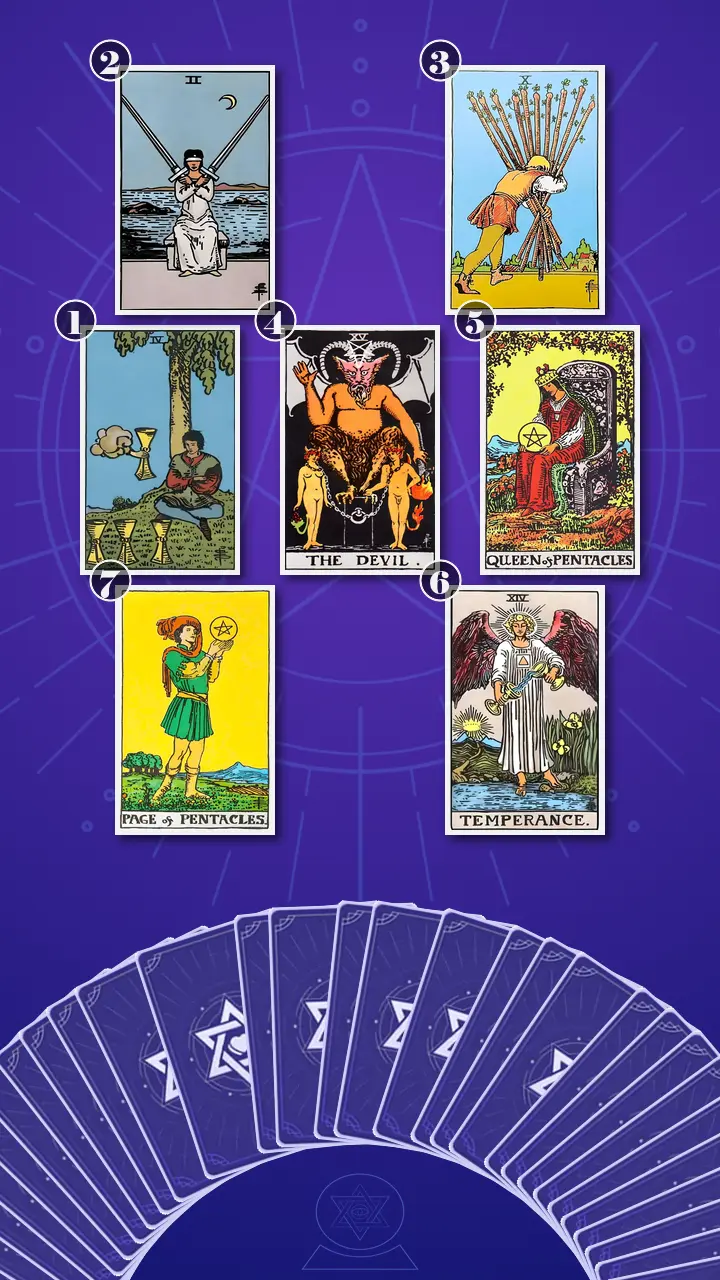
Reading the Whirlpool Before the Couch
Position 1: The Flat Blue Screen of the Evening
Now I turned over the card for the visible after-work symptom: the exact moment the evening loses momentum once the body lands on the couch. Four of Cups, upright.
I told her this card was painfully accurate. In modern life it looks like getting home around 6:40, dropping onto the couch before even taking off your shoes, opening Netflix or Instagram, and suddenly finding that leftovers, a shower, a walk, a text reply, even a hobby all register as equally unreachable. The offered cup in the card matters to me because it says the options are still there; your system just can’t receive them as live choices anymore.
This is not a discipline problem first. It is a transition problem first. The energy here is stagnant, not absent. She wasn’t secretly choosing nothing because she didn’t care. She was hitting a state where everything felt emotionally flat, like staring at a streaming home screen full of options and genuinely wanting none of them.
Jordan let out a short laugh that had a little grit in it. “That’s accurate enough to be rude,” she said, rubbing her thumb along the paper cup seam. Then she added, “I don’t even want the show half the time. I just can’t start anything else.” Her face did that nod-and-wince combination I see when someone feels seen and mildly called out at the same time.
Position 2: The Decision Hidden Inside ‘Just a Minute’
Next I turned over the card for the internal tug between needing recovery and wanting the evening to remain usable and self-directed. Two of Swords, upright.
Here the problem sharpened. I told her this card makes the pause look neutral when it isn’t neutral at all. It is the moment she says she’ll decide after sitting down, because choosing between food, chores, movement, creativity, or pure rest feels strangely expensive. Like leaving twelve tabs open because committing to one feels like losing all the others.
The blindfold on the figure told me the energy was blocked by bracing. Her nervous system was trying to avoid the cost of either option: if she cooked, she lost the last little scrap of relief; if she rested, she feared losing the whole night. So the mind created a fake middle ground—I’ll just sit for a second—and called it a break, when really it was a stalemate dressed up as neutrality.
I asked her what choice she was usually trying not to make in that first minute. She stared at the card, jaw tightening. “Whether the night is already over,” she said. That answer landed with more honesty than volume.
Position 3: Home, but Still Carrying the Office
Then I turned over the card for the outside weight still being carried into the apartment and making even small evening choices feel heavy. Ten of Wands, upright.
This one never lets me moralize too quickly. I told her the bent figure carrying that bundle looked exactly like arriving home with client messages still echoing, tomorrow’s list already running, commuter noise still in the ears, hunger hiding inside irritability, and a body that had spent the whole day being available. She was physically in her apartment, yes. But nothing in her had actually arrived.
The energy here was excess—too much load, too little landing. The weight blocked perspective. Even small evening choices like rinsing a plate or starting rice looked much bigger than they objectively were, because she was still mentally hauling the day through the door. For a second, the card made me think of the end of a long coffee shift, when the apron is off but the body still hears phantom orders. Transition matters more than people admit.
Jordan’s shoulders lifted and dropped in one tired motion. “My brain still sounds like Slack,” she said. That was the sentence I wrote down in my mind, because it named the burden more precisely than burnout ever could.
Position 4: Autoplay Logic in Human Form
At the center of the spread, I turned over the card for the core blockage: the automatic habit loop that turns short-term comfort into a self-reinforcing loss of agency. The Devil, upright.
I kept my tone steady here, because this card frightens people only when it’s handled badly. In this reading it wasn’t about doom. It was about autoplay. One familiar show, one scroll, one delivery app, one harmless little check-in—and then the next piece of the evening starts before she ever consciously chose it. The couch isn’t magical. The loop is.
The loose chains in the image were the whole point. The energy was sticky and binding, but not all-powerful. This was not fate; it was a relief ritual that had become self-binding because it caught her at her most depleted. Like Netflix autoplay for her night, or TikTok’s infinite scroll in emotional form. After this scene, after this scroll, after I rest a little more. Then suddenly it’s late and she feels both unrecovered and guilty.
Jordan went very still. First her mouth pressed into a line. Then her gaze dropped to the face-down phone beside her knee. Then came the quiet chest-drop I wait for when a pattern has been named without shame. “That part feels bad,” she said. “Because it really does happen with no clear moment where I agreed to it.” I told her that was exactly why the loose chains mattered: the trap feels stronger than it is when it catches you depleted.
Position 5: The Resource Already in the Room
Then I turned over the card for the existing inner resource that could support a gentler, more embodied re-entry into the evening. Queen of Pentacles, upright.
The whole room changed for me with this card. After the blue-light numbness of the earlier cards, here came warmer light, softer clothes, a glass of water, leftovers heating, hair tied up, shoes off, the lamp turned on instead of the television. I told Jordan, “You do not need a harder push. You need a softer landing.”
The energy in the Queen is balanced and earthy. She doesn’t lecture. She nourishes. In real life, she looks like changing out of work clothes before sitting down, washing your hands or face, making something simple to eat, letting comfort become concrete instead of endless. Agency usually comes back through the body before it comes back through motivation.
And because I pay close attention to how rooms tell on us, I mentioned one of my own tools by name. I call it Daily Clutter Deconstruction. Not because clutter is a moral issue, but because physical disorder often maps psychological noise. Jordan’s tote by the door, keys still in hand at the fridge, work blazer ending up on the couch arm, unopened mail in the drop zone—none of that meant she was failing. It meant her apartment was displaying an unfinished arrival. She looked around and laughed softly. “That is disgustingly true,” she said, but this time the laugh had relief in it.
When Temperance Built the Missing Bridge
Position 6: One Foot Still on the Commute
When I turned over the card for the key transformation point—the shift that could replace collapse with a workable transition between work mode and home mode—the air in the room seemed to quiet itself. Temperance, upright.
I asked her to picture the familiar threshold exactly as it happens: the apartment door closing, tote bag still on her shoulder, phone warm from the commute, couch three steps away. Her body wants relief immediately; her mind still wants the night not to disappear. This was the moment I brought in another lens of mine, the Energy Extraction Audit. I use it to catch the micro-habits that over-extract a person’s baseline energy without looking dramatic: checking one last notification at the door, keeping AirPods in, sitting down before shoes are off, asking the brain to choose dinner while it is still metabolizing the whole commute. None of those habits is the villain alone. Together, they leave no runway between depletion and choice. The fantasy is that life works like Severance and one elevator ride cleanly separates work-self from home-self. Real evenings need a handoff.
The problem is not that you need rest. The problem is that your evening has no bridge between being drained and being able to choose.
Stop treating recovery and agency as opposites; like Temperance pouring between two cups, build a small transition that lets rest become the beginning of your night instead of its ending.
The line hung there for a beat. Then Jordan’s reaction unfolded in layers. First, her breath caught and her fingers froze halfway around the mug. Next, her eyes lost focus—not dissociative, more like she was replaying three work nights at once: tote bag still on, Uber Eats open, one show turning into two, that private little shame spiral before bed. When she finally spoke, relief wasn’t the first thing out. Irritation was. “But doesn’t that mean I’ve been making it harder every night?” she said, and there was a flash of anger in it, mostly at herself. I shook my head. “No,” I told her. “It means you’ve been trying to land a plane on a parking spot.” That got a sharp laugh out of her, then the laugh broke into a long exhale. Her shoulders dropped. Her jaw unclenched. She looked back at Temperance as if the card had moved the furniture inside her head. I gave her the question I always give when the insight finally clicks: with this new lens, was there a moment last week when a bridge like this would have changed the feeling? She answered almost immediately. “Thursday. If I’d changed clothes and started food before I sat down, the whole night would’ve felt different.” There it was—the first real step from drained autopilot and self-blame toward steadier self-trust through a softer landing.
I told her exactly what to test: for the next three work nights, phone on the counter, change into home clothes, take a few sips of water or start heating food, then choose the couch or the next task on purpose. If it annoyed her, she could cut it to one step and still count it. No points for forcing it.
I told her plainly then: the couch is not the whole problem. The missing bridge is. And the deeper relief in that realization is huge, because it turns a character verdict into a design problem.
Position 7: The One-Rule Evening Beta Test
Finally, I turned over the card for the grounded next step she could test this week without demanding a whole personality transplant. Page of Pentacles, upright.
I love this card because it lowers the stakes. In real life it looks like one tiny repeatable rule for the first fifteen minutes at home: change clothes before sitting, or start food before opening any app, or put the phone on the counter before touching the couch. The energy isn’t intense; it’s steady and teachable. More Duolingo streak than lifestyle rebrand.
I told Jordan, “Protect the first ten minutes, not the whole night.” The Page doesn’t ask her to rescue every evening. He asks her to study one behavior closely enough that self-trust can grow back around it.
Bridge Before Couch: Finding Clarity in the First Ten Minutes
When I looked at the full spread, the story was clean. The Four of Cups showed the shutdown on the surface. The Two of Swords showed the hidden stalemate inside the phrase I’ll just sit for a second. The Ten of Wands reminded us that she wasn’t starting from neutral; she was dragging the whole workday home in her nervous system. The Devil sat at the center and translated that strain into an automatic comfort loop, one-click checkout for avoidance: easy in the moment, expensive later. Then the Queen of Pentacles and Temperance answered without shaming her. Care first. Bridge next. Practice after that.
The blind spot was equally clear: Jordan had been reading the threshold as a verdict on her adulthood. If I can’t manage my evenings, what does that say about me? The cards told a different story. This was an energy-sequencing problem, not a moral failure. The transformation direction was precise: shift from collapsing first and deciding later to a pre-decided landing routine before the couch. From feeling like the night vanished to feeling more at home in her own time.
I gave her three grounded steps, all small enough to survive a rough Tuesday and boring enough not to require a Notion makeover:
- Build the landing stripFor the next 48 hours, use my 15-Minute Physical Anchor Experiment on one minimal zone by the door or kitchen counter. Put slippers, a water bottle, and one comfort cue there—a hoodie, hair tie, or bowl for keys—so the first thing home offers is support, not more decisions.If it feels too basic to matter, that is usually a sign it is exactly basic enough to work. Minimum version: shoes off, water sip, hoodie on.
- Run the 7-minute Bridge Before CouchWrite the same sequence in your Notes app and use it for the next three work nights: keys down, phone on counter, change clothes, a few sips of water, start heating food, then decide on purpose whether the couch is next. If you like, use one Spotify playlist or a phone timer as the container.Do not make it aspirational or aesthetic for social media. Make it boring enough to survive an ugly commute. If seven minutes feels impossible, do three. No points for forcing it.
- Choose one single-rule experimentFor one week, test only one rule: no couch until food is started, or no apps until clothes are changed. Track it with a single checkbox in Notes, Notion, or on a sticky note on the fridge.Missing a day is data, not failure. At the end of the week, ask only one question: did this make the evening feel 5 percent more mine?
I reminded her that tarot never asks for perfection from a stressed nervous system. It asks for clarity. And clarity, here, was wonderfully practical: she did not need to become a more disciplined woman overnight. She needed an after-work bridge, a soft landing ritual, and permission to make her home a transition zone instead of a sinkhole.

A Week Later, the Quiet Proof
A week later, Jordan sent me a text I loved for its lack of drama. She didn’t announce a new life. She wrote: “Four nights. Changed clothes before couch. Put my phone on the counter. Heated soup before opening anything. Still tired, but the apartment didn’t swallow me whole.”
That was the proof I cared about. Not a perfect routine. Not optimized womanhood. Just one clear move from passive evenings to intentional evenings; from guilt and numbness to steadier agency. The cards had not taken control of her night. She had.
When the door closes and your whole body goes soft, it can feel strangely lonely to want rest so badly and still watch the night slip away like proof that your time is no longer yours. If that’s your weeknight too, you do not have to rescue the whole evening. What tiny Bridge Before Couch ritual would make walking through your door feel 5 percent more like arriving than disappearing?
Every reading at AceTarot is a Journey to connect with inner wisdom and empower next step.
Learn more about our Journey to Clarity.