After 'You've Changed,' a Notes App Draft Became One Honest Sentence
The 9:18 p.m. Ride Home
If you’re the late-20s city person who can write clean copy all day but goes completely wordless at a Toronto dinner when an old friend says you’ve changed, I know this flavor of conversation replay well.
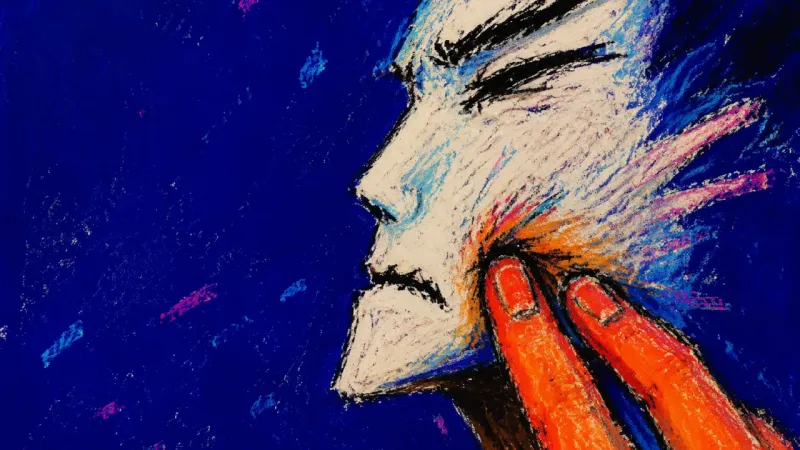
When Jordan (name changed for privacy) sat across from me, she described 9:18 p.m. on Line 2 eastbound after a patio catch-up in the west end: her phone screen reflecting back at her in the subway window, the car smelling faintly of wet denim and takeout fries, the overhead light buzzing like a thought she couldn’t switch off. She had laughed when her friend said it. Ten minutes later, her jaw was tight, her stomach had that dropped-elevator knot, and her Notes app was already open before the train had crossed the Don.
‘I know people change,’ she told me, looking down at her tea, ‘but why does it feel like I’m being accused?’
I could hear the real conflict immediately: she wanted to answer the joke honestly and preserve the friendship, but she was afraid that a direct response would create distance. She didn’t want a fight. She also didn’t want to keep pretending it was funny. The hurt in her sat like a subway brake screech trapped behind her teeth — sharp, metallic, and impossible to fully ignore once it started.
I nodded. ‘You laugh in the moment, and then your body keeps having the conversation without you.’ Her eyes lifted at that. ‘You’re not weak for noticing where the joke keeps landing. And we’re not here to script the perfect clapback. I’m here to help you draw a map through the fog, so you can answer from the person you are now.’
Choosing the Compass: A Four-Card Relationship Spread
I asked her to take one slow breath and hold the question plainly in her mind: not How do I win this exchange, but How do I respond when an old friend keeps joking that I’ve changed without abandoning myself? Then I shuffled slowly, not as theatre, but as a way of helping the nervous system cross from replay into attention.
This is how tarot works at its best for friendship boundaries: not as prophecy, and never as a verdict, but as a structured mirror. For Jordan, I chose a four-card Relationship Spread. It was the cleanest tool for this kind of tension because the issue wasn’t about predicting the future of her whole life. It was relational. We needed to see her immediate reaction, her friend’s posture, the deeper truth shaping the connection, and the healthiest next step in communication.
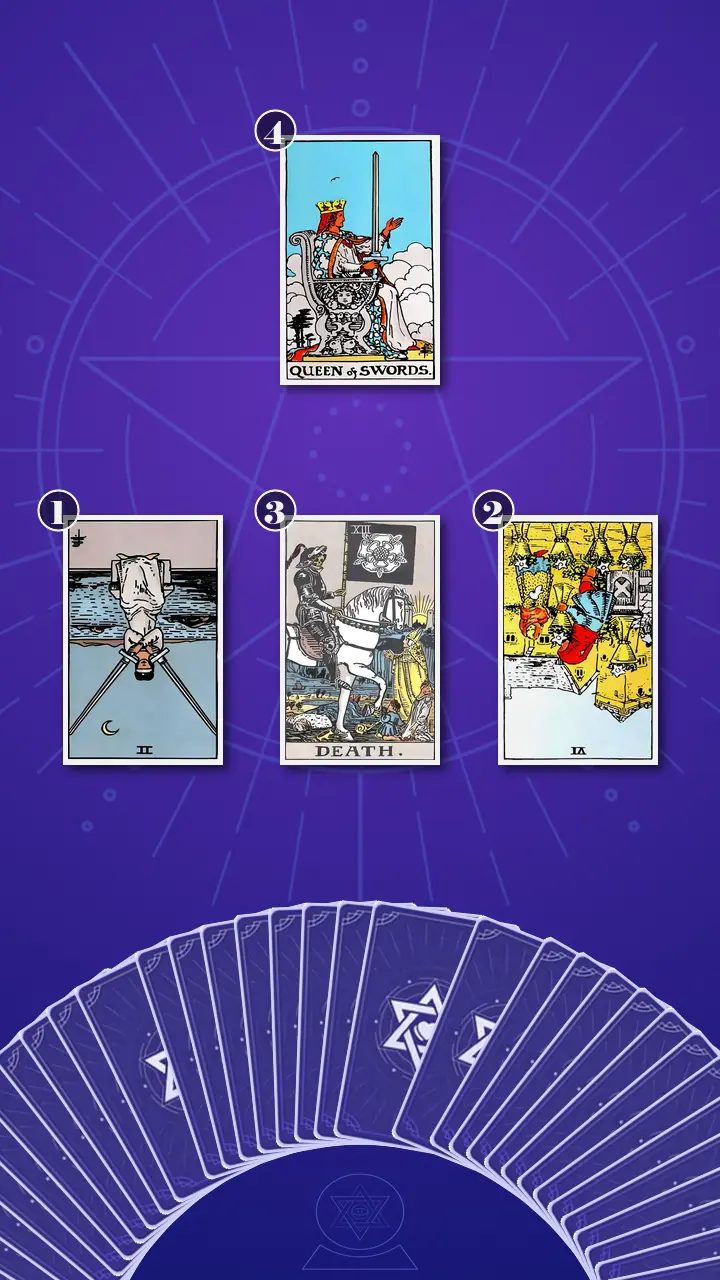
I laid the spread in a cross. The first card on the left would show what happened inside Jordan in the first five seconds after the joke landed. The second, on the right, would show what old-friend posture was entering the moment. The third sat in the center — the heart of the interaction, the deeper truth beneath the repeated line. The fourth above it would give the lifted response, the cleanest way forward. It always feels to me like a bridge with a signal light above it.
Reading the Bridge Between Hurt and Honesty
The Sentence Stuck Behind Her Teeth
Now I turned the card representing Jordan’s immediate inner reaction and the self-silencing that happens when the joke lands. It was Two of Swords, reversed.
In real life, this looked exactly like the scene she had already described to me: Jordan at a friend’s dinner laughing on cue when the you’ve changed line lands, then going quiet on the ride home and typing three increasingly thoughtful replies into Notes without sending any of them. The response exists. It is not missing. It is simply trapped behind the social need to stay easy in the moment.
Reversed, the Two of Swords shows blocked Air — not absence of thought, but too much of it. The blindfold is slipping, so she already knows the joke stung. The swords are still crossed over the chest, so the sentence stays locked in the body instead of entering the room. It creates that exact inner split: I know it bothered me. I don’t know if I’m allowed to say it bothered me. It’s like having twenty tabs open in the brain while the one sentence she needs keeps buffering.
Jordan gave a short laugh, but there was a bitter edge under it. ‘Okay,’ she said, rubbing her thumb against the mug handle, ‘that is accurate enough to be a little rude.’
I smiled. ‘That’s usually how this card feels in this position. Not rude. Just precise. You’re not struggling because you don’t know language. You’re struggling because belonging anxiety gets to the microphone first.’ Her shoulders loosened a fraction at that, the kind of tiny exhale I’ve learned never to miss.
When the Friendship Algorithm Keeps Recommending Season One
Next I turned the card representing the old-friend posture being brought into the interaction. It was Six of Cups, reversed.
This is the card of history — and here, history was leaning too hard on the present. I told Jordan this looked like an old friend pulling up a college-era snapshot of her, in a group chat or at dinner, and treating that archived version as the more lovable, more legible one. Like people are rewatching your pilot episode and calling it your most authentic season. The friendship algorithm keeps recommending your 2019 self and ignoring every update since.
Reversed, the Six of Cups doesn’t prove bad intent. I’m always careful with that. It doesn’t tell me her friend is secretly cruel. It tells me the interaction is being filtered through nostalgia and outdated assumptions. In tight friend groups, I often use what I call Clique Power Dynamics to read moments like this — the tiny jokes, the little public nudges, the raised-eyebrow comments that test whether someone will keep playing the role the group remembers. And alongside that, I could feel something I call Sidekick Syndrome Diagnosis: the quiet way a friendship can box you into one useful character — the fun one, the easy one, the one who never makes the vibe complicated — because that role keeps the old emotional hierarchy intact.
Jordan went very still. Then she nodded once. ‘I think that’s what gets me,’ she said. ‘It’s not even the exact words. It’s the feeling that they’re talking to someone who isn’t me anymore.’
‘Exactly,’ I said. ‘And that’s why it lands so hard. You’re not just hearing a joke. You’re feeling the pressure to become emotionally legible by shrinking back into an earlier version of yourself.’
The Scene That Has Already Ended
At the center of the spread — the deeper relational truth beneath the recurring joke — I turned Death, upright.
I watched Jordan’s face carefully and said it before she could tense against the name. ‘Not doom. Not punishment. Not a sign to burn the friendship to the ground. This card is about necessary endings, honest transformation, and the moment an expired script finally stops pretending it still works.’ In real life, this looked like the hinge point she had been circling all along: the issue was not whether she had changed. The issue was whether the friendship could stop negotiating with a version of her that no longer existed.
Whenever Death lands at the center of a reading like this, my mind goes to an editing suite. As an artist, I know the hardest cuts are never the obviously bad scenes. They’re the beloved ones that everyone memorized years ago, the scenes that once worked beautifully and now keep the whole film from moving forward. That is what I felt in this card. Jordan was trying to squeeze back into clothes that fit a past version of her life and calling the discomfort loyalty. But growth isn’t betrayal just because someone misses your old settings.
The white rose in Death always matters to me — truth with dignity. The rising sun matters too — not just ending, but emergence. I told her, ‘If the friendship only works with your old script, the script is the problem.’
She looked down, then out toward my window where late light was thinning against the glass. For a few seconds she said nothing. When she finally spoke, her voice had gone softer. ‘So this isn’t just about tonight’s joke.’
‘No,’ I said. ‘It’s about the role you’re most tired of being cast back into just so everything stays easy.’
When the Queen of Swords Lifted the Present-Self Reply
No Monologue, Just the Truth
By the time I reached the final card, the room had gone noticeably quieter. Even the radiator seemed to stop humming for a beat. This was the guidance position — the healthiest communication stance for Jordan’s response — and when I turned it, there she was: Queen of Swords, upright.
For questions about how to respond when a friend says you’ve changed, this is one of my clearest cards. This is Queen of Swords meaning for friendship boundaries in real life: one clean sentence, not a defensive essay; an upright sword in one hand, an open palm in the other. Truth and relationship together. When she appears, I think of my own strategy called The Role Resignation Act — not a dramatic speech, just a graceful refusal to keep playing the assigned character.
I looked at Jordan and gave the setup slowly. ‘You’re on the TTC after dinner, jaw tight, phone warm in your hand, rewriting the moment because you still haven’t said the one thing your body already knows: that the joke didn’t feel light to you.’
You do not have to squeeze yourself back into an old version of you; raise the Queen's sword and say clearly what kind of joke you are no longer willing to carry.
For a second, Jordan froze. Her breath stopped halfway in. Her fingers stayed curled around the mug, but they stopped moving. Then I watched the sentence travel through her in three clear waves: first the physical stillness, then the faraway look as her eyes unfocused and replayed some recent dinner scene frame by frame, and finally the emotional break in the surface. Her jaw shifted once, hard. When she spoke, relief wasn’t the first thing there — anger was.
‘But if I say that,’ she said, voice low and sharp, ‘doesn’t that basically mean I’ve been helping keep the old version alive?’
‘No,’ I told her gently. ‘It means you’ve been protecting belonging with the tools you had. That’s different.’ I let that sit for a moment. Then I added, ‘But the point isn’t to prove you’re still lovable after changing. The point is to let one honest sentence show the friendship who is actually in the room now.’
That was when her body finally moved. Her shoulders dropped a full inch. The hand she had tucked against her ribs opened. Her eyes watered, not dramatically, just enough to brighten, and she let out one shaky laugh followed by a long breath that seemed to come from somewhere far below language. It reminded me of watching someone set down a shopping bag only after the handles have already marked their skin. Relief arrived, but so did that brief, strange dizziness that often follows clarity — the tiny blank space that comes when the path is suddenly visible and therefore yours to walk.
I asked, ‘With this new lens, can you think of a moment last week when one clean sentence would have changed how your body carried the rest of the night?’
She nodded before she answered. ‘The birthday dinner. I could have just said it landed off. I didn’t need the whole dissertation.’
‘Exactly,’ I said. ‘You don’t need a perfect comeback. You need one honest sentence.’ And that was the turn of the reading: the first clear step from hurt, replay-driven self-editing to calm, present-self honesty.
From Old Script to Actionable Advice
When I stepped back from the spread as a whole, the story was clean. First, Jordan’s own voice jammed in the throat the moment the joke landed. Then her friend’s nostalgia kept rewarding an older version of her, which made honesty feel risky and silence feel socially safer. At the center, Death showed what the repeated joke was exposing: an old relational script had already expired. And above it all, the Queen of Swords showed the way through — not by winning the joke, but by stepping out of the old script entirely and answering from a more adult, present-tense position.
I told her the hidden blind spot was this: she had been waiting to feel fully safe before speaking, when this spread showed me there was no ready-made Earth here to hand her certainty first. Grounding would have to be created by the spoken boundary itself. In other words, clarity would not arrive before the sentence. Clarity would begin because of the sentence. A calm boundary is not a dramatic moment.
To help her make that real, I gave her three very small next steps.
- The Present-Self Sentence Save one 10- to 15-word reply in your Notes app tonight or before your next catch-up: Yeah, I’ve changed, and that joke doesn’t really land for me. Practice saying it once out loud while walking home, in the shower, or before you see this friend again. If 15 words feels too exposed, use the minimum version: That one lands weird for me. Calm is not the same as vague.
- The Meaning-Check Pivot If the comment shows up live or in the group chat, ask one short question before you explain anything: What do you mean by changed? Listen for whether your friend gets curious about your present self or keeps talking to a past version of you. If they dodge, joke harder, or make you manage their discomfort, treat that as information — not as proof that you asked the wrong question.
- The Role Resignation Act Before your next social plan, write a two-column note called Old Role / Present Self. Name the role you are resigning from — the easy one, the forever-fun one, the one who laughs first. If the joke appears, use your one-sentence boundary once, then pivot: take a sip, ask a new question, or leave when you actually want to leave instead of staying late to prove continuity. The pivot matters. You are showing the room that the old character is no longer available, and you can do that gracefully without turning the night into a trial.
I watched her take out her phone and type the short sentence into Notes while we were still sitting there. No monologue. Just the truth. That mattered more than people realize. Actionable advice only helps if it can survive a real nervous system.
A Week Later, the Typing Bubble Wasn’t in Charge
A week later, I got a message from Jordan just after rain. She was sitting alone in a café with her coat draped over the back of the chair, morning light catching in the window. Her text was short: ‘It happened in the group chat. I used the sentence. I said, Yeah, I have changed, and when it keeps being the joke it doesn’t feel great. Then I put my phone face down and stared at my coffee for like three minutes.’
She told me the reply from her friend was slower than she wanted, and yes, she still checked the typing bubble twice even with Do Not Disturb on. But she had slept a full night afterward. In the morning, her first thought was still, What if I overdid it? — only this time she caught herself and laughed. Not the old laugh-first, feel-later laugh. A smaller one. A steadier one.
That, to me, is the real Journey to Clarity. Tarot did not hand Jordan a magical line. It showed her where she had been self-silencing, where the friendship was still clinging to an outdated script, and where her power actually lived. She was always the author of the next scene. The cards simply helped her pick up the pen with a steadier hand.
Sometimes the loneliest part isn’t the joke itself — it’s feeling your jaw lock while you laugh along because belonging suddenly seems more fragile than your real reaction.
If tonight you stopped trying to prove you’re still the old version of you, what one calm sentence would your present self want to say?