When a Coworker Got Promoted, 'Soon' Stopped Counting as a Plan

The 6:18 p.m. LinkedIn Spiral
I knew exactly what kind of career limbo I was looking at when Jordan (name changed for privacy), a 29-year-old marketing specialist in Toronto, joined my video session and told me her whole commute home had been hijacked by a coworker’s promotion post. She described the 504 King streetcar at 6:18 p.m.—brakes screaming at each stop, damp wool coats brushing her arm, blue phone light on her hand, her jaw tightening as she read a new title under one of those LinkedIn posts that begins with ‘Excited to share...’
Then she said the line that opened the reading for me: ‘If soon was real, why does it still sound like fog?’
She told me her manager had been warm, encouraging, and chronically vague. A promotion was ‘coming soon,’ apparently. But there was no date, no written criteria, no scope change, no follow-up in writing. So every night she kept both options half-open: draft the message asking for clarity, delete it; open job listings, save three roles, apply to none. Part of her wanted clear recognition and advancement. Part of her was afraid that if she asked too directly or left too early, she would miss the exact opportunity she had been quietly overworking for.
The uncertainty sat in her body like standing on a TTC platform where the arrival board only says ‘soon’ while cold air keeps slipping under your coat—nothing dramatic, just a steady, needling discomfort that makes your stomach drop and your breathing go shallow. I told her gently that she was not imagining the pressure. Keeping both options half-open can feel strategic while quietly keeping you stuck. Then I said what I say at the beginning of every real reading: ‘Let’s not try to force certainty tonight. Let’s just draw a map through the fog and see what becomes measurable.’
Choosing the Compass for a Stay-or-Go Career Reading
I asked her to put both feet on the floor, take one slow breath, and hold the actual question in her mind: not ‘Am I worthy?’ but ‘Do I keep waiting for this promotion, or do I widen the field and move on?’ Then I shuffled. I do that slowly on purpose. It is not theatre. It gives the nervous system a beat to stop doom-scrolling and start noticing what is true.
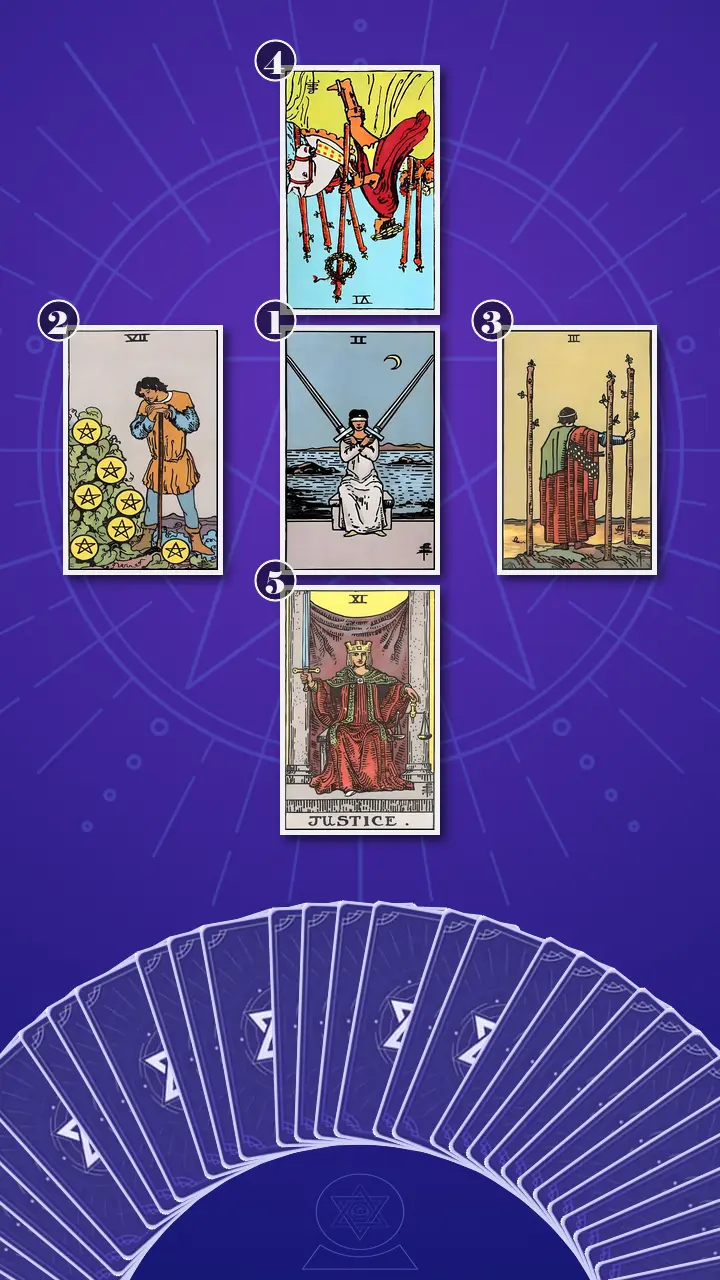
For a boss-said-promotion-soon-but-no-timeline dilemma, I like a five-card Decision Cross. When people ask me how tarot works in a career decision, this is one of the clearest examples: the cards do not replace judgment; they separate the layers that anxiety has tangled together. This spread is small enough to stay focused on the real choice, but structured enough to show the whole chain—present stalemate, the path of waiting, the path of moving on, the hidden bias distorting both, and the decision compass that restores clarity.
I explained the layout to her as I set the cards down. The center card would show the live standstill. The left card would reveal what waiting was truly offering and costing. The right card would show what moving on opened up. The upper card would expose the emotional pressure pressing down on the choice. And the bottom card—the most important one tonight—would show the cleanest standard for deciding, the true north beneath the noise.
Reading the Map: Where the Freeze Lives
Position 1: The Tabs That Never Close
I turned over the center card first. ‘Now we’re looking at the position of the present stalemate,’ I told her, ‘the concrete indecision pattern itself.’ The card was the Two of Swords, upright.
I almost laughed—not at her, but at how exact tarot can be when a pattern has been running for too long. The Two of Swords was her whole modern loop in one image: the draft message to her manager on one screen, saved job listings on the other, both untouched because touching either one might create an answer she could not un-hear. In real life, this was the commute-home freeze she had described to me so vividly. She kept staying and leaving technically available because choosing either one would force contact with disappointment.
Energetically, this card showed blocked Air. Her mind was sharp, but it was being used like crossed swords over the chest—analysis as armor. The blindfold mattered too. She was trying to decide from tone, hope, and replay instead of from fresh information. I asked her the question that lives inside this card: ‘The last time you opened that draft and then deleted it, what exact answer were you trying not to hear?’
She gave one short laugh, the kind that lands half a second before a wince. ‘That’s... accurate in a rude way,’ she said. Then she exhaled through her nose and looked down at her mug. That was the recognition I needed. The paralysis was named, and it had been named without shaming her.
Position 2: What Waiting Is Actually Buying
I moved to the card on the left. ‘This position shows the path of waiting,’ I said, ‘what staying is genuinely offering, and what kind of patience it would actually require.’ The card was the Seven of Pentacles, upright.
This was important, because the card did not mock patience. It refined it. The Seven of Pentacles is not passive hope; it is an investment review. In Jordan’s life, it looked like late nights, extra campaign work, visible stretch tasks, and the quiet loyalty of a person trying to make her future grow where she already is. But the real question of this card was brutally practical: is the investment paying out in anything measurable—title, pay, scope, documented criteria, written next steps—or only in encouraging tone?
Energetically, this was balanced Earth with a warning label. Earth is useful when it asks for reality. It becomes a trap when it turns into sunk-cost loyalty. I told her, ‘If you stay another 60 to 90 days, something concrete has to exist for that wait to count as progress rather than drift.’ Warmth is not the same thing as a timeline.
She nodded slowly this time, not defensive anymore. Her thumb kept rubbing the edge of the mug, but the look on her face had changed. It was less ‘Should I just be more patient?’ and more ‘What exactly would I need to see for patience to make sense?’ That is the Seven of Pentacles doing its job.
Position 3: The Horizon Beyond One Boss
I turned the card on the right. ‘This is the path of moving on,’ I said, ‘what exploring outside opportunities opens up in terms of agency, horizon, and self-definition.’ The card was the Three of Wands, upright.
I liked the relief that came into the reading the moment I saw it. This card did not say rage-quit. It did not say blow everything up. It said widen the map. In Jordan’s real life, that meant one application, one coffee chat, one salary band, one recruiter reply—enough to prove that her career story was bigger than one manager’s timing. The ships on the horizon were outside roles and outside perspectives that only come into view once she stops staring at one shoreline.
Energetically, this was forward-moving Fire in a healthy form: not panic, not drama, not ‘I’ll leave just to prove I can.’ It was expansion. I told her, ‘What if you don’t need to decide today to learn something this week?’ That sentence landed exactly as I hoped it would. For the first time in the reading, her shoulders dropped a little.
I have learned over years of readings that this is the first believable moment of movement for people in decision fatigue. Not certainty—just oxygen. She looked back at me and said, ‘That feels different. Less like betrayal. More like... location services.’ I smiled, because yes. That was the Three of Wands in plain language.
Position 4: When Someone Else’s Spotlight Gets Under Your Skin
Then I lifted the upper card. ‘This position shows the hidden bias,’ I said, ‘the recognition wound and comparison trigger that may be distorting the decision more than the actual facts.’ The card was the Six of Wands, reversed.
There it was—the quiet injury above the crossroads. Reversed, the Six of Wands is blocked recognition, public optics, and the way another person’s applause can become a private verdict on your own value. In Jordan’s world, this was the Slack announcement, the clapping emojis, the org-chart visibility, the coworker’s new title arriving like a push notification that said, ‘Everyone else got the update but you.’ Before she even had facts about her own path, her inner OS had already asked the cruel question: what do they have that I don’t?
Energetically, this was distorted Fire. Fire wants visibility, movement, expression. Reversed, it can turn into over-performing for the crowd and calling it strategy. I told her plainly, ‘Don’t let someone else’s spotlight become a verdict on your value.’ Then I added the harder truth: ‘Part of why this choice feels so loaded is that it stopped being only about career fit. It started feeling like proof.’
Her reaction was immediate. Her chest visibly tightened; her gaze slipped off-screen for a second; when she looked back, her mouth had gone flat in that way people do when they have been caught in a truth they already know. ‘I hate how much that hit me,’ she said quietly. I believed her. This was the bruise underneath the logic problem, the emotional sting she had been trying to solve like a spreadsheet.
When Justice Lifted the Sword
Position 5: The Standard That Doesn’t Blink
By the time I reached the final card, the atmosphere had changed. The small brass lamp on my desk threw a sharp line of light across the table, and even through the screen I felt the room go still. ‘This,’ I told her, ‘is the decision compass—the clearest mindset and next conversation needed to move from vague hope to an evidence-based choice.’ I turned it over. Justice, upright.
I felt the reading lock into place. Justice in this position was almost exact to the bone. In modern life, it looked like going into the next one-to-one with documented impact, direct questions, a follow-up email, and a personal deadline—instead of trying to decode whether a manager’s tone sounded encouraging enough to live on for another month. The scales were words versus evidence. The sword was one clear question that cut through vagueness without cruelty.
Galactic Gravity Analysis: Brightness Is Not Mass
I spend my days under a planetarium dome, and when I saw Justice, I had the same flash of recognition I get when a student points to the brightest object in the sky and assumes it must have the greatest pull. It usually doesn’t. Brightness is not mass. I told Jordan that I use a lens I call Galactic Gravity Analysis: whenever a life starts revolving around one powerful center, I ask what is actually exerting measurable force and what is only glowing. Her manager’s warmth was bright. Her coworker’s promotion was bright. Her fear of missing the moment was bright. But Justice asked a much better question: what here has enough mass to hold your future in orbit? A date. Written criteria. Scope. Accountability. A named decision-maker. Those have mass. ‘Soon’ does not.
By then, she was right back in the Sunday-night ritual she had described to me earlier: job tabs open, resume half-edited, the message draft deleted, the whole future somehow hanging on whether one vague promise meant anything at all.
Stop weighing your worth against someone else’s spotlight; let Justice’s scales measure actions and let the sword cut through "soon."
I let that sit between us for a breath. Then I said the part I wanted her to be able to screenshot in her mind: if it can’t be dated, it isn’t a plan. A promise only counts when it can survive a calendar, a paper trail, and a clear standard.
Jordan’s breath stopped halfway in. Her fingers, which had been tracing the rim of her water glass, froze in the air. Then her eyes went slightly unfocused—not absent, but replaying, I could tell, a string of one-to-ones where warmth had stood in for structure. The first emotion was not relief. It was anger. ‘But if that’s true,’ she said, with a short, disbelieving laugh, ‘then I’ve been organizing my whole life around one word.’ Her shoulders lifted, held, and then dropped all at once, as if her body had finally been given permission to stop translating tone into fate. I asked her, softly, ‘Now, with this lens, was there a moment last week that would have felt different if you had judged it by evidence instead of hope?’ She knew it immediately: a check-in where her manager praised her, promised movement, named nothing, and still managed to leave her feeling like she should be grateful. ‘I left thinking I was supposed to feel better,’ she said, her voice thinner now, ‘but I actually felt smaller.’ That was the turning point. Not from fear to certainty, but from comparison-fueled waiting to self-respecting, evidence-based career agency.
From Insight to Action: Evidence, Not Vibes
Once all five cards were on the table, the story was clean. The Two of Swords showed why she was frozen: she had been protecting herself from disappointment by keeping both doors technically open. The Seven of Pentacles showed that waiting only made sense if it became a real return-on-investment review, not an endless auto-renewal of loyalty. The Three of Wands showed that exploring the market was not a betrayal but a way to get perspective back. The reversed Six of Wands showed the hidden bruise: a coworker’s recognition had quietly turned a strategy question into a self-worth test. And Justice gave the antidote—clarity through standards, documentation, and mutual accountability.
I told her the cognitive blind spot directly: she had been treating encouragement as evidence and comparison as information. Both had kept her off balance. The transformation direction was just as clear: from reading tone to reading evidence, from approval-seeking to self-led choice, from waiting on hints to career agency.
When I started turning that into next steps, she made the most realistic face of the night and said, ‘Okay, but I barely protect a lunch break. I don’t know where this magical extra thirty minutes is supposed to come from.’ I appreciated that immediately. Real obstacles make real plans better. I told her we would make the first version small enough to survive a Tuesday.
- Build the ‘Evidence, Not Vibes’ note Before your next one-to-one, open a note on your phone and list three measurable wins, the title or scope you want, and three direct questions: what specific criteria do I still need to meet; what timeline are we talking about; what are the next written steps if promotion is not happening this cycle. Bring that note into the meeting, ask for one concrete follow-up, and leave with either a date, written criteria, or a named gap. If your throat goes tight, read the questions straight from your phone or send them ahead in writing. You are asking for clarity, not begging to be chosen.
- Run a 30-minute Horizon Scan Block one half-hour this week for outside data only: save five roles, note salary bands, message one former coworker for a low-pressure coffee chat, and submit one application that feels about 70 percent right. Let the market tell you something your current company cannot. Minimum version: on the ride home, save one role with salary data and send one message. Exploration is information, not disloyalty.
- Use my Comet Cycle review date I borrow another timing tool I use called Comet Cycle Prediction: if something matters, it gets a visible return date. Put a personal review date 30 to 45 days after the manager conversation in your calendar. On that day, compare what was promised with what was documented and decide whether staying still meets your threshold. Let the date hold the question for you. No more re-deciding every night on the streetcar.
That was the practical heart of the reading. Career limbo survives on hints; agency needs criteria.

A Week Later, the Quiet Proof
A week later, Jordan sent me a message that was almost comically brief: ‘Asked the questions. Got a date. Sent the recap. Also applied to one job.’ That was enough. She had walked into her one-to-one with the note on her phone, asked for the criteria and timeline directly, and sent the follow-up email before adrenaline could talk her out of it. Later that week, she used one half-hour to message a former coworker and submit one application she would previously have saved and abandoned.
The detail that stayed with me was the smallest one. She told me she had finally slept through the night, then woke with the old first thought—what if I handled that wrong?—and laughed instead of spiraling. Clear, but still a little tender. That is usually what finding clarity looks like in real life: not a movie ending, just your nervous system unclenching enough for self-respect to become usable.
From my side of the screen, this reading was never only about whether she should stay or move on. It was about changing the standard by which she judged the entire situation. Once she stopped asking whether the promise still sounded hopeful and started asking whether it was real, the fog lost authority.
I want to leave you with this. When one vague promise can tighten your jaw for weeks, it usually does not mean you are asking for too much—it often means some part of you is still carrying the ache of wanting your work to finally make the room choose you.
If I asked you to stop letting ‘soon’ count as evidence the next time it drifts in like station fog, what one question, date, or tiny next move would put something solid back in your hands?