The Justice Draft Email: Turning Offer Anxiety into a 24-Hour Send Plan

Finding Clarity in the 11:32 p.m. Inbox Spiral
You’ve got a contract-to-hire offer sitting in your inbox, and somehow replying feels harder than the entire job hunt—classic choice paralysis.
When Jordan (name changed for privacy) sat down across from me, they didn’t look dramatic. They looked… braced. Like their whole body had been quietly holding a plank for days.
They told me it was 11:32 p.m. in their Toronto condo bedroom when the spiral hit hardest: laptop open on the offer email, phone glowing with LinkedIn “I’m excited to announce…” posts. The blue light made everything feel sharper and meaner. Their jaw kept flexing like it was trying to chew through the decision. Shoulders had crept up near their ears. In the background, the city hissed—distant traffic, the faint hum that makes your brain think it should keep working.
“I’m not even doing anything,” Jordan said, staring at their hands. “But I’ve reopened the email like… six times. I keep drafting a reply and deleting it. I tell myself I’m being responsible. But I’m not asking the questions I actually need.”
The core tug-of-war was clean and brutal: they wanted momentum—something that could finally turn into skill, credibility, a real next chapter—while fearing unstable terms that could strand them without security. Their anxiety wasn’t loud. It was mechanical. Like a browser with seventeen tabs open, fans whirring, pretending it’s fine.
I leaned in a little, soft on purpose. “We can work with this. We’re not here to force you into a yes or a no. We’re here to turn the fog into a map—so you can choose without needing a guarantee.”

Choosing the Compass: The Decision Cross Tarot Spread
I asked Jordan to take one slow breath and name the question exactly as it showed up in real life: “This contract-to-hire offer email—do I take the risk or keep job hunting?” I shuffled while they held that sentence in mind, not as a mystical ritual, but as a way to stop the mind from chasing ten different future timelines at once.
For this, I used a five-card layout I rely on for career crossroads: the Decision Cross.
If you’ve ever wondered how tarot works in a practical, non-fate-telling way, this spread is a good example. It’s built to do what spreadsheets often can’t: reveal the pattern behind your pros/cons—then give you actionable next steps. It maps: your current stuck loop → the energy of each option → the deciding factor that makes a choice feel “fair enough to try” → a grounded move for the week ahead.
Here’s what I told Jordan (and what I want you to track as you read): the first card shows the visible stuck behavior around the offer email. Cards two and three compare the two paths—accepting the offer vs continuing the search. Card four is the pivot: what must be clarified or negotiated so the decision becomes aligned and safe enough. Card five is the simplest next step that creates motion without forcing a forever outcome.
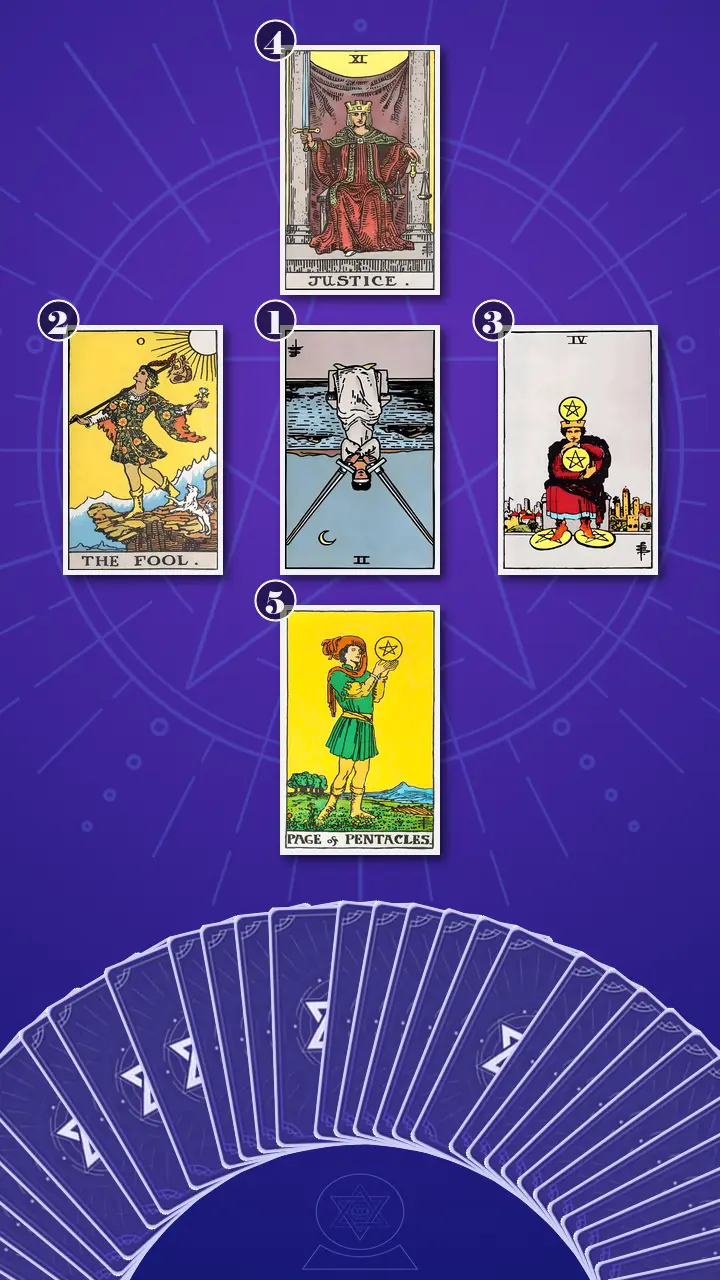
Reading the Map: When “Not Choosing” Becomes a Choice
Position 1 — The current stuck point: Two of Swords (reversed)
“Now we’re turning over the card that represents the current stuck point and observable decision behavior around the offer email,” I said.
Two of Swords, reversed.
I didn’t need to embellish it. This card already speaks fluent modern life: offer email open, reply drafted, deleted, re-drafted—then the switch to job boards “just to check.” You’re holding the decision at arm’s length, and your body reacts like you’re in danger anyway: jaw tight, shoulders high, stomach restless. The non-choice becomes the choice.
Reversed, the Two of Swords is a stalemate that’s starting to leak. This isn’t balance anymore—it’s blockage. The energy is stuck in Air: thoughts spinning, communication delayed, “what if” branching into infinity.
I nodded toward Jordan’s phone on the table. “The cursor blinking in that draft reply—like a metronome for anxiety. Part of you is thinking, ‘If I don’t reply, I’m safe for one more night… but tomorrow it’s worse.’ That’s the loop.”
Jordan let out a quick, tight laugh—half recognition, half disbelief. “That’s… kind of rude,” they said, but their eyes softened. “Like, yeah. That’s exactly what I’m doing.” Their fingers rubbed the edge of their water bottle as if friction could produce certainty.
“And just so it’s said out loud,” I added, “Your anxiety isn’t asking for more tabs—it’s asking for clearer terms.”
Position 2 — Path A (accepting): The Fool (upright)
“Now we’re turning over the card that represents Path A: the psychological and practical experience of accepting the contract-to-hire,” I said.
The Fool, upright.
In real-world terms, this is the version of you who hits send on a “yes”—but frames it like a trial period, not a marriage. First 60–90 days as a learning sprint. Ship something tangible. Ask for expectations early. Set a calendar reminder for a conversion check-in. Energizing… and still scary, because you can’t research your way into certainty.
The Fool’s energy is Fire: forward motion, appetite for growth, identity expansion. The healthy version is balance—curious, open, informed. The shadow risk is excess: leaping to stop the discomfort instead of because the terms make sense.
I looked at Jordan. “This path doesn’t promise safety. It promises momentum. It’s the difference between reading about swimming and actually getting in the water—with a life jacket.”
Position 3 — Path B (continuing to job hunt): Four of Pentacles (upright)
“Now we’re turning over the card that represents Path B: the psychological and practical experience of continuing to job hunt,” I said.
Four of Pentacles, upright.
This is the part of you that keeps applying elsewhere because it feels safer to stay unattached. Protect leverage. Protect stability. Protect dignity. But it starts to feel like clutching your options so tightly you can’t actually move. The search stays ‘open,’ and so does the pressure—every night.
Earth energy, but in excess: security-seeking that hardens into rigidity. The city behind the figure in the card always gets me—opportunity visible, reachable, but not entered because control feels safer than movement.
I let the comparison hang between The Fool and the Four of Pentacles, the way Jordan had been living it: “If I say yes, I’m scared I’m settling / If I say no, I’m scared I’m sabotaging myself.”
Jordan swallowed and glanced away, like they could hear the TTC outside even though we were nowhere near Line 1. “It’s both,” they said quietly. “And it’s exhausting.”
“Good,” I said, gentle but firm. “Not ‘good’ like fun. Good like honest. A contract-to-hire is not a prophecy. It’s a proposal. And proposals can be negotiated.”
When Justice Spoke: The Terms-of-Service Moment
Position 4 — The deciding factor: Justice (upright)
“We’re turning over the card that represents the key factor to weigh—what must be clarified, negotiated, or made explicit,” I said, and I could feel the room sharpen. Even the quiet seemed to lean in.
Justice, upright.
Here’s the shift: you stop asking, “Will this convert?” and you start asking, “What are the terms, criteria, and timeline—exactly?” You close LinkedIn. You open the offer email. You type bullet-point questions like you’re writing a clean Jira ticket. Not because you’re cold—because you’re trying to make consent real.
In my old life on Wall Street, the word “fair” wasn’t a vibe. It was a structure: clarity in writing, accountability, terms you could point to when adrenaline tried to rewrite reality. Justice is that same energy—Air again, but this time structured, not chaotic.
And this is where I bring in my own diagnostic lens—something I call Human Capital Valuation. It’s a fancy phrase for a simple truth: your skills, time, and nervous system are assets. A contract-to-hire offer isn’t just “will they like me?” It’s “what are they paying for my competency, and what protections are in place while I deliver it?” Justice asks you to price your labor with standards, not fear.
Jordan’s face tightened for a second, like they were about to apologize for wanting basic information. They were still stuck in that late-night Toronto toggle: offer email, LinkedIn updates, half-written reply, telling themselves they were being “responsible” while their shoulders crept up and their stomach stayed on alert.
Not “wait until you feel certain,” but “weigh the facts and set your terms”—let the scales and sword of Justice turn this offer into an informed, bounded choice.
I let the sentence sit there. No rescue. No extra explanation. Just air.
Jordan’s reaction came in a small chain, like a body receiving news it’s been waiting for. First: their breath stopped mid-inhale, and their eyes fixed on the card like it had just said their government name. Second: their gaze went slightly unfocused—like they were replaying the last week of opening tabs, deleting drafts, and trying to buy certainty through research. Third: a long exhale slipped out, and their shoulders dropped maybe five percent, the way people unclench when they realize they’re allowed to ask.
“But if I ask questions,” they said, and there was a flash of anger underneath the fear, “doesn’t that make me look… difficult? Like I don’t deserve it?”
“No,” I said. “It makes you employable on purpose.”
I watched their hands loosen on the water bottle. Their voice got quieter. “I’ve been acting like clarity is a moral failing,” they admitted. “Like I should just be grateful.”
“Justice doesn’t care about gratitude,” I said, wry. “Justice cares about alignment.” Then I softened. “And listen—You don’t need a guarantee. You need fair terms you can stand behind.”
I guided them through a quick, contained exercise I use when people are about to open a fourth tab out of panic: a 10-minute Justice Draft. Must-have / Nice-to-have / Dealbreakers. Only 2–3 must-haves. Then one line: “Before I confirm, can I clarify a few details so we’re aligned?” Add two questions. Save—not send. Set a 24-hour window for sending. If the urge to spiral shows up, you stop. You come back to the two questions.
Then I asked, “Now—with this new lens—think back to last week. Was there a moment when you felt your jaw clench and you reached for LinkedIn? If you’d had permission to ‘verify instead of predict,’ what would you have asked right then?”
Jordan blinked hard, like they were holding back something tender. “Tuesday night,” they said. “I highlighted the start date line and then jumped to Glassdoor. I could’ve just… asked about conversion criteria. I could’ve gotten real data.”
That was the pivot—moving from anxious, tab-hopping choice paralysis to the first inch of grounded confidence built on fair terms. Not certainty. Standards.
Position 5 — The grounded next step: Page of Pentacles (upright)
“Now we’re turning over the card that represents the most grounded next step for the coming week,” I said.
Page of Pentacles, upright.
This card is the antidote to the all-or-nothing brain. It says: make it measurable. Treat confidence like a savings account—small deposits, consistently.
In modern terms, it’s: turn the whole situation into a practical plan. If you accept, set 2–3 learning goals, track weekly wins, and ask what metrics define “good performance.” If you keep searching, build a realistic weekly routine with measurable outputs. Either way, you rebuild self-trust through small actions—not one giant perfect choice.
When I looked at Jordan, I could see their mind wanting to turn this into a grand identity referendum. So I gave them my other business-flavored frame: Transition Roadmapping. I structure career changes like an IPO prep cycle—short phases, clear checkpoints, clean reporting. Not because you’re a company, but because your nervous system calms down when it knows what “week 4” means.
The Fair-Terms Filter: Actionable Next Steps for the Next 48 Hours
I summarized what the Decision Cross had shown us: Jordan’s stuckness wasn’t a character flaw—it was a protection strategy. The Two of Swords reversed showed the cost of trying to stay neutral. The Fool and Four of Pentacles revealed the honest debate—momentum vs security. Justice reframed the entire dilemma into something solvable: fair exchange, in writing. And the Page of Pentacles promised relief through steady, trackable action.
The cognitive blind spot was subtle but powerful: Jordan had been treating the decision like a verdict on their worth (“choosing wrong proves I lack control”) instead of treating it like a negotiation plus a time-bound experiment. The transformation direction was clear: stop seeking certainty; start setting criteria, asking direct questions, and creating checkpoints.
Here’s what I gave Jordan—simple, concrete, and designed to interrupt the tab-hopping loop:
- The Justice Draft EmailSet a 30-minute timer. Open the offer email and draft a reply with 3–5 bullet questions: conversion criteria, expected timeline, benefits start date, schedule flexibility, and who evaluates performance. Start with: “Before I confirm, can I clarify a few details so we’re aligned?”If you feel “needy” or “awkward,” label it as stress—not a red flag. Bullets reduce emotional load. No paragraphs.
- Get It in Writing (No Vibes-Only Offers)Ask for the contract terms as an official document (PDF or formal offer letter) before agreeing to anything that affects pay or benefits. If there’s a recruiter, send it to them directly.Your nervous system doesn’t need more reassurance. It needs clearer clauses—like reading Terms of Service before you click “I agree.”
- The Trading-Floor SendRight before you hit send, do my “opening bell” routine: feet grounded, shoulders down, voice steady. Read the email out loud once like you’re making a calm market open call—clear, professional, no apology tone. Then send within a 24-hour decision window.If you catch yourself opening a fourth tab, pause for 60 seconds. Come back to only the two most essential questions.

A Week Later: The Quiet Proof
A week later, Jordan messaged me a screenshot—not of a perfect outcome, just a real one. Their email was crisp. Bullets. No over-explaining. And the reply they got back included what their brain had been trying to hallucinate through late-night research: a conversion timeline, who evaluates performance, and when benefits would begin.
“I slept,” they wrote. “Like, an actual full night. I still don’t know what I’ll choose. But I’m not guessing anymore.”
That’s what I mean when I talk about a Journey to Clarity. It’s not a lightning bolt. It’s the moment your shoulders drop because you’ve stopped treating an offer like a prophecy and started treating it like a proposal—with terms you can stand behind.
When the inbox is asking for an answer, it can feel like your whole future is on the line—so you keep researching, not because you’re lazy, but because choosing wrong feels like losing control in public.
If you treated this offer like a time-bound experiment with your boundaries written down, what’s the smallest ‘fair terms’ question you’d feel ready to ask first?