From Invite-Snub Spirals to Calm Directness: A Workweek Reset

The Monday Chatter That Hits Like a Cold Draft
You draft a “Hey, I noticed…” DM, delete it, rewrite it, delete it again, and walk into the office like nothing happened—because you’d rather feel rejected than look “needy.”
Jordan said that to me like it was a confession and a joke at the same time. They were calling from Toronto, camera angled a little too low, the kind of Zoom setup you do when you’ve booked a tiny meeting room “just for ten minutes” and you don’t want anyone clocking that you’re having feelings at work.
They described Monday, 8:41 a.m., cutting through the PATH from Union Station. Burnt coffee in the air, winter trapped in their scarf. Slack buzzing with the usual Monday banter—someone tossing out, “Still recovering from Friday drinks 😂”—and Jordan’s chest going tight like a seatbelt locking. On the outside: neutral face, steady pace, competent-person posture. On the inside: jaw clamped, phone warm in their palm, brain doing high-speed math on something that shouldn’t matter this much but does.
“I wasn’t invited,” they said. “And now I can’t tell if this is politics or just… people being people. If I ask, I’m the problem. If I don’t ask, I’m still the problem.”
The way they said it wasn’t dramatic. It was measured—like someone trying to keep dignity intact while their nervous system kept pulling the fire alarm. Rejection, in Jordan’s body, wasn’t a concept. It was a tight chest and a slightly clenched jaw that showed up the second the office kitchen got loud or Monday chatter got a little too “we all know what happened.”
I let the silence do its job for a beat. Then I said, “You’re not overreacting. You’re reacting to missing information in a place where missing information can cost you opportunities. Let’s turn this into something clearer—something you can actually move with. We’re here for a Journey to Clarity, not a week-long spiral.”

Choosing the Compass: The Celtic Cross · Context Edition
I asked Jordan to take one slow breath—not as a mystical ritual, but as a nervous-system handoff: from rumination to observation. While they exhaled, I shuffled. The sound was small and ordinary, like a deck of cards in any apartment, which is exactly the point. We weren’t summoning anything. We were focusing.
“Today,” I said, “I’m going to use the Celtic Cross · Context Edition.”
For readers who are new to tarot and wondering how tarot works in a practical, modern workplace situation: this spread is basically a full-spectrum diagnostic. When you’re at a career crossroads or feeling stuck in office politics, you don’t just need ‘a vibe.’ You need to separate the sting (what happened) from the obstacle (why it’s hard to address), from the root (what fear is filling the gap), and then find an actual next move.
This is why the Celtic Cross works so well here: it maps card meanings in context. It doesn’t tell Jordan, “They hate you” or “Quit your job.” It tells us what energy is driving the reaction, what the environment is doing, and what a dignified next step looks like.
I previewed the three positions I cared most about for this reading: the center card for the lived moment of being left off the invite, the crossing card for the political complication, and the near-future card for Jordan’s next best move in office politics—the move that keeps self-respect intact without escalating conflict.
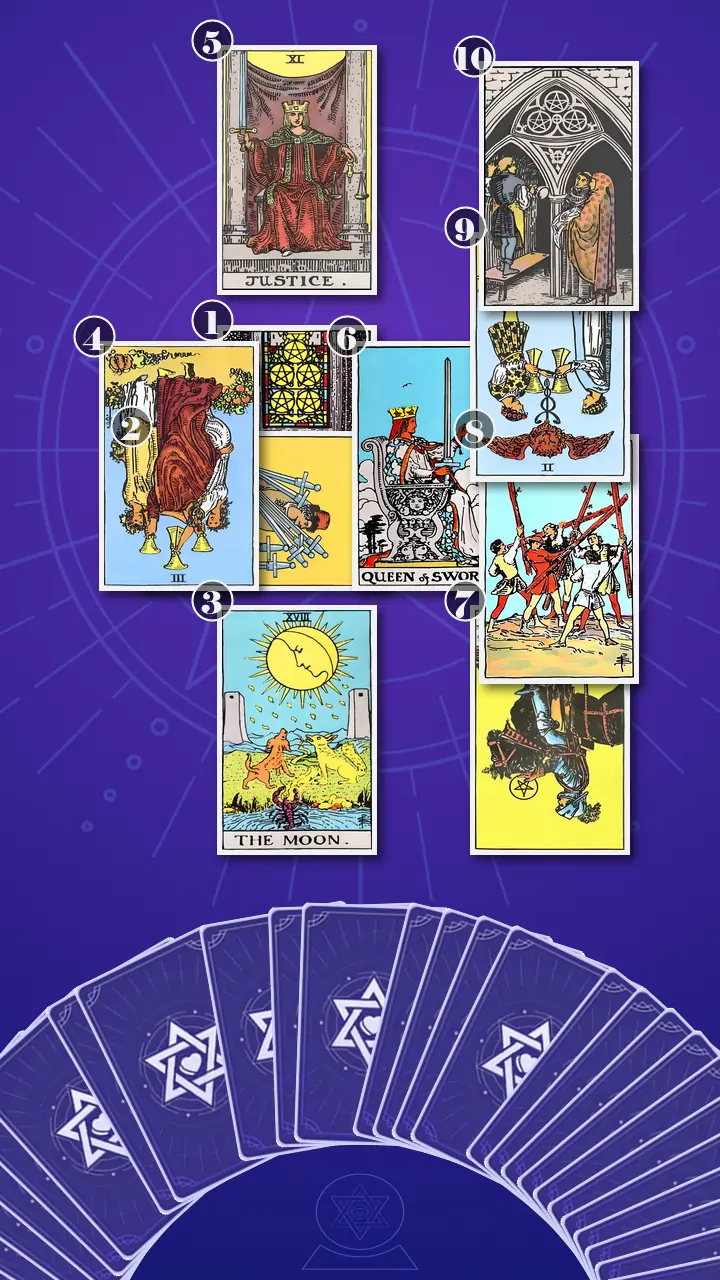
Reading the Map: Office Politics, But Make It Verifiable
Position 1: The Immediate Sting You Can’t Unfeel
“Now we’re turning over the card that represents the immediate lived moment of being left off the invite and how it’s impacting your behavior at work,” I said.
Five of Pentacles, upright.
In the classic image, two figures walk outside in the cold while a warm, lit window glows just out of reach. In modern life, it’s brutally familiar: Jordan seeing post-event photos in the team chat and instantly feeling a step behind—then trying to limp through the week by working harder instead of addressing the information gap.
This card isn’t about your competence. It’s about access—who’s inside the informal network when decisions, context, and stretch opportunities quietly get shaped. The Five of Pentacles is the part of you that goes, The door is locked… even when the door might just require a knock.
Jordan gave a short laugh that held more bitterness than humor. “That’s… painfully accurate. Like, it’s kind of rude how accurate that is.”
“I know,” I said gently. “And I’m not saying your feelings are irrational. I’m saying this card shows why your body is bracing. It’s treating the missing invite like a scarcity event—like it means less belonging, less safety, less status.”
Position 2: The Political Complication That Turns ‘Small’ Into High-Stakes
“Now we’re turning over the card that represents the main political dynamic or obstacle—what’s making this feel risky or confusing to address,” I said.
Seven of Swords, upright.
This is the ‘side-chat’ card. It’s the sense that some information is being carried elsewhere—off-record. It can be strategy, avoidance, discretion, or just a messy human tendency to talk to whoever is closest.
Modern translation: Jordan sensing decisions are being pre-sorted in side conversations, so they start trying to decode who’s aligned with whom instead of asking one clear question. It’s that “group chat within the group chat” energy—where you’re staring at emoji reactions like they’re performance reviews. High-resolution attention on low-information signals.
Energy-wise, the Seven of Swords is a blockage of clarity. Not necessarily hostility—just selective visibility. And it makes your next move feel like it has to be perfect, because you don’t know what game you’re even playing.
Position 3: The Root—What Your Brain Does When It Can’t Get Clean Data
“Now we’re turning over the card that represents the deeper root—what uncertainty or fear is filling the information gap and driving your interpretation,” I said.
The Moon, upright.
Here’s where the story gets honest. The Moon is what happens when ambiguity hits the nervous system like danger. It’s a dim path between towers. It’s your mind trying to create certainty where the situation is inherently murky.
I used the split-screen I’ve seen in a thousand modern careers:
(Night) 12:41 a.m. blue light, Slack search bar, jaw clenched as you replay tone and timestamps.
(Day) the office kitchen where everyone’s laughing and you’re pretending you’re “too busy,” stirring tea too fast, shoulders practically up to your ears.
I said, “Try this inner monologue structure with me: What I know is ___. What I’m assuming is ___. What I’m afraid it means is ___.”
The Moon’s energy is excess imagination and deficiency verification. It’s not that your brain is broken. It’s that it hates incomplete data, so it manufactures a story—and then tries to control your behavior (silence, overwork) to make that story hurt less.
Jordan exhaled—small, almost annoyed at themselves. Then they went quiet the way people go quiet when they realize how much energy they’ve been spending on guesswork. “Yeah,” they said. “That’s exactly what I do.”
Position 4: The Recent Pattern—The Closed Circle Before This Moment
“Now we’re turning over the card that represents recent group dynamics that set the stage,” I said.
Three of Cups, reversed.
Three of Cups is celebration and belonging—until it flips. Reversed, it’s clique gravity. It’s uneven inclusion. It’s friendships at work that feel closed rather than welcoming.
This doesn’t automatically mean anyone is “bad.” But it does suggest the social container hasn’t been truly reciprocal. The invite becomes a symbol of access to the informal network, not just a fun night out.
And there’s a particular risk in this reversal: to avoid feeling excluded again, you might start pre-rejecting people—acting icy, “too busy,” opting out before you’re left out. That’s a protective strategy, but it can accidentally confirm the story that you’re not interested in bonding.
Jordan’s eyes flicked down and back up. It was the body-language version of, called out.
Position 5: What You’re Trying to Restore—Fairness, Clarity, Respect
“Now we’re turning over the card that represents your conscious aim—the standard you want and the mindset you’re trying to hold,” I said.
Justice, upright.
Justice is my favorite card for workplace situations because it’s not interested in vibes. It’s interested in standards. The scales say: evidence versus interpretation. The sword says: clean language.
I told Jordan, “Think of this like turning a messy rumor in a group chat into a clean Jira ticket. Define the issue. Define the ask. Define the next step. That’s Justice.”
And I felt my own internal flashback—trading floor mornings on Wall Street, where nobody got to say, “I feel like the numbers are bad.” You had to show the numbers. Not because feelings didn’t matter, but because decisions required structure. Justice is that structure.
Jordan nodded, slower this time. You could almost see agency returning—like their shoulders dropped a millimeter. “So it’s not… ‘do they like me.’ It’s ‘what’s fair access to context.’”
“Exactly,” I said. “Fairness isn’t popularity. It’s process.”
When the Queen of Swords Cut Through the Hallway Fog
Position 6 (Key Card): Your Next Best Move in Office Politics
I paused before turning this card. The room on Jordan’s end was still—the kind of stillness you get when you’re about to hear something you can’t unhear. Even through a screen, I felt it: the moment a reading stops being interesting and starts being useful.
“Now we’re turning over the card that represents your next best move in office politics—the most skillful near-term approach you can choose,” I said.
Queen of Swords, upright.
This is directness without drama. Boundaries without punishment. A precise question without apologizing for existing. Modern translation: Jordan sending one calm Slack message—“Hey, I realized I missed the invite—what’s the best way for me to stay looped in on team socials and informal updates?”—and then letting the reply inform next steps.
Energy-wise, the Queen of Swords is balance: emotions acknowledged, but not steering the car. She’s the antidote to the Moon’s fog and the Seven of Swords’ side-channel ambiguity.
Setup: I said, “Right now, you’re on the TTC with your phone warm in your hand, opening a half-written Slack DM, rereading it three times, then closing the app right before you walk into the office—because asking feels like it would expose you.”
Jordan’s lips pressed together. That familiar decision fatigue: Say something and risk dignity, or say nothing and risk invisibility.
Delivery:
Not mind-reading in the dark—choose the Queen’s clean blade of truth and say it plainly, once.
I let the sentence hang there.
Reinforcement: Jordan’s body reacted in a three-step chain. First, a tiny freeze—breath caught, shoulders held. Then the cognitive part: their eyes unfocused for half a second, like their brain was replaying every deleted draft, every kitchen laugh they pretended not to hear. Then the emotion slipped through: a slow exhale, almost shaky, and their jaw unclenched like they’d been holding a weight in their teeth.
“But won’t that make me look… petty?” they asked, and I heard the fear behind it: Don’t get labeled. Don’t become a story.
“Here’s where I bring in my Wall Street brain,” I said. “In Corporate Game Theory, a lot of office politics is about payoffs and signals. Mind-reading from the hallway creates a game where everyone’s payoff is confusion—because nobody has to clarify anything, and you keep paying the cost in your head. The Queen changes the payoff matrix with one clean move: a question that’s about process, not reassurance. It forces reality onto the table.”
“Clarity isn’t cringe,” I added. “It’s leverage.”
I guided them into a 10-minute ‘Clean Question’ drill—stop anytime if their body tightened:
1) Open Notes and write two columns: Facts I saw vs Stories my brain wrote.
2) Under Facts: only verifiable items (“Team mentioned drinks on Monday,” “I wasn’t on the calendar invite”).
3) Draft a 1–2 sentence Slack/Teams message that asks for process, not reassurance.
4) Add a boundary line: “I’m not going to litigate motives in my head for 48 hours after I send this.”
Then I asked, exactly as I always do when a key card lands: “Now, with this new lens, think back—last week, was there a moment when you could’ve asked cleanly and spared yourself ten hours of decoding?”
Jordan blinked hard. “In the kitchen,” they said quietly. “Someone said, ‘We should do that again.’ I could’ve just asked, ‘How do invites usually go out?’ I… didn’t.”
“That,” I said, “is the bridge from being stung and vigilant to calm directness. It’s not about becoming fearless. It’s about becoming reality-based.”
Position 7: Your Stance—Grinding as Camouflage
“Now we’re turning over the card that represents your current stance and habits—how you’re showing up and what you can adjust internally,” I said.
Knight of Pentacles, reversed.
This is the reliable person who’s become invisible. The energy is blocked—cautious to the point of freezing. Modern translation: staying late, perfecting spreadsheets no one asked to be perfect, skipping the kitchen so you don’t walk into a laugh you weren’t part of… and telling yourself “results will speak for me” while you refresh the team channel anyway.
“Overworking is not a substitute for being looped in,” I said, without judgment. “It’s a survival strategy. It’s also a trap.”
Position 8: The Environment—Noise, Competition, and Competing Agendas
“Now we’re turning over the card that represents the office climate—competition, alliances, and external influences,” I said.
Five of Wands, upright.
This is the messy room. Multiple people swinging priorities around. It can look like a coordinated attack when you’re already activated—but often it’s just overlapping agendas and strong personalities.
Modern translation: a workplace where invites double as informal alliance-building, not just friendship. The key move isn’t to win the chaos. It’s to choose where you engage, clarify your lane, and collaborate strategically.
I watched Jordan’s shoulders drop again, like permission. “So it might not be about me,” they said.
“Right,” I said. “Not every signal is a verdict.”
Position 9: Hopes and Fears—Wanting Mutuality, Fearing Permanent Misalignment
“Now we’re turning over the card that represents your hopes and fears—your hope for belonging and your fear of misalignment,” I said.
Two of Cups, reversed.
This is the ache underneath. You want mutual respect and easy rapport. You fear being “the odd one out” in a way that never repairs. Reversed, the bond isn’t flowing right now—misattunement.
And the overcorrection risk here is real: trying to force closeness fast, oversharing feelings about the invite, seeking reassurance from multiple coworkers. That’s understandable—and it can backfire by blurring boundaries.
“Adult connection at work,” I said, “is often smaller than your nervous system wants. It’s one clean reset, not a grand emotional reveal.”
Position 10: Integration Path—Belonging Through Visible Collaboration
“Now we’re turning over the card that represents the integration path—what becomes possible when you act with clarity and collaboration,” I said.
Three of Pentacles, upright.
This is the worksite. The shared plan. The Google Doc you’re actually on, not hearing about afterward. It’s belonging through contribution—not chasing invites, but being structurally necessary in the workflow.
I told Jordan, “This is the part where you stop hovering at the doorway and get on the plan. Not by begging for a seat—by building something with someone.”
And here I pulled in my other lens—Human Capital Valuation. “You already have value here. Not motivational-poster value—actual competency value. Your leverage increases when that value is seen in collaboration. Think of your skills like assets: they appreciate when they’re deployed where other people can reference and rely on them.”
Jordan’s expression changed into something steadier. Less ‘please let me in.’ More ‘I can choose how I participate.’
The One-Page Plan for Finding Clarity (Without Sounding Needy)
I tied the spread together for Jordan the way I would summarize a messy business problem to a room full of executives: simple, coherent, and grounded in reality.
“Here’s the story the cards are telling,” I said. “The Five of Pentacles shows the immediate sting—feeling outside the lit window. The Seven of Swords and the Moon explain why it’s so activating: partial information plus ambiguity makes your brain write a worst-case narrative. Three of Cups reversed says this isn’t a one-off—there’s already a clique-ish pattern. Justice is you trying to restore standards and dignity. And the Queen of Swords is the pivot: one clean question that turns speculation into data. Then, Three of Pentacles is how you build influence without chasing every social doorway—collaboration that puts you inside the structure.”
I named the cognitive blind spot softly, because shame never helps: “Your blind spot is treating social ambiguity like a final verdict. When you do that, you spend more energy decoding signals than building real working alliances.”
“The transformation direction,” I continued, “is exactly what you said you wanted: shift from indirect signal-reading to one clear, respectful conversation plus visible, values-based collaboration.”
Then I gave Jordan actionable advice—actual next steps you can do in a hybrid office, in real life, during work hours.
- Justice Note: Facts vs StoriesOn your commute (or right before you message), write 5 facts you can verify and 3 stories your brain is tempted to treat as fact. Then write 1 clean ask that’s about process (staying looped in), not reassurance.Set a 5-minute timer. If you start spiraling, shrink it: 3 facts / 1 story / 1 ask. Facts first. Stories second. Then one clean ask.
- Queen of Swords Message: One Clean DMSend one Slack/Teams message during work hours to the organizer (or a safer point person): “Hey—quick question. I realized I missed the invite for team drinks. What’s the best way for me to stay looped in on team socials / informal updates going forward?”Write three versions, choose the shortest. If you feel tempted to over-explain, delete half. Clarity isn’t cringe. It’s leverage.
- 48-Hour Boundary: No Hallway-DecodingAfter you send the message, don’t follow up for 24–48 hours unless it’s truly time-sensitive. Let the response be data. If anxiety spikes, re-read your Facts vs Stories note.Use my “trading floor opening simulation” for two minutes first: feet flat, shoulders down, voice low and slow, one sentence only. You’re practicing calm authority—not asking to be liked.

A Week Later: The Quiet Proof
Six days later, Jordan sent me a message that started with, “Okay, so I did it.”
They’d sent the Queen of Swords DM at 10:12 a.m., not at night, not while activated. They didn’t add a smiley face to soften themselves. They didn’t write a paragraph explaining their intentions. One clean ask.
The organizer replied an hour later: a short apology, a practical explanation (“It was last-minute / I grabbed the people I’d just been talking to”), and a simple fix (“I’ll add you next time / we should make a recurring list”). Not a fairy tale ending. Not a confession of wrongdoing. Just reality—finally on the table.
Jordan said something that made me smile: “Once I had an answer, my brain got… bored. Like it didn’t have anything to chew on.”
And in the bittersweet way change often looks, they added: “I slept through the night. In the morning, my first thought was still, ‘What if I’m wrong about all of this?’—but it didn’t punch me in the chest. It was just a thought. I made coffee and moved on.”
I told them, “That’s the shift. From mind-reading to self-trust. From speculation to standards. From the hallway to the room.”
When you want to belong but you’re terrified that asking will make you look insecure, you end up doing the loneliest thing: working harder in silence while your body stays braced for the next small sign you’re not wanted.
If you trusted yourself enough to stop decoding the hallway and just ask one clean question this week, what would you want to learn—so you can choose your alliances from facts, not fear?