From Choice Paralysis to Calm Consistency: Deciding July vs Defer

11:47 p.m., Laptop Glow, and the Cursor That Won’t Click
If your browser has the registration page, two prep course tabs, and a bar exam subreddit thread open—and somehow you’ve built “JULY PLAN v6” instead of clicking Submit—welcome to deadline-driven decision paralysis.
Jordan joined our call from a tiny NYC apartment where the laptop glow was the only real light. I could hear the low AC hum through her mic, and every few seconds the trackpad made that soft, slick shff sound under her thumb. Her phone kept lighting up off-screen—classmates posting “Bar prep starts now” like it was a season premiere everyone had agreed to watch together.
“Registration closes tonight,” she said, and the sentence landed like a gavel. “Sit in July or defer. I don’t need a pep talk, I need the correct decision.”
I watched her mouth tighten on the word correct. Her jaw was doing that braced, almost-feral clench I recognize from people who’ve been holding themselves together by sheer force. Her hands didn’t rest; they hovered, tapped, reached for the keyboard, then pulled back like the keys were hot.
What she was really holding wasn’t just a test date. It was the fear that one timing choice would prove she wasn’t ready—like the calendar could expose her.
Anxiety, in moments like this, isn’t an abstract feeling. It’s a tight chest that makes your breaths shallow, a jaw you forget is locked until it aches, and that “wired but not moving” sensation—like your whole nervous system is an overheating browser with twenty tabs open and no idea which one is the problem.
“Okay,” I told her, keeping my voice low and steady. “We’re not going to force certainty out of an impossible night. We’re going to map the pressure, name what’s actually driving it, and get you to a choice you can live inside. A real journey to clarity—not a verdict.”

Choosing the Compass: The Decision Cross · Context Edition
I’m Laila Hoshino. Most days, I guide strangers through star shows at a Tokyo planetarium—ten years of explaining why the sky looks still when it’s actually moving in patterns we can measure. In quieter hours, I study the overlap between astrophysics and the occult: how humans make meaning under uncertainty, and how timing changes everything.
Jordan’s midnight in New York was my lunchtime in Tokyo. That time gap mattered to me—not as a gimmick, but as a reminder of rhythm. Two people under the same sky, feeling the same pressure, but standing on different points of the clock.
Before we touched the cards, I asked her to try my Pre-meeting 3-minute cosmic breathing. Not mystical. Just a reset—like letting your eyes adjust in a dark dome before the constellations appear.
“In for four,” I said. “Hold for four. Out for six. Let your shoulders drop on the exhale. We’re telling your body it doesn’t have to sprint to decide.”
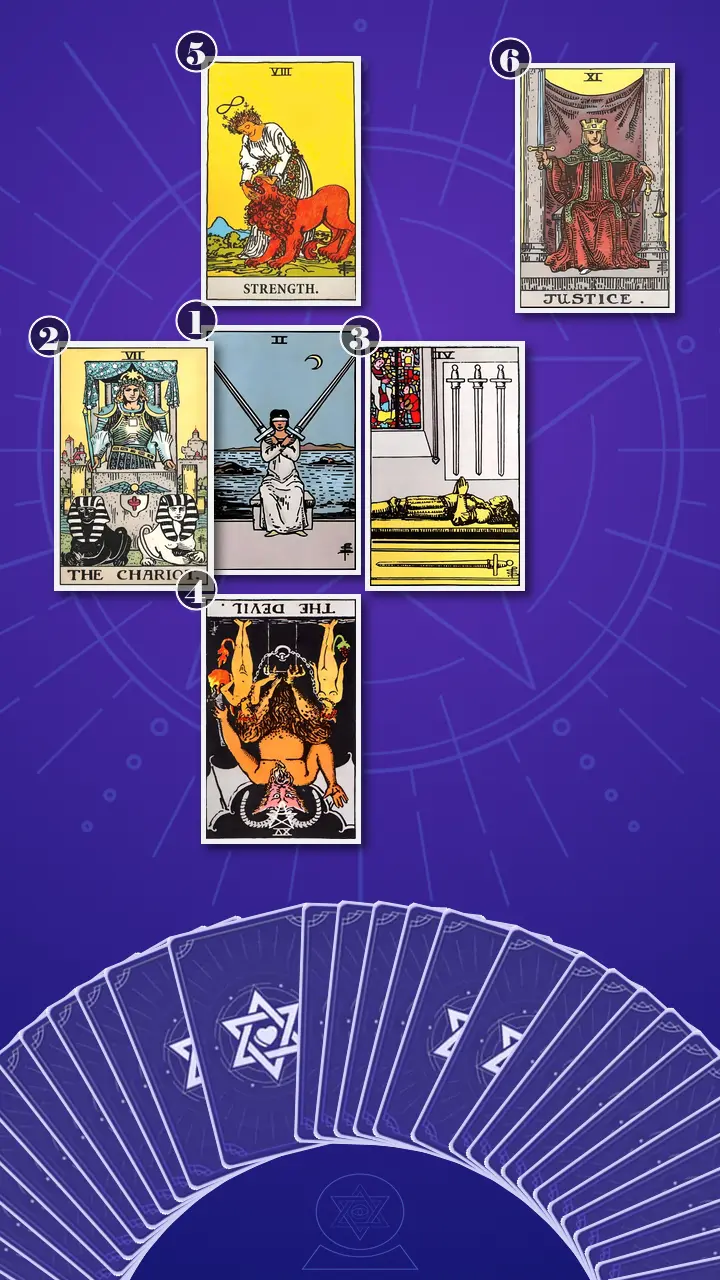
For a deadline like this—bar exam registration closes tonight: July bar vs defer—I use a spread built for side-by-side choices: Decision Cross · Context Edition.
Here’s why this tarot spread works under time pressure: it keeps the logic clean. Card 1 anchors what’s happening right now (the behavior loop). Cards 2 and 3 compare the two paths (July vs defer) without moralizing either. Card 4 exposes the hidden driver—the shame, fear, or comparison pressure that makes a simple scheduling decision feel like an identity trial. Card 5 gives guidance: the inner stance that prevents second-guessing. Card 6 shows the near-term direction—not pass/fail prediction, but the tone and structure you’ll need after you commit.
“We’ll read from the center outward,” I told her. “Like a crossroads with a foundation underneath and a compass overhead.”
Reading the Map When Your Brain Is a Courtroom
Position 1 — Present state: the stuck behavior tonight
“Now flipping,” I said, “is the card that represents the concrete way indecision shows up right now—what you’re doing on autopilot around registering tonight.”
Two of Swords, upright.
It was so on-the-nose it almost felt rude. The Two of Swords is the classic freeze: blindfold on, arms crossed, holding two sharp options at the chest like, if I don’t move, I can’t be wrong.
I used the simplest translation because it was already her life: It’s the exact moment you’re sitting at your desk in NYC at 11-something PM with the registration portal open, cursor hovering over “Submit,” while you pretend you’re being thorough by switching to Reddit threads and your spreadsheet. The blindfold isn’t ignorance—it’s protection. Choosing would force you to feel vulnerability, uncertainty, and the possibility of disappointment. So your mind offers a workaround: planning.
Energetically, this is a blockage—Air energy in excess. Too much thinking, not enough committing. The “responsible” research is actually emotional bracing in browser form.
I said it plainly: “Seventeen tabs feels like control, but it’s a freeze response. It’s your nervous system saying, ‘Don’t make a move that can be judged.’”
Jordan let out a small laugh that had no joy in it—more like a pressure valve. “That’s… accurate,” she said, eyes flicking down to her trackpad. “Accurate in a way that’s kind of mean.”
“Not mean,” I replied. “Useful. We can’t change what we don’t name.”
I leaned in just a little. “Be honest—are you actually deciding July vs defer… or are you deciding what story people will tell about you either way?”
Position 2 — Option A (Sit in July): what it asks you to embody
“Now we’re looking at Option A: sitting in July—how it would likely feel to commit, and what it would ask you to embody day-to-day.”
The Chariot, upright.
The Chariot is movement with mixed feelings still in the car. In Jordan’s world, it looked like this: turning prep into a steerable routine instead of a nightly negotiation—same start time most days, a small set of core materials, fewer detours into ‘just in case’ resources.
Energetically, The Chariot is focus and forward motion—not because doubt disappears, but because doubt stops driving. It’s a balance state that requires boundaries.
I used the commute analogy from her own city. “This isn’t a hype speech. This is a subway route. Same stops. Same time. You don’t re-plan the entire MTA map every night.”
Jordan swallowed. Her shoulders lifted, then dropped a millimeter, like her body was testing whether it was safe to believe me. “That sounds… doable,” she admitted, then immediately added, “but only if I stop adding things.”
“Exactly,” I said. “Your job is to steer, not to erase doubt.”
Position 3 — Option B (Defer): what stability it could create if intentional
“Now,” I said, “is Option B: deferring—what it offers, and what kind of stability it could create if chosen intentionally.”
Four of Swords, upright.
This card doesn’t whisper “quit.” It whispers “sanctuary.” In modern terms: an intentional recovery lane—stop the midnight portal refresh cycle, protect sleep, give your nervous system a reset so studying isn’t fueled by panic.
Energetically, the Four of Swords is a deliberate pause—a balance state when you give it boundaries. Without boundaries, it can turn into drifting. With boundaries, it becomes a strategic regroup.
I said, “If you defer, it has to be a decision with a container. A future decision date. A light weekly anchor. Rest that doesn’t leak into shame.”
Jordan’s fingers loosened around her phone. “That’s what I’m scared I won’t do,” she said. “That it’ll become… nothing.”
“That fear is data,” I told her. “Not a sentence.”
Position 4 — Hidden driver: what’s influencing this more than you admit
“Now we go underneath,” I said. “This is the hidden driver—the fear, shame, or comparison pressure making tonight feel heavier than it needs to.”
The Devil, reversed.
In my research life, I have a name for this: Dark Matter Detection. Dark matter is invisible, but you can measure its pull by watching what it distorts. The Devil reversed is that invisible pull: the pressure you don’t say out loud, but it’s steering your calendar anyway.
In her actual life scenario, it was painfully clear: the decision is being negotiated with a hidden audience—classmates, recruiters, an imagined ‘real lawyer’ standard. You’re not just picking July or defer—you’re trying to avoid feeling ‘less than.’
I offered her the analogy the card begged for: “Your social feed is a weighted vest you forgot you put on. Everything feels harder, but it’s not because you can’t do the work. It’s because you’re trying to do the work while carrying optics.”
I paused. “Optics are a loud advisor,” I said. “They’re not your boss.”
Jordan’s body did the thing the blueprint always predicts when the chain is named: first, a tiny freeze—breath held. Then her eyes unfocused, like she was replaying a scroll through LinkedIn. Then a sharp exhale. “Oh,” she said, barely audible. “I’m not choosing a date. I’m negotiating my worth.”
“Yes,” I said softly. “And tonight, we renegotiate.”
When Strength Spoke, the Room Got Quiet
Position 5 — Guidance: the stance that prevents second-guessing
I let the silence settle. Even through a screen, I could feel the moment her mental arguing slowed—like a subway finally pulling into a station.
“Now we flip,” I said, “the card for guidance: the inner stance that helps you decide cleanly without punishing yourself afterward.”
Strength, upright.
Setup: It was 11:47 pm in her body even if the clock had ticked forward—laptop open, cursor hovering over “Submit,” still tweaking “JULY PLAN v6” like the spreadsheet could make fear go away. She was trying to logic her way into a guarantee, as if one more calculation could eliminate the risk of being judged.
Delivery:
Stop treating fear like a verdict; start treating it like a lion you can steady, and choose the path your hands can hold every day.
I didn’t rush the next sentence. I let it hang there, the way I let a constellation hang in the dome when I’m teaching—long enough for someone to recognize it as theirs.
Reinforcement: Jordan’s reaction came in layers. First, her lips parted like she’d been caught holding her breath for too long. Then her shoulders dropped, not dramatically—just enough to be real. Her jaw worked, unclenching in small increments, like a lock turning. Her hands, which had been buzzing at the edges of her keyboard, flattened on the desk. She stared at the card on my side of the camera and whispered, “So… fear isn’t evidence.”
“Fear is a sensation,” I said, mirroring her body back to her. “Tight chest. Wired hands. A surge. That’s the lion. Not a character flaw.”
This is where I used my other lens—Spacecraft Attitude Adjustment. “When a spacecraft hits turbulence, we don’t panic and abandon the mission,” I told her. “We fire small thrusters. Tiny adjustments. Not to erase motion—but to keep the nose pointed where we decided to go. Tonight, your thruster is a clean, kind minimum you can repeat.”
Then I gave her the 9-minute reset as something she could do tonight, even with the deadline clock loud:
A 9-minute “One Clean Click” reset: (1) Set a 3-minute timer and write two lines: “If I choose July, I’m afraid people will think ___.” / “If I defer, I’m afraid people will think ___.” (2) Set another 3-minute timer and rewrite each as a neutral fact you’d say to a friend (no judgment words like ‘weak’ or ‘behind’). (3) Final 3 minutes: pick ONE next action you can do tonight that matches the neutral-fact version (submit registration OR set a defer decision date + one small prep anchor). If your body starts to spike (tight chest/jaw), pause—hands off keyboard, one slow breath, then continue only if it feels tolerable.
I watched her do the tiniest nod. Not enthusiastic. But committed.
“Now,” I asked her, “with this new lens—can you think of one moment last week when the fear spiked and you treated it like a verdict? What would’ve changed if you’d treated it like a sensation you could hold?”
Jordan looked to the side, eyes glossy but not spilling. “This morning,” she said. “On the 4 train. I saw a post—‘Day 1 of bar prep.’ My chest dropped and I decided I was behind in real time. I didn’t even notice I was making that a… moral thing.”
“That,” I said, “is the first step in the transformation—moving from deadline-driven anxiety and shame into self-led commitment. Not perfect calm. Just a steadier hand on the wheel.”
Position 6 — Near-term direction: what it will feel like after you commit
“Last card,” I said. “This is near-term direction—the practical and psychological tone after you commit. Not a pass/fail prediction. More like: what kind of container will keep you from reopening the loop tomorrow night.”
Justice, upright.
Justice was almost tender in this context—because it offered relief through structure. In real life: a simple readiness framework—practice sets completed, review quality, rest protected, weekly check-in for accountability, not self-attack.
Energetically, Justice is balance plus a clean cut. The scales weigh honestly. The sword stops the endless debate.
“Stop grading yourself on vibes—use a rubric,” I said, and I felt her attention sharpen. Like a student who finally hears an instruction that makes the assignment finite.
The One-Page Flight Plan: Metrics Over Mood for the Next 8–12 Weeks
I pulled the whole story together for her, the way I would for a planetarium audience when the star field finally makes sense.
“Here’s what the spread is saying,” I told Jordan. “Right now, Two of Swords has you braced—holding both options so you can’t be wrong. The Chariot says July is viable if you steer hard: fewer detours, repeatable routine. Four of Swords says deferring can be wise if it’s a protected pause with guardrails. But the real gravity well is The Devil reversed—comparison and shame quietly driving urgency. Strength is the bridge: regulated courage, self-compassion, a daily minimum. And Justice is the landing gear: a fair system so you don’t re-litigate the decision every night.”
“Your cognitive blind spot,” I added, “is thinking you need certainty before you commit. But your clarity is going to come from execution—from showing up consistently enough that you start trusting yourself again.”
I said the line I wanted her to keep: “Consistency creates certainty. Not the other way around.”
Jordan frowned, then gave me the most honest obstacle of the night. “But I can’t even find five minutes,” she said. “Because if I start, it means it’s real. And then if I’m not perfect, it’s… proof.”
“That’s the Devil chain talking,” I said gently. “And that’s why we’re going small. Small is not avoidance. Small is how you build a system your nervous system will actually enter.”
Then I gave her concrete next steps—deadline-aware, low-friction, and built to stop the second-guessing loop. I framed them as interstellar navigation: you don’t need a prophecy, you need a course you can correct.
- The Justice Rubric (6 rows, ugly on purpose)Open Notes right now and make a 6-row checklist: Practice sets/week, Review block/week, Rest day, Admin tasks, Score trend (if applicable), Red-flag signs (sleep <6h, doomscrolling past midnight). Review it only on Sundays at 6 p.m.—not every night.If your brain says “too simplistic,” that’s the point. Simple is executable. Voice memo counts if typing feels hard.
- The Strength Minimum (daily baseline you can repeat)Choose one minimum you can sustain even on a bad day: e.g., 45 minutes mixed MBE practice + 15 minutes review. Put it on your calendar as a recurring block for the next 7 days. Your win condition is showing up, not being impressive.Use “minimum + bonus”: if you have more energy, add a bonus block; if not, minimum still counts as success.
- The 7-Day Chain Identification (comparison detox window)Mute bar-prep keywords or specific accounts that spike you for 7 days—just until you’re past the decision window and into your first week of follow-through. When you catch yourself tab-hopping, say out loud: “I’m looking for certainty. I can’t download it. I can only build it.” Then close one tab.You don’t have to announce your choice to anyone tonight. Silence is a boundary. Boundaries create traction.
To help her decide between July and defer without turning it into self-punishment, I offered a quick, grounded version of my constellation alignment pros/cons assessment. “We’re not asking which option makes you look strongest,” I said. “We’re asking which option your body and calendar can repeat.”
And because she needed a future-facing lens, I ran a brief Gravity Assist Simulation out loud: “In six months, you won’t remember the drama of tonight. You’ll remember whether you built consistent effort. Either choice can get you there if it’s self-led. The wrong choice isn’t July or defer—the wrong choice is letting shame choose, then living in backlash.”

A Week Later: The Quiet Proof
Six days later, I got a message from Jordan. No paragraph. No TED Talk. Just: “I did the One Clean Click. I registered. I muted three accounts. I wrote the rubric in Notes. Minimum block is on my calendar. I’m still scared, but it’s not driving.”
She added, almost like an afterthought: “I slept. Like, a full night.”
In my mind, I could see the bittersweet version of that win: she wakes up, reaches for her phone out of habit, and the first thought is still What if I’m wrong?—but this time she exhales once, sees her calendar block, and thinks, Okay. Just today’s minimum.
That’s the journey to clarity I trust—the kind that doesn’t promise certainty, but proves self-trust through repetition.
When the deadline clock is loud, it’s so easy to mistake anxiety for evidence—and turn a scheduling choice into a trial about whether you deserve the life you’re building.
If you didn’t need this decision to prove anything to anyone, what would the most workable next 8–12 weeks look like in your actual body and actual calendar?