The No-Agenda Check-In That Hijacked My Night—and the Question I Sent

The No-Agenda “Check-In” That Hijacked Your Evening
When Taylor (name changed for privacy) sat down across from me, they didn’t start with the PIP. They started with the calendar invite.
“It’s a ‘check-in,’” they said, voice flat in that way people get when they’re trying to make something sound normal. “No agenda. Just… a 1:1.”
I watched their hand hover over their phone like it was magnetic—like the screen could cough up a clue. They were a Toronto PM, early-career but already carrying that high-visibility pressure where one manager’s mood can feel like a stock price. And they were doing the thing I see all the time with performance conversation dread: trying to think their way into safety.
Taylor described Wednesday night, 8:47 p.m., condo kitchen. The fridge humming. The blue glow of their phone bouncing off the counter. Socks on cold tile. Thumb flicking between a Notes app titled “1:1 prep,” the internal job board, and LinkedIn—back and forth, back and forth—like switching tabs could regulate their nervous system. Their chest had that tight, zip-tie feeling where a full breath feels oddly out of reach.
“I want a clean next move—transfer teams or job hunt—so I can regain control,” they said. “But every move feels like it would confirm I’m failing. If I transfer, it’s admitting I couldn’t cut it. If I job hunt and nothing happens fast, it means I’m not hireable.”
That contradiction was the engine of the spiral: wanting a clear decision to feel steady, while fearing that any decision would stamp a permanent label on their worth.
I nodded, slow. “That makes sense,” I said, keeping my tone grounded. “Your body is reacting as if this 1:1 is a verdict on your identity. Today, let’s turn it back into what it actually is: a conversation that needs definitions. We’re going to map this—so you can find clarity without forcing certainty.”

Choosing the Compass: The Two Paths Spread
I invited Taylor to put both feet on the floor and take one deliberate breath—not as a ritual for luck, but as a clean switch from spiraling to observing. I shuffled slowly, the soft snap of cards loud in the quiet.
“For this,” I said, “I want to use a spread called Two Paths.”
To you, reading along: this spread is perfect for a career crossroads when there’s a decision on the surface (internal transfer vs job hunt) and a fear-loop underneath (PIP anxiety spiraling at night). It’s minimal but complete. It anchors what’s objectively true, compares two options without pretending to predict the future, exposes the hidden trigger, names the turning point, and ends with a practical next step you can do within a week.
I pointed to the layout as I dealt it. “Card 1 is the reality of the 1:1—what needs to be clarified in plain terms. Card 4 is what’s feeding the spiral underneath. Card 5 is the steering wheel—the key shift that restores agency. Then we’ll compare Path A and Path B, and finish with one grounded action.”
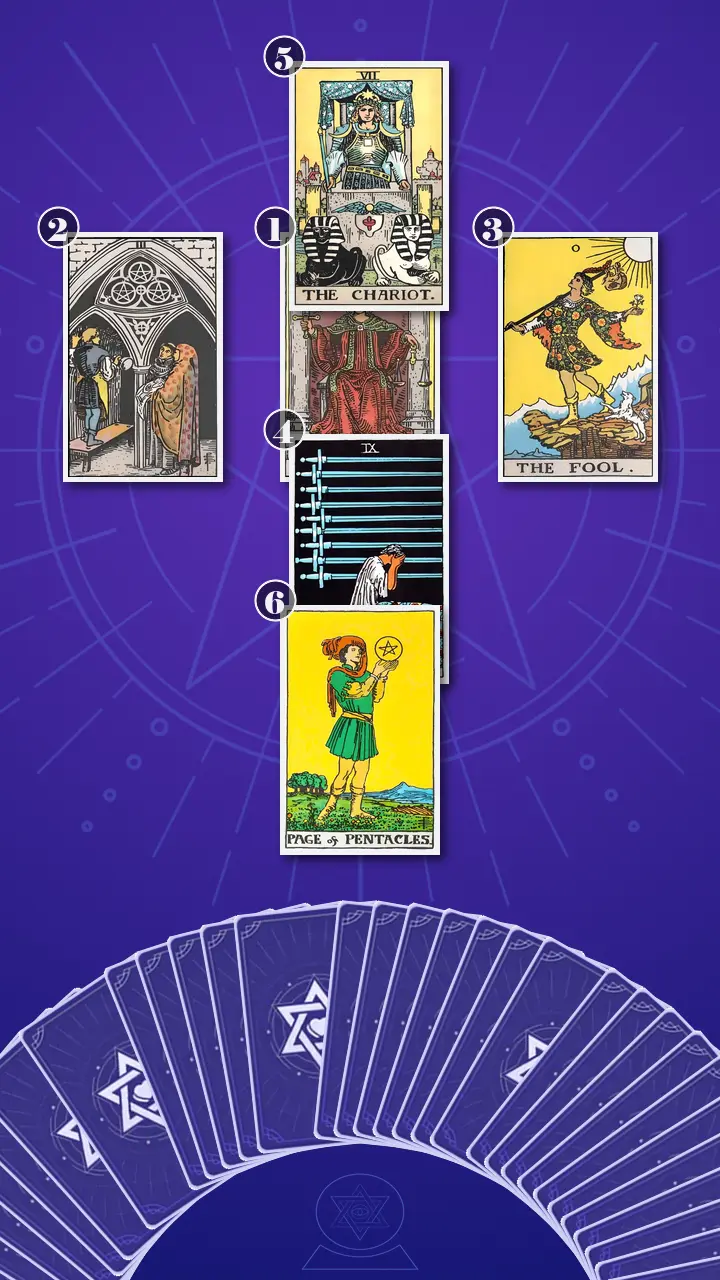
Reading the Map: A Tarot Reading for PIP Anxiety and Decision Paralysis
Position 1: The Objective Reality That Needs Criteria
“Now flipping over,” I said, “is the card that represents the objective reality of the upcoming 1:1/PIP talk—what needs to be clarified in plain terms.”
Justice, upright.
I tapped the scales. “This is the moment where your brain wants to treat the 1:1 like a high-stakes meeting with no PRD. Everyone uses loaded words—‘performance,’ ‘expectations,’ ‘alignment’—but nothing is defined.”
And I used the exact translation that always lands in corporate rooms: “Justice is you pulling up one doc titled ‘Success Criteria,’ and calmly asking: What are the exact metrics? What is the timeline? What does ‘good’ look like in observable behaviors? You’re turning the conversation from vibes into specs.”
In energy terms, Justice here is Balance—but it’s also a corrective to a blocked system. When you’re spiraling, it’s not because you’re “too sensitive.” It’s because ambiguity plus high stakes makes your mind start writing fanfiction. Justice says: gather logs before you guess the root cause.
Taylor let out a small laugh that had no humor in it. “That’s… brutal,” they said. “Because I’m literally building a case file in Notes. Like I’m both prosecutor and defendant.”
I nodded. “Exactly. And Justice is the judge. Not to punish you—just to require plain language. Clarity isn’t begging. Clarity is process.”
Position 4: The Spiral Trigger Underneath the Decision
“Now flipping over,” I said, “is the card that represents the spiral trigger underneath the decision—the fear/belief keeping you stuck and overthinking.”
Nine of Swords, upright.
It was almost too on the nose. “This,” I said softly, “is 3:12 a.m. energy.”
And I described it the way it actually feels: the phone glow painting the ceiling; Slack silence feeling louder than any message; dry mouth; restless legs that can’t settle into the sheets. The mind looping like a notification feed you can’t refresh into certainty: maybe they meant I’m slipping… or maybe HR’s joining… or maybe they’ve already decided…
In energy terms, this is Excess Air—thoughts multiplying faster than facts can support them. It mimics control, but it’s really an attempt to control other people’s perceptions from inside your own skull.
I let the quiet sit for a beat, then said the line I’ve learned people need to hear in this exact moment: “The spiral isn’t proof—you’re just missing information.”
Taylor’s jaw unclenched slightly. Their gaze went unfocused, like they were replaying a week of nights in fast-forward. Then they swallowed, throat bobbing once. “So it’s not intuition,” they murmured. “It’s… missing info wearing a trench coat.”
“Yes,” I said. “And once you see it, we can stop obeying it.”
Position 5: When The Chariot Took the Wheel
“Now flipping over,” I said, “is the card that represents the key shift that restores agency—the mindset and boundary that turns analysis into a plan.”
The room felt different as soon as my fingers touched the edge of the card—like the air got a little still, the way it does right before a subway pulls into the station.
The Chariot, upright.
I looked at the black and white sphinxes. “This is your two pulls,” I said. “Transfer vs job hunt. And the point isn’t to erase one pull before you’re allowed to move. The point is to hold the wheel.”
In Toronto terms, I told them, it’s like choosing a route on the TTC even when there are service alerts. You don’t get perfect conditions. You get direction, boundaries, and a decision date.
Then I felt my own signature lens click into place—the way it does when I’m in my studio looking at a blank canvas. “I want to use what I call my Mondrian Grid Method for this,” I said. “Because right now your life looks like paint thrown at a wall. The Chariot wants clean lines.”
I sketched an invisible grid with my finger on the table: one block for what you can control (questions, timeline, scope), one block for internal mobility (one conversation), one block for external options (a tiny application sprint), and one block for the nervous system rule (no rehearsing past the point of converting it into a question). “A grid doesn’t remove pressure,” I said. “It gives pressure somewhere to live that isn’t your chest.”
Setup: It’s 8:47 p.m. in your condo, laptop open, phone warm in your hand. You bounce between a Notes app “1:1 script,” the internal job board, and LinkedIn—busy for an hour, but nothing actually moves.
Stop treating uncertainty as a verdict, start driving with a clear direction—like The Chariot, you don’t need perfect conditions to take the reins.
Reinforcement: Taylor froze in a very specific way: first their breath paused, like their lungs were waiting for permission; then their eyes widened a fraction, unfixed, as if the last week of doom-scrolling and rewriting was suddenly being re-labeled in their mind; then their shoulders dropped—one long notch down—followed by a shaky exhale that sounded almost annoyed at how much they needed it.
“But if I drive without certainty,” they said, and there was a flash of anger under it, “doesn’t that mean I’ve been doing this wrong? Like… all this prep was pointless?”
I kept my voice steady. “It wasn’t pointless,” I said. “It was protective. Your brain was trying to keep you from being labeled ‘not good enough.’ We’re just upgrading the method. If you can’t get calm first, get specific first.”
I leaned in a little. “Now—use this new lens and look back at last week. Was there a moment when one clear question, sent in two sentences, would’ve changed how your body felt?”
Taylor stared at the table for a second, then nodded once. “Tuesday,” they whispered. “The ‘quick check-in’ invite. If I’d just asked what ‘success’ means for the next two weeks… I wouldn’t have spent the whole night rehearsing.”
That was the shift I was watching for: not from fear to bliss, but from spiraling dread and shame-driven overthinking to bounded agency—the first real step toward steadier self-trust.
Position 2: Path A — Transfer as Systems Fit, Not Moral Failure
“Now flipping over,” I said, “is the card that represents Path A—transferring teams: what it supports, what it costs, and what kind of environment it requires from you.”
Three of Pentacles, upright.
I smiled a little. “This is the ‘craft narrative,’” I said. “Not the shame narrative.”
And I grounded it in Taylor’s real-life scenario: “A transfer isn’t you ‘failing’—it’s you choosing a team where your work is visible in the right way. Picture a quick internal coffee chat where someone describes weekly stakeholder rituals, clear ownership, and a manager who gives feedback in real time instead of surprise check-ins.”
In energy terms, this is Balance leaning toward support: Earth energy that steadies the Air-heavy mind. It says your best work shows up in collaboration structures—clear feedback loops, defined scope, shared ownership—rather than guessing games.
Taylor’s fingers stopped worrying the edge of their sleeve. “So transferring could be… a design problem,” they said, “not a character flaw.”
“Exactly,” I said. “Team fit is a system. Not a verdict.”
Position 3: Path B — Job Hunting as Data, Not Destiny
“Now flipping over,” I said, “is the card that represents Path B—job hunting: what it supports, what it costs, and what kind of momentum it asks from you.”
The Fool, upright.
“This is the part of you that can begin without guarantees,” I said, “and treat the next step as an experiment—not an identity statement.”
I used the modern-life frame exactly as it’s lived: “Job hunting becomes a controlled experiment instead of a panic escape hatch: you make a short list of 10 roles, tailor one resume version, and send 2 applications this week—then you stop. The Fool is you letting the first applications be ‘imperfect reps’ that generate data (responses, recruiter screens, salary ranges), rather than proof you’re hireable/unhireable.”
In energy terms, The Fool is Potential with a risk of excess. It can become impulsive escape if you let panic drive. But paired with The Chariot, it becomes intentional exploration.
Taylor nodded slowly. “Treat interviews like data,” they said, tasting the phrase like it might be edible. “Not destiny.”
“Exactly,” I said. “Curiosity is lighter than dread.”
Position 6: The Grounded Next Step That Calms the Nervous System
“Now flipping over,” I said, “is the card that represents a grounded next step you can take within one week that supports either path while reducing spiraling.”
Page of Pentacles, upright.
“This is your one-hour antidote,” I said. “One coin. One deliverable. One definition of done.”
And I named it in their language: “You block 60 minutes on your calendar and produce one tangible thing: a one-page ‘1:1 Clarity Doc,’ or three resume bullets, or a draft internal transfer message. Then you stop. Page of Pentacles is rebuilding self-trust through finished, measurable actions—less spiraling, more receipts.”
In energy terms, it’s Deficiency turning into steady supply: you’re not trying to flood yourself with motivation. You’re making one small deposit that your brain can’t argue with.
Taylor flinched—tiny, but real. “But I don’t have an hour,” they said quickly. “I’m behind on everything. I can’t even—”
I held up a hand. “Then we do the 20-minute version,” I said. “The point is not the number. The point is proof that ‘done’ exists.”
From Insight to Action: A Two-Track Plan That Replaces Dread with Data
Here’s the story the spread told, cleanly: Justice says the 1:1 needs criteria, not mind-reading. Nine of Swords says your nervous system is filling missing information with worst-case scripts. The Chariot says you regain stability by steering—direction plus boundaries—before you feel calm. Three of Pentacles reframes internal transfer as systems fit and feedback structure. The Fool reframes job hunting as a small experiment. Page of Pentacles lands it in one finishable deliverable.
The cognitive blind spot was subtle but brutal: Taylor kept trying to earn the right to act by rehearsing until they felt certain. But certainty is not a prerequisite here—specificity is. The transformation direction was clear: from “I need certainty before I act” to “I will ask for specifics and set a two-track plan with a deadline.”
I offered Taylor something I use with clients who feel like they’re trapped in an endless performance conversation loop: I call it Oscars Speech Training. Not because your life is a movie—but because you deserve to speak without over-explaining. Two minutes. Clear beats. No apologizing for needing definitions.
- Build the “1:1 Clarity Doc” (Justice receipts)Open one Google Doc titled “Success Criteria.” Add 3 sections: (1) What I understand expectations are, (2) What I’ve delivered (3 bullets max), (3) Three questions: metrics, timeline, support/resources.If you start polishing, cap it at 15 minutes. This doc is for clarity, not for proving your worth.
- Send the agenda-request micro-boundary (The Chariot steering)Send a two-sentence message today: “To prep well, can we cover success criteria + timeline in our 1:1? I’ll bring a one-pager.”If your anxiety spikes, schedule-send it 30 minutes later. No extra context. Two sentences only.
- Run a two-week Two-Track Steering Plan (transfer + job hunt)Put one calendar hold 14 days out titled “Transfer vs Job Hunt—reassess with data.” Before that date, do just three actions: 1 internal informational chat (15–20 min), update 3 resume bullets, submit 2 applications—then stop.Cap it on purpose. Busy isn’t the same as moving. Let data replace dread.

A Week Later: Your Identity Doesn’t Have to Be on the Agenda
A week after our session, Taylor messaged me. Not a paragraph. Just a screenshot: the sent agenda request. Two sentences. No apology. The time stamp was 9:14 a.m., not 3:12 a.m.
They added: “Still scared. But I slept. Woke up and my first thought was ‘what if I’m wrong?’ and… I didn’t spiral. I just wrote the three questions again.”
That’s the quiet proof I care about in a Journey to Clarity: not a miracle outcome, but a new relationship with uncertainty. Your manager gets a meeting. Your identity doesn’t have to be on the agenda.
When a vague 1:1 starts to feel like a verdict on your worth, it makes sense that your chest tightens and your brain tries to rehearse your way into safety—because choosing a direction feels like choosing what kind of “failure” you’ll be judged for.
If you gave yourself a two-week container instead of a forever decision, what’s the first specific question you’d want answered—and what tiny step would you take this week to get that answer?