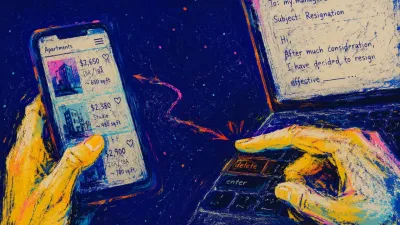
Flagged RTO Email, Half-Written Reply—Then the Tuesday Carry Test

The Sunday-Night RTO Spiral: Status-Versus-Flexibility Career Paralysis
If you keep a remote-job tab open during lunch, then reopen your promotion notes before the 2 p.m. check-in because you do not want to look unserious, you are probably not flaky—you are in RTO anxiety. That was the energy Jordan (name changed for privacy) brought into my session: Sunday Scaries in career form, the kind of status-versus-flexibility career paralysis after an RTO email that looks rational on a screen and feels like an alarm in the body.
When she sat down with me, I could almost see the whole scene she described: 9:17 on a Sunday night, in a downtown Toronto condo kitchen, Google Calendar filled with required office days, the fridge humming, the overhead light too cold, a Slack preview flashing on her phone. She told herself she was just organizing the week, but her shoulders were already climbing toward her ears and her stomach was dropping like an elevator that forgot to stop.
“I do not want to throw away a promotion just because I am tired of commuting,” she said. Then, after a beat: “I want a career I can actually live inside, not just explain on LinkedIn.”
I had already heard the knot. She was bouncing between drafting a reply to the RTO notice, updating remote job filters, and reopening her promotion notes without committing to a single next step. It was like having nineteen browser tabs open for the same flight and still not booking because certainty mattered more than movement.
I leaned in and kept my voice soft. I told her I was not there to shame her ambition or romanticize remote work. I was there to help her hear the signal underneath the noise. “Let’s draw a map for the fog,” I said. “Clarity usually arrives when the pressure stops pretending to be data.”
Choosing the Compass: A Decision Cross for a Promotion vs Remote Role
I asked Jordan to put both feet on the floor and take one slower breath before we started. While I shuffled, I had her hold the question in plain language: stay for the promotion, or find a remote role that fits the life she actually wants.
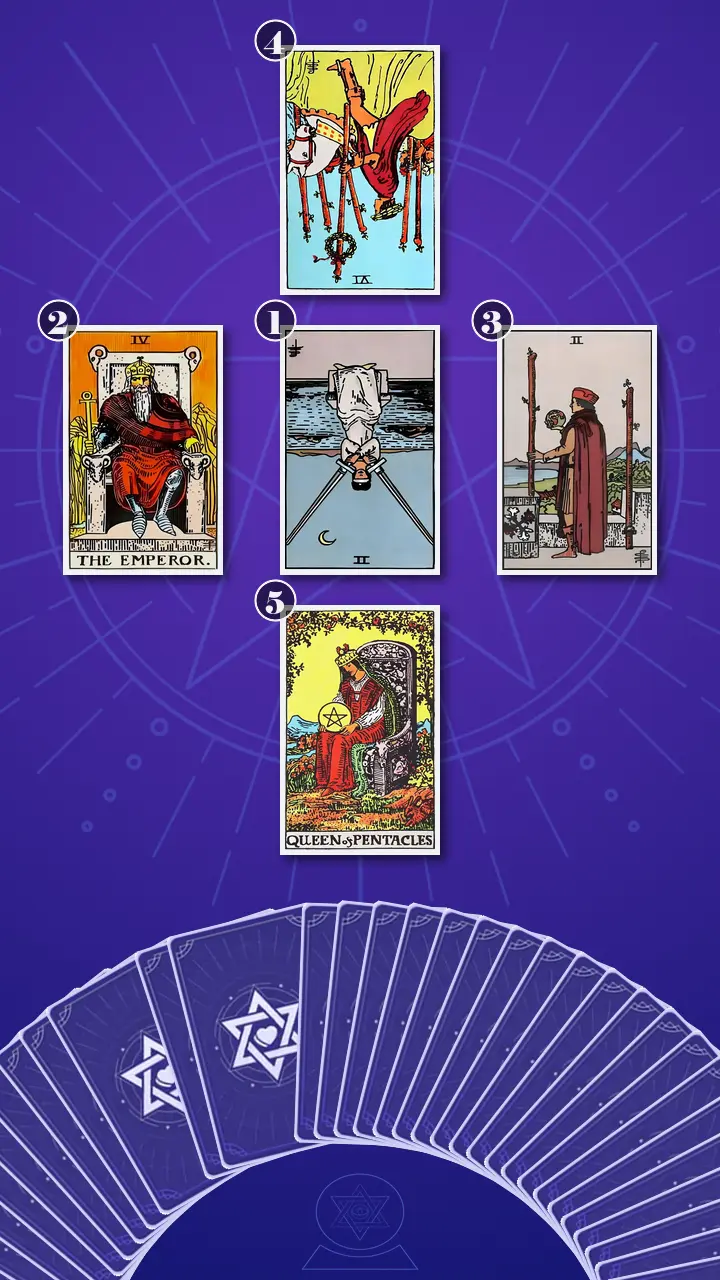
For this reading, I used my Decision Cross · Context Edition tarot spread for a promotion-versus-remote work decision, a lean five-card career choice spread I reach for when two options are clear but the stress around them is not. This is how tarot works best in a career crossroads like this: not as a command from the sky, but as a structure that separates the practical choice from the self-worth story wrapped around it.
The center card would show the decision knot itself. The card on the left would show what staying really offered—and what it demanded. The card on the right would show what the remote path opened—and what it required in return. The card above would expose the hidden pressure shaping the whole dilemma. The card below would give us the grounding criterion, the one that could turn a stay-or-go work choice into something livable instead of theatrical.
Reading the Map: Where the Pressure Actually Lives
Tarot only becomes useful when card meanings are read in context, and Jordan’s context was painfully specific.
The Draft That Never Sends
Now I turned over the card representing the concrete decision knot triggered by the RTO email and the observable stop-start behavior keeping Jordan stuck. It was the Two of Swords, reversed.
In a classic deck, this card shows a blindfolded figure with crossed swords over the chest and water moving behind her. In Jordan’s life, I did not need medieval imagery to translate it. I could already see her back at her desk after a rushed lunch in the PATH, laptop warm against her wrists, office air dry, flipping between a flagged RTO email, a half-written reply, LinkedIn remote filters, and a note called ‘Stay vs Remote’ in Apple Notes. She kept telling herself she was being objective. But the choice was already live. More tabs were not bringing more clarity; they were delaying the exposed feeling of choosing.
Because the card was reversed, I read the energy as blockage finally leaking. The false neutrality was gone. Her mind was still trying to act like a spreadsheet, but her body had crossed into pressure—shallow breathing, a tight jaw, locked shoulders, that sharp internal drop every time a work message landed.
“A decision does not get clearer just because you made it more complicated,” I told her. “This card asks a brutal question: what information is actually missing, and what discomfort are you calling research because choosing feels too personal?”
Jordan let out a short laugh that had a little grit in it. “Okay,” she said, rubbing the edge of her mug with her thumb, “that’s accurate enough to be rude.” I smiled. “Good,” I said. “Rude and useful can coexist.”
The Ladder With an Energy Tax
Next, I turned over the card representing what staying for the promotion genuinely offered Jordan and what that path required in visibility, structure, and compliance. The Emperor, upright.
I told her this was the stay path in clean, recognizable form: hierarchy, authority, a stronger title, more in-room influence, clearer internal status. This is the route with the best LinkedIn headline because the system already knows how to reward it. The stone throne and visible armor in the card matched the truth of her company culture perfectly—there was real opportunity here, but also real guardedness.
Upright, The Emperor was not a bad card. Its energy was structured, not toxic. But structure always has a price. In Jordan’s case, the price looked like commute days, face time, compliance with leadership norms, and the quiet pressure to prove seriousness by being seen. This path could absolutely build her career. It could also quietly charge her an energy tax every single week.
When I asked how that landed, I saw her chin lift just slightly. Part of her relaxed at the thought of a path she could explain in one sentence. That mattered, so I named it. “There is nothing wrong with wanting a clear ladder,” I said. “The question is whether the ladder is taking you somewhere you actually want to live.”
The Horizon That Asked for Authorship
Then I turned over the card representing what pursuing a remote role opened for Jordan and what that path asked in initiative, uncertainty, and self-direction. It was the Two of Wands, upright.
The energy in the room changed immediately. The card’s whole posture is different from the Two of Swords. Instead of crossed blades and protected stillness, here is someone looking outward, globe in hand, horizon open. In Jordan’s life, this was not an escape hatch. It was the point where the question stopped being ‘Which option sounds safer forever?’ and became ‘What kind of week, city life, and career range do I want to build over the next six to twelve months?’
Upright, I read this as active but not reckless fire—directional energy. A remote move would widen her field: more companies, more control over her schedule, more authorship over what success meant. But it would also ask for more self-direction. Fewer baked-in signals of approval. More responsibility to define her own standard instead of borrowing one from the office.
That was the catalyst in the spread. The same decision energy that had become paralysis in the Two of Swords became possibility here. Not certainty—authorship. Jordan’s whole face softened by a degree. It was small, but I noticed it. The doom drained just enough for curiosity to get a turn.
The Imagined LinkedIn Audience
Then I lifted the card above the center—the hidden influence shaping everything underneath. It was the Six of Wands, reversed.
I did not have to stretch for the translation. I could see the scene she had already lived: 8:11 on Line 1, someone’s wet coat pressed against her sleeve, the car smelling like stale coffee, her phone lighting up with a former coworker’s promotion post. Her stomach drops before the thought even finishes: ‘If I leave now, will it look like I couldn’t cut it?’ That is this card in modern clothes. Not just a career choice, but a little Black Mirror version of it, where the internalized audience matters so much that the score starts to feel more real than the day itself.
Reversed, the Six of Wands becomes distorted fire: recognition anxiety, comparison loops, applause metrics mistaken for fit metrics. I told her, “You are not bad at deciding. You are deciding under an audience.” Then I added the line I felt she needed most: “Visibility is not the same as fit.”
For a second, she went very still. First her breath paused. Then her gaze slid off the cards and unfocused, as if some private replay had started behind her eyes. Then she exhaled through her nose and pressed her palm flat against her thigh, grounding herself back into the chair. “That’s it,” she said. “I keep turning this into a PR statement in my own head.”
Working in radio taught me a version of this years ago: when the crowd noise is pushed too far up in the mix, you stop hearing the singer. Looking at that reversed Six, I knew her real problem was not lack of intelligence. It was signal contamination. Manager. Peers. Recruiters. Old coworkers. An imagined comments section had gotten louder than her actual needs.
When the Queen of Pentacles Took the Mic
The Garden Below the Noise
When I turned over the last card—the one offering the decision criterion that could ground the whole reading—the room seemed to go quieter around us. Even the city noise beyond my window thinned out into a low hush. The card was the Queen of Pentacles, upright.
This was the bridge card, the one I had been waiting for. On paper, the dilemma looked like ambition versus comfort. In practice, this Queen said something far more adult: judge both paths by an ordinary Tuesday. Groceries. Bills. Dinner. Recovery time. A workout you might or might not do. Enough focus to do strong work, and enough life left afterward to still feel like yourself.
This is where I brought in one of my own tools, something I call the Melodic Mirror. I asked Jordan to hear each option as a playlist. The promotion path sounded like an anthem with a huge chorus—clean beat, obvious payoff, very easy to post about. But its tempo was fast enough that her body never really unclenched. The Queen of Pentacles asked for a different song entirely: one she could cook to, pay bills to, answer one last Slack to, and still breathe inside. As a music therapist and radio host, I have learned that the loudest track is not the healthiest one. The better question is always: can your nervous system keep time with this?
I looked back at her. “You are not choosing your worth,” I said. “You are choosing a work setup.”
She was back in that Sunday-night kitchen in her own mind—I could see it. Calendar open. Office days stacked together. Slack buzzing. Trying to solve her whole future before bed while her body was already acting like the decision had become personal.
Not every shiny crown is worth the cost; choose the garden you can truly tend, and let your success grow there.
She did not melt into instant relief. First her fingers froze around the mug. Then her mouth tightened, not with disagreement exactly, but with the sting of recognition. “But that sounds so… unglamorous,” she said, and there was a flash of anger under it. “Like if I choose based on groceries and energy and whether I can make dinner, I’m making myself smaller.”
I shook my head. “No,” I said. “It means your actual life gets a vote. Ambition that only works in screenshots is expensive. Sustainable ambition is not smaller. It is just harder to fake.”
Something shifted visibly then. Her eyes glassed for a second, not quite tears, more the blur that comes when the nervous system finally stops bracing. Her shoulders dropped a full inch. She took a deeper breath, then another, like she had just put down a box she had been pretending was light. There was relief in it, but also that slightly dizzy feeling that comes after a long clench—the odd vulnerability of realizing the path might be clearer than the panic wanted it to be. I let the silence hold for a beat, then asked, “With this lens, think back over last week. Was there a moment this would have changed the feeling?”
She nodded almost immediately. “Thursday,” she said. “I got home after an office day, dropped my tote by the door, stared at groceries I was too tired to cook, and still opened my laptop again. That was the moment. I wasn’t asking what worked. I was asking what looked serious.”
That was the real crossing point of the reading: from comparison-driven decision panic to grounded self-trust about a sustainable career setup. Not a final answer yet, but the first honest move from imagined audience to lived fit.
From Insight to Action: The Tuesday Carry Test
By the time I laid the whole spread together, the story was clean. The RTO email had triggered the center knot, but it was not the whole problem. The Emperor showed a real promotion path with real rewards. The Two of Wands showed that a remote role was not avoidance but authorship. The Six of Wands reversed showed the actual distortion: Jordan had started measuring the choice from the crowd’s point of view instead of from her own daily life. And the Queen of Pentacles pulled the center of gravity lower, into the body, the calendar, the budget, the workweek itself.
I also pointed out something subtle in the spread’s energy: blocked air, a lot of fire, and finally earth—but almost no open water. She had been talking like a strategist while feeling like a flooded nervous system. That was her cognitive blind spot. She had been treating a work-setup decision like a referendum on identity. Once that happens, every comparison chart gets smarter while the person using it feels worse. The transformation direction was just as clear: shift from chasing the most impressive-looking option to testing which setup supports strong performance, recovery time, and self-respect.
So I gave her a fit-over-optics filter—practical, small, and impossible to confuse with fantasy.
- Non-Negotiables Scorecard Block one 30-minute slot in your calendar this week, put your phone on Do Not Disturb, and write your top three non-negotiables in plain language: max commute days, deep-focus time, and enough energy to see people after work. Then score the stay path and the remote path from 1 to 5 against those three criteria only. When your mind says this is too simplistic for a serious career decision, that is the old loop talking. I had Jordan use my Emotional BPM rule here: one low-tempo instrumental track, one timer, no extra tabs until the music ends.
- Status-Language Swap For one workweek, keep a note on your phone called ‘Status vs Fit.’ Every time you catch a thought like ‘Will this look bad?’ translate it into one concrete metric: commute load, focus quality, recovery time, pay stability, or manager support. Keep it private. You are collecting usable data, not confessing weakness. If a full week feels annoying, do two office days and one quieter day instead.
- Two-Conversation Clarity Check Send exactly two short messages: one to your manager asking what measurable promotion readiness would look like over the next three to six months, and one to a trusted remote contact asking what tradeoffs are actually real in their role. After each conversation, write down one fact you learned and one assumption it replaced. One question per message. Draft it in Notes if you need to, then send within ten minutes. Direct information lowers anxiety faster than private speculation.
That is exactly why I use this Decision Cross · Context Edition reading when someone asks me how to decide between office and remote work. It turns career comparison fatigue into usable data.
I told her to keep one sentence in front of her all week: pick the success your Tuesday can actually carry.
A Week Later: The Quiet Proof
A week later, Jordan sent me a message at 7:42 on a Tuesday evening. Not a life overhaul. Not a dramatic resignation. Just this: she had booked the Decision Lab, sent the manager question, and learned that promotion readiness was far less mystical than she had made it in her head. She had also asked a remote contact about their day-to-day tradeoffs and, for the first time, felt like she was comparing realities instead of headlines.
She told me the decision was not fully finished, but the panic had changed shape. The night before, she had slept a full eight hours. In the morning, her first thought was still, ‘What if I get this wrong?’—and then, she said, she laughed, made coffee, and opened her notes without that old stomach drop.
That is what this kind of journey to clarity usually looks like in my practice. Not fireworks. More often it is a quiet return to your own signal: from prestige panic to grounded self-trust, from the imagined audience to the life you actually have to live inside.
When every option starts sounding like a verdict on who you are, even one work email can make your chest go tight, because it stops feeling like a schedule question and starts feeling like a worth question.
So if your own career crossroads has gotten loud with Slack pings, LinkedIn headlines, and other people’s applause, what would your next ordinary Tuesday need in order for your ambition to feel like your own song—and sustainable enough to keep saying yes to?