From Anxious Slack-Checking to Steadier Pride: Rewriting the 'Good Kid' Loop

The 8:47 p.m. Slack Scroll
If you’ve ever rewritten a Slack message three times, hit send, and then checked for an emoji reaction like it’s a mini performance review—hi, yes, the “good kid” sticker chart is still running in the background.
Taylor (name changed for privacy) sat across from me in my small studio space, their shoulders lifted like coat hangers. They told me they’d found an actual childhood “good kid” chart while cleaning—smiley faces, gold stars, neat columns—and it was funny for about ten seconds. Then it wasn’t.
They described Tuesday night in their Toronto condo: TV on, Netflix dialogue leaking into the room like static, but they weren’t watching. Their phone stayed warm in their palm, Slack open, that harsh blue light turning the whole living room into a confession booth. They’d sent a message to their manager, put the phone face-down like a brave adult, and then—ninety seconds later—flipped it back over. Their jaw had gone tight. Their stomach had done that drop, like a sudden elevator lurch.
“I don’t even want applause,” they said, voice flat the way people get when they’re trying not to sound needy. “I just want to feel safe. If no one reacts, I assume I messed up.”
I heard the core contradiction underneath every sentence: craving to feel self-directed and internally proud, versus fearing that without constant approval they’d become not enough.
Their anxiety didn’t look like a dramatic spiral; it looked like a body braced for impact—tight shoulders, a buzzing urge to fix it immediately, and a quiet shame that they were still waiting for a gold star at twenty-nine. It was like carrying an invisible sticker chart into adult life, and every task came with a hidden question: Am I still good?
I leaned in, gentle on purpose. “We’re not here to judge you for the loop,” I said. “We’re here to see it clearly. Let’s try to draw a map through the fog—so ‘done’ can mean done again. When did ‘done’ start meaning ‘approved’?”

Choosing the Compass: The Four-Layer Insight Ladder
I asked Taylor to take one slow breath—not as a ritual for the universe, but as a handoff for their nervous system. “Just let your body know we’re switching modes,” I said, and began to shuffle.
“Today I’m using a spread I call the Four-Layer Insight Ladder · Context Edition,” I told them. “It’s six cards in a straight line. We read it like walking down stairs: surface behavior, triggers, inherited rulebook, core fear—then we flip the breaker with the transformation key, and we end with one concrete practice for the next week.”
To you, the reader: this structure works for an adult ‘good kid’ approval loop because it doesn’t predict outcomes or outsource your choices to the cards. It tracks a chain: what you do (refreshing, over-editing), what activates it (reviews, vague pings), what belief system runs it (the internal rulebook), what it’s protecting (belonging), and what to build instead (self-trust with practical next steps).
“The fifth card is the turning point,” I added. “That’s where we stop diagnosing and start rebuilding.”
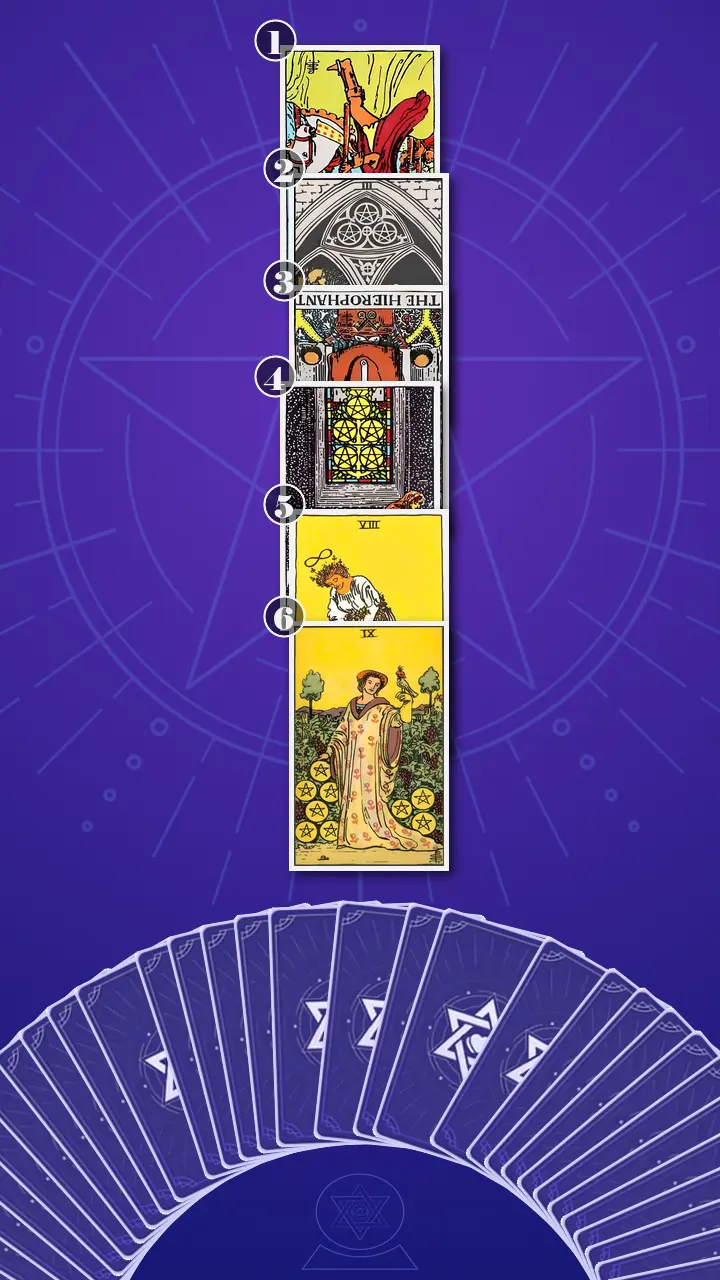
Reading the Ladder: From Crowd to Rulebook
Position 1 — The loop running your day-to-day
“Now we’re turning over the card that represents the current approval loop in daily adult life—what it looks like behaviorally right now.”
Six of Wands, reversed.
I tapped the laurel wreath and the implied crowd. “This is the gold-star reflex in grown-up clothing,” I said. “You finish something solid, but instead of feeling done, you hover—refreshing Slack, rereading the thread, scanning for a 👍 from the one person whose opinion feels like it counts. If there’s silence, your brain rewrites the story into: ‘It wasn’t good.’ And your body goes straight into fix-it mode.”
I made it uncomfortably specific, because specificity is kindness here: “Slack message sent → phone face-down → ninety seconds later, screen back on. Inner monologue: If nobody reacts, it means I misread the room. Finished and approved are not the same thing.”
Taylor let out a tight, almost laughing sound—more wince than humor. “That’s… brutal,” they said. Then a small exhale, like their ribs finally moved.
“Brutal, but fixable,” I replied. “Reversed doesn’t mean you’re failing. It means your confidence is being held hostage by an audience that isn’t always there.”
Position 2 — What triggers the gold-star reflex
“Now we’re turning over the card that represents the situations and cues that activate the loop—where you most seek ‘gold stars’ today.”
Three of Pentacles, upright.
“This is evaluation and being witnessed,” I said, picturing their calendar packed with meetings. “Any time your work is being reviewed—stakeholder decks, comments in a doc, performance review season—you treat every note like it’s grading you as a person. So you over-prepare, over-explain, and try to anticipate every critique before it arrives.”
“That’s exactly when I start performing competence,” Taylor said, eyes on the card. “Like I’m in a meeting, but also on trial.”
I nodded. “This card isn’t saying feedback is bad. It’s showing you where your nervous system confuses learning with verdict.”
Position 3 — The inherited ‘good kid’ rulebook
“Now we’re turning over the card that represents the inherited rulebook from the ‘good kid’ identity—what internal authority you’re still obeying.”
The Hierophant, reversed.
“This is the internal policy doc you never consciously agreed to,” I said. “It reads: Be agreeable. Be flawless. Don’t be a problem. And in a modern office, it turns into apologizing for normal questions, saying yes too fast, and feeling guilty for boundaries—like workplace norms and a manager’s mood are moral law.”
Taylor went still, then nodded once, slow. Their mouth pressed into a line like they were watching an old memory replay. “I literally feel like I’m going to get in trouble,” they admitted. “Even when nothing happened.”
My mind flashed to my early years training intuition for cruise staff—watching people respond to authority the way bodies respond to weather. On rough seas, you don’t argue with the waves; you learn what steadies you. “Your inner rulebook isn’t the law anymore,” I said quietly. “But it still sounds official. That’s why it keeps winning.”
Position 4 — The fear underneath the behavior
“Now we’re turning over the card that represents the deeper fear the loop is protecting—what feels at stake if you don’t perform for approval.”
Five of Pentacles, upright.
“Here’s the warm window versus the cold sidewalk,” I said, and kept my voice steady. “When feedback is delayed or neutral, a deeper fear shows up: ‘I’m about to be quietly sidelined.’ It’s not just about the work—it’s about belonging. Some part of you believes usefulness is your ticket inside.”
Taylor swallowed hard. Their gaze lifted off the card and landed somewhere beyond my shoulder, like they were staring at an empty meeting invite list. “If I’m not useful, I’m not safe here,” they said, almost to themselves.
I let the silence sit on purpose. “Silence isn’t a grade,” I said. “It’s just space. But I understand why your body doesn’t believe that yet.”
When Strength Held the Lion, Not the Crowd
I took a beat before turning the next card. The room felt quieter—like the city noise outside had stepped back a half-inch. “We’re flipping the turning point now,” I said. “The card that shows what breaks the cycle.”
Position 5 — The psychological shift that resets the system
“Now we’re turning over the card that represents the key psychological shift that breaks the cycle—what to build instead of chasing validation.”
Strength, upright.
“Strength isn’t ‘be confident.’ It’s ‘hold the alarm.’ It’s the gentle hand on the lion—your jaw, your shoulders, the stomach drop—without feeding it by doom-refreshing or over-performing,” I said. “You don’t break an approval loop by earning bigger stars. You break it by soothing the part of you that equates silence with danger.”
In Venice, we have an old habit of reading ourselves in reflections—canal water, shop windows, polished stone after rain. I offered Taylor my version of that, my Water Mirror Dialogue: “When the urge to refresh rises, treat it like a reflection, not a command. ‘There’s my gold-star alarm. I see you.’ Then choose one calm action you control before you check for a reaction.”
They nodded, but I could feel them still caught in the micro-moment they’d described—sent, waiting, braced.
Setup. Taylor’s mind was stuck in that narrow corridor between “sent” and “reacted,” where quiet feels louder than it should. In that corridor, the old rulebook starts grading in real time: If I relax, I’ll miss something. If I don’t get a clear win, I’m slipping.
Delivery.
Not “tame yourself to be lovable,” but “tame the inner alarm with gentle strength,” like calmly holding the lion instead of chasing the crowd’s wreath.
I let it hang for a breath.
Reinforcement. Taylor’s reaction came in a chain. First, a tiny freeze—breath caught, fingers tightening around their water glass. Then I saw it: their eyes went unfocused for a second, like they were replaying a hundred Slack threads and “quick chat?” invites at once. Finally, their shoulders dropped a fraction, and their jaw loosened as if they’d just noticed they’d been clenching for years.
“But if I stop chasing it,” they said, voice sharper with sudden fear, “doesn’t that mean I’ve been doing it wrong this whole time?”
I met that without flinching. “It means you found a strategy that once kept you safe,” I said. “And now you’re outgrowing it. That’s not failure—that’s development.”
“Okay,” they whispered, and then, softer: “I can wait. I can decide my next step without a reaction.”
I asked the question that turns insight into something lived: “Now, with this new lens—think back to last week. Was there a moment where silence hit and you sprinted for proof, when this would’ve let you feel different?”
Taylor blinked, once, slow. “Thursday,” they said. “I sent the deck. No comments for two hours. I started rewriting slide titles in my head like I could time-travel into a safer version of myself.” A pause. “I could’ve… just gone for a walk. And waited.”
That was the authority transfer beginning—the shift from anxious scorekeeping to grounded calm. Not perfect calm. But the first real inch of self-sourced pride that can handle silence.
Position 6 — The practice that makes it stick this week
“Now we’re turning over the card that represents a concrete next-step practice to self-reward and stabilize change over the next week.”
Nine of Pentacles, upright.
“This is private mastery,” I said, picturing the walled garden and the trained falcon. “It’s building a reward system that pays you in calm before the internet pays you in likes. A private scorecard you control. Feedback still matters—but it becomes information, not a verdict.”
Taylor’s face softened in a way that looked almost practical. “That feels… doable,” they said. “Like, I can make it a routine instead of a drama.”
From Insight to Action: The Quiet Pride Protocol
I stitched the whole ladder into one story, so Taylor could feel the logic rather than just the emotion: the Six of Wands reversed showed the present pattern—finished doesn’t register as finished without public signals. The Three of Pentacles showed the trigger zone—any watched moment turns into a personal grading event. The Hierophant reversed named the engine—an inherited ‘good kid’ rulebook pretending to be law. The Five of Pentacles revealed the stake—fear of exclusion, the belief that usefulness equals safety. Strength moved authority inward—regulating the inner alarm. And Nine of Pentacles turned that into embodiment—self-defined standards and private completion markers.
“Your cognitive blind spot,” I told Taylor, “is that you keep treating external feedback like it’s the only reliable evidence. But that keeps your nervous system on standby. The transformation direction is simple, not easy: shifting from earning safety through approval to building safety through self-trust and consistent self-defined standards. Let feedback be information, not a verdict.”
Then I gave them experiments—small enough to start even on a packed calendar.
- Done List Before DashboardFor one deliverable each workday, open Notes before you check Slack/email. Write: (1) what you shipped, (2) what standard you met, (3) what you learned.Keep it private. If it feels “cringe,” make it one sentence. No making up missed days with extra effort—just restart.
- The 90% Ship ExperimentPick one daily task (an email, a slide, a short doc) and ship it at 90%, not 110%. After you send it, write your predicted worst-case outcome vs what actually happened.You’re not lowering your standards; you’re testing whether adulthood can hold imperfection without punishment.
- A Bounded Feedback Ask (no panic-refreshing)Replace one reassurance-seeking ping with one clear, time-bounded ask: “When you have a moment tomorrow, could you confirm the direction on slide 4? That’s the only piece I’m waiting on.”This is the boundary version of seeking feedback—direct and contained. If your body wants to apologize, pause and send it anyway.
To make it even more concrete, I used my Bollard Marking Method—the way Venetian docks teach boundaries. “Pick a ‘piling’ in your day,” I said. “A marker that means: after I ship, I do not check for six minutes. That’s not avoidance. That’s Strength training.”

A Week Later: Ownership, Not Applause
A week later, Taylor messaged me a screenshot—just their Notes app. Three lines. No dramatic caption. “Did the Done List before checking Slack,” they wrote. “Felt weird. Then… kind of quiet.” They added, almost embarrassed: “I still checked. But I didn’t check immediately.”
That’s the kind of proof I trust: not a new personality, just a new hinge. In our Journey to Clarity, the win wasn’t eliminating the urge. It was not obeying it on autopilot—building steadier self-trust that can hold silence without turning it into a threat.
When nobody reacts, it can feel like the floor drops out—like you’re back on an invisible sticker chart, waiting to find out whether you’re still “good” enough to belong.
If you let “done” be true for you—just once this week—what would be the smallest sign of self-trust you’d be willing to try before anyone else weighs in?