The Splitwise Notification That Hit Like a Gavel—And the Tab Switch

Finding Clarity in the Splitwise Notification That Hits Like a Gavel
If a Splitwise request can turn a totally normal hangout into instant Sunday Scaries-level dread, you’re not being dramatic—you’re catching a specific money-shame panic loop.
Jordan (name changed for privacy) slid into the chair across from me in my little Italian café off College Street, still wearing that post-commute stiffness—shoulders creeping up like they were trying to hide their ears. Outside, the streetcar bell kept chiming; inside, the espresso machine sighed and clicked like it was keeping time.
They told me it started at 8:47 PM on Line 1 heading north: fluorescent buzz, stop announcements dissolving into white noise, phone warming their palm. A Splitwise notification lit up—nothing dramatic, just a number. And yet their body reacted like someone had yanked a trapdoor open: stomach dropping, chest tightening, fingers going cold.
“I do the loop,” they said, voice flat like they’d already tried to talk themselves out of it. “Splitwise. Banking app. Notes. Draft a message. Delete. Close everything. And then I feel… gross.”
Wanting to be seen as fair and dependable vs fearing that owing money will expose you as unsafe, burdensome, or not in control—that contradiction can make a tiny notification feel like a courtroom you didn’t consent to. Panic isn’t loud for everyone; sometimes it’s quiet, meticulous, and repetitive—like refreshing your balance the way you refresh a feed, hoping the next reload will finally make you feel safe.
I set down a small glass of water—cold enough to be real, not performative. “We’re not here to make you ‘good with money’ overnight,” I said. “We’re here to figure out what story gets activated, and how to give you a fair, simple next step. A Journey to Clarity—so money admin becomes logistics, not a personality test.”

Choosing the Compass: The Four-Layer Insight Ladder
I asked Jordan to take one slow inhale, one slow exhale—nothing mystical, just a nervous-system handoff from “brace for impact” to “let’s look at facts.” While the café hummed—milk steaming, a spoon tapping ceramic—I shuffled with the kind of steady rhythm you only get after doing something every day for years.
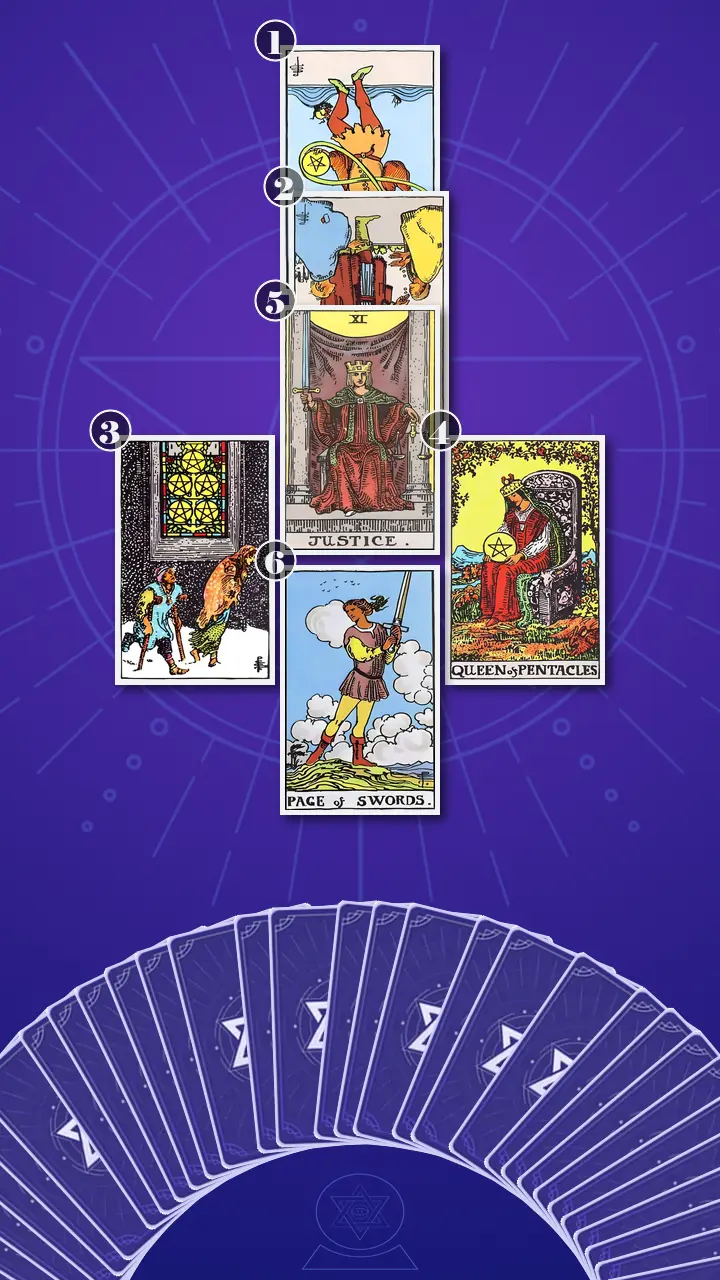
Today I used a spread called the Four-Layer Insight Ladder · Context Edition. I like it for moments like this because it’s not trying to predict the future. It’s designed for decoding a trigger—especially when someone asks, “What past money story is this?”
For you reading along (and maybe Googling something like why does a Splitwise request make me panic), this is also a clean way to see how tarot works in context: we start with the visible reaction, drop into the hidden driver, trace the origin story, find the stabilizing inner resource, then pivot into one reframe and one concrete action. Minimal cards, maximum signal.
In this spread, the first card shows the immediate Splitwise reaction loop. The second captures the relationship-power charge—how apps can turn “owe” into “being watched.” The fifth is the key reframe: how to separate facts from shame and restore fairness-based clarity.
Reading the Map: From the App Loop to the Old Weather
Position 1: The immediate, observable reaction
“Now turning over,” I said, “is the card that represents the immediate, observable reaction—what you do and feel right after the Splitwise request hits.”
Two of Pentacles, reversed.
The image is a person trying to juggle two coins wrapped in an infinity loop. The symbolism is almost too on-the-nose for modern life: the infinity loop becomes the “app loop.”
“You’re on the TTC,” I said, “thumb bouncing between Splitwise and your banking app like you’re juggling two tabs in your brain. You keep re-checking, not because the math is hard, but because you’re trying to find a version of reality where you don’t feel exposed—then you close the apps without paying or replying.”
Reversed, this card isn’t ‘bad’—it’s overload. The energy is blocked earth: practical stuff that should be manageable becomes emotionally unfinished. The number can be correct and your body still won’t let you hit ‘pay.’ That’s the freeze response wearing a spreadsheet costume.
Jordan let out a quick laugh that wasn’t really humor. More like recognition with teeth. “Yep,” they said. “It’s… brutal seeing it that clearly.” Their fingers rubbed the edge of their phone case like they were trying to sand the feeling down.
In my head, I thought about espresso extraction: too short and it’s sour; too long and it’s bitter. Social panic does the same thing—when you keep “extracting” reassurance by checking again and again, you don’t get clarity. You get bitterness.
Position 2: The relational charge underneath it
“Now turning over,” I said, “is the card that represents the relational charge—what this request symbolizes about reciprocity, fairness, and being perceived.”
Six of Pentacles, reversed.
In the card, coins are being handed down while scales hover nearby. In real life, this can feel like Splitwise becomes a scoreboard when you’re already sensitive to being ‘the burden.’
“The request feels less like ‘please send $24’ and more like ‘we’re all watching who handles money like an adult,’” I said. “You want to be fair, but it triggers that prickly mix—guilt and resentment. Paying late feels like being ‘that person.’ Paying instantly feels like proving something.”
Reversed, the energy shows a perceived imbalance: not necessarily that anyone is actually unfair, but that your nervous system reads the interaction as power + evaluation. “Stop mind-reading your friends through an app,” I said gently. “The app tracks transactions, not your worth.”
Jordan nodded once, fast—like they were agreeing before they could argue. Then they swallowed. Their jaw tightened, released, tightened again.
Position 3: The past money story being activated
“Now turning over,” I said, “is the card that represents the past money story—the older scarcity or shame imprint this moment is activating.”
Five of Pentacles, upright.
Snow. A lit window. Two figures outside, moving like they’re trying not to take up space. This card doesn’t whisper; it radiates that sensation of being just slightly behind the glass, close enough to see warmth but not close enough to claim it.
“A small bill triggers a much older feeling,” I said. “Being the one who can’t keep pace. Who might be quietly excluded. Your body reacts like you’re about to be left out of the warm circle—even if your friends are actually reasonable—so you brace, hide, and try to handle it alone.”
Jordan went still in a way I recognized: breath paused, eyes unfocusing like they were replaying a clip. Then their shoulders sagged a millimeter, like gravity finally got permission. “I hate that this is true,” they said, quieter. “It feels… embarrassing.”
“Embarrassing doesn’t mean inaccurate,” I replied. “It usually means it’s old.”
The café door opened and a gust of cold air rolled in—Toronto spring pretending it was still winter. It fit the card too perfectly. Environment as co-conspirator.
Position 4: The stabilizing inner resource
“Now turning over,” I said, “is the card that represents the stabilizing inner resource—the part of you that can hold money with care and self-respect.”
Queen of Pentacles, upright.
She sits steady. Not flashy. Not apologetic. The pentacle is held like something valuable, not like evidence in a trial.
“Before you reply,” I said, “you make it physical and kind. Sit at the table. Drink water. Let your shoulders drop. Look at your budget once like it’s care, not punishment. From that steadier place, you pick a plan that protects your wellbeing—including timing—instead of trying to look effortlessly chill.”
This is balance returning to earth. Less braced body, more resourced body. The Queen isn’t here to impress your friends; she’s here to keep you housed, fed, and dignified.
Jordan’s face softened. They stared at the Queen for a long second, then gave a small exhale like they’d been holding air hostage. “I can do that,” they said. “The table thing. Not… in bed at midnight with my phone in my face.”
When Justice Spoke: Closing the Shame Tab
Position 5: The key reframe that breaks the loop
I slowed down before flipping the next card. The café noise faded into a kind of hush—still there, but farther away, like someone turned the volume knob down.
“Now turning over,” I said, “is the card that represents the key reframe that breaks the loop—how to separate facts from shame and restore fairness-based clarity.”
Justice, upright.
Here’s what I see every time Justice appears in a money-and-relationships question: the invitation to stop treating an amount like a moral evaluation. The scales are Splitwise at its best—neutral accounting. The sword is the message that ends the spiral.
Jordan was still living in that TTC moment where their brain turned a $24.60 request into a full character review. Their mind wanted certainty, like if they could just pick the perfect words, nobody could judge them. But that’s the trap: you can’t write a text that makes you un-judgeable. You can only write a text that is fair.
You don’t need a perfect excuse; you need a fair plan—let the scales of Justice hold the truth so you can put down the shame.
Jordan’s reaction came in three waves. First: a freeze—eyes widening, breath catching like they’d been startled. Second: the “tab switch”—their gaze drifted away from the card and went somewhere inside their own memory, like they were closing a ‘Shame Story’ window that had been running in the background for years. Third: a release—chin trembling slightly, then a long exhale that seemed to loosen their collarbone and unhook their shoulders from their ears.
“But if I’m not explaining…,” they started, and their voice sharpened with a flash of defensiveness, almost anger. “Doesn’t that make me seem cold? Or like I don’t care?”
I kept my tone even. “This is the part where your brain confuses clarity with cruelty. Justice isn’t cold. It’s clean. It’s respectful.” I tapped the scales lightly. “Fairness is facts + timing. Shame is guessing what the facts mean about you.”
Then I asked, “With this new lens—facts, not verdict—was there a moment last week when you felt the stomach-drop and you could’ve responded differently if you believed you were allowed to structure the conversation?”
Jordan blinked, fast. “Yeah,” they said. “Saturday. After dinner. I wanted to say, ‘I can pay Friday,’ but I started writing a whole backstory. Like I was submitting evidence.”
That was the shift: from panic-driven over-checking and people-pleasing to fairness-based clarity and calm self-respect. Not a personality makeover—just one internal adult stepping forward.
This is where my Social Espresso Extraction lens clicks in. In coffee, “optimal extraction time” changes depending on the beans and the method. In relationships, it changes depending on the context. Justice says: choose an extraction time that’s honest. Not instant payment to look chill. Not silence to avoid discomfort. A fair plan, delivered cleanly, at a time you can stand behind.
Position 6: The next-step action
“Now turning over,” I said, “is the card that represents a concrete next step—what you can do within a week to resolve the tension and rebuild self-trust.”
Page of Swords, upright.
The Page holds the sword up like: we’re doing this, even if it feels windy. This is communication as a skill—not a performance.
“You send the short message you’ve been avoiding,” I said. “Two sentences, max. The win is not sounding perfect; the win is closing the loop.”
I watched Jordan’s thumb hover over their phone like they were already seeing a typing cursor in their mind. Their shoulders were lower now. Not relaxed, exactly—more like ready.
The Fair Plan Framework: Actionable Advice That Actually Fits Real Life
Here’s the story your cards told, in one straight line: the Splitwise request hits (Two of Pentacles reversed) and your body goes into “juggle everything perfectly or drop the ball” mode. Under that is a fear of being judged and ranked (Six of Pentacles reversed), as if timing equals morality. Beneath that is an older exclusion-weather story (Five of Pentacles): if I can’t keep up, I don’t belong. The antidote isn’t more checking—it’s self-stewardship (Queen of Pentacles) plus a clean fairness agreement (Justice) delivered through simple communication (Page of Swords).
The cognitive blind spot is subtle: you keep treating discomfort as proof that the plan isn’t good enough. But discomfort is often just your nervous system adjusting. The transformation direction is exactly this: shift from perfecting your response to choosing one clear, fair boundary and communicating it directly.
Here are your next steps—small, specific, and designed for people who get decision fatigue and still need to function in group chats:
- One-Pass Money Check (7 minutes)Set a 7-minute timer. Open Splitwise once and your banking app once. Verify the amount one time, then choose one fair plan: pay now, pay by a specific date, or ask one clarifying question.If you feel the urge to loop again, treat that as a cue to act—shorten the process instead of expanding it.
- Two-Sentence Boundary TextSend: “Got it—thanks for sending this. I can pay on Friday.” (Or: “Just paid—thanks!”) No extra context, no apology spiral.If paragraph #2 starts forming, stop and delete one sentence. Fair plan > perfect excuse.
- One Clean Question (If Needed)If something’s unclear, ask exactly one: “Quick check—does this include the tickets, or just dinner?” Then wait.Clarity is kinder than disappearing. One question beats ten imagined arguments.
And because your stress spikes in relationships, I’ll add one of my café strategies: my Social Thermometer. Before you hit send, check your “temperature.” If you’re boiling—chest tight, jaw clenched—do the Queen of Pentacles reset: feet on the floor, one slow inhale/exhale, shoulders dropped. Then send. The goal isn’t to feel zero nerves. It’s to send from a temperature that won’t scorch you.

A Week Later: The Quiet Proof
Five days later, Jordan messaged me a screenshot: a clean, two-sentence reply sent—no essay, no apology stack. Under it, their friend’s response: “Totally fine, thanks!” Jordan added, “I still felt weird for like ten seconds. But then it was… done.”
The bittersweet part was almost funny in its honesty: they slept through the night for the first time in a week, and in the morning their first thought was still, What if I sounded cheap?—but this time they paused, breathed, and answered themselves: I sounded clear.
This is what clarity looks like in real life. Not the absence of feelings—just the presence of self-respect. A bill is logistics. Your worth doesn’t need to be negotiated in an app.
When a tiny money notification makes your stomach drop, it’s not the dollars—it’s the fear that being ‘late’ or ‘needing time’ will rewrite you as unreliable, and you can feel your whole body brace like you’re about to be judged.
If you treated the next Splitwise request as pure logistics—not a personality test—what’s one fair, specific plan you’d be willing to send in two sentences?