Zero PTO, Always-On Slack—Learning Pacing and Protected Rest

The Zero-PTO Night, the Half-Open Laptop
If your PTO balance hit 0 and your first thought was, “So I guess I’m not allowed to be tired,” you’re not alone.
Jordan (name changed for privacy) sat across from me with the kind of posture I recognize instantly: shoulders slightly forward like she was still carrying her workday on her back, even though she’d already left the office hours ago. She was a product manager in Toronto—smart, fast, used to being the person who “just handles it.”
She described a Wednesday at 11:30 p.m. in her condo bedroom: laptop half-open on the duvet, screen brightness too harsh for the hour, rewriting a two-sentence Slack message for the third time so it sounded calm and competent. Her phone kept lighting up on the nightstand, warm to the touch from being held. “I keep telling myself I’ll just quickly clear it,” she said, and her jaw tightened like she was bracing for a performance review that never ended.
Burnout wasn’t a dramatic crash for her. It was more like living inside a low, constant pressure—like walking around with heavy limbs while your mind keeps spinning at full speed, the way a laptop runs with 37 Chrome tabs, Slack, and a Zoom call all at once: everything still technically works, but the fan is screaming and any new tab feels personal.
“My PTO is at zero,” she told me, looking almost embarrassed. “So… I can’t tell if I need a vacation or a different way of living.”
I nodded, keeping my voice grounded. “We’re not going to treat your body like it needs permission from a spreadsheet. Let’s try to map what’s draining you and what could start restoring you—without needing a perfect week off. This is our journey to clarity.”

Choosing the Compass: The Energy Diagnostic Map · Context Edition
I asked Jordan to take one slow breath before we touched the cards—nothing mystical, just a nervous-system handoff. Then I shuffled slowly, the way I used to onboard anxious travelers on long ocean crossings: you don’t calm a system by rushing it.
“Today,” I said, “I’m using a spread I call the Energy Diagnostic Map · Context Edition.”
For readers who wonder how tarot works in a situation like this: I’m not using the cards to predict whether Jordan will get fired if she logs off. I’m using them as a structured mirror—an energy and pattern audit—so we can see what’s happening on the surface, what’s being negotiated internally, what the environment reinforces, what the root belief is, and then identify one usable resource, one key transformation, and one repeatable next step.
This spread is especially useful as an Energy Diagnostic Map tarot spread for burnout because burnout across life domains isn’t one decision—it’s a system. A whole-system scan keeps the reading actionable, self-directed, and practical.
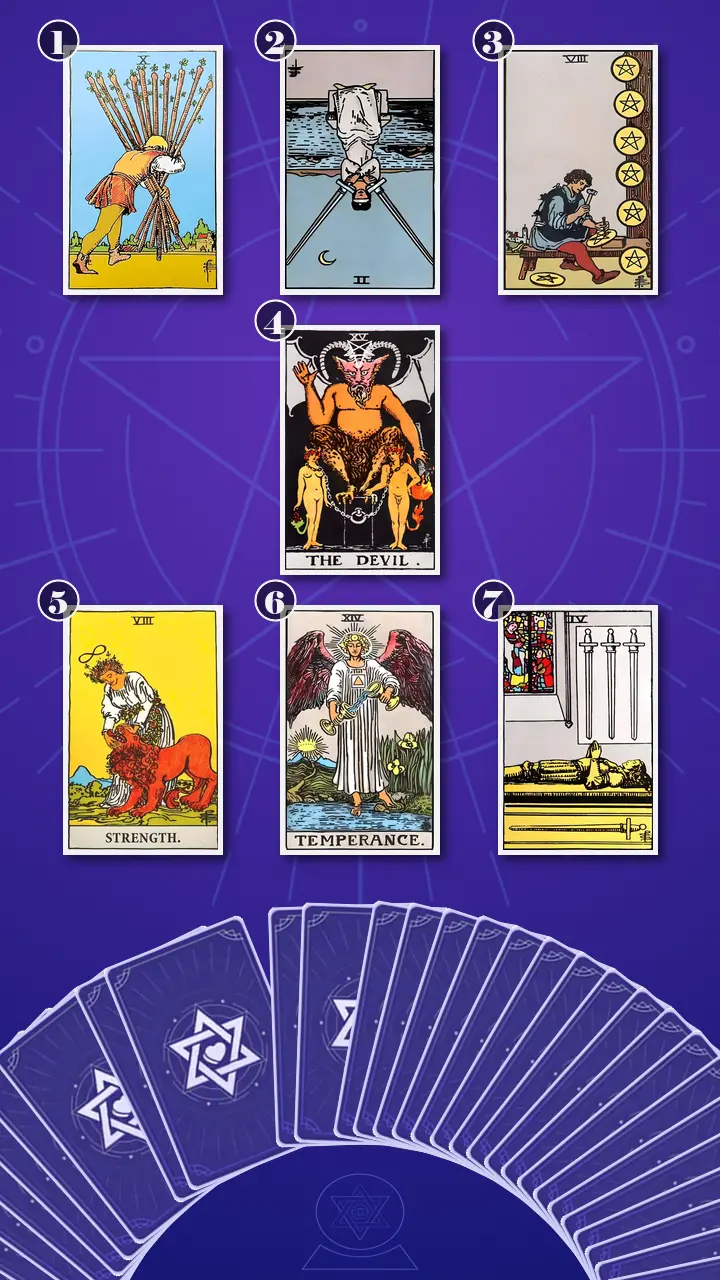
I previewed the three positions that tend to matter most in a work-burnout reading: the center card (the core blockage that keeps the loop running), the transformation card (the reframe that resets the whole system), and the final card (the next step you can actually do this week).
Reading the Map: Where the Energy Leaks
Position 1: Surface burnout pattern
“Now I’m turning over the card that represents your surface burnout pattern—the most visible way overextension shows up in your day-to-day energy,” I said.
Ten of Wands, upright.
I pointed to the image’s bundled weight and the figure’s blocked vision. “This is what it looks like when your life becomes load-bearing by default.”
Then I anchored it to her reality using the scene that kept showing up in her language: “This is like you on the TTC after work with one hand on a crowded pole, the other scrolling Slack, mentally stacking obligations like they’re all equally urgent—sprint planning notes, a ‘quick’ stakeholder follow-up, groceries, replying to your friend’s ‘are you alive?’ text. You feel the weight in your shoulders, and the worst part is you can’t even see what matters anymore because your arms are full.”
Energetically, Ten of Wands is excess—too much Fire doing the job of everything else. It’s effort trying to substitute for boundaries, rest, and prioritization. When Fire runs like this, it doesn’t warm you; it scorches you.
Jordan let out a short laugh that wasn’t amused. It was the kind of laugh you make when someone says the quiet part out loud. “That’s… too accurate,” she said. “Like, weirdly specific. Even the ‘are you alive?’ texts.”
I softened my tone. “It’s not you being dramatic. It’s physics: when there’s no free hand, one more ‘quick ask’ means you drop something.”
Position 2: Inner tug-of-war
“Now I’m turning over the card that represents your inner tug-of-war—the decision stalemate that keeps boundaries from being set,” I said.
Two of Swords, reversed.
“This is the moment you open your calendar and it’s back-to-back meetings, so you do the familiar thing: you stop feeling,” I said, making sure it landed gently, not as a critique. “You tell yourself, ‘I’ll decide later’ about that boundary—whether you’ll stop replying after 6, whether you’ll decline the optional meeting—then you draft the message, delete it, and go back to ‘just getting through today.’”
Reversed, the energy is blocked but cracking. The denial is failing. Not because you’re weak—because the system can’t hold that much tension forever. And this card is blunt about the cost: holding “neutral” is still work.
I added, “A boundary doesn’t have to be dramatic to be real.”
Jordan’s fingers pinched the edge of her sleeve, then released it. A tiny, unconscious movement—like she was testing what it would feel like to let go of something without the whole world collapsing.
Position 3: External pressure
“Now I’m turning over the card that represents external pressure—the environment cues and reinforcement loops that keep the pace normalized,” I said.
Eight of Pentacles, upright.
“This,” I told her, “is your Jira/roadmap life.”
I connected it directly to the modern loop: “Your workday is a cycle of tickets, ‘quick alignment’ calls, and feedback where ‘done’ is temporary and ‘better’ is always the next bar. Even when you do great work, it upgrades the expectation. You’re proud of your craft—and also quietly terrified that if you pause, the conveyor belt keeps moving without you.”
Eight of Pentacles is Earth energy in overdrive: steady output, repetition, refinement. In a healthy form it’s craft. In an unhealthy system it becomes an infinite backlog disguised as ambition.
I held her gaze and said the line I needed her to hear without shame: “If your life only works when you push harder, it’s not working.”
Her eyes flicked down to the table, then back up, like she was realizing this wasn’t a personal moral failure—it was a design flaw in the way her week was built.
Position 4: Core blockage
“Now I’m turning over the card that represents the core blockage—the binding belief or compulsion that sustains burnout even when you know you need rest,” I said.
The Devil, upright.
“This is the chain,” I said plainly. “And it’s not about you being lazy. It’s about safety.”
I used the ‘loose chain’ scene exactly as it lives in real life: “It’s 9:54 p.m. on a Sunday. Netflix asks ‘Are you still watching?’ Your phone lights up with a late message. Your thumb moves before you decide. You feel that quick hit of relief—then the sinking resentment, because part of you knows you just traded rest for proof you’re still valuable.”
Then I split the inner monologue the way I hear it in so many high-functioning burnout clients:
One voice: If I answer now, I’m safe.
The other voice: If I keep doing this, I’m disappearing.
“Availability can look like dedication—but it can also be a chain,” I added. “And notice the symbolism: the chains are loose. The trap is real, but not absolute.”
This is where my Jungian training always comes in, whether I name it or not. “In shadow terms,” I said, “this is the part of you that learned, somewhere along the way, that being needed equals being safe. It’s not evil. It’s protective. But it’s running the schedule like a dictator.”
Jordan swallowed, then exhaled through her nose. Her face didn’t crumble into tears. It did something subtler: it stopped pretending. “Rest feels unsafe,” she admitted, almost like she hated the sentence, “because if I’m not on top of things… someone will notice I’m slipping.”
Position 5: Usable resource
“Now I’m turning over the card that represents your usable resource—something you can access without PTO or perfect conditions,” I said.
Strength, upright.
“Strength is not ‘push harder,’” I told her. “It’s containment.”
I anchored it to a lived micro-moment: “You notice the surge when Slack pings, and instead of reacting like it’s a fire alarm, you pause. You respond with calm clarity, or you decide a response can wait—and you tolerate the discomfort of that choice without spiraling into ‘they’ll think I’m failing.’”
Energetically, Strength is balance: regulated Fire. Not motivation. Not grit. A nervous-system skill.
I taught her one of my “coffee-break” adjustment techniques—the kind I’ve had people do in ship hallways between ports: “Before you open any ‘urgent’ message after hours, take one breath and drop your shoulders. One breath isn’t self-care theater. It’s you telling your body, ‘I’m in charge of the pace.’”
Jordan tried it once, right there. Her shoulders lowered a millimeter. Not dramatic. Real.
Position 6: Key transformation
“We’re turning over the most important card in this spread,” I said, and the room felt suddenly quieter—like even the city noise outside her condo windows paused to listen.
Temperance, upright.
Temperance is the bridge card in burnout work. It’s the end of the false choice between “I work until I collapse” and “I disappear for a week and then drown in catch-up.”
Using her real-world context, I said, “Instead of waiting for a vacation you can’t take, this is you redesigning your week like a system: a shutdown ritual after your last meeting, a protected decompression block, realistic deep work windows, transitions that let you leave work mode instead of dragging it through the evening. Not dramatic. Just livable.”
Here’s the setup I named out loud, because naming it reduces its power: it’s 11:30 p.m. in Toronto, laptop half-open on the duvet, and she’s rewriting a two-sentence Slack message for the third time because it has to sound calm and competent—while her body feels heavy and her jaw won’t unclench. She’s trapped in the belief that the reset has to be one perfect week she can’t actually take.
You don’t need to carry everything until you collapse; start mixing rest and responsibility like Temperance blends the cups, one small pour at a time.
The words sat between us for a beat. Jordan’s reaction came in a chain—three small movements that told me her system understood before her logic did: first, a brief freeze, like her breath paused mid-inhale; then her eyes unfocused for half a second, as if replaying a hundred late-night “just one more thing” spirals; then her shoulders dropped, and her jaw loosened with a shaky exhale that sounded almost annoyed.
“But,” she said, and the annoyance turned into something sharper, “doesn’t that mean I was doing it wrong? Like… if I can’t handle this pace, maybe I’m not built for this job.”
I didn’t rush to comfort her. I held the truth steady. “That’s The Devil talking,” I said. “It’s the belief that worth equals output. Temperance doesn’t shame you—it updates your operating system.”
This is where my signature way of working—Energy State Diagnosis—clicked into place. “Let’s locate the leaks in 3D,” I said, and I drew an invisible map on the table with my finger. “Environment: time zones, Slack norms, a calendar that’s full before real work starts. Relationships: you being the reliable one, the fixer, the person everyone brings ‘quick asks’ to. Self: the belief that rest is something you earn later, not something you protect now.”
Then I brought my Venetian lens in, because it’s the most honest metaphor I have: “In Venice, we don’t stop the water. We regulate it. We use gates. We redirect currents. Temperance is that. Your life doesn’t need a total shutdown. It needs a smarter flow.”
And I gave her the reframe I wanted her to take home as a sentence: “PTO isn’t the only kind of rest—rhythm is.”
I asked her, gently but directly: “Now, with this new lens, think back over the last week. Was there a moment—one moment—where mixing one small pour of recovery in would have changed how you felt? Not fixed your whole life. Just shifted the ending of the night.”
Jordan looked down and nodded once. “Tuesday,” she said. “I could’ve stopped at 8:30. Nothing actually exploded. I just… kept going because I didn’t know how to stop.”
That was the crossing: from numb endurance toward cautious relief and steadier self-trust. Not perfect clarity. Real clarity.
Position 7: Next step
“Now I’m turning over the card that represents the next step—one grounded, repeatable action that starts recovery this week and makes rest structural,” I said.
Four of Swords, upright.
“This is sanctuary,” I told her. “Not a spa fantasy. A container.”
I translated it straight into her week: “You schedule a recovery block like a real meeting: one hour, notifications off, phone in another room, lights softer, no multitasking. Not catching up. Not optimizing. Just letting your system come back online.”
Four of Swords is Air energy in balance: mental quiet that restores clarity. And it has one blunt warning I always share: “Rest that isn’t protected becomes another task you fail at.”
From Insight to Action: A Pacing-Not-PTO Reset You Can Start This Week
I brought the spread together as one story, so it didn’t stay abstract. “Your surface reality is Ten of Wands: you’re carrying too much, and it blocks your vision. Your inner conflict is Two of Swords reversed: you keep postponing the boundary decision until it becomes a crisis. Your environment is Eight of Pentacles: an endless iteration loop that rewards output. Under it all is The Devil: a shadow belief that constant availability equals safety and value. The resource is Strength: regulated steadiness. The transformation is Temperance: building a rhythm that mixes effort with recovery. And the next step is Four of Swords: protected rest that has edges.”
Then I named the blind spot—the one that keeps high achievers stuck at a career crossroads even when they’re technically succeeding: “You’ve been treating rest as a reward you earn after finishing everything. But in your current system, ‘everything’ is an infinite backlog. The transformation direction is to treat rest as a structural requirement you schedule before you break.”
Jordan hesitated and then hit me with the most honest obstacle: “I hear you. But I can’t even find 30 minutes. My day starts early, ends late, and if I don’t answer people, it becomes more work later.”
“Totally fair,” I said. “So we don’t aim for dramatic. We aim for boring and repeatable. We regulate the current like a canal—one gate at a time.”
Here are the next steps I gave her—actionable advice designed for a tech schedule, not a fantasy schedule:
- Schedule one Sanctuary BlockPut a 30–60 minute block on your Google Calendar once this week. Phone in another room, notifications off. Do one low-stimulation thing (quiet walk, shower, lie down with eyes closed).If 60 minutes feels impossible, do a 10-minute version. The point is to practice being unreachable safely, not to “win” at resting.
- Run the one-boundary-for-seven-days experimentChoose one tiny boundary: “No Slack after 7 p.m.” OR “A daily 30-minute notifications-off block during the workday.” Communicate it once in plain language to the one person/team it affects most.Keep it boring: “I’m offline after 7, back tomorrow morning.” Consistency reads as reliable.
- Add a 10-minute shutdown ritual after your last meetingWhen your final call ends, close the laptop and do one physical transition (wash your face, change clothes, step outside, even just open a window).If your brain tries to reopen Slack, redirect that urge into a “Modern Life Detox”: spend those 10 minutes organizing one month of photos on your phone. It scratches the ‘do something’ itch without feeding the work loop.
A Week Later: The Quiet Proof of Finding Clarity
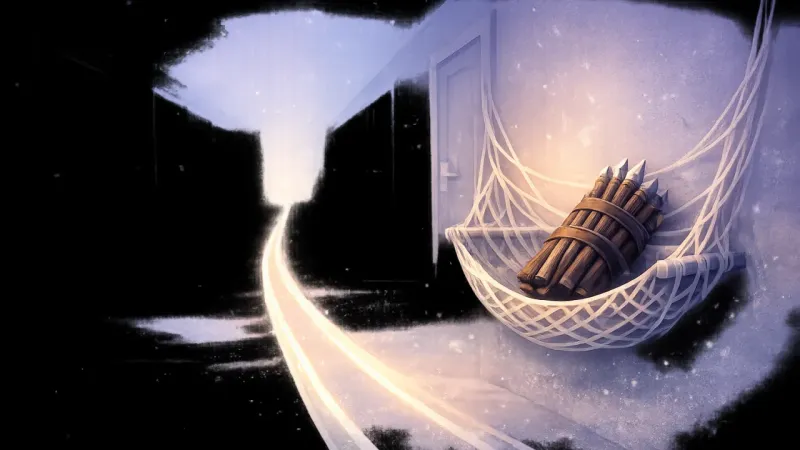
A week later, Jordan messaged me. Not a long update—just a screenshot of her calendar with a block labeled “Sanctuary (no devices)” and a short line: “I did 30 minutes on Thursday. Phone in the bathroom. I hated it for the first five minutes… then my shoulders dropped. Also: I told my team I’m offline after 7. Nothing exploded.”
She added something I loved because it was so unpolished and true: “I slept through the night once. Woke up and immediately thought ‘what if I’m falling behind?’—but then I laughed. Like, okay, brain. Noted.”
That’s the kind of clarity I trust: not certainty, but ownership. The system begins to change when you stop waiting for rescue and start designing rhythm on purpose.
When your PTO hits zero, it can feel like your body is begging for a pause while your brain keeps gripping the wheel—tight jaw, heavy limbs, and that wired bedtime thought: “If I stop, I’ll fall behind and they’ll notice.”
If you didn’t have to earn rest by finishing everything, what tiny piece of recovery would you let into your week first—just enough to prove to your body that you’re not trapped?