The 11:43 p.m. TikTok Draft Loop—And the Boundary-First Ritual I Tried

Finding Clarity in the 11:43 p.m. Draft Loop (TikTok draft paralysis)
If you’ve ever saved a TikTok draft with your face in it—thumb hovering over “Post”—and backed out like you touched a hot stove (face reveal anxiety), you’ll understand exactly how Jordan (name changed for privacy) walked into my reading room.
They told me they were in Toronto, in a small apartment where the kitchen counter becomes a tripod stand. The scene was so specific it felt like I was there: 11:43 PM on a Wednesday, their phone propped against a water glass, the fridge doing that steady hum, the bluish overhead bulb making everything look a little harsher than it needs to. They’d record a 17‑second face-to-camera clip, then replay the same two seconds with the volume at 5%, scrubbing the timeline like it’s a bruise they can’t stop touching.
“I can talk about anything,” they said, fingers tapping edit → back → edit. “But the second my face is in it, I freeze.”
I watched their throat tighten when they said the word face. Their jaw set like a lock. A small heat-flare rose in their chest—visible even in the way they shifted in the chair. Fear, in the body, can be oddly practical: it grabs the nearest object and makes it feel like a lifeline. In Jordan’s case, it was the phone—gripped like it was the only thing standing between them and being permanently misread.
They didn’t come to me asking, “Should I post?” Not really. They came asking how to stop needing total control over how they’re perceived, while still wanting to be seen and build momentum.
“Let’s make this gentle and specific,” I said. “Not a pep talk. A map. Today is a Journey to Clarity—something you can actually do this week, even with the fear still in the room.”
Choosing the Compass: The Decision Cross · Context Edition
I invited Jordan to take one slow breath—not as a ritual for the universe, but as a way to bring their nervous system back into the room. Then I shuffled, steady and unhurried, the way I used to watch travelers grip a railing before a ship docked: not because the sea was dangerous, but because arriving always feels like exposure.
“We’ll use a spread called Decision Cross · Context Edition,” I told them.
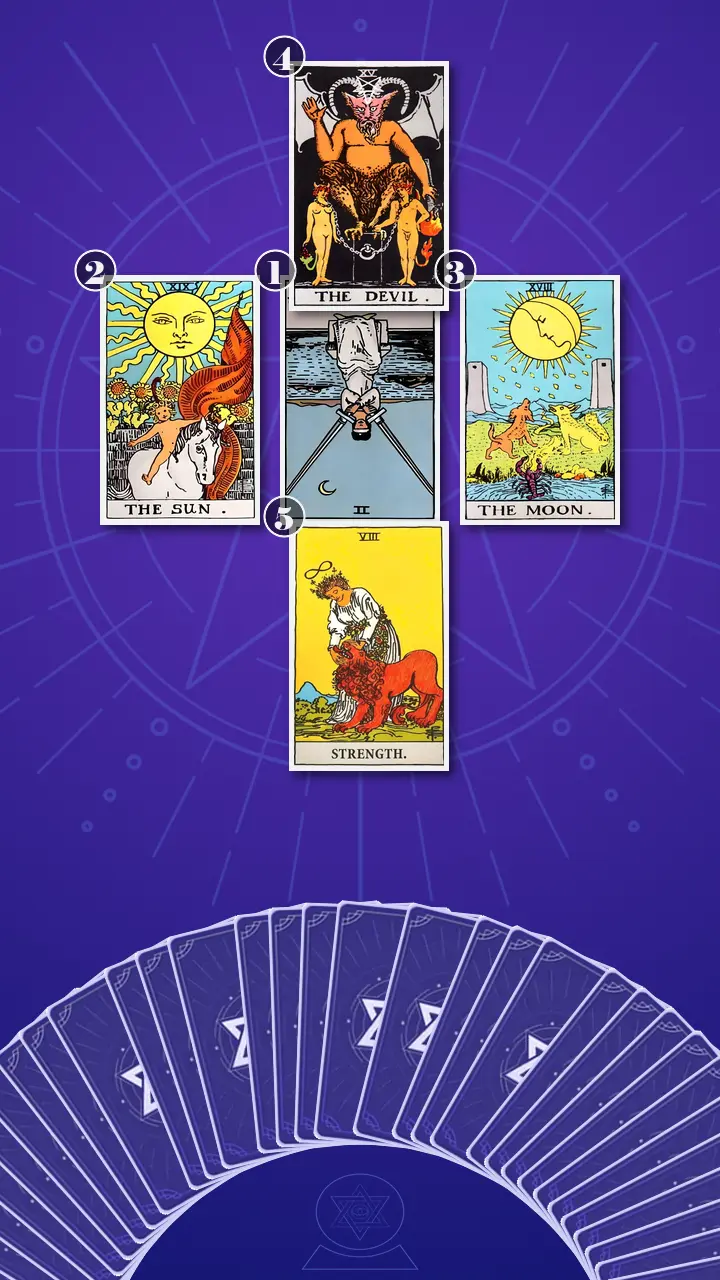
For you reading this: it’s a clean five-card framework for a tough choice—especially when the choice isn’t really about “Option A vs Option B,” but about the pressure underneath the choice. The cross gives us: the exact stuck point, the two paths, the hidden driver (the shame/control bond), and then a grounded integration step—actionable advice, not a prediction.
I pointed to the layout as I placed the cards. “Center is the stuck moment—your draft-loop. Left is Path A: posting your face. Right is Path B: staying anonymous. Above is what’s secretly loading the decision with fear. Below is what stabilizes you this week—your next steps.”
Reading the Map: Control, Moonlight, and the Algorithm-as-Judge
Position 1: The exact stuck point — Two of Swords (reversed)
“Now we turn over the card representing the exact stuck point: the observable draft-loop behavior and mental posture that keeps you from posting.”
Two of Swords, reversed.
I didn’t need to stretch for the meaning; it landed with the accuracy of a notification you didn’t ask for. “This is 11:40 PM on the TikTok edit screen again,” I said, using the life-context exactly as it is. “Scrubbing the same second where your expression changes. Lowering the volume. Zooming in. Rewriting the caption—because deciding to post means stepping into reactions you can’t pre-control.”
Reversed, the energy isn’t balanced decision-making. It’s blocked—a self-protective posture that turns into mental noise. It looks like productivity (“I’ll just fix this”), but it’s really avoidance dressed in CapCut precision.
I mirrored the loop out loud, stacking it the way it happens in the body: “I’ll just fix this → Wait, what if… → Tomorrow.” Control (draft) vs uncertainty (publish).
Jordan let out a small laugh that had no joy in it. “That’s… too accurate,” they said, blinking fast. “Kind of cruel, honestly.”
“I know,” I said softly. “And it’s not a character flaw. This is a protection reflex. But—” I held my palm open over the card, like offering the plain cost. “Draft mode feels like control. It’s also how your ideas starve.”
This is where I used my own diagnostic lens—what I call Procrastination Decoding. “Your system has a pattern: trigger (face attached) → micro-control (rewatch, tweak, check privacy) → retreat (save draft). Short-term relief. Long-term pressure.” I watched Jordan’s shoulders rise on the word relief—like their body recognized the bargain.
Position 2: Path A — The Sun (upright)
“Now we turn over the card representing Path A: what becomes possible if you post your face.”
The Sun, upright.
“This isn’t ‘go viral,’” I said, because their eyes had already darted toward that fear. “This is: you film in simple window light, say one clear point, and post without negotiating with yourself for an hour. And the relief isn’t that everyone loved it—it’s that you stopped micromanaging your vibe long enough for your message to land.”
The Sun’s energy is balanced openness: uncomplicated visibility, less armor, more clarity. I named the contrast the way their life already speaks it: fluorescent late-night editing versus morning light that doesn’t interrogate you.
“Simplicity isn’t lazy—it's less surface area for anxiety to micromanage,” I added. “This path asks you to stop controlling every possible interpretation. One clear point. Natural light. A face that isn’t auditioning.”
Jordan’s mouth softened at the corners—tiny, but there. They could picture it, which matters more than hype.
Position 3: Path B — The Moon (upright)
“Now we turn over the card representing Path B: what becomes possible—and what it protects—if you stay anonymous.”
The Moon, upright.
“Anonymity can be a real creative choice,” I said. “Voiceover. Hands-only. Aesthetic shots. It protects privacy. It lets you make mood-driven work without feeling watched.”
But The Moon’s energy is also excess uncertainty—when imagination becomes threat prediction. “The cost shows up after,” I continued. “You spend hours imagining what people would say if they saw your face, and those imagined comments start feeling more real than reality. The uncertainty becomes a projector screen.”
Jordan swallowed. “That’s the thing,” they said. “I don’t mind strangers seeing it. I mind being perceived… like, by someone who can connect it to my real life.”
“That’s The Moon exactly,” I nodded. “Not danger—ambiguity. And your mind tries to close the gap by writing scripts.”
Position 4: The hidden driver — The Devil (upright)
“Now we turn over the card representing the hidden driver: the underlying fear/bond that loads the decision with shame, control, or self-worth.”
The Devil, upright.
The room felt quieter for a beat, like the building decided to listen. “This is the chain,” I said plainly. “Not TikTok. The chain is the moment you treat the comment section like a courtroom and your analytics like a verdict on your worth.”
I used the modern metaphor that always hits because it’s so real: “Metrics become a keycard badge you keep scanning for permission. You refresh views the way people refresh delivery tracking—hoping certainty will show up.”
Jordan’s jaw clenched on cue, then they went very still. Heat rose in their chest again, that visibility alarm. The Devil’s energy is binding fixation: external approval becomes the boss before you’ve even posted.
“Here’s the reframe,” I said, making it clean enough to remember: A post is data, not a verdict. “A low-view post is information. It’s not proof you’re embarrassing. The moment it becomes an identity verdict, the chain tightens—and saving drafts starts to feel like survival.”
When Strength Held the Lion: The Sentence That Changed the Room
Position 5: Integration — Strength (upright) [Key Card]
I told Jordan, “We’re turning over the core card now—the one that bridges this whole dilemma into something workable.” Even the overhead light seemed less harsh, as if my Venetian instinct for atmosphere was pulling us from night walk into morning.
“Now we turn over the card representing Integration: the best next step that builds self-trust and turns the dilemma into a workable practice this week.”
Strength, upright.
Setup. I looked at Jordan, not the card. “You know that moment at 11:43 PM—phone on the water glass, volume low, replaying the same two seconds—like if you just find the ‘right’ expression, posting will finally feel safe.” Their eyes flicked down, caught. “That’s you trying to solve a feelings-and-risk problem with more control.”
Delivery.
Not “wait until you feel confident”; practice taming the lion one small post at a time until visibility becomes survivable—and then normal.
I let silence do what silence does. In my work—Jungian, yes, but also decades of listening to people confess tiny truths between ports—this is the moment an idea either bounces off armor or finds the seam.
Reinforcement. Jordan’s body responded in a three-part wave: first, a freeze—breath held, fingers hovering midair as if still above the “Post” button. Then the cognition seeped in—their gaze unfocused, like they were replaying a week’s worth of drafts in fast-forward. Then the release: a long exhale that seemed to come from below the ribs, shoulders dropping a fraction, jaw loosening like a knot finally admitting it exists.
“But if I’m scared and I post anyway,” they said, voice sharp with a flash of resistance, “doesn’t that mean I’m just… forcing myself? Like I should be over this already?”
“No,” I said, steady. “Strength isn’t forcing. It’s holding. Confidence is a nervous-system skill, not a personality trait.” I tapped the lion gently on the card. “You’re not deciding a personality. You’re choosing a dose.”
Then I asked the question that turns insight into memory: “Now, with this new lens—think back to last week. Was there a moment, even a small one, where this would’ve changed how you felt? Maybe the elevator mirror. The coworker comment. The thumb hovering.”
Jordan blinked, and their voice went quieter. “Sunday night,” they said. “I literally had it ready. If I’d had a way to… hold it, instead of solve it… I might’ve posted.”
That was the shift: from draft-loop self-consciousness and fear of being perceived to boundary-led, repeatable visibility and steadier self-trust. Not a glow-up. A recalibration.
The Boundary-First Visibility Ritual: Next Steps That Actually Work
I gathered the spread into one story for Jordan: the Two of Swords reversed showed the bottleneck—analysis as a shield. The Sun showed what’s possible when you simplify and let yourself be seen plainly. The Moon validated privacy while naming the trap of projection. The Devil named the real bind—handing your belonging to an imagined audience. And Strength offered the redesign: replace chains with a ritual; trade total control for clear boundaries.
The cognitive blind spot was simple and brutal: Jordan kept treating visibility like a cliff jump—either total exposure or total safety—when it’s more like a dimmer switch. The transformation direction was equally clear: from trying to prevent all judgment to practicing controlled visibility with boundaries and a repeatable posting ritual.
I offered a plan that fit real life in a Toronto apartment, not an inspirational poster. I used my cruise-trained decision framework—the Port Decision Model: you don’t wait for perfect weather forever; you choose a safe docking window and you commit to it.
- The 15-Minute Post WindowPick one day this week. Set a 15-minute timer, open the face-on-camera draft, allow one edit pass (caption + volume + cut), and post when the timer ends.Expect your brain to argue (“I look weird,” “what if a coworker sees it?”). That’s the growth edge. Don’t negotiate—ship when the timer ends.
- The 30-Minute Post-and-Step-AwayImmediately put your phone in another room for 30 minutes. Turn on Do Not Disturb. Let your body spike without trying to fix it.Name it quietly: “This is my visibility alarm.” Exhale longer than you inhale. Then do something physical (dish, shower, short walk).
- One Boundary Before You PublishBefore you post, choose one guardrail: comments off, limit to followers, or turn on comment filters/blocked words for 24 hours.Boundaries make visibility survivable. You’re allowed to be private and be clear—those aren’t opposites.
“This is Reality Testing,” I added, keeping it practical. “It’s a 48-hour experiment, not a forever identity. We’re collecting data, not seeking a verdict.”

A Week Later: Ownership, Not Certainty
Six days later, Jordan messaged me. “I did it,” they wrote. “Fifteen minutes. One edit. Comments limited. Phone in the bedroom.”
They told me they celebrated in the smallest way: they sat alone in a coffee shop near King Street, pretending to read while their body kept checking for danger that didn’t arrive. The video didn’t explode. It also didn’t end them. They still felt a flicker of “what if I’m cringe?”—but this time, they could breathe through it.
That’s what I trust about tarot when it’s used well: it doesn’t promise you’ll never feel fear. It helps you build a structure where fear stops driving your thumb—and your life starts moving again, one brave-but-doable dose at a time.
And if you recognized yourself in Jordan—wanting to be seen while still keeping total control over how you’re perceived—remember this: your body ends up gripping the phone like it’s the only thing standing between you and being misunderstood.
If you treated visibility like a dimmer switch instead of a cliff, what’s the smallest “brave-but-doable” dose you’d be willing to try this week?