Caught in the Parental Approval Loop - How One Breath Starts Boundaries

Finding Clarity in the Central Line Text
I meet a lot of high-functioning people in their late 20s and early 30s—London professionals who can run a roadmap workshop, ship features, handle stakeholders—yet one “I’m disappointed” from Dad turns their nervous system into a 12-tab browser of shame and contingency plans. Jordan said it like she hated how true it was: “I hate how fast I turn into a kid when he says that.”
She’d booked me after a Thursday commute that went sideways emotionally. 6:12 p.m. on the Central line heading east: carriage swaying, someone’s headphones leaking tinny bass, grey daylight flattening everyone’s faces. Her phone lit up with a single word from her dad—Disappointed. No context. No specifics. Just that.
Jordan told me her stomach dropped so fast it felt like missing a step on the stairs. Her thumb hovered over WhatsApp, typing “I didn’t mean—” then deleting it. Typing again. Deleting again. She could feel her throat tighten like she was swallowing a stone; her jaw locked the way it does right before you try not to cry in public.
“The worst part,” she said, staring at the table between us like it had the answer, “is I don’t even know what he wanted from me. But I’m already writing an essay to fix it.”
I nodded, not as a performance of empathy, but because I recognize that exact body math: the way shame turns your chest into a too-tight jumper. “Okay,” I said gently. “Let’s not make you improvise in the middle of an emotional fire alarm. We’re going to map the loop—so you can hear his disappointment without treating it like a verdict on your worth.”

Choosing the Compass: The Celtic Cross · Context Edition
I asked Jordan to take one slow inhale, then an exhale that was just a second longer than the inhale—enough to give her nervous system a tiny signal of we’re safe enough to look. While she did that, I shuffled slowly. Not for mystique. For focus. A clean transition from “reliving the text” to “observing the pattern.”
“Today,” I said, “we’ll use a spread called the Celtic Cross · Context Edition.”
For readers who wonder how tarot works in a practical way: I like this structure for family-trigger loops because it separates the visible trigger-response (what you do right after the sentence lands) from the deeper imprint (the old belief underneath), and then it shows a workable path of change that isn’t about predicting your dad’s next move. It’s about finding clarity and building actionable advice you can try in real life.
I told Jordan what to expect: “Card one is the immediate reaction pattern. Card two is the block—the thing that keeps the loop running. Card three and four take us into the older conditioning. And there’s a card near the right side—position six—that’s your next experiment. Not a grand transformation. A near-term shift you can actually do.”
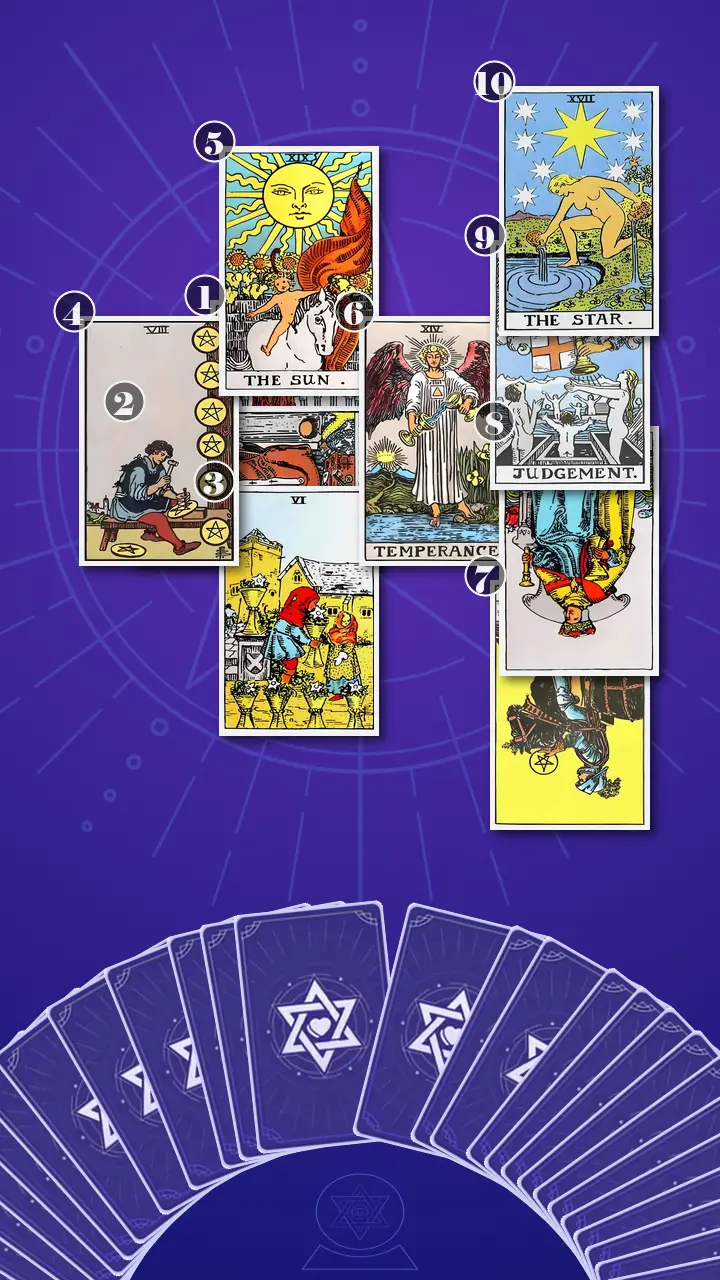
Reading the Map: The Loop in Card Meanings, in Context
Position 1: The immediate reaction pattern
“Now we turn over the card that represents the immediate reaction pattern: what you do right after hearing ‘I’m disappointed.’”
Eight of Swords, upright.
I watched Jordan’s eyes land on the blindfolded figure ringed by swords. “Right after Dad says it,” I said, “your options collapse into two: defend yourself with a detailed explanation, or go quiet and accept being ‘the problem.’ You stare at your phone, chest tight, and your mind starts generating scripts like a crisis comms plan—except the crisis is your worth.”
This is Air energy in blockage form: thought loops that feel like “research,” but actually tighten the cage. The Eight of Swords is a perceived no-win—like being stuck in a pop-up modal with only two buttons: Explain Yourself or Accept Guilt, and no obvious X in the corner.
Jordan let out a short laugh that didn’t reach her face. “That’s… so accurate it’s kind of brutal,” she said. Her shoulders rose as if she was bracing for impact, then dropped half a centimetre, like her body was relieved to be understood.
Position 2: The core block
“Now we turn over the card that represents the core block: what keeps the approval loop running in the moment.”
The Hierophant, reversed.
“This,” I said, tapping the edge of the card lightly, “is the internal rulebook. The thing keeping the loop running isn’t the single sentence—it’s the inherited logic that activates instantly: good daughter = approved, competent adult = praised.”
Reversed, The Hierophant shows authority energy that’s gone rigid and outdated—like you’re still trying to pass an old compliance checklist for a company you don’t even work for anymore. His disappointment lands like you violated doctrine, so you scramble to get back into compliance instead of checking what you actually believe.
I kept my voice clear and direct. “That’s not a conversation—you’re in a performance review you didn’t consent to.”
Jordan’s hand moved to her throat without her noticing. She pressed her thumb under her jaw, as if she could physically hold the words in.
Position 3: The old imprint underneath
“Now we turn over the card that represents the old imprint underneath: the unconscious belief that gets activated.”
Six of Cups, upright.
“A younger part of you,” I said, “still believes closeness is earned by being sweet, impressive, and easy to approve of. When he’s disappointed, it doesn’t feel like adult feedback—it feels like warmth got taken away, and your system reaches for the old way to get it back.”
This is Water energy in attachment form—tender, sticky. The Six of Cups isn’t accusing you of being childish. It’s naming why the reaction is so fast. Your nervous system is reacting to the memory of what “being good” used to buy you: peace, attention, predictability.
Jordan stared at the card, blinking slowly. “I used to bring home good grades like… offerings,” she said, then immediately looked embarrassed, like she’d overshared. I shook my head. “That makes sense,” I said. “It’s a strategy that worked.”
Position 4: The earlier conditioning
“Now we turn over the card that represents the earlier conditioning: the pattern you learned about love, praise, and performance.”
Eight of Pentacles, upright.
“You learned that effort equals safety,” I said. “So after a hard call, you soothe yourself by producing: staying late, polishing, stacking achievements like receipts. It’s not ambition—it’s emotional regulation through work, because excellence used to reduce the chance of being criticised.”
This is Earth energy in excess: steady craft becoming self-punishment. I’ve seen this in product teams and in families—when your work ethic becomes a way to manage someone else’s mood. Jordan’s face tightened like she’d been caught on CCTV. “I literally did that last night,” she said. “I polished a deck that was already fine.”
I thought of my own radio studio days—how you can’t fix a distorted vocal by turning the volume up. You have to change the mix. “Same principle here,” I said. “More output won’t resolve an emotional distortion.”
Position 5: The conscious goal
“Now we turn over the card that represents the conscious goal: what you think will make you feel okay again.”
The Sun, upright.
Jordan’s eyes softened at the bright image—like her body remembered what warmth feels like. “What you consciously want isn’t perfection,” I said. “It’s uncomplicated warmth. You want the version of the relationship where you can share your life and hear a simple ‘I’m proud of you’ that lets your body unclench and your mind stop bargaining.”
I held her gaze for a beat. “Wanting your dad to be proud of you is tender—not childish.”
The Sun is Fire in balance: visibility, being seen. The risk, as this spread is showing, is outsourcing your inner light to someone else’s mood.
When Temperance Lowered the Volume
Position 6: The next experiment
I took a breath before turning the next card. The room felt quieter, like even the traffic outside had decided to listen.
“Now we turn over the card that represents the next experiment: a near-term inner move that disrupts the loop without escalating conflict.”
Temperance, upright.
“This is the pause that creates choice,” I said. “You acknowledge his feeling without turning it into a trial: one breath, one clarifying question, one boundary sentence. You let his disappointment exist without immediately paying it off with proof.”
Then I brought in my own lens—my signature way of diagnosing relational energy through sound. “Jordan, can I use a music therapy framework for a second?” I asked. She nodded, wary but curious.
“One of my tools is something I call Generational Echo,” I said. “In families, certain phrases function like a recurring hook in a song. ‘I’m disappointed’ isn’t just information—it’s a sample that’s been looped for years. When it plays, your system jumps into the same old verse: prove, soothe, perform. Temperance is you becoming the sound engineer. Not muting him. Not blasting your résumé. Adjusting the mix so you can hear his feeling without it swallowing your self-respect.”
I watched Jordan’s face go still in a three-beat sequence: (1) her breath paused—tiny freeze; (2) her eyes unfocused as if she was replaying old scenes like a playlist; (3) her shoulders dropped with a shaky exhale that sounded like relief and grief at the same time.
Stop treating his disappointment as a verdict, start practicing the slow alchemy of Temperance—one paused breath and one clear sentence at a time.
Jordan swallowed hard. In that moment, she was exactly in the setup I see so often: trapped in the instant shame spike—tight throat, clenched jaw, stomach drop—like she’d just been handed a grade she didn’t study for, and the only way to survive was to argue the marking scheme.
Her reaction wasn’t clean relief. It was complicated. She blinked fast, then frowned—angry for a second. “But if I don’t explain,” she said, voice sharper, “doesn’t that mean I’m just… letting him think I’m failing?”
I didn’t rush to soothe that. I respected it. “It means you’re refusing to put your worth on a live debate,” I said. “Respecting his feelings doesn’t require surrendering your self-trust.”
I leaned in slightly, keeping it practical. “Try this once within the next 7 days: when you feel the urge to send the long explanation, set a timer for 90 seconds. In that time, do only two things: (1) exhale slowly five times, (2) write one sentence that asks for specifics. Then stop. You can choose to send it or not—either way, you just practiced not turning your worth into a live debate.”
Jordan’s eyes went glassy, then steadier. Her jaw unclenched in a way you can almost hear. She stared at Temperance again, and her voice dropped. “Last week,” she said quietly, “he said it on a call and I started listing everything I’d done at work like I was reading a PRD. I could’ve just… asked what he meant.”
“Exactly,” I said. “Now, with this new lens—think back. Is there a moment in the last week where one paused breath and one clear sentence would’ve changed how your body felt?”
That was the shift: not from conflict to harmony, but from shame-driven performance to self-led response. A real step on the journey from “I can’t trust myself” toward steadier self-respect.
The Ladder Up: From Judgement to a Quieter Star
Position 7: Your role in the cycle
“Now we turn over the card that represents your role in the cycle: the identity you step into when seeking approval.”
Knight of Pentacles, reversed.
“In this loop,” I said, “you become ‘the responsible one’ so hard that it turns into a cage. You keep grinding because it feels like the best defence against disapproval. But reversed, this is Earth energy in stagnation—duty without movement.”
Jordan nodded once, sharp. “I call it being practical,” she said. “But it’s… fear.”
Position 8: The relational environment
“Now we turn over the card that represents the relational environment: the family emotional climate and how it impacts your nervous system.”
King of Cups, reversed.
“This is mood-as-authority,” I said. “Feelings are powerful but not clear. ‘I’m disappointed’ arrives heavy and vague, and you end up managing his mood—softening your voice, offering fixes—because the unspoken pressure feels like it sets the rules of the room.”
Water energy here is in distortion: emotion without clarity becomes pressure. Jordan’s lips pressed into a line. “It’s the vagueness,” she said. “If he told me what it was, I could… do something.”
“Or,” I said gently, “you could decide what’s yours to do.”
Position 9: The deep pull
“Now we turn over the card that represents the deep pull: the hope and fear that keeps you hooked to his verdict.”
Judgement, upright.
I felt Jordan go still again, but this time softer. “Judgement is the fantasy of a final ruling,” I said. “Cleared and you can relax. Condemned and you must work harder. And this card is the wake-up call that the real court is inside you now—you’re not waiting for his sentencing; you’re rehearsing your own.”
As I said it, I could see her mind doing what so many minds do after a hard family call: re-reading the transcript in her head like a case file, checking tone the way she’d rewrite a Slack message five times so it couldn’t be criticised.
“Is this feedback,” I asked, “or is this an old court?”
She exhaled through her nose—quiet, almost a laugh. “Old court,” she said.
Position 10: Integration outcome
“Now we turn over the card that represents the integration outcome: what changes internally if you practice the shift consistently.”
The Star, upright.
“This is the part people underestimate,” I said. “The Star isn’t fireworks. It’s recovery. It’s you building a quiet inner steadiness—self-trust that doesn’t require him to be in a good mood for you to feel okay.”
The Star is healing energy in balance: practical grounding and emotional replenishment, held in two steady hands. “Your worth isn’t produced,” I said. “It’s practiced.”
Clarity First. Résumé Later (If at All)
I summarised the story the spread told us: the trigger (“I’m disappointed”) blindsides Jordan into a mental cage (Eight of Swords), and the cage is built from an inherited rubric she never agreed to (Hierophant reversed). Underneath is a younger part that learned closeness through being good (Six of Cups), reinforced by a very effective coping method—excellence as anesthesia (Eight of Pentacles). Consciously, she wants warmth and visibility (The Sun), and the bridge out is Temperance: a regulated pause where she can ask for clarity and hold her own standard. From there, she stops living as the dutiful achiever in standby mode (Knight of Pentacles reversed), stops treating someone else’s mood as the weather system of her week (King of Cups reversed), wakes up to the internal courtroom (Judgement), and rebuilds self-trust through repeatable recovery (The Star).
The cognitive blind spot was simple and brutal: Jordan had been treating relief as something her dad could grant—so she kept trying to earn it in real time. The transformation direction was just as simple: self-approval first, then choose a response that matches her values and limits.
I gave her next steps that were deliberately small—because that’s how you retrain a loop.
- Pin the one-sentence Temperance scriptIn your phone Notes (or as a pinned chat with yourself), save: “I hear you’re disappointed. What specifically are you disappointed about?” Use it the next time the vague critique lands—text or call.If your throat tightens, read it out loud once before sending. Hearing your own calm voice helps your nervous system believe you.
- Practice the 10-second gapOnce this week, after he answers your clarifying question, count ten seconds in your head before you explain anything. If ten is too much, do three. The goal is to prove to your body that silence won’t kill you.Use my radio-host trick: imagine you’re leaving “room tone” on a recording. Silence isn’t failure—it’s space for meaning.
- Build a Soundproof Barrier for after-contact recoveryRight after any family contact, do a 2-minute jaw + throat reset (unclench jaw, drop tongue, exhale longer than inhale for five breaths), then put on one low-tempo track or steady sound (brown/pink noise, or a 60–80 bpm song) for five minutes with your phone face-down.This isn’t about “fixing” your feelings; it’s about giving your body a boundary. If you’re tempted to open your laptop and overwork, treat that as the cue—not a command.
I added one more option, because it fit her real life: “If you’re ever at home and you’re cooking together, you can use my Kitchen Radio strategy. Not to manipulate anyone—just to soften the charged silence. A neutral playlist at a steady tempo makes it easier for you to stay in Temperance while you ask for specifics.”

A Week Later: Ownership, Not Certainty
Six days later, Jordan sent me a message: “He did it again. I used the script.” She told me her hands shook as she typed it, but she sent the one sentence anyway. When he replied with something slightly more specific (still imperfect, still Dad), she did a three-second gap and didn’t launch into her life résumé.
Her proof of progress wasn’t that the relationship suddenly felt easy. It was smaller: she put her phone face-down, took a shower, changed into a clean T-shirt, and went to bed early. In the morning, the first thought was still, “What if I handled it wrong?”—but then she wrote, “I’m proud I didn’t perform,” and made tea anyway.
That’s the journey I care about: not certainty, but ownership. Not chasing the perfect emotional response from someone else, but practicing a steadier breath inside yourself.
When a single “I’m disappointed” makes your throat tighten and your brain scramble for proof, it’s not because you’re fragile—it’s because some part of you still thinks love is something you have to re-qualify for, fast.
If you didn’t have to earn relief from his mood, what’s one small sentence—or one small pause—you’d want to try the next time disappointment shows up?