From First-Week Impostor Syndrome to Learning Out Loud at Work

Finding Clarity in the 11:30 p.m. Slack Hover
If you’ve rewritten a Slack message three times, hovered over Send like it could decide your future, and then didn’t send it until the moment passed—welcome to the perfectionism loop disguised as professionalism.
Jordan (name changed for privacy) came onto my screen from London with that very specific first-week-at-a-new-job lighting: laptop glow doing weird things to tired skin, the overhead bulb too bright, the rest of the flat dim like it was trying not to watch. They sat at a small kitchen table; I could hear the faint whirr of a laptop fan and, every so often, the small click of a trackpad like a metronome for worry.
“It’s my first week,” Jordan said, and their voice did the thing I’ve heard a hundred times—tight at the edges, like they were trying to sound casual while holding a stack of plates that might slip. “I want to make a strong first impression. But every normal beginner moment feels like… exposure. Like if I ask the wrong question, someone’s going to realise I’m a mistake hire.”
I watched their shoulders stay slightly lifted even while they talked, jaw set like they were bracing for impact. Anxiety, when it’s this flavour, doesn’t feel like “nerves.” It feels like trying to breathe through a straw while you’re pretending you’re fine.
They described their pattern in detail—staying late to reformat a doc that was already fine, nodding through acronyms in meetings and then reverse-engineering what everyone meant alone afterward, drafting a message to their manager and then polishing it into a tiny thesis until it was too late to send. The more they tried to look competent, the quieter they became in real time. The quieter they became, the later they stayed. The later they stayed, the less human they felt at work.
“I’m here because I don’t know what old career story I’m replaying,” Jordan said. “It feels… familiar. Like I’ve done this before.”
“We can absolutely map that,” I told them, keeping my voice steady on purpose—warm, clear, no theatrics. “Not to judge it. Just to see it. Because once a pattern is visible, it stops running the whole show.”
I paused, then added, “Think of tonight as a Journey to Clarity. We’re not trying to predict your entire career. We’re trying to name what’s happening in your nervous system during week one—and find the next smallest true step.”

Choosing the Compass: How This Tarot Spread Works for First-Week Impostor Syndrome
I asked Jordan to take one breath that actually moved their ribs—not a polite breath, a real one. While they did, I shuffled slowly on my desk in New York, the cards making that soft, papery sound that always feels like a gearshift from spiralling to observing.
“For this,” I said, “I’m using something called the Four-Layer Insight Ladder · Context Edition.”
To you—the reader—here’s why that matters. A lot of people search for a tarot reading when they’re feeling stuck at a career crossroads, but the real need isn’t fortune-telling. It’s pattern recognition. This spread is built exactly for that: it moves from what’s visible (what you’re doing) to what’s underneath (the story, the fear-hook), and then it lands on one pivot and one practical next step. Minimal cards, complete arc.
We set the “ladder” like a vertical descent: Card 1 at the top is the observable first-week behaviour. Card 3 is the old career story lens—what makes neutral moments feel like exclusion. Card 5 is the pivot: the key inner shift that breaks the loop. Card 6 is the seven-day practice that turns insight into something you can actually do on Tuesday at 2:26 p.m. when Slack pings and your brain wants to audition for approval.
“Your first week isn’t a test—it’s a feedback loop,” I told Jordan, and I saw their eyes flick up, like a part of them wanted to believe it.
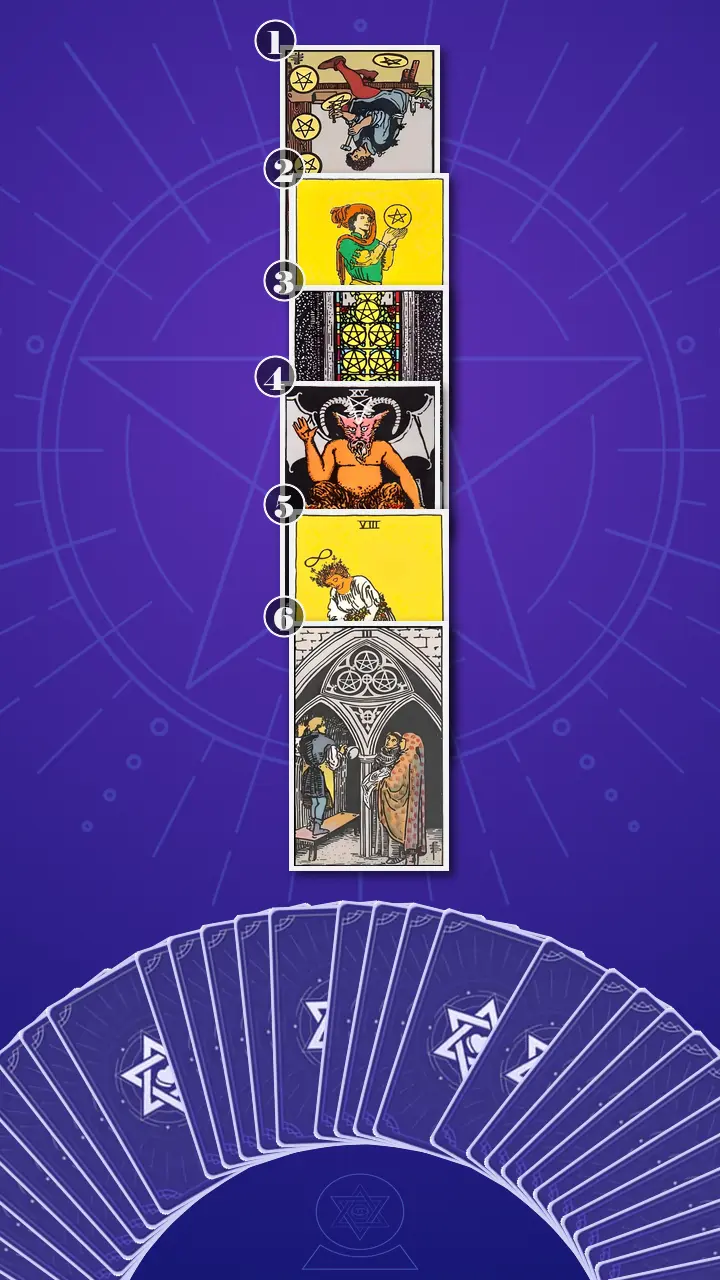
Reading the Ladder: Card Meanings in Context
Position 1 — What you’re doing in week one that shows the pattern
“Now we’re turning over the card that represents what you’re doing in week one that shows the pattern—the observable replay behaviour,” I said.
Eight of Pentacles, reversed.
This card, in this position, is painfully specific. It’s the first week and you’re ‘being diligent,’ but it shows up as re-editing a simple doc until it’s immaculate, re-reading onboarding notes instead of asking for alignment, and staying late to fix things no one asked to be fixed—because perfect output feels safer than being seen as a beginner.
Energetically, reversed Eight of Pentacles is Earth energy in blockage: effort is there, skill is there, but it’s turned sideways into a private bench-work loop that never feels finished. It’s craftsmanship with the door locked.
As I said the words “perfect output feels safer,” Jordan let out a tiny laugh—quick, sharp, and not amused. “That’s… rude,” they said, but their eyes softened. “Accurate. But rude.”
“Perfection is a hiding strategy that looks like professionalism,” I replied, gently. Not as a gotcha—more like naming a spell so it can break. “This isn’t who you are. It’s what you’re doing to feel safe.”
I watched their shoulders lift, then drop a millimetre, like their body recognised itself in the description.
Position 2 — What’s triggering the old career story right now
“Now we’re turning over the card that represents what’s triggering the old career story in this new environment—the specific pressure point,” I said.
Page of Pentacles, upright.
This is the honest beginner card. You’re in genuine ‘new role’ mode: learning tools, processes, and how the team defines “good.” The healthier track here looks like treating onboarding as a curriculum—taking notes, naming one skill you’re building, and letting questions be part of the job instead of evidence you’re lacking.
Energetically, this is Earth energy in balance. Not flashy. Not “effortless.” Just steady. The Page doesn’t pretend the pentacle is weightless; they hold it like it matters.
Jordan frowned slightly, the way people do when a card is kind but not indulgent. “So the trigger is literally… being new?”
“Yes,” I said, and I let it be simple. “The trigger is that you’re in a learning phase. And your nervous system is treating ‘learning phase’ like ‘danger phase.’”
For a second, I flashed back to my own first week in a studio residency years ago—New York, everyone speaking in references I didn’t have yet, me smiling like I understood while my stomach clenched. Different industry, same body response. That’s the thing about archetypes: they repeat across settings like a familiar chord progression.
Position 3 — The old career story you’re replaying
“Now we’re turning over the card that represents the old career story—the narrative lens you’re looking through,” I said.
Five of Pentacles, upright.
This card is the outsider narrative. You interpret normal first-week moments—busy colleagues, short Slack replies, unfamiliar acronyms—as proof you’re not really meant to be here. So you don’t ask, you don’t take up space, and you try to earn belonging privately… even though there’s literally an onboarding path designed for questions.
Energetically, it’s Earth in deficiency: “not enough access,” “not enough warmth,” “not enough permission.” The imagery is brutal: cold street, hunched bodies, a lit window behind them that they don’t look up at.
I used the echo scene that always lands with Londoners. “Picture 9:10 a.m.,” I said. “You’re walking past a bright office kitchen near Liverpool Street. People are laughing over tea like they’ve known each other since uni. You clutch your phone, pretend you’re fine, and the inner monologue goes: If I ask, I take up space. If I don’t ask, I stay safe. Warmth exists, but you choose the cold street of doing it alone.”
Jordan went still. A three-step reaction moved across their face and body: first a tiny breath-hold like a freeze; then their eyes unfocused for a beat, like replaying a real morning; then a slow exhale, almost soundless.
“Oh,” they said. Just that. “That’s… the story.”
“And it’s a story,” I emphasised, “not a fact.”
Position 4 — The fear that keeps the story in place
“Now we’re turning over the card that represents the underlying fear-hook—what the story is trying to protect you from,” I said.
The Devil, upright.
Underneath the outsider story is attachment: to approval, to looking effortless, to being ‘the right hire’ with no messy learning curve. You measure safety by speed and polish, which makes you work later, speak less, and feel more trapped—like you’re being managed by fear instead of leading yourself.
Energetically, The Devil is a contract. Not a moral judgement—more like a silent subscription you forgot you signed: “If I’m not exceptional immediately, I don’t get to rest.”
I translated the chains into modern metrics. “This can look like response-time obsession,” I said. “A short ‘Looks good’ from your manager that somehow doesn’t calm you. Watching whether people react with an emoji. Needing to sound like you already know everything, because ‘not knowing’ feels like a cliff.”
Jordan’s jaw tightened on cue, like their body had been waiting for someone to name it. “Yes,” they said, sharper. “Exactly. They said ‘Looks good’ today and I felt worse. Like… what if they didn’t really look? What if they’re just being polite?”
“That’s the Devil’s trick,” I said softly. “Safety theatre. You keep performing competence because it gives you the illusion of control. But it costs you the thing you actually need: a real feedback loop.”
I let the silence hold for a second. Outside my studio window, a siren went by—New York doing its constant soundtrack thing. In Jordan’s flat, the only sound was the laptop fan. Two cities, same tight-grip energy.
When Strength Spoke in a Glass Meeting Room
Position 5 — The key inner shift that breaks the loop
“Now we’re turning over the card that represents the key inner shift—the new way to relate to this situation,” I said. “This is the pivot.”
Strength, upright.
The room felt quieter as soon as it showed up—like even through a screen, the card changed the air. Strength doesn’t shout. It regulates.
Setup (the moment you’re living): I described it exactly as it lives in Jordan’s week. “It’s 11:30 p.m., laptop open at the kitchen table, and you’re rewriting the same onboarding summary again. Your Slack message is ‘ready,’ but your thumb keeps hovering—because hitting Send feels like submitting a verdict on whether you belong.”
Jordan blinked, once, slowly. Their shoulders were still high, but their hands had stopped fidgeting.
Delivery (the sentence that lands):
Stop gripping your first week like a test you must pass, and start holding it like Strength holds the lion—steady, gentle, and brave enough to be seen learning.
I didn’t rush after that. I let the line sit between us like a lantern.
Reinforcement (what happens in your body when it becomes real): Jordan’s reaction came in layers. First, their breath caught—almost a hiccup of emotion they didn’t expect. Their eyes widened just a touch, then softened; the corners went glossy but they didn’t cry, not exactly. Their shoulders dropped in a visible release, like a coat sliding off. Then, right after the release, a new kind of vulnerability showed up: their posture tilted forward, as if clarity had weight and now they had to hold it.
“But… if I’m seen learning,” they said, voice thinner, “doesn’t that mean I’ve been doing it wrong? Like I’ve been hiding.”
There it was—an unexpected flare of resistance, not anger exactly, but grief for the time and energy spent white-knuckling. I nodded. “It means you’ve been protecting yourself. That’s different from ‘wrong.’ The question is: does the protection still match the reality of this new team?”
This is where I used one of my signature tools—the way I think in images. “I’m going to borrow a frame from jazz,” I said. “In Louis Armstrong’s world, you don’t earn your place by pretending you never miss a note. You earn it by staying in time. You listen, you respond, you make the next phrase honest. Strength is that kind of musician: calm hands, steady tempo, brave enough to be heard while still learning the tune.”
I saw Jordan’s face shift—less defended, more curious. Their throat moved as they swallowed, like their body was trying on a new way to exist in meetings.
“Now,” I added, “use this new lens and look back at last week. Was there a moment—one moment—where this could have changed how you felt?”
Jordan stared slightly off-screen, like they were rewinding. “Yesterday,” they said quietly. “In standup. Someone said ‘ship’ and I didn’t know if they meant staging or production. I nodded. And then I spent an hour after trying to figure it out alone.”
“That,” I said, “is Strength’s meeting. One breath. One clean clarifier. Brave softness.”
I named the shift explicitly, because clarity loves to be spoken: “This isn’t just about a job. It’s a move from first-week hypervigilance and perfectionism-driven overwork to grounded curiosity and belonging-through-participation.”
Position 6 — The next 7 days: the practical step that embodies the shift
“Now we’re turning over the card that represents your practical next step for the next seven days—what you can actually do,” I said.
Three of Pentacles, upright.
This is the daylight card. The shared blueprint. The moment you stop building alone in the dark.
In modern life, it’s simple: the fastest way to stop replaying the old story is to get inside the feedback loop—show a draft, ask what great looks like here, request an example, and let your work be shaped with others early. Your competence becomes real in daylight—through shared standards, not midnight proving.
Energetically, it’s Earth in balance again, but this time it’s communal. Not “I must be perfect.” More like: “We’re building something together, and I’m allowed to learn the house style.”
Jordan let out a breath that sounded almost like relief. “That feels… doable,” they said. “Like I don’t have to become a different person.”
“Exactly,” I said. “It’s not a personality transplant. It’s a container change.”
The One-Week Reset: Actionable Advice for Asking Questions Without Sounding Incompetent
I pulled the whole ladder into a short story, the way I would storyboard a film: same character, different lighting.
In the beginning, Jordan’s work ethic is real—but it’s trapped in the Eight of Pentacles reversed loop: late-night polishing meant to manufacture certainty. The Page of Pentacles shows the truth: week one is an apprenticeship, and the trigger is simply being new. The Five of Pentacles reveals the old lens—“I’m outside; I shouldn’t take up space”—and The Devil shows the fear-contract beneath it: “If I’m not exceptional immediately, I’m at risk.” Strength breaks the loop by shifting from force to steadiness. Then Three of Pentacles grounds it: belonging isn’t earned in isolation; it’s built through visible collaboration and shared standards.
The cognitive blind spot here is subtle: you’ve been using polish as a substitute for alignment. You’re making things safer, not better. The transformation direction is clean: shift from “prove you’re already perfect” to “learn out loud with clear asks and small deliverables.”
Here are your next steps—small, specific, and designed for a real calendar.
- The 10-Minute “Draft + Ask” ResetOnce this week, set a 10-minute timer. Write the roughest useful version of one tiny deliverable (a Slack update, a bullet list, a doc outline). Then add one clean question: “Is this the right direction?” Stop when the timer ends—save as draft or send to one person.If your jaw clamps or your heart races, put both feet on the floor and take one full exhale. You’re allowed to keep it as a draft tonight and send it tomorrow—what matters is interrupting the midnight-polish loop.
- Book a 10-Minute Alignment Check-In (Three of Pentacles move)Put one 10-minute slot on someone’s calendar titled “Quick alignment on X.” Bring a 5-bullet draft and ask: “What does ‘good’ look like here?” or “Is there a past deck/doc/ticket that’s a good model for this?”Make it boundary-friendly: “Do you have 5–10 minutes, or should I drop this async?” If you don’t get an immediate reply, cap solo work at 20 minutes before you ask another resource (doc, buddy, channel).
- Oscars Speech Training (2-minute intro for standup)Before your next intro/standup, write a 2-minute “acceptance speech” for your role: who you are, what you’re focused on this week, and one clear ask. Example: “I’m Jordan, I’m ramping on X process, and I’d love a pointer on where the template lives.” Practice once out loud.Keep it short enough that you can’t over-defend yourself. The goal is presence, not persuasion. If you feel cringe, that’s just your nervous system renegotiating the old ‘don’t take up space’ rule.
I ended the practical part with a rule Jordan could carry into any meeting like a pocket stone: “Ask early, fix less.”

A Week Later: The Quiet Proof
Six days after our reading, Jordan messaged me—not a long update, not a dramatic turnaround. Just a screenshot of a calendar invite: “Quick alignment on onboarding summary — 10 mins.” Under it: “I sent the 80% draft before 5 p.m. My manager replied with two bullets and a link to a template. I didn’t stay late. I still felt wobbly for a second… but then I ate dinner like a person.”
It was the clearest kind of proof: not that fear disappears, but that participation becomes possible. They hadn’t “solved” their first-week anxiety. They’d built one rung of belonging in daylight.
When I think about this Journey to Clarity, I don’t remember perfect outcomes. I remember the moment Jordan’s shoulders dropped when they realised the first week wasn’t a verdict—it was a feedback loop they were allowed to enter.
When you’re new, it’s easy to walk into every meeting like it’s a verdict—so your shoulders tighten, your breath goes shallow, and you start trying to earn safety with perfection instead of letting yourself be a real person in the room.
If you didn’t have to prove you belong this week—only participate—what’s one small question you’d let yourself ask out loud, exactly as you are?