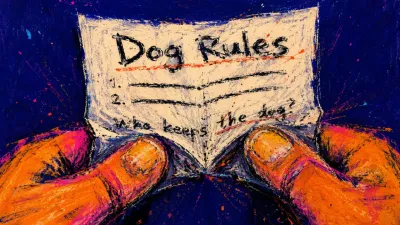
When One Lease Feels Like Your Whole Future: Self-Trust in Stages

When the Lease PDF Felt Like a Verdict
If you have multiple apartment tabs open, a Notes app pros-and-cons list, and still can't hit reply on the actual lease email, that isn't clarity—it's commitment panic dressed up as research.
When Maya (name changed for privacy) came to me, she didn't start with a dramatic fight or a shocking confession. She started with a Wednesday at 12:14 a.m. in her west-end Toronto apartment: phone two inches from her face, radiator hissing, blue-white screen light flattening the room into something colder than it was. Her partner had said, 'If we like the place, we should probably apply tomorrow,' and within minutes she was on Reddit breakup threads, studio listings, and rent calculators, mouth dry, chest tight, stomach fizzing like she'd swallowed a live wire.
'I know it's just an apartment,' she told me, 'but it doesn't feel like just an apartment.'
I believed her immediately. I see this kind of moving-in-together anxiety all the time in capable late-20s city people who can handle launches, deadlines, and Toronto rent, but get knocked sideways by one lease PDF with both names on it. In Maya, the dread felt like her whole future had been vacuum-sealed inside a document she couldn't stop reopening, while her body searched for an exit clause before anything had even been signed. She wanted closeness. She also feared that one shared step would erase her autonomy and lock in the wrong life.
I kept my voice warm and simple. 'That makes sense to me,' I said. 'A lease can be real without being forever. We don't need to treat this like a prophecy. Let me help you map the fog so you can hear your own voice again.'

Choosing the Relationship Spread · Context Edition
I asked Maya to take one slow breath and let her exhale run a little longer than her inhale. Then I asked her to keep one plain question in focus: why does moving in together make me question my whole future? I shuffled slowly—not as a mystical performance, but as a psychological transition from spiraling thought into deliberate attention.
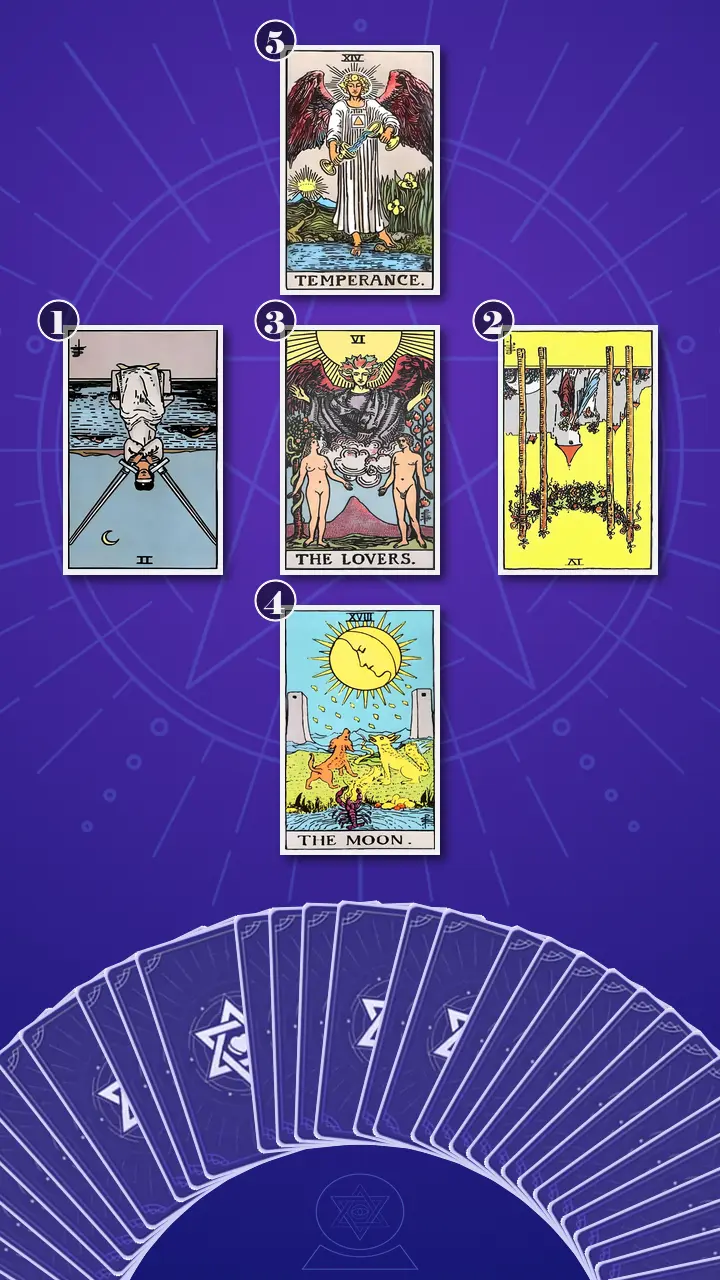
For her reading, I chose the Relationship Spread · Context Edition, a five-card relationship tarot spread I use when a partnership milestone is real, but the emotional charge is living inside what that milestone symbolizes. This is how tarot works when I trust it most: not as fate, but as structure. This spread lets me move from the present symptom, to what the moving-in milestone means emotionally, to the intimacy-versus-autonomy dynamic underneath it, down into the shadow fear, and finally up toward grounded, actionable guidance.
I told her what I would be looking for. The first card would show the present symptom—how cohabitation immediately scrambles her thinking and behavior. The center card would reveal the central push-pull between intimacy, autonomy, and value alignment. The fourth card would name the deeper fear and projection making ordinary planning feel existential. And the fifth card, the bridge card, would show the healthiest path from lease-signing dread toward something steadier and more collaborative.
Reading the Map in Low Light
Position 1: The Loop That Calls Itself Research
I turned over the card representing the present symptom: how cohabitation immediately scrambles her thinking and behavior.
Two of Swords, reversed.
I told Maya I wasn't surprised. This card shows a mind trying to protect a vulnerable heart by refusing to choose, and in reversed position that protective pause has turned into overload. In real life, I could already see the whole modern-life version of it: Maya on her lunch break with a starred lease email, a dozen tabs open, a half-written text to her partner, bouncing between rent-split math, neighborhood commute times, and 'did we move in too soon?' forums. Nothing new actually changes the decision, but the research loop gives her the temporary feeling that she is still in control.
I named the energy clearly. This was blocked Air with excess motion—thinking multiplying while clarity thinned. As a product designer, she knew the pattern as soon as I said it out loud: like staying in the compare-and-iterate stage of a design file forever because hitting publish feels like losing all future edits.
She gave a short laugh that had a little ache in it. 'Okay,' she said, looking down at the card. 'That's accurate enough to be rude.' Her fingers tightened around her mug and then eased. I asked her the question I always ask with this card in plain clothes: 'What exact decision needed answering last time—and which extra tabs were camouflage?'
Position 2: The Doorway That Doesn't Feel Like Home Yet
I turned over the card representing what the moving-in milestone symbolizes and activates for her beyond simple logistics.
Four of Wands, reversed.
I told her this was the card that explains why ordinary domestic details suddenly feel emotionally radioactive. Upright, the Four of Wands is home, welcome, celebration, a threshold you cross with some joy in your body. Reversed, the threshold goes shaky. In Maya's life, I saw it instantly as that IKEA North York moment: cart wheels squeaking, cinnamon-bun smell in the air, a partner saying something totally normal like, 'We could put the table here,' and the sentence landing in the body like a door clicking shut.
'You are not overreacting to furniture,' I told her. 'You're reacting to what it symbolizes.'
Here the energy of home is unstable. Instead of warmth, the milestone triggers fear of losing independence in a relationship. Shelf space, kitchen storage, whose desk goes where, whose routines survive—each practical choice starts carrying the emotional weight of identity loss. Home versus trap. Welcome versus point of no return.
She went very still for a second, then nodded hard. 'Yes,' she said. 'That is exactly when it flips.' I nodded back. 'Of course it does. The doorway matters. The nervous system hears more than the words. It hears, Will I still get to feel like myself in here?'
Position 3: What Are We Actually Building?
I turned over the center card, the one revealing the central push-pull between intimacy, autonomy, and value alignment.
The Lovers, upright.
This is always the moment when I feel a reading change temperature. I told Maya that The Lovers is rarely as simple as romance. In the center of a spread like this, I read it as conscious choice, honest desire, and values spoken clearly enough that commitment feels chosen rather than assumed. In her real life, that meant the question was not just 'Should we move in together, yes or no?' It was, 'Can we build a shared life without either of us disappearing inside assumptions?'
I translated it into language that fit her world: less soulmate magic, more a relationship version of a product spec review. What are we actually building? Do we mean the same thing by home, privacy, money, pace, and togetherness? The energy here is balanced, but it asks for courage. Intimacy wants truth. Autonomy wants language.
As I looked at the card, my artist brain flashed to the storyboards pinned in my studio: two scenes can both be beautiful and still need a deliberate cut between them. Meaning doesn't come from pretending the difference isn't there. Meaning comes from choosing how to bridge it. I saw Maya soften when I said that.
'So maybe the real question isn't yes or no,' she said after a moment. 'Maybe it's whether we can actually talk about what this means before I spin out.'
'Exactly,' I told her. 'You do not need a five-year answer to make one honest next step.'
Position 4: When Anxiety Masquerades as Intuition
I turned over the card representing the deeper fear and projection that keep ordinary planning feeling existential.
The Moon, upright.
I told Maya immediately that this card was not proof the relationship was wrong. It was proof that visibility had become distorted under emotional charge. In her world, The Moon looked exactly like that 12:14 a.m. spiral: one ordinary comment about timing or neighborhoods, and suddenly she was reading breakup stories, checking solo-apartment listings, rehearsing exit plans, and mistaking every anxious sensation for a message that disaster was coming. Like doomscrolling your own future at 1 a.m. and calling it intuition.
This was excess projection in low light. The path ahead existed, but because it wasn't fully illuminated, her mind filled the gaps with threat. I said the line slowly so she could actually hear it: 'Not every wave of panic is intuition.'
Her breathing changed. One hand went to the center of her chest before she seemed to realize it had moved. Outside my window, the rain sharpened against the glass, and the room seemed to lean into the card's own moonlit logic. I asked her gently, 'What is the exact regret your mind keeps rehearsing at night? What are you afraid moving in will prove about you?'
She looked past me for a second, as if the memory was replaying somewhere just over my shoulder. 'That I'll move in, panic later,' she said, 'and then have to admit I can't trust myself with my own life.'
When Temperance Poured Between Two Cups
When I turned the final card, the room went noticeably quieter. Even the rain had thinned to a softer hush. I could feel we were at the hinge point of the reading.
Position 5: Building Shared Life in Stages
I turned over the card representing the key shift from future panic to grounded, collaborative decision-making.
Temperance, upright.
I told Maya this was the bridge card, and I meant that in the deepest way. Temperance is measured self-trust, emotional regulation, pacing, and collaborative balance. In real life, it looks like treating cohabitation not as a lifetime hard launch, but as something you can build through small explicit agreements: one honest check-in, one visible boundary, one low-stakes decision, one version check at a time. Shared life becomes a conversation instead of a verdict.
This is where I used one of my own private lenses—the thing I call a Macro-Narrative Arc Audit. When someone is in panic, I ask myself whether they're truly at an ending, a dead end, or just inside a false climax that their nervous system has mistaken for the whole film. Nothing in Maya's spread looked like a dead end. It looked like a false climax: a doorway scene carrying way too much soundtrack, as if one lease had to explain the entire plot. And that meant the panic itself could become the inciting incident for the next act—the first more honest conversation about pace, privacy, and boundaries. As a painter, I know what happens when I mash two wet colors together too fast on a palette: I don't get harmony, I get mud. Temperance says the same thing about love.
I brought her back to the lunch-break spiral I could feel haunting the whole reading: commute tabs open, lease email unanswered, body tight, mind trying to solve the whole future before it could answer one practical question about this week.
This is not proof that love is swallowing your future; like Temperance pouring between two cups, your task is to blend closeness with clear boundaries until shared life feels chosen, not consuming.
I watched the sentence land in three waves. First came the freeze: her breath stopped for a beat, thumb suspended against the rim of her mug. Then came the cognitive shift: her eyes unfocused, not blank but replaying—PATH food court, cold noodles, fluorescent buzz, the starred lease email she had been treating like full terms and conditions for the rest of her life. Then came the emotional release: her jaw unclenched, her shoulders dropped, and her eyes brightened with the kind of tears that are half relief, half grief for how hard she had been trying to earn certainty by suffering for it.
'But if that's true,' she said, voice catching, 'does that mean I've been asking the wrong question this whole time?'
'Not the wrong question,' I said. 'Just an impossible one. You were asking one address to guarantee your whole identity. Temperance doesn't ask you for less honesty. It asks you for better structure.'
I gave her the reinforcement immediately. 'Within the next ten minutes,' I told her, 'open a note called Shared / Mine. List three things you want shared in a home and three things you need to stay yours. Then choose one low-stakes logistics decision to make with your partner in fifteen minutes or less. If your body spikes, pause and come back later. This is a check-in, not a test you have to pass.' Then I asked her, 'Now, using this lens, was there a moment last week when this insight would have changed how you felt?'
She nodded almost before I finished. 'The sofa text,' she said. 'I didn't need to solve marriage. I needed to say I was scared of losing space.' That was the shift I had been hoping to see: not perfect certainty, but the first clean step from future-tripping dread toward steadier self-trust inside commitment.
From Verdict to Version One
I gathered the whole spread into one clear story for her. The Two of Swords reversed showed the visible symptom: control-seeking through endless research, where more tabs create less trust. The Four of Wands reversed showed why furniture, keys, and floor plans hit so hard: the container of home felt undefined, so everyday logistics started carrying the weight of selfhood. The Lovers told me the relationship question underneath was not 'Do you love your partner enough?' but 'Can love, agency, and truth stay audible at the same time?' The Moon named the blind spot with precision: she had been treating uncertainty as evidence of danger, and anxiety as if it were always intuition. Temperance offered the transformation direction—testing compatibility through small, explicit agreements so cohabitation feels like a process rather than a verdict.
I told her the deepest cognitive blind spot was this: she had been assuming that if she could not feel one hundred percent sure, something must be wrong. But the reading didn't show wrongness. It showed relationship milestone panic, fear of losing independence, and a nervous system trying to solve vulnerability with control. The healthier direction was much more practical: stop demanding total certainty before any commitment step, and start building shared life in stages with clear, revisable agreements.
Then I gave her what I call The Director's Cut Reframe. I asked her not to write the lifetime script. I asked her to draft the logline for the next six months. We came up with this together: Two people experiment with building a home that protects closeness without erasing individuality. The moment she heard it phrased that way, I could feel her body stop bracing against forever.
She made a face that was half smile, half wince. 'Twenty minutes sounds reasonable,' she said, 'but sometimes I can't even get through five without making it weird.'
'Then we don't start with twenty,' I told her. 'We start with the smallest workable version. Seven minutes on a walk still counts. A nervous system learns from doable, not dramatic.'
- Boundary-First Cohabitation Check-In This week, book one 20-minute conversation at the kitchen table, on a walk, or in a calm café. Set a phone timer and choose only one topic: money, alone time, chores, or guests. Keep it focused on this week, not the next five years. If 20 minutes feels too big, do the 7-minute version. Stop while it still feels manageable.
- Shared / Mine Map Open a shared note titled 'Shared / Mine.' List three things you want shared in a home and three things you want to remain distinctly yours. Then choose one visible individuality anchor this week—a desk corner, Sunday solo coffee, one drawer, one hobby night, or a default decompression block after work. Keep the list simple and revisable. The goal isn't fusion. It's a shared life that still has your name on it.
- Version 1 Home Agreement End the conversation by making exactly one low-stakes decision within 15 minutes—rule out one neighborhood, book one viewing, or agree who replies to the lease email. Then put one follow-up date in both calendars labeled 'Version Check' so the process stays ongoing instead of turning into a one-time verdict. One decision is enough. One calendar hold is enough. You are testing compatibility in real time, not auditioning for certainty.
I reminded her that actionable advice only helps if it respects the body's pace. Cohabitation panic loosens when the structure is kind enough to hold it. That is how you move from control-driven delay toward collaborative balance.

A Week Later, the Jaw Unclenched
A week later, morning light was moving across my desk when Maya texted me. 'We did the Shared / Mine list in a café,' she wrote. 'I said I need one desk corner and Sunday mornings to stay mine. He said he needs quiet after work before logistics. We ruled out one neighborhood in twelve minutes. I still had the stomach drop the next morning—but I didn't open Reddit.'
I smiled when I read that. To me, that is what finding clarity usually looks like in real life. Not a thunderbolt. Not zero fear. Just the quiet proof that a person has stopped asking one apartment to explain her entire future, and started trusting herself enough to build a shared life in stages. Tarot didn't make the choice for her. It gave her a cleaner frame, and she used it. That is why I return to the Relationship Spread · Context Edition whenever someone asks me whether tarot can help with moving-in-together anxiety: the cards turn emotional fog into card meanings in context, and then into next steps a real person can actually try.
If you're carrying that same chest-tight fear that one loving yes could somehow sign away the life and selfhood you fought hard to build, I want to say this clearly from where I sit: I do not read that fear as a verdict. I read it as the moment the old script becomes visible enough to revise.
So if your own doorway has started feeling like a verdict, what small agreement could you place between those two cups this week—one boundary, one check-in, one 15-minute decision—that would make the next step feel a little more chosen, and a little more yours?
Every reading at AceTarot is a journey to connect with inner wisdom and empower your next step. The stories shared here are psychological mirrors, not private records—crafted to reflect universal emotional loops and help you find your own clarity. Learn more about our Journey to Clarity.
Author Profile