The 1:12 p.m. Lunch-Break Spiral: From AI Headline Panic to Practice
Finding Clarity in the 1:12 p.m. Lunch-Break Spiral
If you are a junior creative or strategist in a big city and one lunch-break AI headline can turn into full-on career-pivot anxiety before your actual task is done, I understand why so many people end up asking me some version of: why does AI news make me question my career? Jordan (name changed for privacy) came to me carrying exactly that question.
When they sat across from me, they described Tuesday at 1:12 p.m. in a downtown Toronto office tower: the client brief still open in one tab, three new ones layered over it - an AI-in-media article, a salary report, and a course landing page. The fluorescent light buzzed overhead. Their coffee tasted stale. Even their leftovers had gone cold by the time they noticed they had spent twenty minutes searching how to stay relevant in marketing with AI instead of finishing the paragraph already on the screen.
'I can work hard,' they told me, looking at their phone like it had personally betrayed them, 'but I cannot work hard at the wrong future.'
I heard the real split immediately. Jordan wanted to build a creative career that felt meaningful and worth investing in, but every fresh AI headline made that same path feel like disappearing ground. Their anxiety did not look dramatic from the outside. It looked like a silent evacuation alarm going off inside the chest while the rest of the office kept typing.
I nodded. 'That makes sense,' I said. 'We are not here to pretend AI is not changing work. We are here to stop every headline from acting like judge and jury. Let me help you draw a map through the fog, so you can get your hands back on your own life.'
Choosing the Compass: A Simple Cross for AI Career Anxiety
I asked Jordan to put their phone face down, take one slow breath, and hold a single question in mind: what exactly gets hijacked when AI news hits? Then I shuffled. I do that not as theatre, but as a practical transition - a way to move the nervous system from reactivity into attention.
For this reading, I chose the Simple Cross · Context Edition. When people ask me how tarot works for career anxiety, I tell them the same thing every time: tarot is most useful when card meanings stay in context. This problem is not a literal yes-or-no choice. It is a pressure system. One part of Jordan is trying to build a real career. Another part is getting yanked sideways by future-of-work panic.
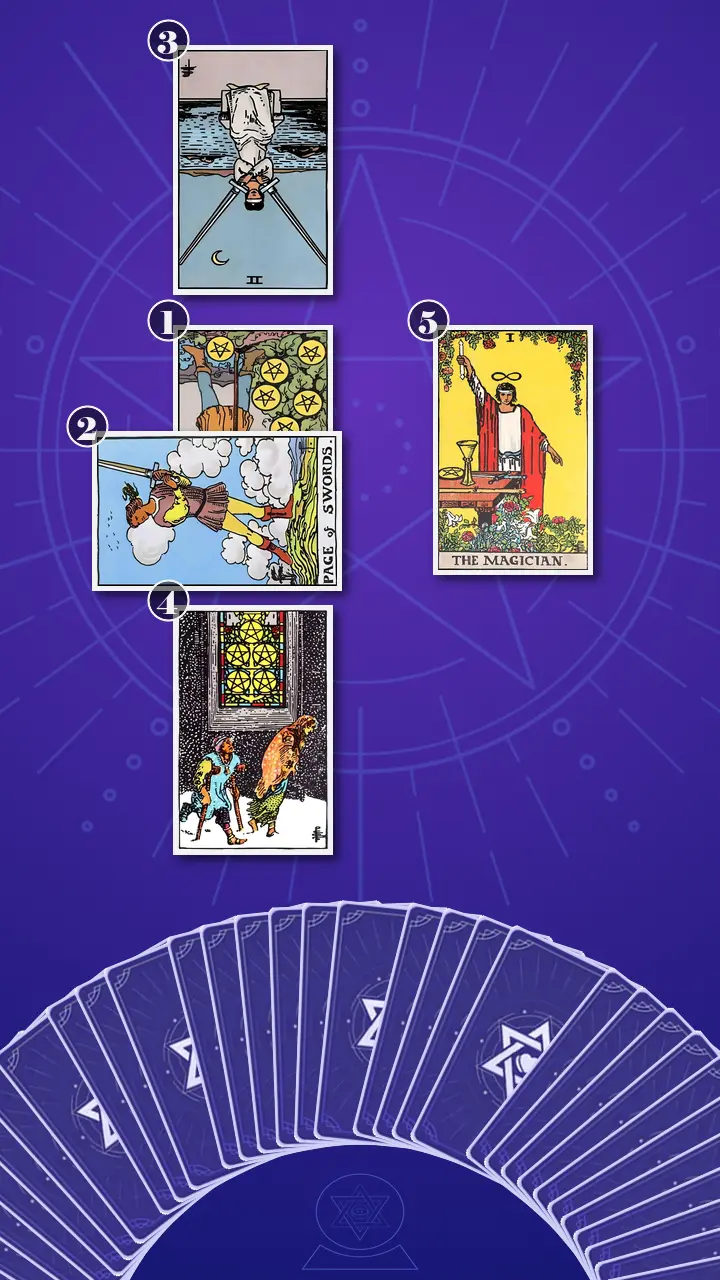
A bigger spread would only have fed the overthinking. This one stays lean and psychologically precise. The center card shows the visible symptom - where building turns into second-guessing. The crossing card shows the pressure making that worse. The card above names the conscious belief loop. The card below shows the deeper fear underneath it. The card to the right shows the lane of movement and agency. The whole layout reads like a road sign at an intersection: the jam in the middle, and the path forward just off to the side if you know where to look.
The Crossed Middle: Where Scanning Replaces Building
Position 1: The Harvest You Keep Interrupting
I turned the center card first, the position showing the visible symptom from the heart of the matter - how career-building keeps turning into progress-checking and second-guessing whenever AI discourse flares up. The card was Seven of Pentacles, reversed.
In real life, this looked exactly like Jordan midway through building a real foundation in content strategy, then reopening the portfolio, resume, or learning plan after every AI headline as if an unfinished season of work should already prove its long-term safety. It is like digging up a plant every few days to check whether the roots are growing.
Energetically, this is blocked Earth. The work is there. The investment is there. But patience collapses into premature auditing. Years ago, on a Wall Street floor, I watched brilliant people confuse short-term volatility with permanent loss. This card carries the same distortion. It is one of the places where I use a framework I call Sunk Cost Decoupling: separating what you have already invested - time, education, status, effort - from the next clean decision. The real question is not, 'Were the last two years wasted?' The real question is, 'What is still compounding if I stop interrupting it?'
Jordan let out a short laugh, the kind with a bruise in it. 'That is accurate enough to be rude,' they said. 'I reopen my portfolio like it is going to confess whether I am safe.'
'Exactly,' I told them. 'And right now, the checking is stealing from the building.'
Position 2: When Staying Informed Turns into Threat Monitoring
I laid the crossing card over the center. This position reveals the immediate pressure crossing the situation - the stream of AI headlines and reactive mental noise intensifying the symptom. The card was Page of Swords, reversed.
This is the lunch-break tab spiral. The 11:43 p.m. blue-light LinkedIn carousel. The Hard Fork clip in the group chat that suddenly changes the emotional temperature of the whole day. A new AI thread or product launch hits the feed, and the workday tilts. Jordan screenshots predictions, opens ChatGPT-versus-Claude comparisons, maybe saves a Ben's Bites newsletter for later, and tells themself, 'I just need to stay informed.'
But this is not balanced curiosity. It is excess Air - the mind running so fast that discernment cannot land. The Page of Swords is the scout archetype tipped into hypervigilance, bracing against every gust and treating every update like a fire alarm in the building. Scanning is not the same as building.
I felt a flash of memory then: six monitors, market alerts, bodies reacting before facts were sorted. Most alarms on a trading floor were noise disguised as urgency. This card held the same posture.
I asked Jordan, 'If constant scanning were true preparation, would you feel this shaky after consuming so much information?'
They winced first, then looked down at their hands, then finally nodded. 'This is literally me,' they said quietly. 'I keep calling it research.'
Position 3: The Notion Board with No Doing Column
Above the center sat the next card, the position that names the conscious story - over-analysis, choice paralysis, and the belief that one perfectly future-proof answer must exist. It was Two of Swords, reversed.
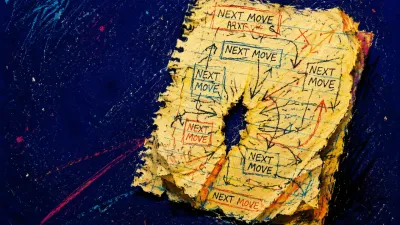
In modern life, this is a Notion board full of possible pivots - content strategy, UX writing, AI operations, product marketing, analytics - and no clean next move because every option immediately generates a new risk calculation. It is the infinite Netflix-scroll feeling, except the thing you cannot pick is your livelihood.
Energetically, this is overloaded Air. Not a lack of thought - far too much of it. Jordan was not only trying to decide what to do next month. They were trying to solve the entire future of work in one sitting. The blindfold in this card is not ignorance. It is the fantasy that if you compare enough tabs, one perfect answer will appear and remove all risk.
'You do not need a perfect future-proof answer to take a grounded next step,' I said. 'Right now, you are checking five transit routes and still missing the train because you never board one.'
Jordan exhaled hard through their nose and leaned back. The movement was small, but I could feel the defense loosen. 'Yeah,' they said. 'I keep telling myself I am being strategic, but mostly I am scared to commit.'
Position 4: The Cold Story Under the Tech Story
I turned the lower card next. This position uncovers the unconscious root - the mechanism-level fear of being left out, replaceable, and out of control in the career arena. The card was Five of Pentacles, upright.
This was the moment the reading stopped being about technology and got honest. Under the AI panic is a colder story: rent, relevance, and belonging all braided together. One article about automation does not land as industry news. It lands like a flash of being left outside the professional room while everyone else stays warm, employed, and already calling themselves AI-native.
Energetically, this is exposed Earth. Safety feels threatened, so every headline turns into a full-body story about income, identity, and social standing shrinking at once. I asked Jordan what actually felt most at risk when the spiral hit hardest. Their face softened before they answered. Their throat moved once. 'It is not really about the tool,' they said. 'It is about feeling like there will not be room for me.'
Rain tapped softly against the window beside us just then, thin and cold against the glass, and the lamplight in my room suddenly looked a little like the stained-glass window on the card. Environment can be honest that way. 'The internet got loud,' I told them, 'but that does not mean your path disappeared.'
When The Magician Put the Tools Back on the Table
Position 5: The Tool-on-the-Table Method
When I turned the final card, the room went noticeably still. Even the radiator had stopped clicking. This was the card to the right, the lane of movement and integration - the antidote in the spread. It was The Magician, upright.
Jordan was still caught in the familiar loop: the brief open, lunch going cold, the cursor blinking while fear asked for total certainty before they were allowed to keep building. That is what headline-triggered career obsolescence panic does so well. It makes paralysis look strategic.
You are not behind because the world is changing; The Magician asks you to stop staring at the noise and start using the tools on the table.
I let that sentence hang there for a beat. Then I added, 'A headline can give context, but it cannot hand down a final ruling on your future. The shift is not from uncertainty to certainty. It is from panic-checking to practice-built evidence.'
The Magician shows a table, not a forecast. One real project. One tool. One person choosing what the tool is for. That is why this card is such a clean answer to AI career anxiety. When I use my framework of Strategic Path Valuation, I do not score a career path by how panic-proof it sounds in a LinkedIn carousel. I ask a harder question: which direction produces the strongest long-term return from your existing strengths if you test it in live conditions? The Magician always improves the valuation because it creates evidence. Voice. Taste. Audience judgment. Relationship reading. Strategic thinking. New tech used intentionally. All of it goes back on the table.
Jordan's breathing caught for half a beat. Their pen hovered above the notebook without touching the page. Then their eyes went slightly unfocused, as if they were replaying last Tuesday - the cold lunch, the salary tabs, the unfinished brief still waiting behind the panic. When they looked back at me, resistance arrived first. 'So what,' they said, voice tight, 'I just stop reading and hope for the best?'
'No,' I said. 'A headline is not a verdict. Hope is not the assignment. Supervised contact is. Close the tutorial tabs and open the sandbox file.'
Something in their face shifted after that. The jaw unclenched. The shoulders dropped a full inch. Their next breath came out shakier, like relief had to squeeze past embarrassment on the way out. They looked down at The Magician again and gave the smallest nod, the kind people give when a truth lands before they are fully ready for it. I asked, 'Now, with this angle, think back over last week. Was there a moment when this would have changed how you felt?'
Jordan swallowed, then laughed softly. 'Tuesday,' they said. 'I could have used the tool on the brief instead of researching whether the brief itself was a dead profession.'
That was the crossing point right there: a move from hypervigilant future-proofing panic to grounded experimentation and steadier self-trust. Adaptability grows faster through practice than through self-surveillance.
The Headline-to-Hands Shift
When I looked back at the whole cross, the story was clean. Seven of Pentacles reversed showed Jordan interrupting slow, meaningful compounding work. Page of Swords reversed showed outside noise weaponizing curiosity into threat-monitoring. Two of Swords reversed showed the conscious myth that one perfectly future-proof answer had to exist before movement could feel safe. Five of Pentacles revealed the real wound: not tech itself, but the fear of exclusion, instability, and becoming professionally invisible. The Magician did not promise certainty. It restored agency. The whole spread felt like a builder getting blown off course by weather until they remembered they could anchor, test, and use the conditions instead of obeying every gust.
The blind spot was just as clear: Jordan had been treating information as control. In practice, that meant outsourcing self-trust to whichever headline arrived last. The transformation direction was simpler and stronger - treat AI news as context, then test one practical skill experiment on one real task. I call that the Headline-to-Hands Shift.
To keep that from becoming another beautiful idea with no traction, I ran it through my 5-Year Horizon Stress Test. I do not ask, 'Can you guarantee this field will look the same in five years?' Nobody can. I ask, 'If you become tool-literate instead of panic-led, does this path still allow your judgment, taste, strategy, and human strengths to compound over the next five years?' If yes, you hold and test. If no, you pivot deliberately. But within the next 72 hours, you make one micro-decision instead of feeding another month of vague dread.
- Boundary-First Trend ScanEach weekday, put one 20-minute AI/news window on your calendar with a hard stop - lunch break, commute home, or after work. The moment it ends, spend an equal 20 minutes using one tool on one live task you already have, like generating headline options for a client brief, clustering research notes, or testing a rough outline.Reading will feel safer than doing because it creates the illusion of control. Use a timer. If 20 minutes feels too big, cut both blocks to 10 and keep the sequence intact.
- The 30-Day Good-Enough ExperimentWithin 72 hours, write one sentence that defines a single 30-day test: 'For the next 30 days, I am testing how AI can support my content strategy work by practicing on one deliverable type.' Before you start, choose three good-enough markers - for example, four finished tests, one clear use case, and one human strength the tool did not replace.Do not let the experiment stay vague so you can keep escaping into theory. Small and specific is the whole point. If 30 days feels too loaded, start with 7.
- Existing-Value Evidence LogFor one week, open your Notes app after work and record one moment when your current skills created value: clarifying a messy brief, catching a tone issue, spotting audience nuance, or turning chaos into a usable structure. At the end of the week, highlight what was specifically human in that value - judgment, taste, synthesis, trust-building, or context.Use receipts, not vibes. A Slack thank-you, a revised paragraph, a cleaner meeting, a better angle - all of that counts.
Jordan frowned at the first step. 'But I do not always have a clean twenty minutes in the day.'
'Then we do not worship the number,' I said. 'We protect the sequence. Ten minutes of news. Ten minutes of tool use. Two bullets: what the tool did quickly, and what still needed you. Small enough that your nervous system will actually let you do it.'

A Week Later, the Quiet Proof
Six days later, Jordan sent me a screenshot from their Notes app. Under a client project were two bullets: 'Tool sped up headline variations.' 'Still needed me for tone, audience nuance, and what not to promise.' Under that, one more line: 'Finished the brief before opening LinkedIn.'
They told me the fear had not vanished, which was exactly the point. The next morning, the first thought in their head was still, what if I am wrong? But this time they laughed, opened the doc first, and ran the experiment before the spiral. Clear, but still a little fragile. That is usually what real change looks like at the beginning.
I do not use tarot to hand people certainty. I use it to give structure back to the moment panic steals it. Jordan did not leave with a guaranteed future. They left with ownership, which is far more useful.
When every new headline makes your chest tighten and your cursor leave the work in front of you, it can feel like you are not just questioning a career path, you are trying to make sure there will still be a place for you inside the future.
So in the next 48 hours, what tiny, almost boring act could prove to your own nervous system that the next headline is context rather than a verdict - one tool on one live task, one note about what still needed your judgment, one experiment with the skills already on your table?
Every reading at AceTarot is a Journey to connect with inner wisdom and empower next step.
Learn more about our Journey to Clarity.