When Career Research Becomes Armor: Testing One Path in Real Life
Finding Clarity in the 1:07 a.m. Tab Spiral
If your Notes app has a list called 'Possible Next Moves,' your search history includes 'choice paralysis career,' and somehow you still end up researching at 1 a.m. instead of choosing, I know this pattern well. That was exactly what Jordan (name changed for privacy) brought to my table on a rainy Toronto afternoon: 'Why do I keep researching new paths at 1 a.m. instead of picking one?'
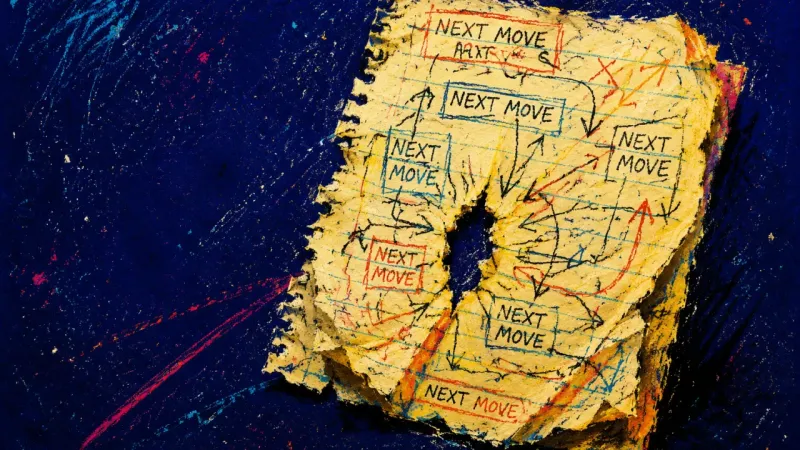
As she spoke, I could almost see the scene she described. It was 1:07 a.m. on a Wednesday, her laptop open on the duvet, phone charging face-up beside the pillow, the room washed in that tired blue screen light that makes everything feel both urgent and unreal. The laptop fan blew warm against her legs. A faint traffic hiss leaked through the window. On-screen: a certificate page, three job listings, a Reddit salary thread, and a Notes page titled 'Possible Next Moves.' Off-screen: sandy eyes, a tight chest, and hands that kept clicking to the next tab as if one more link might finally make the future hold still.
She told me that by day she could look completely functional in her stable-but-not-quite-right marketing job, but one 'I’m thrilled to announce...' post on the TTC could send her straight into a late-night career spiral. She wanted one path she could trust, yet the second a choice felt real, she needed every other door to stay lit. That is the central contradiction of decision fatigue at a career crossroads: wanting to move forward, while fearing that one wrong move will close off a better life somewhere else. Choice paralysis can cosplay as productivity.
What I felt in her words was not laziness and not lack of ambition. It was anxiety with the texture of blue-screen static under the ribs, the kind that flickers fast enough to make twelve open tabs feel safer than one honest application. I met her there gently. I told her I was not here to force a verdict or sell her certainty. I was here to help her draw a map through the fog and find a cleaner kind of clarity.
Choosing the Compass: Why I Used The Shadow Spread
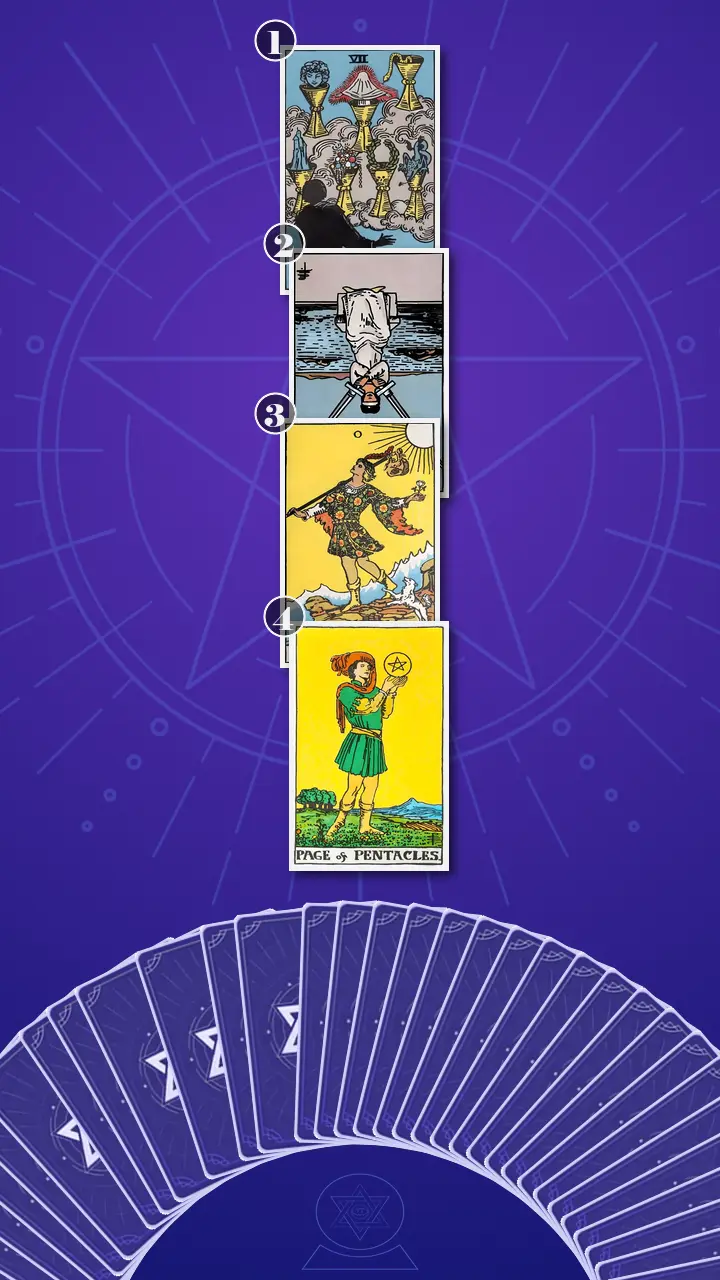
I asked Jordan to take one slow breath and hold the real question in mind, not as a performance for fate, but as a way of gathering her attention back from the internet. Then I shuffled slowly and laid four cards in a vertical line.
For this reading, I chose The Shadow Spread. When people ask me how tarot works in moments like this, my answer is simple: the cards do not replace your judgment; they reveal the pattern your judgment is stuck inside. This is why tarot can help with career indecision and overthinking: not by choosing for you, but by naming the mechanics of the loop more honestly than your browser history can. This spread was right for Jordan because she did not need more options laid out side by side. She already had too many. A more comparison-heavy spread would have fed the very habit that kept her up at night. The Shadow Spread goes deeper with fewer cards: it shows the visible habit, the hidden fear beneath it, the medicine inside the fear, and the grounded next move.
I told her what I was looking for as I turned the spread into a narrow staircase. The first card would name the conscious pattern she could already recognize in daily life. The second would reveal the shadow driver: the hidden fear that kept the loop alive. The third, the key card of the reading, would show the medicine—the part of her that could move before certainty arrived. The fourth would bring the insight back down to earth as practical next steps she could actually take this week.
Reading the Staircase from Midnight Fog to Solid Ground
The Tabs in the Mist
I turned over the first card and named its job before anything else. This position presents the surface behavior named in the diagnosis: the 1 a.m. research spiral, option overload, and the habit of keeping possibilities open instead of making contact with one path. The card was the Seven of Cups, upright.
I have learned to trust the accuracy of that image when someone is staying up researching careers and still getting nowhere. The seven floating cups looked exactly like Jordan’s open browser tabs: all visible, all charged, none embodied. I told her this card was her in bed after midnight with a certificate page, three job listings, a Reddit salary thread, and two 'day in the life' videos open, getting a tiny hit of hope from each one because none of them had asked anything from her yet. It was like building a massive Netflix watchlist and never pressing play, except the subject was her future.
Energetically, this card showed excess Water. Possibility was multiplying faster than her system could digest it. The glow felt like momentum, but it had no traction. The question underneath it was not 'Which option looks best on a screen?' It was 'Which option has touched your real life enough to give you evidence?' Jordan let out a short laugh with a bitter edge and said, 'That is so accurate it feels a little rude.' I smiled and told her that accuracy often feels rude right before it becomes useful.
When Thinking Became Armor
I turned to the second card. This position reveals the shadow driver beneath the behavior: the underlying fear of choosing wrong, losing control, and using more information to postpone emotional risk. The card was the Two of Swords, reversed.
This was the choke point of the whole spread. I pointed to the blindfold and the crossed blades over the chest and told her that reversed, this card is what happens when thinking stops being a tool and starts becoming armor. I translated it into her real life exactly as it had been living in her body: the cursor hovering over Apply, shoulders creeping up, jaw setting hard, chest locking, one more review opening just to be sure. At that point the article is not research anymore. It is protection.
More tabs are not the same as more truth. Reversed, the Two of Swords showed blocked Air—mental energy so overloaded it begins to defend itself from feeling. The real question hiding underneath her late-night spiral was not whether she had gathered enough information. It was what felt hardest to tolerate if she chose one path this week: wasting time, looking inconsistent, spending money, or finding out she could not fully control the outcome. As I said that, Jordan’s fingers froze around her tea mug, her gaze slid away from the table, and she said quietly, 'The extra input really is a shield, isn’t it?' It carried that same split-self feeling people joke about with Severance: competent by day, emotionally gridlocked once the work mask comes off. She nodded before I even finished the thought.
That was the moment I brought in a framework I use often, something I call Void Phase Identification. I told her I was not interested in pathologizing her for being in-between. A void phase is the stretch between one orbit and the next, when the old trajectory no longer feels like a full yes and the new one has not earned trust yet. People are often cruelest to themselves in that stretch. After a decade of reading charts and cards side by side, I have learned that naming the phase correctly removes a lot of unnecessary shame. She was not broken. She was in transition, and she had been using research to avoid the vulnerability of being visibly in process.
When The Fool Stepped into Daylight
The Card That Refused a Verdict
When I turned the third card, the room seemed to quiet itself around the table. A pale strip of afternoon light slid across the spread and caught the yellow sky on the card, as if the reading itself wanted out of blue-screen night. This was the most important card in the spread—the bridge between self-protection and self-trust. This position shows the medicine inside the shadow: the exact shift from certainty-seeking to experimentation and self-trust. The card was The Fool, upright.
The contrast was immediate. After the moonlit tension of the previous card, The Fool brought in clean sky, open light, a cliff edge, a white rose, a small bundle, a dog that feels more like instinct than threat. I told Jordan this was her picking one direction—an intro event, one informational call, one application step—and letting herself be visibly unfinished on purpose. Not asking the internet to certify the path first. Letting the first move produce the information. This is where my Macro-Orbital Projection lens clicked into place: she had been treating a normal orbital transfer as if it were a final lock on her entire life. But a life is not one hallway with one right door. It is a series of changing orbits, and this card asks for beginner courage, not omniscience. When I see this sequence after the reversed Two of Swords, I always think of a planet finally clearing retrograde shadow—not magically certain, simply moving enough for reality to answer back.
It is 1:07 a.m., the laptop is warm on the duvet, your Notes app says 'Possible Next Moves,' and your chest is tight enough that even closing two tabs feels dramatic. That is usually the exact moment you tell yourself more information will calm you down.
You do not need a guarantee before you move; you need one honest step into the unknown, because the Fool learns more at the cliff edge than the mind does in another midnight spiral.
I let the sentence sit between us. Then Jordan had the reaction I was half-expecting and still respected. First, she went completely still—breath paused, hand hovering an inch above the table as if the body had heard the truth before the mind could decide whether it liked it. Then her eyes lost focus for a beat, not absent, but replaying memory; I could almost see last week’s midnight application page returning to her. Then came the emotional turn: not immediate relief, but a flash of anger. 'But if that is true,' she said, 'doesn’t that mean I have been wasting all this time?' Her voice was tight, and for a second that clarity landed like a bruise.
I told her no. It meant the research had been doing a job—trying to protect her from the ego sting of choosing, revising, and being seen learning in public. Once named, that job no longer had to run the whole system. 'A path is data, not destiny,' I said. 'You are not missing the perfect answer. You are missing permission to learn by choosing.' Her shoulders dropped a fraction. She exhaled slowly, then laughed once, softer now, like someone setting down a bag she did not realize she had been carrying with both hands. I asked her, 'Now, with this new view, can you think of a moment last week when one small move would have taught you more than another hour of comparison?' She stared at the Fool, blinked hard, and said, 'The internal content role. I had the draft open. I could have just sent the outreach message.' There it was—the first real step from wired midnight overanalysis toward steadier self-trust built through contact with reality.
One Pentacle at Eye Level
The Apprentice Returns to Earth
I turned the last card and named its role. This position grounds the insight into a practical next move: one concrete beginner step that interrupts the limiting pattern and creates real feedback this week. The card was the Page of Pentacles, upright.
I love this card after The Fool because it lands the leap. The Page does not say, 'Define your entire identity by Friday.' The Page says, 'Hold one thing at eye level and learn from it.' I translated it for Jordan in plain, modern terms: one booked informational interview, one intro webinar, one sample draft, one application paragraph submitted. Not a prettier spreadsheet. Not a renamed folder. One timestamped contact point with reality.
Energetically, this was Earth—balanced, grounded, almost deliberately unglamorous after all the midnight intensity. The card answered her biggest fear with structure. Clarity arrives after contact. When she heard that, she gave me the smallest nod of the reading, but it mattered more than any dramatic reaction. It was the nod people make when something feels small enough to do and real enough to trust.
From Midnight Mental Static to Actionable Advice
When I stepped back and looked at the full spread, the story was clean. Jordan had been living in a hallway full of glowing doors, reading every plaque and calling it progress. The Seven of Cups showed the visible loop: many imagined futures kept emotionally alive at once. The reversed Two of Swords showed why the loop felt so hard to break: more information had become emotional armor against the discomfort of choosing, risking, and maybe revising. The Fool disrupted that old agreement by reframing a choice as a testable direction instead of a lifelong verdict. And the Page of Pentacles completed the lesson: the nervous system she was trying to calm with research would trust her more quickly if she created lived evidence.
The blind spot was simple, but not obvious from inside the spiral. She had been treating a reversible experiment like an irreversible identity verdict. That is why closing one browser tab felt strangely tragic. The transformation direction was equally simple: stop trying to eliminate uncertainty before acting, and choose one low-stakes experiment that creates real-world feedback. Not because tarot says so, but because her own life will teach her more accurately than comparison content ever can.
When I gave her next steps, Jordan made one last honest objection. 'But by night I am fried,' she said. 'That is when I end up doing all of this.' I told her that was not a flaw in discipline. It was a lab problem. One a.m. is a terrible laboratory for big life decisions. So we built the next week around daylight, constraint, and evidence.
- The One-Path ExperimentBy Wednesday evening, pick one lane only—one role, one course direction, or one skill path—and write it at the top of a note called 'This Week’s Experiment.' Do this at your kitchen table, on your lunch break, or in a Saturday café slot, not in bed after 11:15 p.m.If your mind insists on backup options, park them in a separate note. You are not banning future change; you are pausing it long enough to get evidence.
- The Twenty-Twenty Decision SprintSet a 20-minute timer for research on that one chosen path, then a second 20-minute timer for one real-world action: send one outreach message, register for one intro event, or draft one application paragraph to one real person or opportunity.If resistance suddenly sounds very intelligent—'I should compare just a little more first'—that is the loop talking. Do the two-minute version if you need to, but make contact.
- Cosmic Redshift ObservationFor seven days, keep a note with two headings: 'Redshift' for interests that fade when touched by reality, and 'Blueshift' for signals that feel more alive after action. If a late-night search urge hits, drop it into a section called 'After 11:15 p.m., park it here,' then revisit it in daylight. After each decision slot, log what happened, what surprised you, and what your body did before and after.This is not about having dramatic revelations. It is about objective pattern-tracking. Self-trust grows when you notice what is actually approaching your life and what is only glowing at a distance.
I reminded her of the boundary that matters in every career crossroads reading: do not spend money you do not want to spend, do not turn one experiment into a new pressure identity, and do not confuse urgency with truth. You do not need a lifelong verdict to take a beginner step.
A Week Later: The Quiet Proof
Five days later, Jordan messaged me: 'Booked the intro event for Thursday lunch. I still woke up thinking, what if I am wrong? But this time I kept the extra tabs closed and went anyway.'
That was the whole journey to clarity in miniature. Not perfect certainty. Not a cinematic reinvention. Just one woman moving from midnight mental static to steadier self-trust because she let reality answer a question her browser never could.
If tonight you know that particular loneliness of lying under blue light with ten tabs open, wanting one clear future while your chest tightens at the thought of closing even one door, I want you to remember this: being able to name the loop means you are already no longer fully trapped inside it.
If your next move did not have to prove anything about who you are, what is one small experiment you would actually be curious to try?
Every reading at AceTarot is a Journey to connect with inner wisdom and empower next step.
Learn more about our Journey to Clarity.