The Clause I Rewrote All Night - Until We Named Who Decides What

Finding Clarity in the 11:47 p.m. Notion–Cap Table–Slack Triangle
If you keep rewriting one clause at 1 a.m. because it feels safer than telling your cofounder what you actually want—classic founder control vs fairness paralysis with a contract due today.
Jordan (name changed for privacy) sat down across from me in a way I’ve come to recognize: laptop first, body second. She was twenty-nine, building an early-stage startup in New York, and her whole nervous system was still lit up by the document that was due—today.
She described Wednesday night in her Brooklyn apartment like it was a crime scene: Notion on the left, cap-table spreadsheet on the right, Slack draft hovering in the middle like a ghost she couldn’t send. The AC rattled. Her screen glow dried her eyes. Every few minutes her phone warmed in her palm from checking “standard founder split” threads—YC debates, LinkedIn hot takes, a Carta calculator she’d already run three times.
“I changed ‘mutual consent’ to ‘reasonable consent,’ then I changed it back,” she said, voice flat with fatigue. “I’m not trying to win, I’m trying not to get trapped.”
Even as she said it, her jaw worked like she was chewing on a sentence she didn’t want to swallow. Shoulders up. Stomach restless. That wired-but-tired buzz that makes you feel like you could do another hour of edits, but couldn’t possibly sleep.
Her question was simple and brutal: the founders’ agreement was due today—do they go 50/50 to keep it equal, motivating, “we’re in this together”… or does she keep majority control to avoid future deadlock if things get tense?
Underneath it, I could hear the real contradiction humming: wanting a clean 50/50 partnership that feels fair and real and fearing loss of control and future stalemate—fearing, too, that the “wrong” split would later be proof she wasn’t credible enough to lead.
I nodded, slow. “Okay. Let’s not try to solve this with a perfect sentence,” I said. “Let’s try to make a map. We’re here for clarity—not certainty. Clarity you can actually act on today.”

Choosing the Compass: The Scales · Context Edition Spread
I asked Jordan to take one breath that wasn’t for productivity. Not a ‘biohack’ inhale—just a reset. While she held the question in mind, I shuffled slowly, not as theater, but as a way to transition from spiraling analysis into structured reflection. The point is focus: the mind stops sprinting long enough to be observed.
“For this,” I told her, “I’m using a spread called The Scales · Context Edition.”
And for anyone reading this who’s ever searched ‘founders agreement due today can’t decide 50/50 or majority’: this spread works because it refuses to let your brain keep blending everything into one anxious stew. It forces a comparison—benefits and costs—on two clear columns, and then it gives you a synthesis card so you don’t leave with a verdict, but with a principle and next steps.
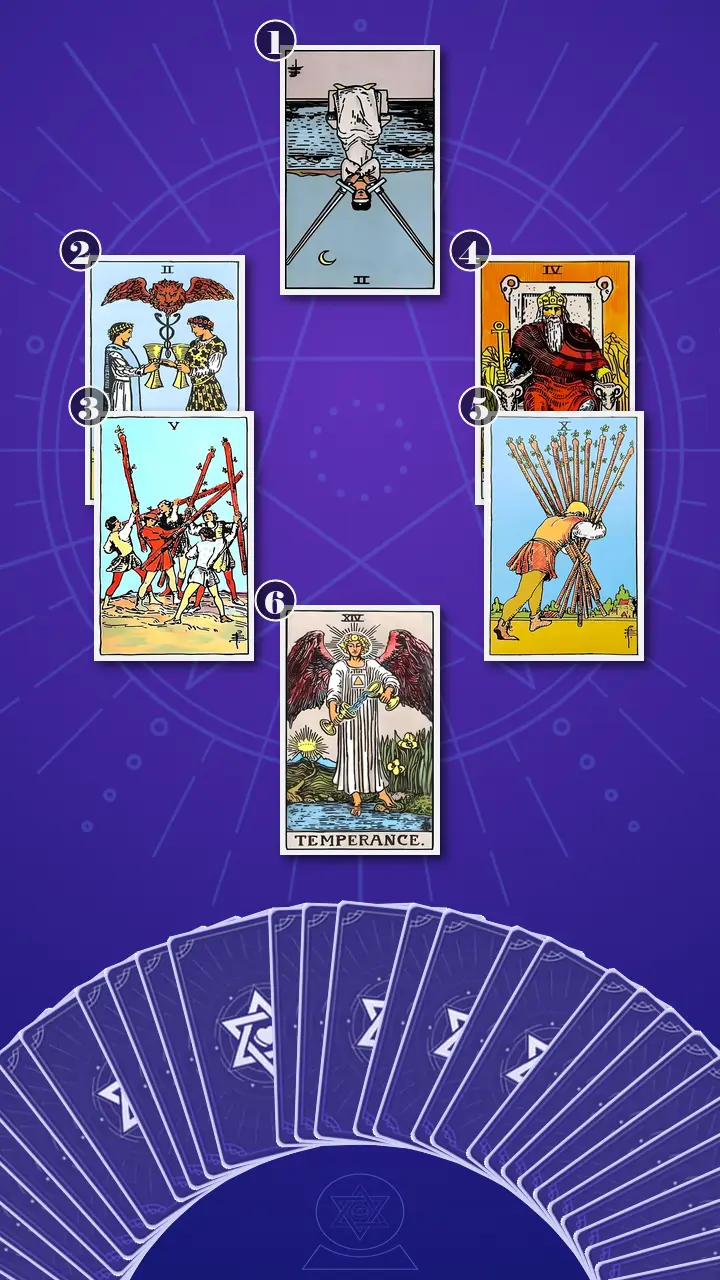
I pointed to the layout as I placed the positions: “The top card names the exact loop keeping you stuck under deadline pressure. The left column will weigh 50/50—what it supports, then what it risks. The right column will weigh keeping control—what it supports, then the hidden tax. And the final card at the bottom is the integration: how you decide and communicate today, in a way that protects the relationship and the business.”
The First Turn of the Scale: What’s Actually Blocking You Today
Position 1: Your current decision block under the deadline
“Now flipped over,” I said, “is the card representing your current decision block under the deadline—the specific pattern keeping you stuck today.”
Two of Swords, reversed.
The image is a blindfolded figure with crossed blades over the chest—defensive neutrality—while restless water moves behind them. Reversed, the stalemate doesn’t stay contained. It spills into urgency, overthinking, and that particular form of ‘responsibility’ that looks like endless editing.
I didn’t have to reach for symbolism very far. I used the life-scene that matched her reality exactly: it’s past midnight and you’re still fine-tuning language in the founders’ agreement—toggling between Notion, a cap-table calculator, and a Slack draft you keep deleting. You’re acting like one more scenario will create certainty, but the real block is that you don’t want to reveal your preference—or your fear—to your cofounder under a due-today deadline.
“This card is blocked Air,” I said, keeping my voice calm. “Thinking is loud, but it’s not landing anywhere. The blindfold isn’t ignorance. It’s intentional. It’s ‘If I don’t admit what I want, I can’t be judged for it.’”
Then I gave her the scene-class analogy exactly as it arrived in my mind—tight and a little wry: “Three tabs, twelve drafts, zero decision. You’re editing one clause. You tell yourself, ‘I’m being responsible.’ Your body is doing the opposite: jaw locked, shoulders up. And the sentence you’re avoiding saying out loud is: ‘I want ____.’”
Jordan let out a laugh that wasn’t amusement—it was a small, bitter bark of recognition. “That’s… cruel,” she said, eyes on the card like it had snitched on her. “But yeah. That’s exactly it.”
“It’s not cruelty,” I replied. “It’s accuracy. And accuracy is the first kindness when you’re trying to get unstuck.” I paused. “Also—stop asking wording to do the job of a conversation.”
Position 2: 50/50 split — what it supports
“Now flipped over,” I said, “is the card representing 50/50—what it supports in partnership, motivation, and shared commitment.”
Two of Cups, upright.
This card is as symmetrical as a handshake. Two people, two cups—mutuality that’s chosen and maintained, not assumed. I used the modern translation I trust for founders who do respect each other: you picture a 50/50 split that isn’t naive—one where you and your cofounder can look at the agreement and feel genuinely partnered. Not “perfectly aligned forever,” but committed enough to talk directly, repair fast, and treat conflict as something you handle together instead of weaponize.
“This is Water,” I told her. “It asks the question your spreadsheets can’t: what kind of partnership do you want to practice when it’s not fun?”
Jordan’s shoulders dropped—just a couple millimeters, but it changed her whole silhouette. Her chest seemed to soften as if she’d been holding her breath since the investor email landed. I saw the impulse to text her cofounder something more human than legalese flicker across her face.
“Yeah,” she said quietly. “When it’s good, it’s really good. We’re… not playing games.”
“Then this card is your reminder,” I said. “Trust is a verb. Not a vibe. Not a cap table.”
Position 3: 50/50 split — the main friction it could amplify
“Now flipped over,” I said, “is the card representing 50/50’s main friction—where it could amplify conflict, stalemates, and decision-making stress.”
Five of Wands, upright.
On the card, everyone is swinging their wand in a different direction. No shared rhythm. No clear leader. In founder terms, it’s the Slack thread where everyone has a hot take and nobody has decision rights.
I used the modern life scenario without sugarcoating it: you flash-forward to a future all-hands where a product decision turns into five strong opinions and zero resolution. In a 50/50 structure, every disagreement risks becoming a mini tug-of-war unless you define who owns what decisions, how ties break, and how long you debate before someone calls it.
“This is Fire,” I said. “Not evil—just heat. Ambition. Opinions. Energy. But in a 50/50 without a tie-break story…” I let the sentence land. “If 50/50 has no tie-break, the tie becomes your lifestyle.”
Jordan’s mouth twisted into a nervous smile. “That’s the exact nightmare,” she said. “The ‘we’re still debating pricing three meetings later’ nightmare.”
I held it steady and moral-neutral, because founders—especially women founders—get shamed from both directions. “Wanting decision rights doesn’t make you a villain,” I said. “And avoiding decision rules doesn’t make you pure.”
Position 4: Keeping control — what it supports
“Now flipped over,” I said, “is the card representing keeping control—what it supports in leadership clarity, speed, and accountability.”
The Emperor, upright.
The Emperor is stone and structure: a throne that doesn’t wobble, armor under robes, a forward-facing posture. Governance infrastructure. Not vibes—rules that hold when people are stressed.
I used the scenario that mirrors the relief she’d been chasing: keeping control starts to feel like relief—fewer circular meetings, clearer calls, faster execution. But the card reframes it: can you name control as “accountable final call in specific domains” rather than “I must hold power so I’m not trapped”? This is leadership-as-structure, not leadership-as-ego.
And here my own mind—archaeologist’s mind—did its involuntary flashback. I’ve held clay tablets in museum storage where a city’s trade agreements were etched with almost tedious specificity. Not because they loved paperwork, but because they understood a cold truth: when the grain runs low, people become less poetic. Structure isn’t romance. It’s survival.
“This card is saying: you can be the decider,” I told her, “without being a dictator. Authority can be accountable.”
Jordan nodded, then hesitated. “It’s also… I don’t know,” she said. “It’s like—if I’m not the one who can break the tie, I’m going to look naive.”
“Yes,” I said softly. “That’s the fear under the fear.”
Position 5: Keeping control — the hidden cost
“Now flipped over,” I said, “is the card representing keeping control’s hidden cost—workload, bottlenecking, resentment, and relationship tone.”
Ten of Wands, upright.
On the card, someone is carrying so much they can barely see the road. It’s responsibility piled so high it blocks what matters. The energy here is excess—too much ‘I’ll handle it’ until you become the human API for every decision.
I used the modern translation straight: you choose majority control and then slowly become the bottleneck—every hiring decision, every product call, every “quick question” routes to you. You can’t take a real day off because the company’s momentum is sitting on your shoulders. Control bought speed—but it also concentrated stress and created a quiet resentment tax.
“Control can be structure,” I said, letting the nuance stand. “It can also be a stress magnet.”
Jordan swallowed. Her hand went to her throat, thumb pressing lightly at the base like she was checking for a pulse. “That’s… also real,” she admitted. “I’m already the one pushing timelines and ops. If I add ‘final say on everything,’ I’ll never stop working.”
“Exactly,” I said. “And resentment doesn’t show up with a calendar invite. It shows up as a slow loss of warmth.”
When Temperance Spoke: The Third Option Hidden Inside the Binary
Position 6: Integration — how to decide and communicate today
I let the room quiet for a second before turning the last card. Even on a Zoom call you can feel it—when the air shifts from debate to something closer to truth.
“Now flipped over,” I said, “is the card representing integration—the principle to prioritize and a concrete direction for how to decide and communicate today.”
Temperance, upright.
The image is an angel pouring water between two cups, one foot on land and one in water: practical terms blended with relationship care. It’s the opposite of the Two of Swords blindfold. Nothing is being avoided. Everything is being calibrated.
Setup. Jordan was caught in the night-before-contract-due spiral: Notion terms open, cap-table spreadsheet open, Slack draft half-written—jaw clenched like the right wording might prevent every future founder fight. She was trying to eliminate all future risk through the split, as if math could pre-solve conflict.
I said the line that often changes the temperature in the room: “Equity isn’t where you ‘prove’ trust. Governance is where you make trust survivable when you’re both stressed, stubborn, and right.”
Delivery.
You’re not choosing between being ‘equal’ or being ‘in charge’; you’re learning to pour structure and trust between two cups until it becomes a system you can both live with.
I stopped speaking. I let the sentence hang there like a bell continuing to ring after the strike.
Reinforcement. Jordan’s reaction came in a chain—three small movements that told me the message went past her intellect and into her body. First, a freeze: her breath caught, and her eyes went unfocused, like she was watching a memory replay—future meetings, future ties, future resentment—rewind in real time. Second, the cognitive shift: her gaze returned to the card, but softer, less combative, like she was seeing the question in a new frame. Third, the release: her shoulders dropped fully, and she exhaled through her nose with a tremor of almost-annoyed relief. “Oh,” she said. Not triumphant—just clear. Then, a flicker of vulnerability followed it, the kind that comes when you realize you can’t hide behind research anymore. “But if that’s true,” she added, voice sharper for a beat, “doesn’t that mean I wasted all night obsessing?”
I didn’t rush to soothe it. “No,” I said. “It means your system is working exactly as designed: when a relationship risk shows up, you try to handle it with analysis. Temperance is asking you to redesign the system.”
Then I used my own diagnostic lens—my Historical Case Matching. “In archaeology we study civilizations at crossroads,” I told her. “What collapses them usually isn’t the presence of conflict. It’s conflict without a durable process—no shared method for dispute, no agreed escalation. The Roman Republic didn’t fail because people disagreed. It failed when its governance couldn’t hold the stress. Your company is not Rome, but the pattern is the same: you don’t need perfect people. You need survivable rules.”
I leaned in. “Now, with this new frame, I want you to look back at last week. Was there a moment—one specific moment—where you felt the deadlock fear spike? A product call, a hire, pricing?”
Jordan didn’t even have to think. “Product direction,” she said immediately. “We both have strong instincts there.”
“Good,” I said. “Now we translate heat into system. ‘What if we disagree on product direction?’ becomes: ‘Product strategy requires unanimous agreement. Sprint execution has a single owner. Tie-break is X.’ That’s Temperance. Conflict-to-system translation.”
And I named the shift for her, explicitly: “This is the move from deadline-driven analysis paralysis and fear of regret to grounded, governance-first confidence with clear decision rights. Not by picking a morally ‘right’ split. By designing how trust survives stress.”
The One-Page Governance Draft: Actionable Advice for the Next 60 Minutes
I gathered the spread into one story, the way I’d summarize a dig site for a student: you don’t start with the artifact; you start with the layers.
“Here’s the layer-cake,” I said. “Two of Swords reversed shows your current loop: you’re trying to stay neutral and safe by rewriting clauses, but it’s actually increasing risk by delaying the real conversation. Two of Cups shows what you’re protecting: a partnership where respect is real and repair is possible. Five of Wands shows the stress-test: 50/50 without decision rules becomes endless sparring. The Emperor shows the temptation and the strength of clear authority—someone can decide—but Ten of Wands shows the tax: control can turn you into the bottleneck and quietly poison your energy. Temperance is the bridge: you don’t choose trust or structure; you blend them into governance.”
“Your cognitive blind spot,” I continued, “is treating the equity split like a character test: fair founder versus strong CEO. That’s why you feel guilty no matter what. The transformation direction is different: shift from trying to eliminate all future risk through structure to choosing a structure that matches your values, then defining decision-making rules that reduce deadlock.”
Jordan blinked. “Okay,” she said, and then the inevitable real-world objection surfaced. “But I literally don’t have time. I have an investor email thread, and my cofounder is in back-to-back meetings. I can’t fit… a whole governance overhaul today.”
“Perfect,” I said. “Temperance doesn’t ask for a governance dissertation. It asks for a messy v0 you can ship.”
I introduced my intervention framework the way I’d teach fieldwork: Time Stratigraphy Method. “We separate what’s an impulse from what’s lasting value. Deadline panic is a topsoil layer—loud, recent. Your real values are deeper strata. We’re going to write from the deeper layer, not the buzzy one.”
- The One-Sentence Non‑NegotiableOpen a blank note and write exactly one sentence: “I need this agreement to protect us from ____.” Don’t explain it yet. Just name what you’re actually protecting (deadlock, burnout, resentment, loss of speed, loss of trust).Set a 3‑minute timer. When it goes off, stop. If you feel the urge to edit wording, put your hand on your jaw for 10 seconds and write the sentence you’ve been avoiding—messy is fine.
- Decision Rights List (3–3–3)Draft three bullets: (1) “Unanimous decisions:” pick 2–3 categories max (e.g., product strategy, fundraising, hiring execs). (2) “Single-owner decisions:” assign 2–3 categories to you and 2–3 to your cofounder (e.g., ops, marketing, sprint execution). (3) “Tie-break / escalation:” choose one rule (trusted advisor vote, CEO call after X minutes, or 24‑hour cool‑off + written proposals).Name domains, not identity. You’re not writing “I’m in charge.” You’re writing “who decides what.” Lower the bar: five sentences max.
- A 30‑Minute “Governance, Not Equity” ChatSend your cofounder a short Slack/email today: “Before we finalize the split, can we agree on decision rules so 50/50 doesn’t become deadlock (and control doesn’t become burnout)? Can we do 30 minutes—roles, decision areas, tie-break, and a 90‑day review checkpoint?”Use my Voyage Log Technique: treat it like ancient navigators—date, route, and checkpoints. One calendar invite, one agenda, one 90‑day revisit. Cameras optional. If the conversation heats up, pause and name the state: “I’m getting flooded—can we take 10 and come back?”
“And if you end up keeping control in any domain,” I added, “pair it with an accountability clause: how you’ll communicate decisions, when you’ll consult, and how feedback is handled. That’s my Artifact Restoration Thinking: power without repair instructions is a cracked vessel—you can still carry water, but it leaks trust.”

A Week Later: Ownership, Not Certainty
Six days later, I received a message from Jordan. No essay. No twelve-paragraph justification. Just a screenshot of a short doc titled: How we decide when we disagree. Under it: three bullets—unanimous, single-owner, tie-break. And one line beneath the screenshot: “Sent the messy v0. We talked. I slept.”
She told me they didn’t magically become conflict-free. The morning after, she still woke up with the first thought—what if we picked wrong?—but this time she noticed it, exhaled, and kept moving. Clear, but still human. She finalized the agreement later that day, then sat alone in a quiet coffee shop for an hour, not celebrating, just feeling the strange lightness of having done the hard, direct thing.
What stayed with me was not which split she chose, but the shift in posture: from trying to pre-solve every future fight with perfect clauses to building a governance-first system where trust could breathe under stress.
When the agreement is due today, it can feel like you’re holding a pen over the signature line while trying to pre-solve every future fight—because if you choose “wrong,” you’re terrified it’ll prove you were never credible enough to lead.
If you stopped asking the split to guarantee trust, what’s one simple decision rule you’d want in writing so trust can breathe even on your worst-stress day?