Two Invites, One Night: Escaping Tonight's RSVP Guilt Text Spiral

Finding Clarity in the 6:40 p.m. Scroll
You’re a 20-something in NYC with a client-facing job, and two invites hit the same night—one networking, one a close friend’s birthday—and suddenly your whole evening feels like a moral exam (hello, social obligation guilt).
Maya (name changed for privacy) said it like she was confessing to a crime, not describing a Friday night. She sat on the edge of my chair with her tote bag still looped over her wrist, as if she might sprint out the door the second she had “the right answer.”
In my mind, I could already see the scene she’d lived an hour earlier: 6:40 PM in an East Village apartment, half in a dress, half in work mode. Laptop still open on a deck. Phone warm from constant scrolling. The AC rattling like it’s annoyed you’re still home. The glow of the screen bleaching your eyes while subway alerts chirp from somewhere down the block. And your thumb doing that tiny, frantic loop between Eventbrite, Instagram stories, and iMessage drafts, like refreshing could change reality.
“I keep rewriting the text,” she told me. “Like… if I can just get the wording perfect, no one will be mad.” Her hand lifted unconsciously to her face, and I watched her jaw tighten, then tighten again—as if her muscles were taking the blame for her calendar. “If I pick networking, it’s like I’m saying my friend doesn’t matter. If I pick the birthday, I’m falling behind.”
I’ve guided thousands of visitors under a planetarium dome in Tokyo. When the room goes dark and the stars snap into focus, people always want to see everything at once. But the truth is: you can’t hold the whole sky in your eyes in one moment. You choose a constellation. You point the laser. You let one pattern tell you a story.
“The way your chest and jaw are holding this,” I said gently, “it’s like you’re standing at two doors with a hand on each handle, trying to keep both worlds happy—and your body is the one paying the cover charge.”
Her fingers fluttered over her phone, restless. The guilt around her felt physical—like trying to breathe through a scarf pulled too tight.
“Let’s aim for one thing tonight,” I told her. “Not a perfect choice. Clarity. A map you can actually follow—so you can be fully in one room, instead of half-present in both.”

Choosing the Compass: The Decision Cross Tarot Spread
I don’t treat tarot like a mystical courtroom where the cards hand down a verdict. I treat it like a focusing tool—like dimming the house lights so the important details come forward.
“Before we pull cards,” I said, “let’s do something small to get you out of that pre-event spiral.” I guided her into my pre-meeting 3-minute cosmic breathing: three slow inhales, longer exhales, like we were letting her nervous system drift into a stable orbit. Not spiritual theater—just physiology with a little starlight in the metaphor.
Then I shuffled and said, “Tonight we’ll use a spread called the Decision Cross. It’s designed for exactly this: two choices that both matter, plus the guilt-and-boundaries layer that makes a simple RSVP feel like a character test.”
For you reading this—if you’ve ever searched ‘How do I choose between two plans without feeling guilty?’—this is why I like the Decision Cross tarot spread for two choices: it gives just enough structure to separate noise from signal. One card shows the stuck point (where your mind is hijacking the choice). Two cards show what each option is really offering. Two more show what each path tends to reinforce in your identity and capacity (not a prediction, more like a “this is what this choice trains in you”). Then the final card is guidance: the clean boundary, the tone of the message, the principle that helps you commit without guilt bargaining.
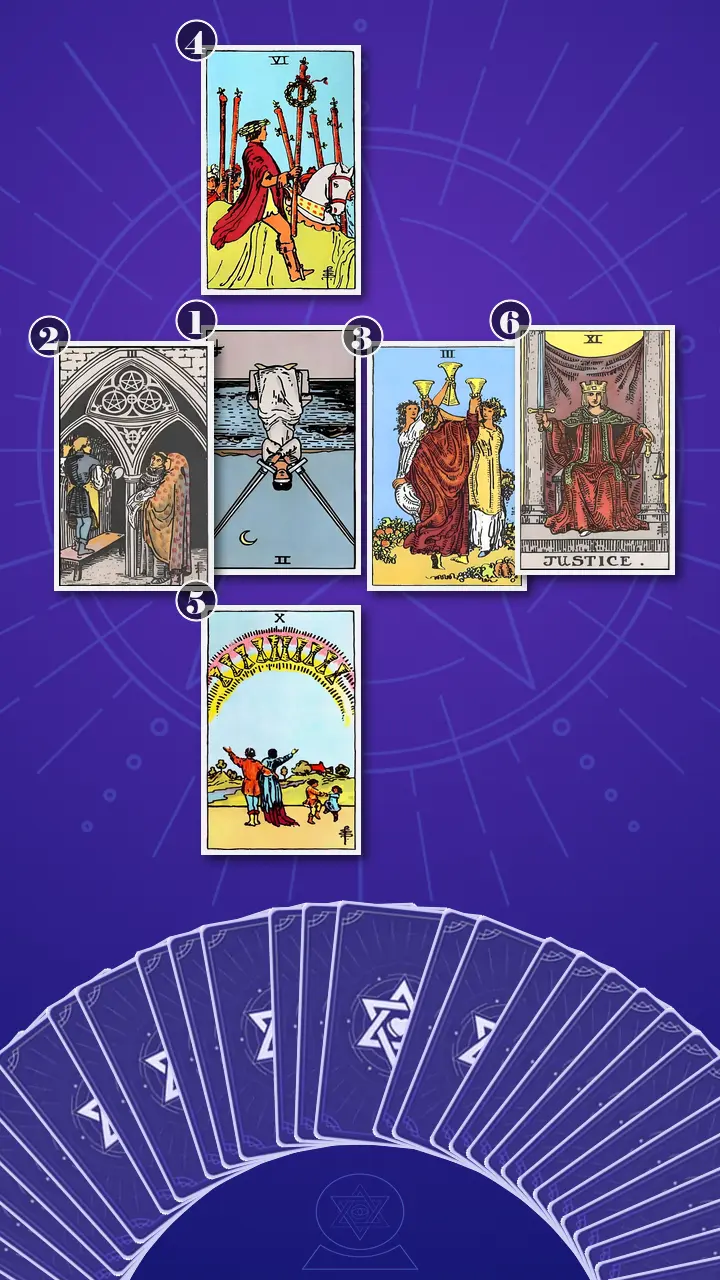
I placed the cards in a cross layout, like balancing two sides of a scale. “We’ll read from the center,” I told her, “then take the left path and its outcome, then the right path and its outcome, and we’ll end with guidance—like setting the scale down with a clear decision stamp.”
Reading the Map: Two Doors, One Body
Position 1 — The immediate stuck point: how guilt and mental pressure are showing up
“Now flipping over,” I said, “is the card that represents the immediate stuck point: how guilt and mental pressure are showing up in the decision.”
The Two of Swords, reversed.
“This is the Two of Swords reversed meaning in real life,” I told her, “when indecision stops being neutral and turns into a stress loop.” I tapped the image lightly. “The blindfold. The crossed swords. It’s self-protection.”
And I used the translation that always lands for people living in their phones: “You’re standing in your apartment with two message drafts open, toggling between them like you’re trying to hack a third option into existence. You keep rewriting the apology so no one can possibly take it the wrong way… but the real tell is your body: tight jaw, tight chest, restless hands. The longer you delay, the more the choice stops being about logistics and starts feeling like a character judgment.”
Maya gave a quick, bitter little laugh—half embarrassment, half relief at being seen. “That’s… honestly kind of brutal,” she said. “But yeah.”
I leaned in slightly. “Here’s the energy dynamic: this isn’t ‘too much logic.’ This is logic as armor. Air energy is overactive and tangled. It’s trying to think away discomfort.”
I let a beat of silence settle, and then I said one of my sharpest truths, the one that always changes the temperature in the room: “A paragraph isn’t a boundary. It’s a negotiation.”
Her eyes flicked down to her phone like she’d been caught. Then back up to me. A quiet wince, then a nod—exactly the “yes, that’s exactly what I’m doing” her body had been trying to say with that clenched jaw.
“You’re calling it being considerate,” I said, “but a part of you is afraid of being misunderstood. That fear is what’s driving the delay.”
Position 2 — Path A energy: what the networking invite is really offering
“Now flipping over,” I said, “is the card that represents Path A energy: what the networking invite is really offering you psychologically and practically.”
The Three of Pentacles, upright.
“This is an Earth card,” I told her, “and it’s the antidote to that airy gridlock. It’s practical. It’s grounded.”
Then I gave her the modern scene: “At the networking event, you don’t force big energy. You find one small cluster where people are actually talking about work—campaigns, tools, what they’re learning. You ask a real question, share one useful detail, and let the connection form around competence. The night feels like building, not begging for approval.”
She blinked, and I watched her shoulders drop a fraction—like her body had been bracing for the word “networking” to mean performance. “Oh,” she said softly. “So it doesn’t have to be… fake.”
“Exactly,” I said. “Builder mode, not audition mode. Think of it like a group project where you bring one useful slide, not a personal TED Talk.”
And because my brain is trained in orbital mechanics, I added my own lens: “Networking can be a gravity assist. You don’t go to ‘be impressive.’ You go to let one well-chosen interaction alter your trajectory over time.”
I saw her breathe a little deeper, like that idea gave her permission to be normal.
Position 3 — Path B energy: what the friend’s birthday is really offering
“Now flipping over,” I said, “is the card that represents Path B energy: what your friend’s birthday is really offering you psychologically and relationally.”
The Three of Cups, upright.
“This is where we stop treating friendship like an obligation,” I told her, “and start treating it like a resource.”
I translated it into her world: “You walk into the birthday and the volume hits you first—laughter, music, that warm chaos of people who already know your face. You’re not trying to impress anyone. You’re just participating: a hug, a drink order, a ‘tell me everything’ moment at the table. For a beat, your shoulders actually drop because belonging isn’t something you have to earn in this room.”
Maya exhaled, warm and long. Her mouth softened into something like tenderness. “I miss that,” she admitted, and it came out quieter than she meant it to. “Like… I miss being able to just be there.”
“That’s the card,” I said. “Belonging, not approval.”
Position 4 — Outcome lens for Path A: what choosing networking tends to reinforce
“Now flipping over,” I said, “is the card that represents the likely growth/outcome of choosing Path A—not predicting a specific result, but what it tends to reinforce in your identity and momentum.”
The Six of Wands, upright.
“This is visibility,” I said, “but not random validation. Earned momentum.”
And I grounded it: “After choosing networking, you leave with one small but real win: someone remembers your name, you exchanged numbers, and you have a clear next step. The biggest shift is internal—you feel more legitimate because you acted like the version of yourself you keep waiting to become.”
Her eyes lit with a flicker of hunger that didn’t feel shallow—it felt like self-respect. “I want that,” she said. “Not clout. Just… momentum.”
“Exactly,” I said. “Fire energy as confidence. Not as ‘everyone has to like me.’”
Position 5 — Outcome lens for Path B: what choosing the birthday tends to reinforce
“Now flipping over,” I said, “is the card that represents the likely growth/outcome of choosing Path B—what it reinforces in belonging and emotional capacity.”
The Ten of Cups, upright.
“This is the long arc of support,” I told her. “It’s what makes everything else sustainable.”
I offered the real-life version: “After choosing the birthday, you get home feeling emotionally filled up—not because the night was perfect, but because you reinforced a bond that makes your life more sustainable. The next morning, you feel less alone in your week. It’s not productivity, but it’s capacity.”
Maya’s face softened further, and her shoulders sank like they’d been held up by wires all day. “That sounds like… what I actually need,” she said. And then, because she was honest, she added, “And I hate that I need it.”
“That hate is just your pressure talking,” I said. “Connection is not a detour. It’s a charging cable.”
Position 6 — How to choose without guilt: the clean boundary and message
I let my hand hover over the final card for a second. The room felt quieter—not in a dramatic way, but in that real way when someone stops talking long enough to hear themselves think.
“Now flipping over,” I said, “is the card that represents how to choose without guilt: the clean boundary, message, or principle that helps you commit with self-respect.”
Justice, upright.
This is one of the clearest cards for boundaries and fairness—Justice tarot meaning isn’t punishment; it’s proportionality. It’s truth that matches reality. Scales and sword: weigh, then decide.
Maya’s first reaction wasn’t relief. It was resistance. Her brows snapped together and she said, sharper than before, “But if I choose one, someone is going to feel disappointed. So… what, I’m just supposed to be okay with that?”
I nodded. “That’s the heart of it.”
Setup: It’s 6:40 PM, you’re half-dressed with your laptop still open, flipping between a networking Eventbrite page and your friend’s Instagram story—rewriting the same “maybe I can do both?” text like the perfect wording will erase disappointment. You’re trying to make a decision that causes zero discomfort, which turns choosing into a trap.
Delivery:
Stop trying to be two places at once and call it kindness; choose one clear yes, then let Justice’s scales and sword turn guilt into an honest boundary.
I let that line hang in the air. No extra explaining. Just the sentence, like a clean cut.
Reinforcement: Maya’s body did a whole three-part reaction chain in front of me. First, a micro-freeze—her breath caught, and her fingers stopped moving as if someone had paused her mid-scroll. Then her eyes unfocused, not blank but inward, like she was replaying the last dozen nights she’d tried to “do both” and ended up resentful in an Uber and distracted in every room. Finally, a release: her shoulders dropped in a slow, unfamiliar way, and she let out a shaky exhale that sounded almost like a laugh without the humor.
“I keep telling myself it’s kindness,” she said, voice smaller now. “But it’s not. It’s… fear. I’m scared they’ll decide I’m not loyal. Or not serious.”
“That fear is the dark matter,” I said—my Dark Matter Detection lens sliding into place. “You can’t see it directly, but it’s shaping everything. The visible problem is ‘two invites.’ The hidden gravity is ‘If I disappoint someone, I lose belonging.’”
Her eyes shimmered, not quite tears, more like the first heat under ice. She swallowed. “So what do I do with that? Just… let it be there?”
“Yes,” I said. “And then choose anyway—with integrity.”
I pointed to Justice’s scales. “Proportionality. What can you actually hold tonight? Time, energy, attention—those are finite.” Then I pointed to the sword. “Clarity. One honest commitment. No bargaining with reactions.”
And I added, “In spacecraft terms, this is an attitude adjustment. You’re not changing your entire life. You’re reorienting your craft so you stop spinning. The discomfort is the moment the thrusters fire.”
I looked at her and asked, “Now, with this new view—think back to last week. Was there a moment where you tried to manage everyone’s feelings instead of making a clean yes? What would Justice have had you do?”
Maya stared at the card, then nodded once, slow. “I would’ve sent the short text,” she said. “And I would’ve stopped checking my phone like it was going to absolve me.”
That was the shift: from guilt-driven people-pleasing and decision paralysis to values-based commitment with calm, clear communication. Not perfect. Not painless. But real.
The One-Room Rule: Actionable Advice for Tonight
I gathered the whole story the cards had told: The Two of Swords reversed showed the core trap—trying to avoid disappointment by not choosing, turning a simple RSVP into a moral verdict. The Two “threes” showed that both options were actually about community: one professional (Three of Pentacles) and one personal (Three of Cups). The outcomes made it clear that neither path was “wrong”—one reinforces visibility and confidence (Six of Wands), the other reinforces belonging and capacity (Ten of Cups). And Justice tied it together with a framework: fairness, reality-based limits, and clean communication.
“Here’s the cognitive blind spot,” I told her. “You’re treating other people’s immediate feelings as proof of your character. But disappointment isn’t a verdict—it’s a normal human moment. Your job isn’t to prevent it. Your job is to be clear and kind.”
“And the transformation direction,” I continued, “is exactly this: moving from avoiding anyone’s disappointment to making one values-based commitment and communicating it clearly and kindly.”
I pulled out my phone for a moment—not to scroll, but to model the thing. “Let’s do my quick constellation alignment,” I said. “Two stars. Two headings. No essay.”
“Seven minutes,” Maya said, half-skeptical.
“Seven minutes,” I agreed. “Not to solve your identity. Just to choose what you can genuinely hold tonight.”
- The 7-Minute Values CheckSet a 7-minute timer. In Notes, write two headers: “Career momentum” and “Friendship home base.” Under each, write one honest value you’d be protecting tonight (not what you “should” do). Choose the invite that best matches the value that feels most time-sensitive this week.If your chest tightens, do three slow exhales first—no forcing. Treat this like interstellar navigation: you pick a direction with the fuel you actually have, not the fuel you wish you had.
- The Two-Sentence RSVP Rule (Justice-Text Template)Text the plan you’re not attending with exactly two sentences: (1) a clear no for tonight, (2) warm care + a specific follow-up plan (“Can I take you for coffee Sunday?” / “I’m free next week—want to pick a night?”).Expect the urge to over-explain. You can add one warm line if needed, but don’t turn it into a defense brief. Clarity can be warm. Vague can be cruel.
- Do Not Disturb for the First 60 MinutesAfter you hit send, put your phone on Do Not Disturb for the first 60 minutes of the event you chose. Pick one room. Then actually arrive.If you’re worried about emergencies, allow calls from Favorites only. Your nervous system deserves a clean landing strip.
Maya frowned at the simplicity like it was suspicious. “But what if they’re mad?” she asked.
“Then they’re mad,” I said, not coldly—just honestly. “Justice isn’t about controlling the reaction. It’s about controlling the integrity of your side of the street.”
And because she was a marketing person, always thinking in outcomes, I offered the gentlest version of my Gravity Assist Simulation: “Which choice helps Future You more this week? Not ‘forever.’ Just this week. Sometimes one night of home-base refueling is what makes the next five workdays possible. Sometimes one strategic room builds momentum that reduces your career FOMO spiral. Either way, your clarity comes from commitment.”

A Week Later: The Quiet Proof
Six days later, I got a message from Maya while I was prepping a late-night planetarium show script—making sure the timing of a meteor shower segment matched what the sky would actually do. Her text was short enough to make me smile.
“I did it,” she wrote. “Two sentences. No essay. I went to the birthday, put my phone on DND for an hour, and I swear my shoulders dropped for the first time all week. I still had a tiny panic wave at first. But it passed.”
It wasn’t a dramatic life overhaul. It was a small, real proof: she’d stopped trying to be two places at once. She’d chosen one clean yes. And she’d let the discomfort exist without turning it into a story about who she was.
That’s the journey I trust—moving from guilt-driven people-pleasing and decision paralysis to values-based commitment with calm, clear communication. Not because it makes everyone perfectly happy, but because it makes you present. It gives you back your night.
When two invites hit the same night, it can feel like your whole identity is on trial—ambitious enough for the room, loyal enough for your people—so your chest tightens and you try to write a message that makes disappointment impossible.
If you didn’t have to be universally liked tonight, what would one clean, values-based “yes” look like—and what’s the kindest two-sentence way you could stand by it?