Two Offer Tabs Open—And the 90-Day Contract That Let Me Commit

The 11:13 p.m. Two-Tab Loop
You’ve got both offer emails open in two tabs, and you keep toggling like the right choice will appear if you stare hard enough—classic choice paralysis.
That’s how Jordan (name changed for privacy) started, sitting at their kitchen table in London on a video call with me. It was 11:13 p.m. their time—the kind of late where the laptop glow makes everything feel slightly more dramatic than it should. A half-finished mug of tea cooled beside the trackpad. The overhead light had that thin fluorescent hum that makes your shoulders creep up without asking permission.
On their screen: agency offer PDF on the left, in-house benefits page on the right. Slack and LinkedIn lurking like background tabs you swear you’re not checking. Their leg kept bouncing under the table—so fast it made the camera shake sometimes—and their thumb hovered near the reply button like it was a trapdoor.
“The deadline is today,” they said, voice tight in a way that tried to sound casual. “And I can’t hit send. I keep thinking: if I pick wrong, I’m going to set myself back a year. Like… permanently.”
I watched their hand move off-screen and come back rubbing at their palm, as if they could massage the buzzing out of it. Pressure has a very specific texture. It isn’t just a thought—sometimes it’s a tight chest, restless legs, and hands that feel electrified right when you’re about to commit.
“I get it,” I said. “When a same-day deadline is loud, your brain starts treating an email like an identity verdict—agency vs in-house becomes ‘who am I forever.’ But we’re not here to shame the spiral. We’re here to map it, and then find clarity in a way you can actually use tonight.”
They exhaled, sharp and annoyed. “Please. Because I’ve made three pros and cons lists, and they’re basically personality tests now.”
“Overthinking is your brain trying to buy certainty with spreadsheets,” I said, and they gave a tiny, bitter laugh that sounded like recognition landing a little too close to home.

Choosing the Compass: The Two Paths Spread
I asked Jordan to put their phone face down for a moment—not as a mystical rule, just a way to cut the noise. “Two breaths,” I said. “Longer exhale than inhale. We’re giving your nervous system a signal that this is a decision, not a chase.”
On my side of the screen in Tokyo, I shuffled slowly. My day job is guiding people through the night sky at a planetarium. Ten years of explaining orbital rhythms teaches you something: when you’re inside a spinning system, everything feels urgent. When you zoom out, you realize motion is normal—and timing matters more than panic.
“We’ll use a spread called Two Paths,” I told them. “It’s simple and deadline-friendly.”
For you reading this: the reason I use the Two Paths tarot spread for choosing between two job offers is that it stops rumination from turning into a foggy debate. It separates what each option offers from what each option costs, and then it gives us an integration card—because the point isn’t ‘which is better,’ it’s ‘how do you make a self-led choice under pressure.’
“Card one shows your current decision state under the deadline,” I said. “Then we’ll look at the agency path and its cost. Then the in-house path and its cost. And the final card is the bridge—the most grounded way to stop overthinking and take a clean next step today.”
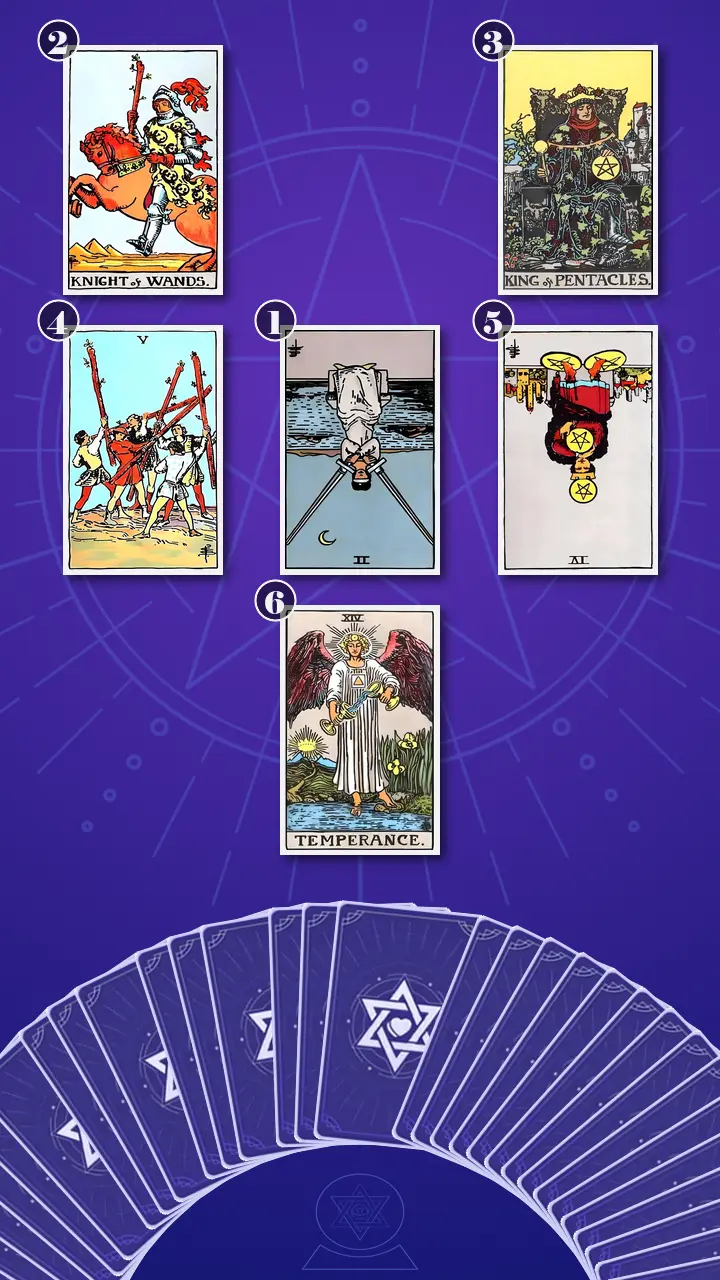
Reading the Map: Fire, Earth, and the Cost of Each
Position 1: The Loop Right Before You Commit
“Now flipped over,” I said, “is the card that represents your current decision state under the deadline: the exact way overthinking shows up behaviorally and mentally.”
Two of Swords, reversed.
I didn’t even have to reach for an abstract explanation; the card met Jordan exactly where they were.
“This is deadline day and you’re doing the exact same loop,” I said. “Agency offer PDF → in-house benefits page → your colour-coded pros/cons in Google Sheets → back to the unsent draft email. You tell yourself you’re being responsible, but your body is giving you a different read: chest tight, legs bouncing, hands buzzing when you hover over ‘Send.’”
Jordan’s mouth twitched. Then they let out a short laugh—almost a snort—like the universe had exposed their browser history.
“That’s… literally my screen,” they said. “Okay, that’s kind of rude.”
“I know,” I said, gently. “And it’s not a moral failing. The Two of Swords is your mind trying to protect you. The blindfold is you cutting off emotional data so you can keep pretending there’s a perfect answer hiding in the details. Reversed, that ‘calm neutrality’ leaks into rumination and last-minute pressure.”
I named the energy dynamic plainly: “This is Air energy in excess—analysis over-activated. Not balanced thinking. Not clarity. More like… ‘The Good Place’ moral philosophy spiral energy, where you keep trying to think your way into the right choice until you’re frozen.”
I watched Jordan’s shoulders lift toward their ears as if bracing for judgement. I kept my voice steady. “It looks like research, but it feels like avoidance. And underneath it is a very specific fear: ‘If I pick wrong, it proves I can’t be trusted.’”
Their eyes flicked away from the screen, unfocused. Their bouncing leg slowed for half a second—then sped up again.
“So,” I asked, “what’s the exact moment you always stop at—right before you’d have to commit?”
“Right before I reply,” they said instantly. “I draft it. Then I rewrite the subject line three times because I want to sound confident. Then I go back to the spreadsheet. Like one more look will change my whole personality.”
“That’s the stalemate,” I said. “And tonight, our job is not to win the argument in your head. It’s to take the blindfold off long enough to choose a lane.”
This isn’t a forever decision. It’s a next-season decision.
Position 2: Agency as Momentum
“Now flipped over,” I said, “is the card that represents the agency path: what this option offers you right now—growth style, learning environment, momentum.”
Knight of Wands, upright.
“Agency shows up as pure momentum,” I said. “You can picture yourself pitching, juggling different brands, getting thrown into new briefs, learning fast because the pace forces you to. The relief is real—movement means you don’t have to sit in uncertainty.”
I could almost hear the soundtrack this card carries. “It’s fast percussion,” I said. “Ideas, deadlines, new decks, new stakeholders. If you’ve ever joined a group chat where everything is urgent, and your nervous system starts syncing to the pace—that’s Knight of Wands energy.”
“Yes,” Jordan said, and their face brightened like someone had turned on a different light. “That’s the thing. It feels… electric. Like I’ll finally stop thinking and just do.”
“That’s the gift,” I said. “Fire breaks inertia. But I want to ask the question this card always sneaks in: are you excited by the growth—or are you relieved by the speed because speed lets you avoid not knowing?”
Their smile stalled. They didn’t answer right away. That pause mattered.
Position 3: In-House as a Platform
“Now flipped over,” I said, “is the card that represents the in-house path: what this option offers you right now—stability, structure, sustainability.”
King of Pentacles, upright.
“In-house looks like a steady platform,” I said. “One brand. Clearer ownership. Fewer last-minute fires. A work rhythm that leaves room for an actual evening.”
I watched Jordan’s posture change without them realizing—shoulders dropping a fraction, jaw unclenching like a knot loosening on its own.
“It’s a good operating system,” I said. “Boring in the best way, so you can build on top of it. Sometimes stability is the thing that gives you your brain back—so you stop doing mental maths at 2 a.m. about benefits and salary and ‘can I afford rent if I hate this?’”
Jordan’s eyes went a little glossy. Not tears—more like the sting of being seen.
“I feel so relieved when I imagine it,” they admitted. “And then immediately I hate myself for wanting that. Like I’m… opting out of ambition.”
“That’s the social pressure twist,” I said. “The urge to justify your choice to an imaginary comment section. But wanting steadiness isn’t a character flaw. It’s information.”
Position 4: The Agency Cost—Five Voices, No Leader
“Now flipped over,” I said, “is the card that represents the agency cost: the trade-offs and stressors that could amplify your current mental pattern if unmanaged.”
Five of Wands, upright.
“Here’s the messy chorus,” I said. “The cost isn’t just workload—it’s competing inputs: client wants A, creative wants B, account wants C, leadership wants it yesterday.”
I leaned in. “If you already overthink, this environment can turn your brain into a debate club where every voice gets a vote unless you set a rule for what matters.”
Jordan swallowed. Their excitement didn’t disappear, but it got more honest—like someone finally reading the fine print.
“That’s what I’m scared of,” they said. “I like pressure, until I don’t. And then I get… snappy. Or I stay up proving myself.”
“Exactly,” I said. “The Knight of Wands says ‘sprint.’ The Five of Wands says ‘sprint while people argue about where the finish line is.’ If you take the agency role, the question becomes: do you thrive in productive debate, or do you collapse into proving yourself to every voice?”
Position 5: The In-House Cost—Optionality Hoarding
“Now flipped over,” I said, “is the card that represents the in-house cost: the trade-offs and fear triggers that could keep you mentally gripping the choice even after deciding.”
Four of Pentacles, reversed.
“If you choose the stable in-house offer,” I said, “the shadow is the urge to keep gripping the future. You accept, then immediately start scanning LinkedIn anyway, keeping recruiter messages open, or overcommitting to ‘prove’ you’re still ambitious.”
Jordan’s face tightened. A small wince. Their tongue pressed against their teeth as if they were biting back an argument with themselves.
“That’s me,” they said quietly. “I do that thing where I keep doors open and never rest. Even when I get what I wanted.”
“Four of Pentacles reversed is optionality hoarding,” I said. “It’s treating backup plans like emotional support items. Stability can be a platform—but gripping it turns it into a cage. Not because the job is a cage. Because your fear says, ‘If I relax, I’ll get trapped.’”
They nodded once, hard. Their jaw was clenched, but their eyes looked clearer—like we’d finally named the real enemy.
When Temperance Poured Between Two Cups
Position 6: The Bridge You Can Use Tonight
I let the room go quiet for a beat. Even through a screen, you can feel when a reading arrives at its hinge—like the moment in a planetarium show when the lights drop and people instinctively look up.
“Now flipped over,” I said, “is the card that represents decision integration: the most grounded way to stop overthinking and take a clean next step today.”
Temperance, upright.
“Temperance is you stopping the binary fight and choosing a process,” I said. “One simple values-based rule plus a 90-day learning contract. Not ‘which offer makes me the best person,’ but ‘what mix of growth and steadiness do I need for the next three months?’”
Jordan stared at the card on my table like it might move. Their breathing went shallow.
Setup: It’s the same scene they described—two offer tabs open, LinkedIn half-scrolled, hands buzzing, and the deadline email sitting there like it’s watching them. Their mind is still trying to solve the decision paralysis by simulating an entire future before pressing send.
Stop treating this as a forever identity verdict and start blending what you need now—like Temperance pouring between two cups—so you can choose and move.
The sentence sat between us. Jordan blinked once. Then again.
Here came the unexpected reaction—not relief first, but resistance. A three-step chain I’ve seen a hundred times, the way a body argues before a mind can accept a new frame: (1) their breath froze, just for a second, like someone had paused the video; (2) their gaze went slightly unfocused, as if replaying every past regret they’d sworn never to repeat; (3) then a flash of anger warmed their voice.
“But if I choose like that,” they said, sharper than before, “doesn’t that mean I’ve been doing it wrong? Like… I’ve wasted so much time. And what if I’m still wrong?”
I didn’t rush to soothe it away. “That anger makes sense,” I said. “It’s your nervous system realizing it’s been carrying the whole decision alone.”
Then I brought in the lens I use when people are stuck between two strong options—my own way of translating Temperance into something you can actually do under a deadline.
“In astronomy,” I said, “there’s a concept called orbital resonance—two bodies influencing each other’s rhythm until the system stabilizes. When resonance is off, everything looks chaotic. When it’s right, motion becomes predictable.”
“Your two offers are like two rhythms,” I continued. “Agency is Fire—fast percussion. In-house is Earth—slow bass. Your anxiety is what happens when you try to live in both tempos at once. Temperance isn’t asking you to pick the ‘correct’ planet. It’s asking you to choose one orbit for the next season—and set a rhythm you can actually live inside.”
Jordan’s shoulders dropped, slowly this time. Their hands unclenched off-screen. The anger didn’t vanish, but it softened into something more usable—like grief for how hard they’d been on themselves.
“Okay,” they whispered. “So what do I do. Like… literally. Tonight.”
“Temperance is literal,” I said. “Open Notes. Title it: ‘90-day learning contract.’ Set a 10-minute timer. Write: (1) one sentence for what you want work to feel like for the next 90 days, (2) one skill you want to build, (3) one boundary you’ll protect—something real, like ‘no work after 7:30 p.m. three nights a week.’ When the timer ends, choose the offer that matches that sentence and draft the acceptance email.”
“If your body spikes with anxiety,” I added, “pause for three slow exhales—then decide whether to send now or take one more minute. You’re allowed to stop if it feels too much; the goal is clarity, not self-punishment.”
I watched Jordan blink back a sudden watery shine. They exhaled—long, shaky, but real.
“Now,” I asked, “with this new perspective, can you think back to last week—was there a moment when this insight could have made you feel different?”
They nodded, slowly. “When my friend said, ‘Agency will look better,’ and I immediately panicked. I wasn’t choosing a job. I was choosing… who gets to criticize me less.”
“More opinions won’t create clarity—only more noise,” I said. “Temperance is you choosing a rule you’ll actually follow.”
And I named the transformation out loud, because it matters to hear it: “This isn’t just about picking a role. This is you moving from deadline-driven pressure and spiraling self-doubt to grounded confidence—confidence you build by choosing and adjusting, not by thinking your way into certainty.”
From Insight to Action: The One-Sentence Priority Filter
Here’s the story your spread told, start to finish.
The Two of Swords reversed showed why you feel stuck: your mind is treating this agency vs in-house decision like there’s one correct answer you must discover before you’re allowed to act—so you loop, you compare, you refresh LinkedIn, and the same-day deadline turns thinking into panic. Then Fire appeared (Knight of Wands + Five of Wands): a path that offers rapid growth and motion, but costs you constant friction unless you have boundaries and a decision rule. Then Earth appeared (King of Pentacles + Four of Pentacles reversed): a path that offers stability and support, but triggers fear of being boxed in—so you keep backup doors open and never fully land. Temperance bridged it: not ‘choose perfectly,’ but ‘choose with a repeatable process.’
Your cognitive blind spot is subtle but huge: you’ve been trying to feel certain before you decide, when what you actually need is to decide using a simple values-based rule—then let real life give you feedback.
In other words: the transformation direction is from “I need to think my way into certainty” to “I can commit using a 90-day learning contract and adjust with real data.”
So I gave Jordan a short, practical plan—small enough to do under pressure, solid enough to stop the spiral.
- Write the one-sentence priority filterOpen Notes and write: “For the next 90 days, I want my work life to feel like ____.” Keep it plain (e.g., “fast learning with protected evenings” or “steady building with clear scope”).If you start explaining or justifying, you’re back in spreadsheet-brain. Stop at one sentence. That’s the point.
- Do the 20-second body-cue checkImagine accepting the agency offer for 10 seconds. Write two words (e.g., “charged / scattered”). Then imagine accepting in-house for 10 seconds. Write two words (e.g., “calm / trapped”).Treat it like user research on yourself: quick, imperfect, informative. You’re not trying to be mystical—you’re collecting data you’ve been ignoring.
- Timer-then-send (the 15-minute commitment ritual)Set a 15-minute timer. Choose the offer that best matches your sentence, draft the acceptance email (accept + confirm start date + thank you), and prepare a polite decline template for the other company.When the timer ends, send the acceptance email. If anxiety spikes, take three longer exhales—then send anyway. Pick the offer, then get your feedback from real life—not from mental simulations.
As a final grounding tool—one from my own “tour guide to time” kit—I offered Jordan a tiny practice for the morning after, when the decision-hangover usually hits.
“Before your first meeting,” I said, “take an earth-rotation perspective. Stand up. Look out a window if you can. The planet keeps moving whether or not your brain approves of your choice. You’re not behind. You’re in motion.”

Ownership, Not Certainty
Six days later, Jordan messaged me: “I sent it. In-house. I didn’t do a big celebration—I just sat in a Pret for an hour after work, no headphones, watching people come and go. I still had a ‘what if I’m wrong?’ thought. But it didn’t hijack me. It was just… a thought.”
That’s what I mean when I say a Journey to Clarity isn’t a lightning bolt. It’s ownership. It’s choosing a next-season rhythm, then letting your real life teach you what to adjust—like checking the sky night after night instead of trying to memorize it once.
When a deadline is screaming and your chest is tight, it’s so easy to treat one email reply like a permanent verdict on whether you can trust your own judgement.
If you let this be a 90-day learning contract instead of a forever label, what would you choose based on what you need right now—not what you could defend to everyone else?
Every reading at AceTarot is a Journey to connect with inner wisdom and empower next step.
Learn more about our Journey to Clarity.