From Draft-Loop Anxiety to One Clean Reply: Choosing Move vs Stay

The Monday Email That Turned a Life Into a Spreadsheet
You’re a mid-level PM in Toronto and one relocation package email just turned your entire life into a spreadsheet—with a Friday deadline and a side of Sunday Scaries.
Taylor (name changed for privacy) said it like she was reading her own diagnosis off a screen. She’d joined me on a video call from a glassy office tower, the kind where the windows make the sky look cleaner than it is. Fluorescent lights buzzed above her, and she kept her camera angle just high enough that I couldn’t see the shake in her knee—only the tension in her jaw.
“It came in at 8:57,” she said. “Subject line: Relocation Package — response requested by Friday. I clicked the attachment like it might bite. And now I can’t stop rereading it.”
I watched her eyes flick off-camera in the way I’ve come to recognize: the muscle memory of tab-hopping. Outlook. Notes app. Cost-of-living calculator. LinkedIn. Back to Outlook. Her shoulders stayed lifted as if she were bracing for impact that hadn’t happened yet.
“I’ve drafted three replies,” she added, voice tight. “A yes. A no. A ‘can we chat?’ And somehow my Drafts folder now feels like… like a performance review.”
What she was describing wasn’t indecision in the cute, whimsical sense. It was the kind that sits in your chest like a vibrating phone you can’t silence. Anxiety can be loud without making a sound—like trying to drink water while someone keeps tilting the glass away at the last second.
“You’re not being dramatic,” I told her. “You’re under a deadline, with high career stakes, and both choices feel like they close a door. Let’s do what we do in tarot at its most practical: we’re going to give the fog a shape. We’re going to turn this into a map—so you can find clarity and write one response you can stand behind.”

Choosing the Compass: The Decision Cross Spread
I asked Taylor to take one slow breath in through her nose and let it out like she was cooling soup—nothing mystical, just a nervous system reset. Then I shuffled, not as a ritual for fate, but as a way to focus the question until it had edges: move cities, or negotiate to stay?
“Today I’m using a spread called the Decision Cross,” I said. “It’s built for a clean fork like yours: Option A on one side, Option B on the other, plus what’s secretly fueling the stall, and what to do next.”
For anyone wondering how tarot works in a situation like this: I’m not here to predict whether HR will magically approve your dream terms. I’m here to use the cards as a structured comparison tool—like a decision doc that includes the parts you’ve been avoiding naming: fear, values, and communication.
The Decision Cross is the smallest structure that still does the full job. It forces a side-by-side comparison of “move” versus “stay,” while keeping the center anchored in what’s actually happening right now (not what you think you should feel). It also adds a hidden influence position—because “I’m still researching” is often a cover for “I’m protecting something.” And it ends with guidance you can use in the next seven days, which is exactly what you need when you’re trying to respond to a relocation package email professionally.
“Card one is the present situation,” I said. “Card two is the ‘move’ path. Card three is the ‘negotiate to stay’ path. Card four is what’s underneath everything. Card five is your best next step.”
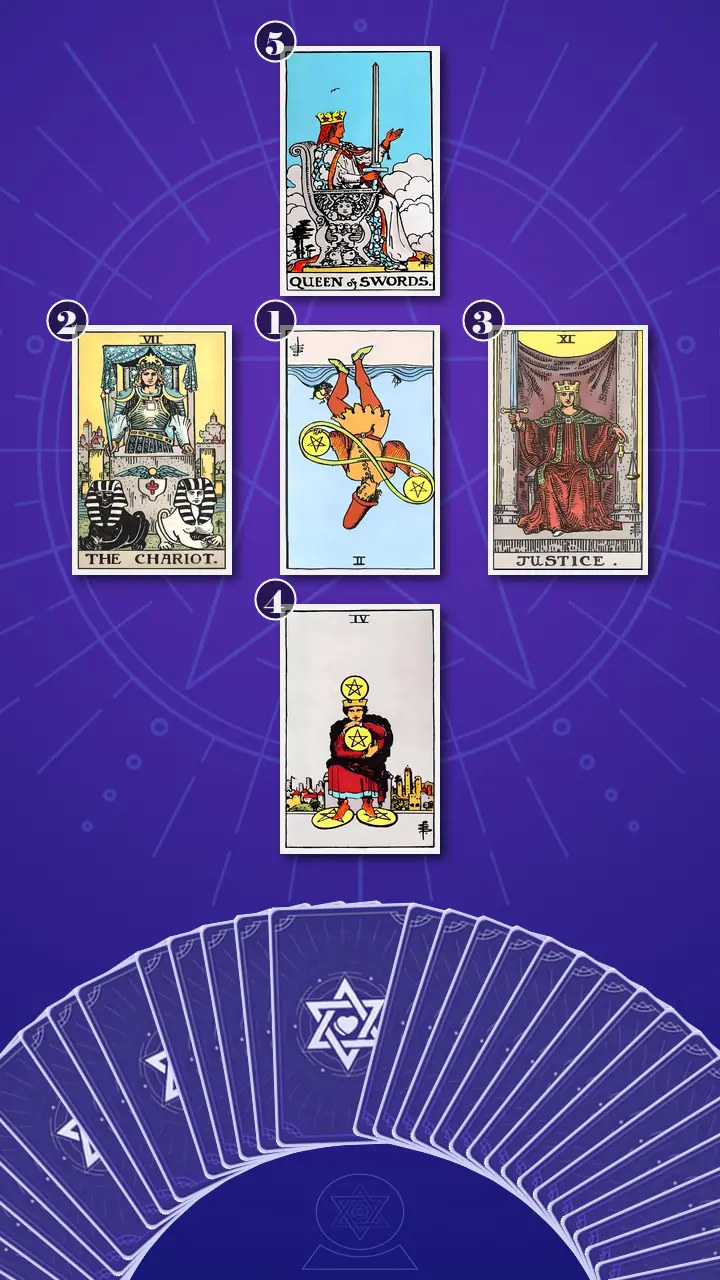
Reading the Map: When the Tabs Become a Trap
Position 1: The immediate situation and the observable stuck pattern
“Now we flip the card that represents the immediate situation and the observable stuck pattern around replying to the relocation package email,” I said.
Two of Pentacles, reversed.
Even through a screen, I could feel her recognize it before I explained it. The imagery is a juggler mid-motion—but reversed, the rhythm drops. The loop that was supposed to be smooth becomes frantic.
“This is like when you have five tabs open—comp, taxes, rent comps, org chart, flights—Slack pings landing, calendar reminders popping,” I said, keeping my voice plain. “And the tab-switching starts to feel like progress. But it’s actually overload. The juggle isn’t smooth anymore. It’s splintering your attention.”
I watched Taylor’s mouth twitch into a smile that didn’t reach her eyes. Then she let out a sharp exhale—half laugh, half surrender.
“That’s… honestly brutal,” she said. “Like—yeah. If I just calculate one more thing, I’ll feel ready… and then I feel worse. I feel more behind.”
“Exactly,” I said. “Motion versus progress. Juggling versus choosing.”
Reversed, the Two of Pentacles is a blockage state: too many variables, not enough spaciousness. The energy isn’t lazy. It’s chaotic. It’s you trying to earn safety by keeping everything in the air so nothing can hit the floor—especially not the vulnerable thing, which is a clear stance.
I added the line I’ve seen land for high-achievers under deadline pressure: “If it’s not a clear yes, it’s a clear question—or a clear counter.”
Her shoulders dropped a millimeter, like her body heard “you have options” before her brain did.
Position 2: Path A — what ‘moving cities’ is asking you to embody and manage
“Now we flip the card that represents Path A: what moving cities is asking you to embody and manage,” I said.
The Chariot, upright.
“This is the card of forward motion,” I said. “But it’s not a guaranteed win. It’s a steering wheel.”
I pointed out the two sphinxes—black and white—pulling in opposite directions. “One decision, two internal pulls. Excitement about growth versus grief about leaving what’s stable.”
Then I translated it into her language: “If you move, this card asks you to move like you’re driving it, not like you’re being dragged by a company timeline. Think: a Notion board called ‘Relocation Rollout.’ Move Week. Onboarding milestones. Support check-ins. A definition of success that isn’t vague vibes.”
Taylor sat up straighter. Not fully relaxed—more like someone who just remembered they have a spine.
“I could do that,” she said. “If I treated it like a plan. Like a product launch.”
“Yes,” I replied. “Freedom with structure. The Chariot is agency-through-structure. It challenges the chaos of the Two of Pentacles reversed by saying: you don’t need more tabs—you need a lane.”
Position 3: Path B — what ‘negotiating to stay’ is asking you to embody and articulate
I let the silence sit for a beat before the next card. “Now we flip the card that represents Path B: what negotiating to stay is asking you to embody and articulate—terms, boundaries, values.”
Justice, upright.
The image is simple and unforgiving: scales in one hand, sword in the other. Weigh, then state. No extra theater.
“This is negotiation energy,” I said. “Not as a plea. As alignment. Staying isn’t passive in this card—it’s an active choice with clear terms.”
I could see Taylor’s eyes narrow slightly, the way they do when someone’s trying not to hope too hard. “But if I push back, I’m scared they’ll see me as not committed,” she said.
“That fear makes sense,” I said. “And Justice doesn’t require you to be loud. It requires you to be specific.”
I gave her a line-level example, because anxiety hates vagueness: “To make either path viable, I’d need X, and clarity on Y by Friday.”
Her gaze dropped to something on her desk—maybe her phone, maybe the printed PDF she’d mentioned. I saw the tiniest nod. Not agreement with me—recognition of herself.
Then I shifted into the moment I’d been waiting for, because Justice was the bridge card in this spread—the one that turns spinning into choosing.
The Aha Moment: When Fairness Becomes a Filter
Setup. If you’ve reread that relocation package email for the tenth time—then flipped to a cost-of-living calculator, then back to your Drafts folder—you know the weird feeling of being “busy” while still not moving. You’re chasing certainty like it’s hiding in Tab #6, because part of you believes there’s a single correct choice you have to prove is strategic.
Delivery.
Stop trying to earn certainty by overthinking, start weighing what’s fair and stating it like a contract—Justice holds the scales steady when your mind won’t.
I let that line hang. No smoothing it. No apologizing for it.
Reinforcement. Taylor’s reaction came in a three-beat sequence I’ve seen a hundred times, and it still gets me every time. First: a brief freeze—her breath caught, her mouth slightly open, like the sentence had physically interrupted her internal monologue. Second: her eyes unfocused, as if a week of late-night draft edits replayed in fast-forward. Third: a long exhale that seemed to come from the bottom of her ribs, not her throat.
“But—” she started, and there was a flash of irritation. Not at me. At the implication. “But doesn’t that mean I’ve been doing it wrong? Like I’ve been wasting time?”
I met her where she was. “It means you’ve been coping,” I said gently. “You’ve been trying to protect stability and prove you’re in control—at the same time. That’s not stupidity. That’s self-protection. We’re just upgrading the method.”
“Okay,” she whispered, and her eyes went glossy—not tears falling, just the edge of them. “Fair. I’ve never… I’ve never let myself use ‘fair to me’ as the filter.”
“Let’s make it concrete,” I said. “Open a blank note. Set a 7-minute timer. Write three bullets only: (1) your non‑negotiable, (2) your negotiable, (3) your decision deadline. Then draft a two-sentence email that references those bullets—no extra justification. If you feel your chest tighten or you start spiraling, pause and do one slow exhale. You’re allowed to stop and come back later. The goal is a clear draft, not a flawless one.”
She nodded again, this time with a steadier chin.
And because I’m Juniper Wilde—someone who lives half in images—I brought in the framework that’s become my most reliable tool for people trapped in decision freeze: my Mondrian Grid Method.
“Justice is a grid,” I told her. “Like a Mondrian painting: clean lines, limited colors, no clutter pretending to be nuance. We’re going to box this decision so it stops spilling everywhere.”
“Non-negotiables in one block. Negotiables in another. Unknowns in a third. Everything else—noise.”
Her shoulders lowered, and for the first time in the call, her face looked less like someone waiting to be graded.
“Now,” I asked, “using this new lens—think back to last week. Was there a moment when the email thread spiked you, and this ‘fairness filter’ would’ve changed what you wrote?”
Taylor swallowed. “Wednesday night,” she said immediately. “10:26. I kept rewriting the first paragraph to sound… uncriticizable. If I’d used ‘fair,’ I would’ve just asked for timing clarity. Instead I wrote three paragraphs of backstory.”
“That’s the shift,” I said. “From anxious draft-looping and tab-hopping overwhelm to values-based clarity and clean, assertive professional communication. Not perfect confidence—just one honest sentence you’re willing to stand behind.”
Position 4: The hidden driver — what you’re protecting or afraid to lose
“Now we flip the card that represents the hidden driver: what you’re protecting or afraid to lose that’s fueling the paralysis,” I said.
Four of Pentacles, upright.
This card always shows itself in the body first. Taylor’s hand came up to her face; she pressed her thumb against her jaw without realizing it. Her shoulders crept up again. Her phone, off to the side, was gripped too tightly—like a life raft.
“This is you guarding what you’ve built,” I said. “The routines. The friends you can text at 9 p.m. The gym class. The familiar commute. The ‘I have my life together’ feeling.”
I kept it honest, not moralizing. “Stability isn’t bad. But this card can turn stability into clutching. It’s like inventory management of your comfort zone.”
Taylor’s eyes flicked down. “I keep telling myself I’m being practical,” she said, voice suddenly quieter. “But… I think I’m also trying not to feel the loss.”
“Yes,” I said. “And when your nervous system is trying to lose nothing at all, it will keep you in research mode forever. Because if you don’t choose, you don’t have to surrender anything yet.”
She nodded once. Slow. Like accepting the truth cost her something, but not too much to pay.
Position 5: Guidance for the next 7 days — the most empowered way to respond
“Last card,” I said. “This represents guidance for the next seven days: the most empowered way to respond and communicate, regardless of which path you choose.”
Queen of Swords, upright.
There are cards that feel like a hug. This one feels like turning on the overhead light and finally seeing what’s in the room. The sword is raised—not as a threat, but as a clean line.
“This is the ‘clear email’ card,” I said. “Not the uncriticizable one. The understandable one.”
I watched Taylor’s face shift into something like relief—the kind that shows up when someone gives you permission to stop performing your pain.
“You can be respectful without being vague,” I told her. “And you don’t need to pre-answer every possible objection.”
Then I pulled one of my own strategies into the moment, because sometimes the difference between insight and action is a format that feels safe: my Oscars Speech Training.
“Pretend you’re giving a two-minute acceptance speech,” I said. “Not a rambling memoir. Two minutes. You thank. You state. You ask. That’s it.”
“Subject line. Three bullets. One ask. One deadline. No backstory paragraph,” I added, and I saw her smile—this time, real.
“Stop writing to avoid criticism,” I said. “Start writing to be understood.”
Her eyes lifted to the camera. “I want to send it,” she said. “I’m scared. But I want to send it.”
The One-Page ‘Justice Sheet’ and the One Clean Email Protocol
I leaned back and let the whole spread click into a single story.
“Here’s what I see,” I said. “You’re not stuck because you’re incapable. You’re stuck because the Two of Pentacles reversed has you juggling every variable at once—money, optics, timelines, social life—so your brain stays in motion without landing. The Chariot shows that moving could be powerful if you structure it like you’re the driver, not the passenger. Justice shows that negotiating to stay isn’t ‘being difficult’; it’s stating fair terms like an adult, the way contracts are actually built. And the Four of Pentacles explains the emotional gravity: you’re gripping your stability so hard that choice feels like loss. The Queen of Swords says the way out is not more research. It’s one clean message.”
“Your blind spot,” I continued, “is believing that clarity is something you earn after perfect research. But the transformation direction is different: you move from ‘I need certainty before I respond’ to ‘I will name my non-negotiables and send one clear, time-bound proposal or decision.’”
Then I gave her the smallest possible set of next steps—actionable advice, not a personality makeover.
- Build your one-page Fairness List (Mondrian Grid style)Open a doc and make three boxes: 3 non-negotiables, 3 negotiables, 3 unknowns you need clarified. Keep it visible while you write your email, so you’re weighing what’s fair instead of predicting every outcome.Set a 7-minute timer. When it ends, stop. Clarity beats completeness.
- Write the One Clean Email (preference + terms + deadline)Draft one email with three parts: (1) your preference (move or stay), (2) what makes it workable (terms or conditions), (3) what you need by when (a specific date/time). Keep it to bullets if you can.If your chest tightens and you start adding paragraphs, do one slow exhale and delete the “backstory” section. You don’t need the perfect email—you need the honest one with terms.
- Ask one direct question (and replace “just checking in”)Choose the single most decision-relevant unknown and ask it cleanly: “Can you confirm X and Y by Thursday EOD so I can make a final decision?”Make your personal deadline 24 hours before their deadline, so you’re not writing from panic.
“Constraint is the medicine,” I reminded her. “Your brain will beg for another calculator, another opinion, another draft. But Justice and the Queen of Swords don’t reward spiraling. They reward clean terms.”

A Week Later: The Quiet Proof of Finding Clarity
Six days later, I got a message from Taylor.
“Sent,” it read. Just that, plus a screenshot: a crisp email with three bullets and one ask. No apology tour. No 400-word preamble trying to prove she was strategic. The subject line was boring—in the best way. The kind of boring that means you’re not bleeding on the page.
She added: “I slept through the night. This morning my first thought was still ‘what if I messed it up?’—but then I looked at my one-page list and… I actually believe myself.”
That’s the part I always want people to hear: tarot doesn’t promise that your company will say yes. It promises you a way to stop buffering your life. It turns analysis paralysis into a decision you can explain in one paragraph without apologizing for it.
When one email makes you feel like your whole life is on trial, you don’t freeze because you’re incapable—you freeze because you’re trying to protect stability and prove you’re in control at the same time.
If you let “fair to me” be the deciding filter for the next seven days, what’s the one clean sentence you’d want your email to say—without apologizing for it?