The Counteroffer Call With an EOD Deadline—And the 3–6 Month Reframe

The EOD Ping That Hits Like a Fire Alarm
Jordan showed up to our session with that particular kind of composure New Yorkers learn fast: the outside looks fine, the inside is doing cardio.
“I’ve rewritten my counteroffer call script in Notes so many times it feels like a personality test with real financial consequences,” they said, like they were trying to make it sound funny. Their laugh didn’t quite land.
They were 28, non-binary, mid-level in a corporate role that measures you even when it pretends it doesn’t. A recruiter wanted an answer by EOD. Their current employer had slid in with a counteroffer—better comp, softer promises. And Jordan was stuck in the exact contradiction that turns smart people into night-shift spreadsheet gremlins: wanting a confident, values-aligned career move versus fearing the loss of stability—and being judged for the “wrong” choice.
I could almost see the scene they described before they even described it—because it’s so common it’s basically a modern urban legend.
“8:52 PM in your Queens shoebox,” I said gently, mirroring them back. “Laptop burning your thighs. AC rattling like it’s mad at you. Blue light making everything look harsher than it is.”
“You alt-tab between Slack, LinkedIn, and a Google Sheet with color-coded columns. You tell yourself, ‘One more comparison.’ You feel your jaw clamp down like you’re trying to hold the decision in place with your teeth.”
“And your chest does that restless buzz—like you drank espresso by accident—because your nervous system thinks this call is a verdict.”
Jordan swallowed. Their hand drifted to their water bottle and tightened around it without them noticing.
What they called overthinking was actually a whole-body bracing: tight jaw, shallow breathing, a sternum-level pressure that made every option feel like a trap.
“We’re not going to force certainty today,” I told them. “We’re going to build clarity—enough clarity to make a clean next move. Let’s draw a map through the fog.”

Choosing the Compass: The Decision Cross Tarot Spread
I asked Jordan to take one slow breath—not as a mystical ritual, just as a gear shift. Then I shuffled while they held the question in plain language: counteroffer call—stay or take the new job, what’s my next move?
“Today I’m using a spread called the Decision Cross,” I said. “It’s one of the best tarot spreads for a counteroffer decision—stay or go—because it holds both options side-by-side without pretending we can predict the future like it’s weather.”
For anyone who’s ever googled how tarot works and gotten lost in incense-level explanations: this is the practical version. The Decision Cross has five positions, and each one does a specific job.
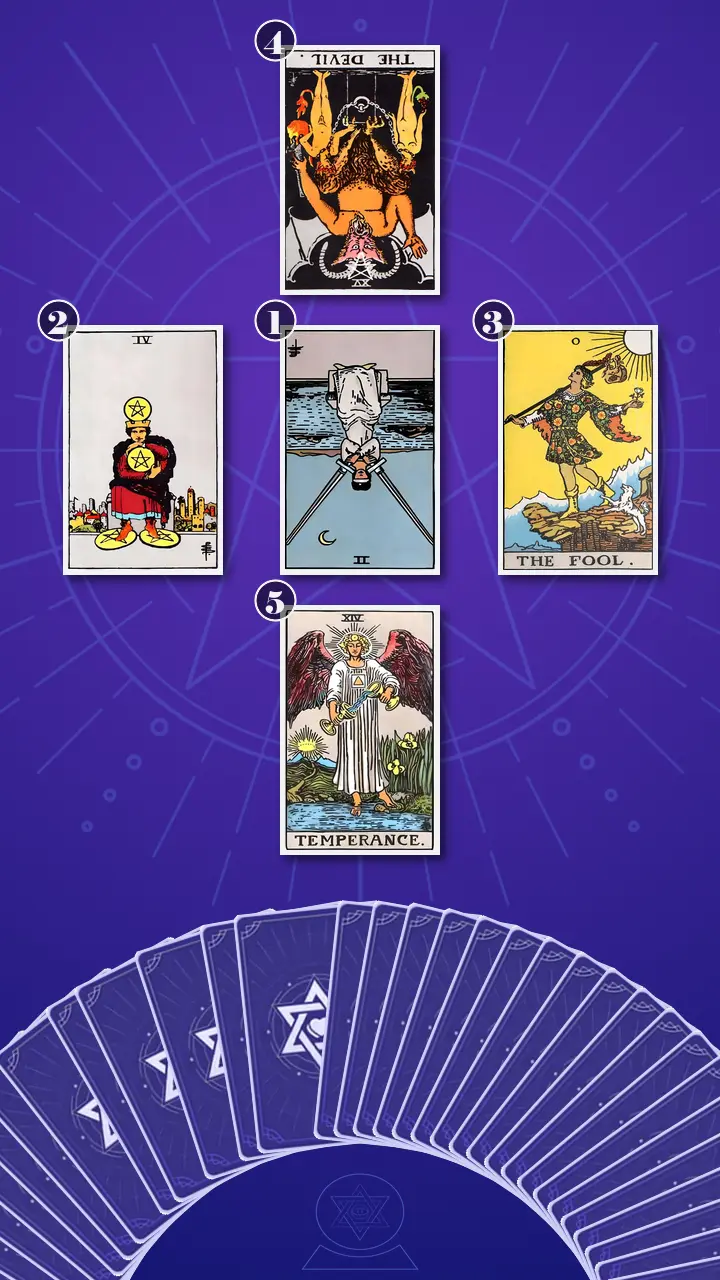
“Card 1 is the pressure point—how your indecision is showing up right now. Card 2 is Option A: staying with the counteroffer. Card 3 is Option B: the new job. Card 4 is the hidden driver—what’s actually steering you beneath the spreadsheet. And Card 5 is the next move: the most empowering way to approach the call this week.”
Jordan nodded, like having structure already lowered the volume in their body by 5%.
Reading the Map: Card Meanings in Context
Position 1 — Present decision dynamic: the moment you keep postponing
“Now turning over,” I said, “is the card that represents the present decision dynamic—the concrete way indecision shows up around the counteroffer call and the deadline pressure.”
Two of Swords, reversed.
In the Rider–Waite image, there’s a blindfold slipping, swords crossed tight to the chest, still water behind. Reversed, the energy isn’t calm neutrality—it’s overflow. Air under strain. Thought trying to do the job of trust.
“This,” I told Jordan, “is like you sitting at your desk with Slack open, the offer email starred, and a Google Sheet full of perfectly formatted columns. You keep saying you’re being ‘objective,’ but you’re really avoiding the one sentence that ends the limbo—because the second you choose, you lose the fantasy that you can’t be wrong.”
I let the words hang for a beat, then added the line I use when someone is punishing themselves with ‘research.’
Not choosing is still a choice—you’re just paying for it in stress.
Jordan did exactly what the card always pulls out of people: a tiny, bitter laugh that sounded like an exhale with teeth. Their shoulders dropped half an inch, like they’d been caught doing something they didn’t realize was a pattern.
“That’s… kind of brutal,” they said. “But accurate.”
“Accurate doesn’t have to be cruel,” I replied. “It just means we can track it.”
And tracking is the beginning of power.
Position 2 — Option A (Stay): what the counteroffer is really offering
“Now turning over,” I said, “is the card that represents Option A—staying with the counteroffer: what it’s truly offering, and what it asks you to prioritize.”
Four of Pentacles, upright.
Earth energy. Holding. Conserving. A figure clutching a coin to their chest, coins pinned under their feet, a coin like a crown. In modern life it’s that exact sensation Jordan described: relief that becomes rigidity.
“You picture saying yes,” I said, “and you feel instant calm about rent, savings, and not having to ramp up somewhere new. Your brain can finally stop calculating the OMNY taps, the month-to-month buffer, the ‘if I miss one paycheck everything wobbles’ feeling.”
As I spoke, Jordan’s shoulders hunched slightly. Their grip tightened around their phone like it was a subway pole.
“Then you notice the second feeling,” I continued. “Your world gets smaller. You start thinking in rules: don’t risk it, don’t rock the boat, don’t lose what you have—even if the growth promises stay vague.”
I said it carefully, because I never want someone to feel shamed for wanting stability in a city that charges you extra just for existing.
Security isn’t the villain. But grip can be.
Jordan nodded, jaw tightening in that conflicted way—relief and claustrophobia in the same breath.
Position 3 — Option B (New job): what the leap is actually asking of you
“Now turning over,” I said, “is the card that represents Option B—the new job: what it’s inviting you into, and what it asks you to risk.”
The Fool, upright.
Open sky. A cliff edge. A light bundle. A little dog at the heels—half warning, half encouragement. In a career crossroads reading, The Fool is never about being reckless. It’s about accepting that you can’t bring guarantees—only capability.
“This is like you reading the new role and feeling a genuine spark,” I said. “New scope, new problems, more room to learn. And then your brain immediately demands a guarantee no new job can offer. So you scroll Glassdoor like it’s going to hand you a signed affidavit that nothing will be messy.”
Jordan’s face lit for a second—then the light dimmed, like a voice in their head had walked in and crossed its arms.
“Here’s the energy dynamic,” I said. “The Fool is movement and beginner energy. Not deficiency—just the willingness to learn in public.”
Then I gave them the reframe that often lands like a permission slip.
Beginner energy isn’t incompetence—it’s growth with the labels still on.
Jordan’s mouth twitched, half smile, half wince. “I hate how much I care about looking stupid.”
“That’s not a moral failing,” I said. “That’s a nervous system trying to keep your social standing intact.”
Inside, I had a quick flash of an old film reel—something I do without trying. In Wall Street, everyone thinks the deal is about numbers, but it’s always about identity. Who’s in control. Who gets to look unshakable. Tarot reads the same way: the surface story is comp; the underlying story is worth.
Position 4 — Hidden driver: what’s steering you beneath the spreadsheet
“Now turning over,” I said, “is the card that represents the hidden driver: the underlying fear or attachment shaping how you evaluate both options.”
The Devil, reversed.
In the classic image there are chains—yet reversed, something loosens. The lock was never as tight as it felt.
I leaned forward a little. “I want to give you a micro-scene,” I said, because this card is best understood in real life, not in theory. “Your manager says, ‘We really value you.’ And in the same second you feel flattered and suspicious. Like: is this love… or a leash?”
Jordan went still. Not dramatic stillness—more like their body paused to listen.
“If the counteroffer feels flattering and sus at the same time, that’s data—not drama,” I added.
Then I asked the hinge question, the one that turns the lights on.
“Is this about the role,” I said softly, “or about being chosen?”
Their eyes dropped to the card. Their throat moved as they swallowed. I watched the three-step reaction chain ripple through them: first a tiny breath-hold (freeze), then a faraway look like a memory replaying (cognition), then a slow exhale that sounded like surrender (release).
“I think… I want the counteroffer to mean I’m safe,” they said. “Not just financially. Like… as a person.”
“That’s the Devil’s binding contract,” I said. “Not the money itself—money is real, rent is real. It’s when salary, title, and praise start quietly negotiating your freedom for you.”
“Reversed means you can unhook,” I continued, “without burning bridges. You don’t have to prove you’re not ‘buyable’ by torching the conversation. You can just… see the chain. And step out of it.”
Position 5 — Next move: where you can find clarity for the counteroffer call
When I reached for the final card, the room felt quieter—not because anything mystical happened, but because Jordan was finally present. Their attention wasn’t scattered across ten hypothetical futures. It was here.
“Now turning over,” I said, “is the card that represents your next move: the most empowering, values-aligned way to approach the call and make a clear step this week.”
Temperance, upright.
The angel pours liquid between two cups. One foot on land, one in water. A path toward the sun. This card is the antidote to extremes: not clinging, not proving, not panicking—integrating.
Setup: I looked at Jordan and named the loop with precision. “It’s 11:38 PM and you’re still toggling between the comp spreadsheet, the offer email, and a Notes app script—telling yourself one more comparison will finally make you feel certain.”
Delivery:
Stop treating the decision like a pass/fail verdict; start blending your real priorities like Temperance pouring between two cups.
I let a full beat pass. Outside, a distant siren moved down Queens Boulevard and faded, like the city itself exhaled and kept going.
Reinforcement: Jordan’s face changed in layers. First their eyebrows lifted—surprise. Then their eyes softened, a little glossy at the edges—not tears, just that thin line between pressure and relief. Their jaw unclenched like it had been holding a secret. Their shoulders lowered. Their hands, which had been gripping their phone, loosened and set it down on the table.
“But if it’s not a verdict…” they started, and there was a flash of resistance—almost anger. “Does that mean I’ve been doing this wrong?”
“No,” I said immediately. “It means you’ve been trying to protect yourself with the tools you had. Temperance isn’t a scolding card. It’s a coaching card.”
This is where my own artist brain always kicks in. I told them, “I think in a Mondrian grid when I’m overwhelmed—three clean blocks instead of a thousand messy lines. Right now your brain wants a masterpiece with zero risk. Temperance wants a workable sketch with good proportions.”
I slid a notebook toward them. “Set a 10-minute timer. In a Notes doc, write three headers: ‘Money floor,’ ‘Growth runway,’ ‘Manager + day-to-day.’ Under each, add one sentence that must be true for you to say yes (to either company). Then write one boundary sentence you can say out loud on the call—something like, ‘I can commit if we can put X in writing by Y date.’”
“And if your chest tightens or you feel dizzy,” I added, watching their breath, “pause. Put a hand on your sternum. Take three slow breaths. Shorten it to just the three headers—no extra criteria today.”
Jordan nodded slowly, like they were realizing they could think in sentences instead of spirals.
“Now,” I asked, exactly as I do when Temperance lands, “use this new lens and think back over the last week. Was there a moment when you could feel your body bracing—jaw tight, breath shallow—where treating it as an experiment instead of a verdict would’ve changed the temperature?”
They stared at the card, then said quietly, “Thursday. The recruiter pinged. I opened the spreadsheet like it was oxygen.”
“That’s the shift,” I said. “This is you moving from golden-handcuffs decision paralysis and anxious uncertainty to grounded, values-based confidence—with clear negotiation boundaries. Not because the future is guaranteed. Because your process is.”
From Insight to Action: Make the Choice, Then Make the Terms
I summarized what the spread had shown in one clean thread, so Jordan could feel the logic without getting dragged back into it.
“The Two of Swords reversed says your current pain isn’t lack of intelligence—it’s avoidance disguised as strategy. The Four of Pentacles says staying offers real security, but it could tighten into grip if you accept vague growth in exchange for immediate relief. The Fool says the new job invites movement and learning—beginner energy—without a guaranteed map. The Devil reversed says the hidden driver is attachment: approval, status, the story of being chosen. Temperance says the way through is integration: choose a values-based direction, then set terms—timeline, scope, and what needs to be in writing—so you don’t abandon yourself.”
The cognitive blind spot was clear: Jordan kept trying to earn certainty through more data, when what they needed was a container—three priorities, one boundary, one timeline.
“Here are your next steps,” I said, keeping it practical. “Small, adult, doable.”
- The Three-Criteria Cap (Mondrian Grid)For the next 7 days, pick exactly three criteria—Money floor, Growth runway, Manager + day-to-day. Write them as three big blocks. No fourth category. If you think of one, park it in a note—but you’re not allowed to score it.When your brain begs for benefits/commute/title/team-vibe as a “necessary” fourth, label it kindly: “Two of Swords trying to reopen the door.” Say, “Not this week.”
- The Calm-Adult Call Script (Temperance Template)Draft a 3-paragraph script: (1) what you value, (2) what you can commit to, (3) what needs to be true in writing for you to say yes. Read it out loud once before the call.Use my “Oscars Speech Training” rule: keep it under 2 minutes. If you can’t read it out loud without rushing, it’s too long—trim, don’t perfect.
- One 4-Sentence Clarifying Email (Terms-Not-Vibes)Send one email to either side that turns a vague promise into a concrete term: timeline, scope, reporting line, or what “growth” means. Four sentences max. Example: “To make a decision, I need clarity on X. Can you confirm Y by Z date? If yes, I can respond by __. Thank you.”You don’t owe either company your anxiety. You can ask for a deadline extension or a recap in writing. Keep it clean and boring—that’s power.

A Week Later: Ownership, Not Certainty
A week later, Jordan texted me a screenshot—not of a spreadsheet, but of a Notes doc with three headers and one boundary sentence highlighted. Under it, one line: “I said it out loud. My voice didn’t shake.”
They chose a direction—not with perfect confidence, but with a calm, adult steadiness. And they asked for one term in writing. The decision stopped being a referendum on their competence and became what it always should’ve been: a negotiated next chapter with a review plan.
They told me they slept a full night, then woke up and had the same first thought—What if I’m wrong?—only this time they noticed it, breathed, and went, “Okay. Still not a verdict.”
When a job decision starts feeling like a personality test with rent-level consequences, your body braces—because you’re not just choosing a role, you’re trying to avoid the story that you picked “wrong.”
If you treated this as a 3–6 month experiment you’re allowed to evaluate (not a forever verdict), what one term or boundary would make your next step feel calmer in your own body?