From Two Proposal Tabs to One Clean Send: The Fair-and-Aligned Rule

Finding Clarity in the 11:34 p.m. Proposal Spiral (Values vs Money Decision Paralysis)
If you’re a 20-something/early-30s freelancer in a major city and your proposal doc has been open so long your laptop fan sounds emotionally involved—welcome to values vs money decision paralysis.
Jordan (name changed for privacy) showed up on my screen from Toronto with that specific kind of “I’m fine” that lives entirely in the jaw.
They described Tuesday night like it was a crime scene: 11:34 p.m., condo bedroom-office corner, two proposal tabs side-by-side, cursor blinking in the pricing section. The laptop fan kept doing that anxious little whirr. The screen threw cold blue light onto their hands. They could still taste mint from late-night gum, and their phone felt warm from doomscrolling rate threads—r/freelance, “what’s standard for Toronto?”, one more scroll like it might finally hand them permission.
“I keep toggling between $7,500 and $8,000,” they said, rubbing their face like they could physically erase the decision. “And I keep rewriting the ‘Why me’ section, like the right paragraph will pick my identity for me. If I pick the money, am I selling out. If I pick the mission, am I being irresponsible. Why does every choice feel like a personality test?”
The pressure wasn’t abstract. It had a texture—like trying to breathe while someone is tightening a drawstring inside your chest. Their jaw was locked, and the energy in their voice was jittery, keyed-up, like their nervous system had been mainlining espresso.
“I’m hearing how hard you’re working,” I told them, keeping my voice steady the way I do at the planetarium when a room full of kids is about to lose it. “And I’m also hearing how much this decision has turned into a verdict. Let’s not shame the spiral. Let’s map it. Our whole journey today is about finding clarity you can actually use—something you can press ‘send’ with, even if you don’t feel 100% sure.”

Choosing the Compass: The Decision Cross · Context Edition Spread
I asked Jordan to sit back and take three minutes with me—my pre-meeting cosmic breathing. Not mystical. Just functional. “In through the nose for four,” I said, “hold for four, out for six. Let your shoulders drop like you’re taking off a heavy backpack.”
While they breathed, I shuffled slowly. I always think of this part as attitude adjustment—like a spacecraft making tiny corrections before it commits to a burn. The cards don’t replace judgment; they help the mind stop ricocheting long enough to see what’s actually driving.
“Today, we’ll use a spread called the Decision Cross · Context Edition,” I said. “It’s one of the cleanest ways to work with a two-option dilemma on a deadline.”
For anyone reading who’s wondered how tarot works in a real career crossroads: this spread is basically a decision-making map. It doesn’t ask, “Which choice is fated?” It asks, “What’s happening in the bottleneck, what does each path truly offer, what’s the hidden driver underneath, and what integrating principle will let you choose with self-respect?”
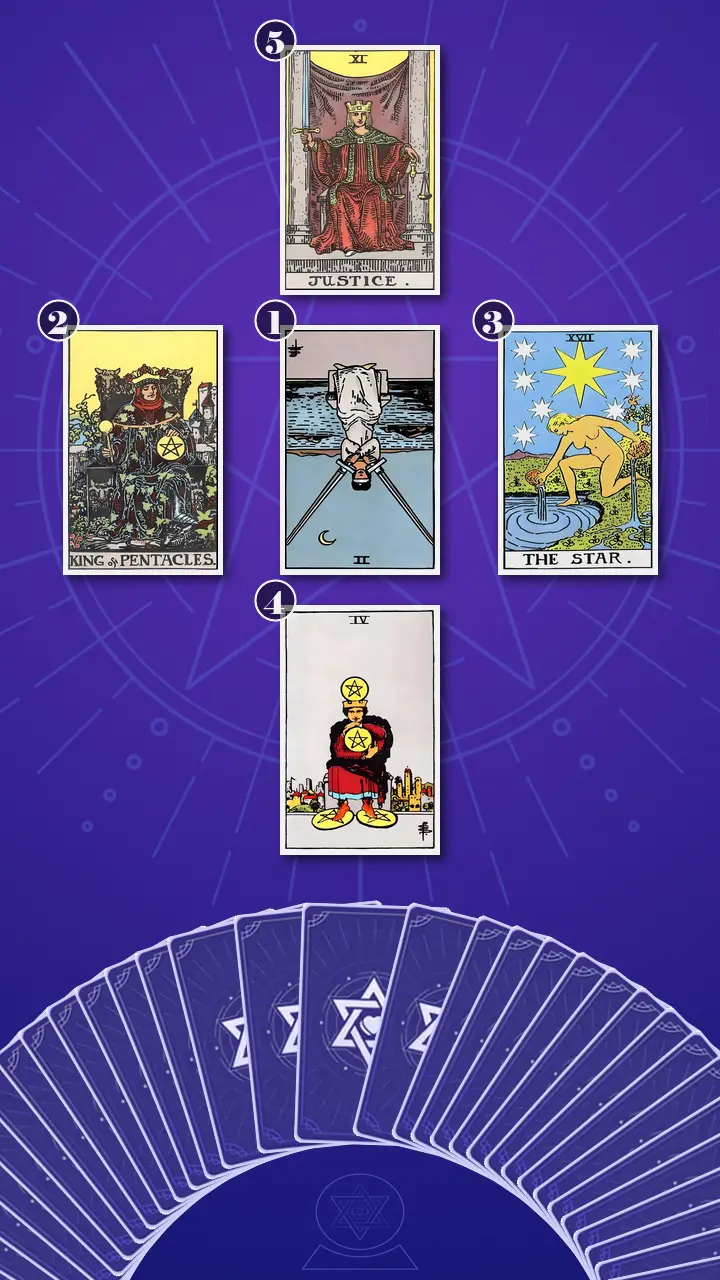
In this cross, Card 1 shows the current stuck moment—the observable bottleneck right before you hit send. Card 4 drops below it as the unseen influence: the scarcity/control knot that makes the choice feel sticky. And Card 5 sits above as the integrating frame—advice, but more specifically a values-and-boundaries rule so the outcome doesn’t become a referendum on identity.
Reading the Map: Two Options, One Nervous System
Position 1: The current stuck moment (the observable bottleneck)
“Now flipping over, is the card that represents the current stuck moment: what you’re doing and feeling right before submitting,” I said.
Two of Swords, reversed.
I watched Jordan’s eyes narrow slightly before they even spoke—like their brain recognized itself.
“This is painfully literal,” I told them. “Two proposal drafts open. You keep toggling—changing the rate line, rewording deliverables, rewriting the same ‘Why me’ paragraph—because committing to one version feels like closing the other door. And the more you edit, the less you can feel your own preference. The ‘send’ button starts to feel like a moral decision instead of an email.”
In tarot terms, the Two of Swords is the stalemate card. Reversed, it’s the moment the stalemate stops looking calm and starts looking like churn. The energy is blocked Air: thinking turned into guarding, logic used like crossed swords over the chest.
“You’re not indecisive—you’re trying to buy certainty with edits,” I said, letting the line land without judgment.
Jordan gave a short laugh—sharp, almost amused, but it had a bitter edge. “Yeah,” they said. “That’s… that’s too accurate. Like, rude accurate.”
I nodded. “The blindfold in this card matters. It’s not that you can’t see options. It’s that you’re trying to decide without letting yourself feel the loss of the unchosen option. And your body is paying for that neutrality. Before we go further—put one hand on your jaw for ten seconds. How hard are you clenching, and what are you trying to control right now?”
They pressed their fingers to the hinge of their jaw. Their breathing caught, just slightly. “I’m trying to control regret,” they admitted. “And looking naive.”
Position 2: Path A (big paycheck)
“Now flipping over, is the card that represents Path A—the big paycheck: what this option genuinely provides and what it asks you to become or prioritize,” I said.
King of Pentacles, upright.
This card always feels like a weighted blanket—Earth energy that actually holds you up when you’re spinning.
“The big paycheck path isn’t a cartoon villain,” I told Jordan. “It’s a stability anchor. It looks like rent feeling lighter, taxes feeling manageable, and a buffer month that lets you stop living in constant recalculation. You can picture yourself quoting your rate with a steadier voice and being taken seriously.”
Then I pointed to the King’s throne—vines, bulls, that grounded “I build things that last” posture. “The hidden ask is stewardship. Can you set clean scope terms so the money buys stability—not burnout, not people-pleasing, not proving yourself 24/7?”
The upright King is balanced Earth when it’s healthy. But even healthy Earth can tip into grip if fear is driving. I could already see how this path might tempt Jordan to over-deliver as a way to earn their own comfort.
Jordan swallowed. “It would honestly be a relief,” they said. “Like… dentist appointment relief.”
“That counts,” I said. “Responsible abundance is allowed. You don’t need to morally prosecute yourself for wanting your life to be easier.”
Position 3: Path B (mission-fit work)
“Now flipping over, is the card that represents Path B—the mission-fit work: what this option genuinely provides and what it asks you to become or prioritize,” I said.
The Star, upright.
The shift in the room—yes, even over video—was immediate. The tempo changed. I’ve seen this card do it a hundred times: it invites a softer breath, a longer horizon.
“This is that rare feeling,” I said, “where your shoulders drop and your breath gets deeper. You can imagine doing the work without performing a version of yourself you don’t like. You’d be proud to share the case study.”
I slowed down, because The Star is not hype. It’s a steady pour. “And it asks for sustainability. Can you keep it life-giving by pricing and scoping it in a way that honors your time—so meaning doesn’t become martyrdom?”
Jordan’s gaze flicked away from the camera toward something offscreen, like they’d pulled up the mission-fit brief in their head. Their shoulders loosened a millimeter.
“I forgot work could feel like that,” they said quietly, and exhaled—small, but real.
For a second, I thought of the planetarium dome, the way a dark ceiling can turn into a starfield the moment the lights drop. The stars don’t solve your problems. They just remind you there’s a bigger map than the one your panic is drawing.
Position 4: The hidden driver (the scarcity/control knot)
“Now flipping over, is the card that represents the hidden driver: the deeper fear/value conflict that keeps the decision loaded and sticky,” I said.
Four of Pentacles, upright.
“Okay,” I said gently. “Here’s the grip.”
I described it the way it shows up in real life, not in a textbook. “It’s Wednesday morning at a Queen West café. Espresso machine hissing. Your hands wrapped around a hot cup. You open your banking app and do that mental run—rent, groceries, transit, taxes—and your shoulders rise before you even finish the math.”
Jordan’s face tightened in recognition.
“When you look at the mission-fit proposal, your brain says, ‘Nice… but risky.’ When you look at the big paycheck, your brain says, ‘Safe… but am I selling out?’ And the tightness is the same either way—because the real decision underneath is ‘Will I be okay?’ not ‘Which project is better?’”
This is where I use my Dark Matter Detection lens—my way of naming what’s invisible but massively influential. In astrophysics, dark matter isn’t seen directly; you infer it from what it does to everything else. In a reading, the Four of Pentacles is that invisible mass: fear of losing control bending both choices into something heavier than they are.
“Money and meaning are inputs, not identity labels,” I said. “But the Four of Pentacles turns money into emotional armor. It’s not ‘bad.’ It’s protective. It’s the part of you that thinks: if you can just hold tight enough—money, reputation, certainty—you won’t have to feel vulnerable.”
Jordan’s reaction came in a chain, like watching a ripple travel across water:
First, their breathing froze for half a beat—shoulders lifting as if bracing.
Second, their eyes unfocused, like they were replaying a private highlight reel of every month their income dipped and they promised themselves they’d never feel that exposed again.
Third, they let out a slow, embarrassed little exhale. “Okay,” they said, voice lower. “Yeah. This is about safety and control, not just values.”
“Exactly,” I said. “And we can work with that. We just can’t let it drive.”
When Justice Spoke: Standards Over Vibes
Position 5: Integration and next-step (the decision principle)
I let the silence sit for a second. Even through their earbuds, Jordan could feel it—the moment where the reading stops being descriptive and starts being a lever.
“Now flipping over,” I said, “is the card that represents integration and next-step: the decision principle and boundary that makes either choice coherent and self-respecting.”
Justice, upright.
The image is simple: scales in one hand, sword in the other. Weigh—and then commit. The card doesn’t promise comfort. It promises clarity that has structure.
Jordan’s lips pressed together. “That feels… intense,” they said. “Like—if I choose, then I can’t pretend I didn’t.”
“That’s a real reaction,” I told them. “And it doesn’t mean you’re doing it wrong. It means you’re about to stop outsourcing your decision to vibes.”
Here’s the setup, the moment I can almost see: it’s that 11:34 p.m. spiral—two tabs, cursor blinking at pricing, jaw tight—where one more edit feels like it might finally make the ‘right’ choice reveal itself.
Stop treating clarity as a mood; set your criteria and let Justice’s scales do the weighing.
I paused on purpose, the way I pause under the planetarium dome right before the first star appears—because a sentence can be a kind of light.
Jordan didn’t immediately look relieved. Their reaction was more complicated—and more honest.
Their chin lifted a fraction, like a reflexive defense. Then their eyes sharpened, almost angry. “But if I have to set criteria,” they said, “doesn’t that mean I’ve been doing this wrong? Like… all those hours editing?”
“No,” I said, and my voice went softer, not indulgent—anchoring. “It means you’ve been trying to protect yourself with the tool you trust most: your brain. Under pressure, your brain is like a browser with 17 tabs open—busy, ‘productive,’ overheating. Justice isn’t here to scold you. It’s here to give your nervous system a steadier job.”
I watched them take it in, layer by layer.
Their mouth opened, then closed—like they were about to argue and realized they didn’t want to.
Their shoulders dropped, slowly, the way you lower heavy grocery bags to the floor and feel the blood return to your hands.
The tightness in their face didn’t vanish, but it reorganized—less chaos, more focus. Their eyes got wet for a second, not with sadness exactly, but with the strange vulnerability of having a clean path appear: Oh. Now it’s on me.
“Clarity isn’t a mood,” I added, echoing the heart of the card. “It’s a standard you’re willing to follow.”
Then I invited the turn that makes the insight usable. “Right now, with this perspective—think back to last week. Was there a moment where you reopened a doc or a rate thread because you were searching for certainty, not making a decision?”
Jordan blinked, once, then nodded. “Thursday night,” they said. “I had basically finished the mission-fit scope. And then I opened LinkedIn and saw someone post about a ‘purpose-driven win’ and then, like, a subtle income flex. And I felt… stupid. I reopened everything.”
“That makes sense,” I said. “Justice isn’t asking you to become unbothered. It’s asking you to become coherent.”
This is also where I bring in my other diagnostic tool—the Gravity Assist Simulation. In spaceflight, a gravity assist uses a planet’s pull to change your trajectory without burning extra fuel. For decisions, it’s the same: instead of fighting your fear head-on, you use a stable body—criteria—to redirect your future with less thrash.
“Let’s simulate the next 60 days,” I said. “Not by predicting outcomes—by predicting you. Which choice, with clean boundaries, gives you more capacity? Which one reduces the midnight spreadsheets? Which one helps you build self-trust because you can say, ‘I followed my standard’?”
Jordan’s eyes steadied. “I can do that,” they said. “I don’t need a cosmic sign. I need a rule I trust.”
And that was the shift: from chaotic, fear-driven over-editing to grounded, criteria-led commitment. From needing perfect information to building self-trust through a clear commitment in writing.
The One-Page Justice Sheet: Actionable Next Steps for a Deadline Choice
I leaned back and summarized what the spread had shown, weaving it into one clean story—because clarity isn’t just insight; it’s a narrative your nervous system can follow.
“Here’s why this has felt so stuck,” I told Jordan. “The Two of Swords reversed says you’ve been holding both doors at once, using edits to delay the grief of choosing. The King of Pentacles says the money path really does offer stability and legitimacy—if you steward it with boundaries. The Star says the mission path really does restore you and point you forward—if you don’t turn meaning into underpaid labor. And the Four of Pentacles shows the dark matter underneath: a security grip where ‘choosing wrong’ equals ‘losing control.’ Justice lifts you out by replacing ‘waiting to feel certain’ with ‘deciding by what is fair and aligned.’”
“Your cognitive blind spot,” I added, “is believing there’s one correct choice that will prove you’re competent—and that without perfect information you can’t trust your judgment. But that’s the trap: perfect information isn’t coming on deadline day. What can arrive is a decision policy you can stand behind.”
Then I switched into coach mode—simple, doable, no over-spiritualizing. I also framed it the way I naturally think: decision-making as interstellar navigation. You don’t need to know every asteroid in the galaxy; you need a heading, a fuel budget, and clear course corrections.
- Do the 25-minute “Justice Timer”Set a Pomodoro for 25 minutes. Open a blank page titled “My Fair & Aligned Proposal Rule.” Write three non-negotiables: (1) a money floor (a real number), (2) a time boundary (hours/week or a hard end date), and (3) a mission requirement (one sentence about what you will/won’t support). Do it on paper or a plain doc—no spreadsheets.If the money floor makes your chest spike, write a range ($X–$Y) for today. You can refine later—after you’ve submitted, not before.
- Run a “constellation alignment” check—highlight, don’t rewriteTake both proposals and, for each non-negotiable, highlight where the draft meets it (green) or breaks it (yellow/red). No re-poetry of the intro, no rewording deliverables. You’re mapping alignment, not auditioning confidence.If you catch yourself opening competitor rate threads, name it out loud: “I’m searching for certainty, not making a decision.” Then return to highlighting.
- Choose by the 2-of-3 rule, then make boundary-only editsPick the proposal that meets at least two of your three non-negotiables. Then make only boundary edits: add a revision cap, clarify scope edges, set timeline and meeting cadence, and confirm pricing terms. Keep your “Why me” section as-is unless it’s factually unclear.Remember: “A clean boundary is kinder than a perfect explanation.” Your future self will thank you more for a revision cap than for a beautifully tortured paragraph.
- Use the “No Reopen” rule and send like you’re shippingExport the PDF. Close the doc tabs. Put your laptop on a different surface (kitchen counter, not your desk). Then send one clean email subject line: “Proposal: [Project Name] — scope + investment.” No apology language.Say it once before you click: “This proposal is a decision—not a prophecy.” Then press send before your brain can renegotiate.
Jordan hesitated, then voiced the practical obstacle—the one I always want clients to say out loud. “But I can’t even find 25 minutes,” they said. “Because if I stop editing, I’ll panic.”
“That’s honest,” I said. “So we’ll do spacecraft attitude adjustment instead of forcing a perfect burn. Make it the five-minute version: write the three non-negotiables as bullet points. That’s it. The goal isn’t to feel calm. The goal is to choose from a standard, not from a spiral.”

A Week Later: The Quiet Proof of a Fair & Aligned Rule
Six days later, I got a message from Jordan.
“Did the Justice Timer,” it read. “Wrote the money floor on paper (hated it, survived). Highlighted both drafts. Picked the one that met 2/3. Added a revision cap. Exported PDF. Closed tabs. Put laptop on the kitchen counter like you said. Hit send.”
Then, one more line: “My chest was still tight, but it wasn’t chaos. It was… cleaner.”
I pictured them at their kitchen table on deadline day—leftover pasta smelling like garlic, laptop fan humming, unopened mail stacked like tiny accusations—and then the moment after: the apartment suddenly quieter because they weren’t holding two doors at once.
They didn’t tell me the world had instantly become certain. They did tell me something better: the next morning, they woke up with a full night’s sleep, and their first thought was still, “What if I’m wrong?”—but this time they exhaled and whispered, “I followed my rule,” and their jaw unclenched a little.
That’s the Journey to Clarity I trust: not a perfect forecast, but a decision you can stand inside. A shift from editing to buy certainty, toward choosing by standards you’re willing to follow—money floor, time boundary, mission requirement—so self-trust has something solid to grow from.
We’ve all had that moment with two drafts open, jaw tight and chest buzzing, where choosing feels less like business and more like a verdict on who we are—because not choosing still lets us pretend we’re in control.
If you didn’t need to feel 100% sure to be allowed to choose, what would your ‘fair and aligned’ rule look like—just for this one proposal, just for today?