When Wedding Invites Turn Dating Into a Stopwatch: Let Pace Be Mutual

Finding Clarity in the Office Kitchen Hum
“The minute I get a wedding invite, I start doing math,” Jordan (name changed for privacy) told me, and I knew exactly where we were headed. She was twenty-nine, a brand marketing manager in Toronto, the kind of late-20s city professional who could run a campaign launch at work and still get hit by relationship timeline panic the second a cream envelope landed in her inbox.
As she spoke, I could see the whole scene with painful clarity: 12:21 on a Thursday in the office kitchen, the microwave humming, leftover salmon hanging in the air, a cream save-the-date open in one hand and a phone warming up in the other. RSVP deadline on the card. Her partner’s text thread open a second later. Draft. Delete. Draft again. Her jaw tightening. Her chest buzzing like a phone alarm trapped under her sternum. What had been a sweet, early connection suddenly felt like a race she had never agreed to enter.
She wanted the relationship to unfold naturally. That was the honest part. The harder part was this: every public milestone made her treat that same relationship like a countdown clock. One plus-one question, one engagement carousel on Instagram, one group chat full of venue links, and she was halfway into a future-heavy message before she had even finished lunch. She hated how quickly she could turn something good into a deadline.
“I know it’s new,” she said, looking down at her hands, “but what if I’m wasting time?”
I answered her the way I answer people when the spiral already comes with its own layer of shame. “The spiral makes sense. It just is not the same thing as the truth.” I let that settle before I added, “We’re not here to shame the urgency or pretend it isn’t intense. We’re here to see what it’s actually made of, and to find the kind of clarity that gives the pace back to you.”

Choosing the Map: The Shadow Spread for Relationship Timeline Panic
I asked Jordan to put both feet on the floor and take one slow breath before I began to shuffle. I always keep this part simple. For me, it is not about theater. It is about helping the nervous system step out of the scroll, out of the drafted text, out of the imagined future long enough to notice what is happening now.
For her question, I chose the Shadow Spread. When people ask me how tarot works for something like wedding-triggered relationship timeline panic, this is what I mean: I’m not using the cards to predict whether a new relationship will end in marriage. I’m using them to map a trigger pattern clearly enough that the person in front of me can see where the pressure begins, what hidden script feeds it, what deeper wound keeps it alive, what medicine interrupts it, and what grounded next step can change the rhythm this week.
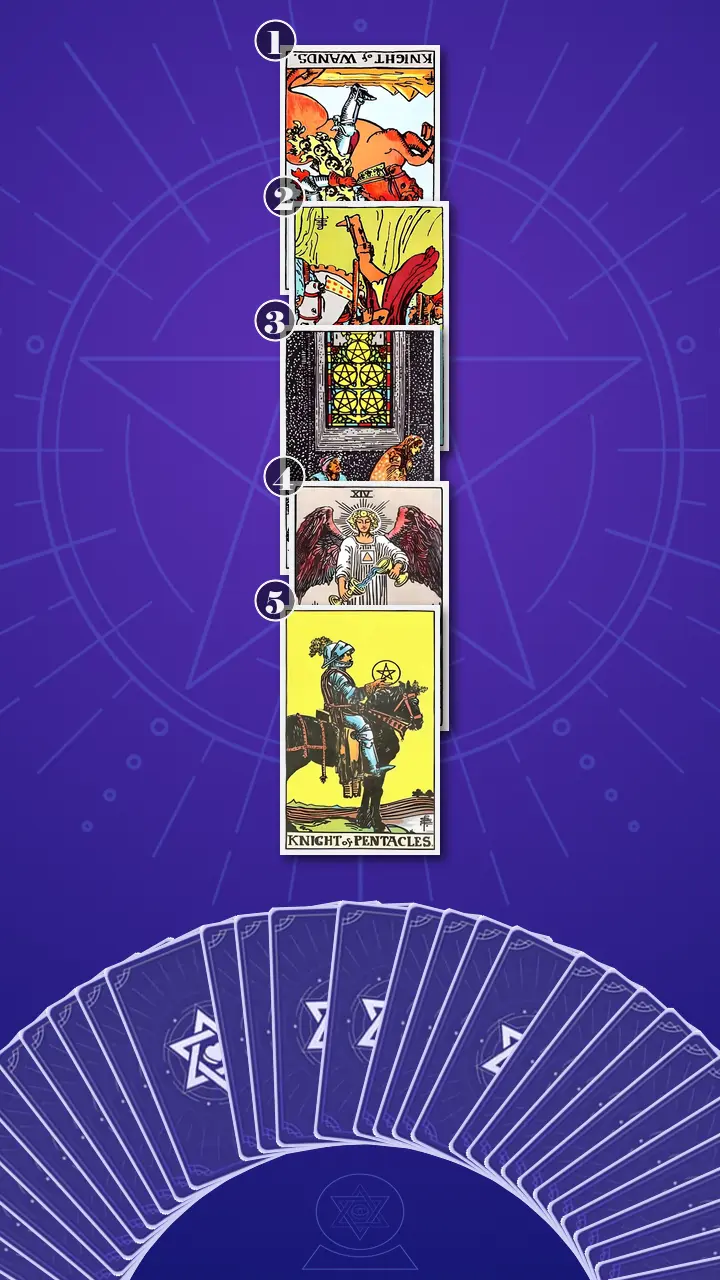
This spread was the cleanest fit because Jordan was not really asking, “Is this the right person?” She was asking, “Why does one invitation make me rush what is still new?” So I told her I would read down the spread like a staircase: the first card would show the presenting problem on the surface; the second would reveal the hidden comparison script; the third would name the deeper fear underneath; the fourth would hold the key shift; and the fifth would translate that shift into something practical she could actually do.
She nodded, exhaled, and said, “Okay. That already feels more useful than another hour in my Notes app.”
Reading the Staircase Beneath the Wedding Invite Spiral
The Rearing Horse at Position 1
The first card I turned over was the one showing the presenting problem from the diagnosis: the sudden urge to accelerate the relationship after a wedding invite lands.
Knight of Wands, reversed.
I told Jordan this card was almost painfully literal in context. It was the exact lunch-break moment when a fresh, promising relationship suddenly got treated like it should already answer questions about exclusivity, holidays, or next summer. It was the draft-delete-redraft text. It was rereading the last few dates like evidence files. It was turning a sweet early-season rom-com into a season finale because one external plot event made her panic about the ending.
Energetically, this was fire in excess and grounding in deficiency. The urge surged first; clear thought arrived later and tried to justify it. The rearing horse on the card matched what happened in her body before her mind could catch up: shoulders up, jaw tight, thumbs moving fast, stomach restless. She was not moving from intimacy. She was moving from activation.
“Urgency is not intimacy,” I said.
Jordan let out a short, bitter laugh. “That is so accurate it’s almost rude.” She rubbed her thumb over the edge of her mug, then gave the smallest wince, the kind people make when a truth lands exactly where they were hoping it wouldn’t.
I smiled a little and stayed gentle. “I’m not saying the desire for commitment is fake. I’m saying the timing of the urge matters. In this card, the energy is outrunning the relationship’s actual lived pace. That’s why the conversation starts sounding like a status meeting instead of closeness.”
The Watching Crowd at Position 2
The next card represented the hidden comparison script beneath the future-tripping and over-analysis.
Six of Wands, reversed.
The moment I saw it, I knew we were in the territory of public proof. I told her this was the card of the watching crowd becoming a scorekeeper. In modern life, that crowd looks like engagement photos on the TTC, honeymoon dumps on Instagram, plus-one questions at dinner, group chats full of rings, leases, venue links, and the soft-launch-to-hard-launch discourse that makes private uncertainty feel like bad optics. This card does not ask, “Is the relationship mutual?” It asks, “Does it look serious enough from the outside?”
That was her hidden script. Notion-brain, project-plan brain, competent-at-work brain trying to measure romance by external markers the way someone else might measure quarterly performance. The relationship became something she imagined other people evaluating. Recognition energy was blocked and distorted here; instead of self-worth coming from lived reciprocity, it was being outsourced to visibility, labels, and social timing.
“It’s like I turn my friends’ wedding season into LinkedIn promotion announcements,” she said quietly. “Like everyone else hit a milestone and I missed mine.”
I watched her shoulders soften by a fraction. Her embarrassment was still there, but recognition had started to replace self-judgment. “That’s exactly this card,” I told her. “It’s not only about wanting love. It’s about using the group chat as a scoreboard.”
I tapped the card lightly. “Private reciprocity matters more than public proof.”
The Cold Window at Position 3
The third card named the underlying fear keeping the pattern alive.
Five of Pentacles, upright.
The room changed the moment this one appeared. I felt the spread drop from noise into something much quieter and much more tender. I told Jordan this was the emotional basement of the entire reading. Under the RSVP math, under the future-text draft, under the comparison spiral, there was a colder fear: not simply that the relationship was moving slowly, but that slow pace might mean she was outside something everyone else had already entered.
I described the scene the card brought up for me because it matched her life exactly: late Sunday night, condo kitchen, fridge door open because sitting still feels impossible, cool air against your legs, group chat buzzing with plus-one logistics while the apartment goes strangely silent around you. Not actually rejected in that moment, not actually abandoned, and yet your whole body reacts like you are standing outside the warm room looking in through glass.
Scarcity was the energy state here. Not factual scarcity. Emotional scarcity. The kind that reads normal early ambiguity as a locked door. The kind that whispers, if this is not becoming serious fast enough, maybe that says something about whether I get chosen at all.
I asked her, “If this relationship stayed tender but undefined a little longer, what would your body be afraid that means about you?”
She went very still. Then her eyes shifted away from the table, unfocused for a moment, like a memory had just stepped into the room. “That I’m the last one to know,” she said. “Like everyone else found the warm version of adulthood and I’m still hovering at the window.”
I nodded. “That’s the wound. And once we name it there, you no longer have to make the relationship carry the full weight of it.”
When Temperance Replaced the Stopwatch
The Antidote at Position 4
The fourth card was the heart of the reading, and I felt the atmosphere change before I even named it. Outside, rain ticked softly against the window in slower intervals, as if the city itself had changed metronomes.
Temperance, upright.
I told Jordan this was the corrective lesson: measured self-trust, moderation, and mutual pacing. In my mind, I could see her back in that office kitchen with a save-the-date in one hand and her partner’s text thread in the other, the whole connection transformed in less than two minutes from something she was living into something she felt pressured to define.
A wedding invite can trigger urgency without earning authority.
Stop treating every invitation like a countdown; let Temperance's slow pour replace the stopwatch with a pace built on balance and lived truth.
I let the sentence sit in the air between us.
Years of sound-energy work have made me attentive to rhythm the way some people are attentive to color. When I see Temperance in a reading like this, I instinctively run what I call a Tempo Misalignment Audit. I listen for the moment an external cue hijacks someone’s internal BPM. That was exactly what had been happening to Jordan. Her desire for commitment had one beat. Her actual daily experience of the relationship had another. Her belonging fear slammed the tempo upward the second a wedding invite appeared, and suddenly she was pushing the whole connection off its natural timing. Temperance did not ask her to want less. It asked her to recalibrate. One foot in feeling. One foot in fact. Desire and discernment poured slowly between the cups until they could belong in the same body again.
Her reaction came in three small waves. First, the physical freeze: her breath paused and her fingers hovered in midair above the mug. Then the cognitive seep: her gaze blurred past the cards, as if she were replaying every deleted draft, every plus-one panic, every careful reply she had over-read. Then the release: her jaw unclenched, her shoulders dropped, and a shaky exhale left her like something heavy had finally found a place to land.
And then, right on the edge of relief, came the resistance. “But doesn’t that mean I’ve been doing this all wrong?”
I answered immediately, because that moment matters. “No. It means your system has been trying to create safety with speed. That is not the same thing as failure. It’s a strategy. It just isn’t giving you the clarity you actually want.”
I leaned in a little. “Using this lens, think about last week. Was there a moment when the relationship showed you something real, but the panic was louder than the evidence?”
She nodded slowly, almost surprised by her own answer. “He planned the next date before the last one was even over,” she said. “And I barely let myself count that.”
There it was. That was the crossing. Not from confusion to certainty in one dramatic second, but from comparison-driven urgency and reassurance-chasing to measured self-trust and mutual pacing. From countdown mode to calibration mode. I could see the relief in her face, and also that slight disorientation that sometimes follows a genuine insight—the tiny, vulnerable pause of realizing that if the pressure is not the truth, then she now gets to choose differently.
The Still Horse at Position 5
The fifth and final card translated that insight into a grounded next step she could practice this week.
Knight of Pentacles, upright.
I loved how cleanly this card answered the first one. Where the opening Knight lunged, this one stayed steady. Where the first card chased relief, this one built trust through repetition. I told Jordan this was ordinary dating evidence made sacred: who follows through, who initiates, who communicates clearly, who makes plans, who leaves your body feeling more grounded than spun up. Not fantasy. Not adrenaline. Not one perfect 11:43 p.m. paragraph followed by three days of silence. Just real patterns with enough time to repeat.
The energy here was balanced and embodied. This was what it looks like when pace is no longer set by the crowd, but by consistency. The card’s still horse and worked field reminded me that some of the healthiest movement in love looks almost boring from the outside—and that is often exactly why it is trustworthy.
“So I don’t need a dramatic answer this week,” she said, half asking, half realizing.
“Exactly,” I said. “Let consistency outrank chemistry spikes.”
She gave me the first practical nod of the session, the kind that means the insight has stopped being beautiful and started becoming usable.
From Panic to Pace: Actionable Advice for the Next 3 Days
By the time I looked back over the full spread, the story it told was beautifully coherent. A public milestone lit the fuse and turned attraction into urgency. Comparison stepped in and made the relationship feel like a performance review. Beneath that was not a secret prophecy about the relationship failing, but a belonging wound that translated ordinary early uncertainty into feared exclusion. The medicine was not detachment and not forced reassurance. It was regulation first, then honest pacing based on what the connection had actually shown.
I told Jordan the blind spot was this: she had been treating activation like information. Because she is organized, thoughtful, and used to solving problems proactively, the panic could sound smart in her head. But the cards showed a different truth. The transformation direction was clear: away from using other people’s milestones as a countdown clock, and toward using present-day evidence of mutuality, reciprocity, and emotional safety as the only pace-setter that counts.
The Syncopation Reset
I gave her a version of my three-day tempo adjustment experiment—the Syncopation Reset—because when a rhythm has been forcing the beat, tiny changes work better than grand vows.
- The RSVP Pause The next time a wedding invite, engagement post, or plus-one question hits, wait 24 hours before sending any text about labels, exclusivity, future trips, holidays, or meeting family. During that pause, open a note titled ‘What I actually know today’ and list only three facts: one action they followed through on, one way you feel around them, and one thing that is still honestly unknown. If 24 hours feels impossible, start with 2. When the thought says, ‘If I wait, I’ll lose my chance,’ treat that as activation, not evidence.
- The Private Proof Check For one week, keep a tiny reciprocity log in Notes or Notion with four columns: follow-through, clarity, initiation, and how your body feels after contact. At the end of each date or meaningful exchange, write one sentence: did I feel more settled, more confused, or about the same? Keep each entry under two minutes. This is for your clarity, not a secret case file against the other person.
- The Present-Focused Reach If you still want connection after you regulate, send one grounded message that belongs to the present tense—something like ‘I liked seeing you this week’ or ‘Want to make a plan for Saturday?’—instead of using a triggered moment to launch a future-defining conversation. If your jaw is tight or your chest is buzzing, take a ten-minute walk first and name the emotion stack out loud: urgency, envy, shame, longing. Small is the point.
A Week Later, the Quiet Proof
A week later, Jordan messaged me after another save-the-date landed. She had made the note, waited, and not sent the big defining text. Instead, after the charge moved through her, she sent something simple: she told him she’d liked seeing him and asked if he wanted to make a plan for Saturday. He said yes, quickly and warmly. No fireworks. No verdict. Just a real response that belonged to the relationship they actually had.
She also told me something I loved because it was so honest. The next morning, the old thought still showed up for a second—what if I’m behind?—but this time she noticed it, smiled without fully believing it, and made coffee before opening her phone. Clear, but still a little tender. That is what real progress usually looks like.
This is why I come back to the Shadow Spread for patterns like this. It does not hand down a destiny. It separates trigger from truth. It gives the power back to the person living the relationship, which is where it belongs.
And if you are reading this because one wedding invite can make your chest tighten and a sweet new connection stop feeling like something you are living and start feeling like proof you might be the one left outside, I want to tell you what I told her: being triggered does not mean you are broken, dramatic, or doomed. It means something tender got activated, and now you have a chance to meet it with more honesty than panic.
If other people’s milestones were not allowed to set the clock, what small piece of mutual evidence would you want to notice in your relationship this week?
Every reading at AceTarot is a Journey to connect with inner wisdom and empower next step.
Learn more about our Journey to Clarity.