Good-on-Paper Life Fatigue at 30—and Leaving the Inner Courtroom

The 8:47 PM Life Audit of a Good-on-Paper Life
If you keep opening LinkedIn, your budget app, and the same Notes app list every night trying to solve your life before 30, you may be deep in milestone dissonance—not a lack of discipline.
That was the room Jordan (name changed for privacy) carried in with her. Even before she finished her first sentence, I could almost see the Tuesday night she had described so many times to herself: 8:47 p.m. in a rented flat in South London, still half in work clothes, one shoe kicked off, leftover pad thai going lukewarm beside her while the radiator hissed and her phone washed her hands in blue light. LinkedIn. Monzo. A Notes app page titled What is actually wrong? LinkedIn again. Nothing was technically wrong, and yet her body was acting like it knew something her spreadsheet didn’t.
When she sat across from me, she said, “I have a life people are supposed to want, so why does it feel like I’m performing it?” Then, after a pause that tightened the room a little, she added, “If I change direction now, was the last decade just me getting it wrong?” I had heard this particular turning-30 life audit before—the good-on-paper life fatigue, the Sunday Scaries that are not really about Monday, the comparison spiral that starts with someone else’s engagement post and ends with you questioning your own pulse. A life can make sense on paper and still feel wrong in your body.
What lived under her voice was disillusionment threaded with guilt, like wearing a beautifully tailored blazer that looks expensive but digs into your ribs every time you breathe. I told her gently that this did not sound like ingratitude, and it did not sound like failure. It sounded like a signal she had been overriding for too long. “Let’s make a map for the fog,” I said. “We’re not here to prove whether your life is acceptable. We’re here to find what is actually true.”

Choosing the Compass: The Four-Layer Insight Ladder for Turning-30 Clarity
I asked Jordan to take one slow breath and hold the question in its simplest form: why does turning 30 make my life look right on paper but feel wrong? Then I shuffled slowly. Not as theatre, and not to perform mystery, but to give her mind a bridge out of its usual sprint. Ritual, at its healthiest, is just focused attention with a container around it.
For this session, I chose my Four-Layer Insight Ladder · Context Edition, a 4-card tarot spread for life clarity before 30. When people ask me for a tarot spread for a life that looks good on paper but feels wrong, this is the one I reach for. Her question was not mainly about one external decision, another person’s motives, or whether some dramatic upheaval was destined. It was about an inner split between outer coherence and inner dissonance. A larger spread would have added more detail but blurred the mechanism. This one stays sharp: present symptom, hidden script, turning insight, grounded next step. That is how tarot works best for a moment like this—not as prediction, but as pattern recognition with enough structure to become useful.
I told her what each position would do. The first card would show the visible symptom already playing out in her habits and body. The second would reveal the hidden rule keeping that symptom alive. The third—the heart of the reading—would name the inner authority capable of interrupting the cycle. And the fourth would translate insight into one small, testable action, because finding clarity matters most when it changes an actual week.
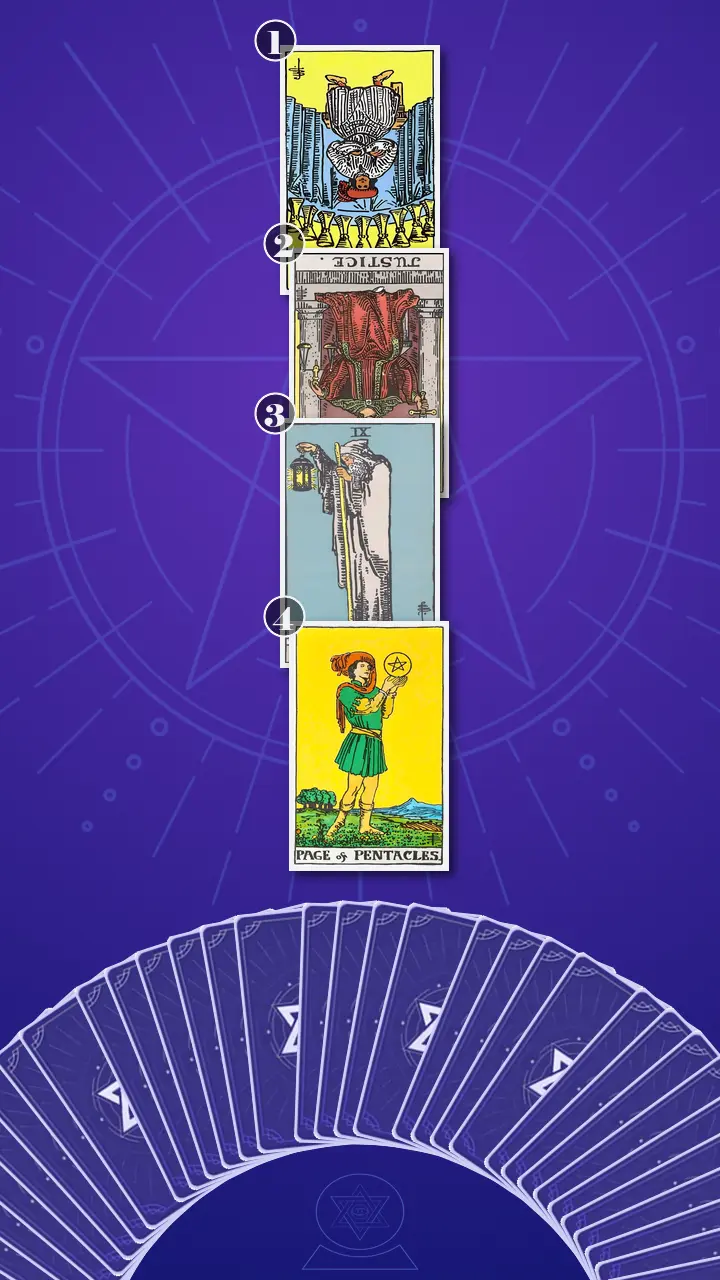
Reading the Map Beneath the Milestone Dissonance
The Card of Hollow Satisfaction — Nine of Cups, Reversed
I turned over the card representing the visible symptom: the right-on-paper, wrong-in-the-body dissonance, and the concrete habits Jordan used to monitor it. It was the Nine of Cups, reversed.
On paper, the Nine of Cups often looks like satisfaction. Reversed here, it showed something much sharper: a life that photographs well but does not emotionally feed the person living it. I told her this looked exactly like her in that London flat after work, staring at a life that was stable, coherent, and socially legible—a decent salary, a respectable mid-level role, birthday plans, routines that looked mature from the outside—while feeling weirdly absent from the life those facts described. The crossed arms on the card became emotional self-protection. The row of cups behind the figure felt like achievements arranged for recognition instead of nourishment. It had the energy of posting a birthday carousel that gets all the right reactions while you still feel flat looking at your own photos.
Energetically, this was blocked Water. Not a lack of feeling, but feeling edited out until only presentation remained. The current setup still worked well enough to defend, so desire had been muted instead of heard. And when other people’s engagements, promotions, relocations, or glossy recaps hit her in the chest, I did not hear simple pettiness in that response. Sometimes envy is just grief wearing better lighting.
Jordan gave a short laugh, the kind that carries a bruise inside it. “That’s almost rude,” she said, but she was smiling when she said it. Then her thumb rubbed once across the edge of her phone case, a tiny self-soothing motion. I know that reaction well. It is what happens when someone feels uncomfortably seen and, at the same time, relieved.
The Inner Courtroom — Justice, Reversed
Next, I turned over the card representing the hidden script: the internal scorekeeping around turning 30 and the fear that changing course would make the last decade look like a mistake. Justice, reversed.
I always slow down for this card in a spread like this, because it rarely speaks in vague moral terms. It speaks like a private tribunal. For Jordan, it looked like the harsh laptop glow after a colleague mentioned an internal opening: Slack still pinging, a fresh note filling with pros, cons, salary impact, CV optics, and what every possible choice would say about her judgment before 30. Can I justify it? kept drowning out Can I live it?
The scales became constant weighing. The sword became mental clarity used as self-surveillance. The stone throne became rigidity. This was excess Air and almost no warmth: discernment hardened into scorekeeping. The more she treated her life like a performance review deck, cross-examining every choice for ROI and defensibility, the less room there was to feel whether any of it still fit in the body she actually had to wake up in each morning.
Whenever I see Justice reversed under a card like this, my mind goes to orbital mechanics. A planet can appear still at the far edge of an orbit, when in truth the arc is already changing. That is what this kind of overthinking often is: not wisdom, but panic wearing a responsible face. I met her eyes and said, “Discomfort is not a failed audit. It’s information.”
She went still in three small stages. First, her inhale caught. Then her gaze slipped past the card, as if she were replaying a dozen late-night lists in fast succession. When the breath finally left her, it came out thin and tired. “I do that,” she said. “I make everything into a case file before I let myself admit whether I even want it.”
When The Hermit’s Lantern Entered the Room
Leaving the Scorecard — The Hermit, Upright
Then I turned over the card representing the turning insight: the inner authority needed to stop outsourcing meaning to milestones and start listening to lived truth. The Hermit, upright. The room changed as soon as it appeared. Even the low rumble from the street seemed to soften, as if the world itself had taken one step back so we could hear something quieter.
The Hermit is not a dramatic reinvention montage. It is more like putting your phone on airplane mode long enough to hear your own thoughts load back in. It is the moment someone stands by a rainy window, or walks home without a podcast, or leaves the group chat unopened for an hour, and finally notices which thought is social pressure and which thought is actually theirs. The lantern does not light a five-year plan. It lights the next honest step. In Jordan’s life, this looked like stepping out of feeds, milestone updates, and borrowed opinions long enough to ask one human question beneath all the analysis: what am I pretending not to know?
This was also the exact moment I brought in one of my own practice frameworks, what I call Void Phase Identification. I told her that many people arrive here convinced something is wrong with them because an old definition of success has stopped generating life. But sometimes nothing is broken. Sometimes you are simply in a void phase between orbits—the low-tide stretch where the last cycle has done all it can do, and the next one has not fully taken shape yet. Turning 30 was not exposing her failure. It was exposing the standard that no longer fit. The discomfort was not proof that she had failed adulthood; it was her inner life asking for a more honest standard than looking right from the outside.
You know that late-night loop where you open the budget app, LinkedIn, and the same note again because if you can just think clearly enough, maybe turning 30 will stop feeling so off? That is the exact moment this card interrupts.
Your life is not wrong because it stops matching the crowd's scorecard; let The Hermit's lantern lead you toward what is quietly true, one honest step at a time.
I let the sentence sit between us.
Jordan’s reaction came in three waves. First, a freeze: her fingers stopped halfway to her mug and her breath held, as if the room had briefly lost oxygen. Then came recognition: her eyes unfocused, not blank but crowded, as if she were replaying the Tube ride home after the perfectly competent presentation, the lukewarm takeaway, the birthday planning spiral, the engagement post on a Sunday evening, the note that kept asking the same question while never reaching the real one. Finally, release arrived through her body before it found language. Her shoulders dropped. Her jaw unclenched. She drew in one fuller breath, and the exhale that followed sounded almost like grief. There was relief in it, yes, but also the slight vertigo that comes when a burden shifts and leaves you facing your own freedom more directly than before.
Then the resistance surfaced, sharp and honest. “But if that’s true,” she said, and now there was heat in her voice, “doesn’t that mean I spent years getting it wrong?”
“No,” I said. “It means your twenties built an orbit that got you here. Respecting that is different from treating it like a contract you can never revise.” I pointed out the pattern quietly: the Nine of Cups and The Hermit both carried the energy of nine, the point in tarot where a cycle has ripened to its limit. Not failure. Ripeness. “Now, with this new perspective, think back to last week. Was there a moment when this insight would have changed how you felt?”
Her answer came quickly. “Sunday night,” she said. “I kept telling myself I needed one clean answer. But I think I already knew the life I’m defending is not the same as the life I want to be inside.”
That was the shift right there: from defended numbness and comparison spirals to quieter self-trust and felt alignment. Or, in simpler language, from public scorecard to private signal. Legible is not the same thing as true.
To keep that insight from drifting back into abstraction, I gave her one immediate anchor. Within the next ten minutes, I asked her to open a note and write two headings: Still looks right and Still feels true. One item under each was enough. If it started turning into a spiral or a self-attack, stop there. The point was signal, not self-interrogation.
The One-Coin Experiment — Page of Pentacles, Upright
The final card I turned over was the one representing action: how to translate self-trust into one small, testable real-world step instead of a dramatic life overhaul. It was the Page of Pentacles, upright.
I smiled when I saw it, because this card is the clean antidote to all-or-nothing panic. The Page does not demand a life rebrand. The Page studies one coin. One possibility. One experiment. In modern terms, it is the opposite of secretly redesigning your future in Notion at 11:30 p.m. and much closer to a low-stakes beta test. Given Jordan’s product-marketer brain, that landed instantly.
The energy here was grounded Earth: steady, teachable, practical. Instead of demanding certainty, the card asked for evidence. Draft one email about the internal stretch project. Book one informational coffee. Change one recurring evening and notice what your nervous system does. This is where self-trust becomes something you build with your hands, not just something you hope to feel one day.
You do not need a verdict. You need data.
She nodded this time without the bitter laugh. Her expression softened into something I often trust more than excitement: relief. When clarity is real, it usually arrives quieter than hype.
From Resume Logic to Lived Truth
Once all four cards were on the table, the story they told was precise. Nine of Cups reversed showed the polished shelf: a life arranged well enough to be admired, but not necessarily inhabited. Justice reversed showed the main blockage: every flicker of desire got dragged into an inner courtroom and judged for optics, responsibility, and correctness before it was allowed to be felt. The Hermit interrupted that cycle by restoring inner authority and naming the void phase for what it was—a necessary pause between orbits, not proof of personal failure. Then the Page of Pentacles brought the whole reading down to earth by refusing the fantasy of one perfect answer. This was not a verdict on her life. It was a method for leaving the courtroom, stepping into honesty, and testing reality one small move at a time.
The blind spot was subtle but powerful. Jordan had been treating gratitude and misalignment as opposites, as if admitting one quiet no would erase everything her twenties had built. It doesn’t. The real transformation direction was kinder than that: move from asking Does this still look right? to testing Does this still feel true when I actually live it? That is the difference between resume logic and lived truth.
She gave me a rueful smile. “I can absolutely turn all of this into another optimisation ritual.”
“Then we make it smaller,” I said. “And we cap it.”
- The Cosmic Redshift ObservationFor the next seven nights, open your Notes app before bed for three minutes max and make two short columns: Looked good and Felt alive. If you want the full orbit version of the exercise, add a tiny tag beside each item—redshift for something whose energy feels like it is fading, blueshift for something that feels like it is approaching you. Keep each side to three bullets or fewer.If writing feels annoying, record a two-minute voice note while brushing your teeth or walking home. Stop before it turns into evidence gathering.
- The No-Input HourBook one protected hour this week—an East London café on Saturday, a Sunday walk, or twenty airplane-mode minutes on your commute—with no LinkedIn, no Instagram, no podcasts, and no advice texts. Bring one question only: what am I pretending not to know?Expect restlessness before clarity. That does not mean it is not working; it usually means the noise has dropped enough for the real signal to become audible.
- The One-Coin ExperimentWithin the next seven days, take one concrete step that gathers evidence instead of demanding certainty: draft the email about the stretch project during Thursday lunch, book one class, ask one person for coffee, or change one recurring evening so your week feels more like your values and less like a default template. Give it twenty minutes, not your whole future.Before you begin, say this once: no verdict, just data. You are not proving who you are at 30. You are learning what actually fits.

A Week Later, the Quiet Proof
A week later, Jordan messaged me from a rainy Thursday lunch break. She had done the redshift notes four nights in a row. On the fading side she kept writing some version of the same thing: work praise without afterglow. On the approaching side she wrote longer walk home, writing without an audience, and the internal project she had kept talking herself out of exploring. Then came the smallest sentence that told me the reading had landed exactly where it needed to: she had sent the email before she had a five-year plan.
That was her proof. Not a new identity. Not a dramatic reinvention. Just one honest action taken from quieter self-trust. She told me she slept properly that night, though when she woke the next morning the first thought was still, What if I’m wrong? This time, she smiled at it instead of obeying it.
When I think about our session now, I do not remember a prediction coming true. I remember a person hearing herself more clearly. That, to me, is the real journey to clarity: using tarot to illuminate a pattern, then handing the power of choice back to the person who actually has to live the week ahead.
Sometimes the loneliest place to be is inside a life everyone else keeps congratulating while your body already knows it doesn’t fit the same way anymore.
If you gave yourself one small experiment instead of one final verdict, what corner of your actual week would you want to test for truth first?
Every reading at AceTarot is a Journey to connect with inner wisdom and empower next step.
Learn more about our Journey to Clarity.