From Zotero Overwhelm to Draft Momentum: The Core 12 Week Plan

Finding Clarity in the Pristine Zotero, the Empty Doc
If you’re a grad student whose Zotero is pristine but your lit review doc is still basically empty, you know the specific kind of lit review paralysis that feels like “being productive” while nothing actually gets written.
Taylor (name changed for privacy) joined my Zoom from Toronto with their camera angled down at a kitchen table. It was 8:47 PM there—Tuesday-night quiet, the kind that makes every unfinished task feel louder. A half-cold mug of tea sat near their trackpad. The laptop fan had that constant whirr like a low-grade anxiety soundtrack. Zotero was open in one window. A blank Google Doc in the other. The overhead light gave off a faint fluorescent buzz, and their fingers kept doing restless little clicks—dragging PDFs between collections like they could physically rearrange their way into courage.
“I keep telling myself it’s just thirty minutes of reading,” they said, and their voice tightened on the word just. “Then I’m renaming files, tweaking tags, saving quotes… and suddenly it’s midnight and I’ve written nothing.”
I watched their shoulders inch up toward their ears when they glanced at the Zotero sidebar. The feeling in the room wasn’t laziness. It was more like standing under a teetering stack of books you promised yourself you’d read before you’re allowed to speak—except the stack is digital, endless, and it follows you into bed.
And under all the micro-organization was the plain, sharp contradiction: they wanted to finish a credible lit review draft, but they were terrified that missing one key source would expose them as incompetent.
“We’re not going to solve your entire chapter tonight,” I told them gently. “But we can absolutely find your next step. Think of this as a Journey to Clarity—making a map that your nervous system can actually follow.”

Choosing the Compass: The Celtic Cross · Context Edition
I asked Taylor to take one slow breath in, one slow breath out—nothing mystical, just a clean transition from scrolling to seeing. While they shuffled their own deck on camera, I shuffled mine in Tokyo, in the small staff room behind the planetarium. A poster of the Orion Nebula hung slightly crooked on the wall; the hum of the building’s ventilation felt like distant white noise. Two cities, one question: Zotero full of to-read PDFs—what’s my next step for my lit review?
“For this,” I said, “I’m using a spread called the Celtic Cross · Context Edition.”
And here’s why it works—especially for research overload turning into writing paralysis. The Celtic Cross separates what you can see (the stuck behaviors, the backlog, the blank page) from what’s driving it underneath (the belief that you must read everything to be safe, the fear loop, the self-positioning). Then it pivots into something practical: not prediction, but a near-future move and an integration principle that makes your workflow sustainable.
I previewed three anchors so Taylor—and you—could track the logic: the first card would name the current stuck point in observable behavior, the crossing card would show the main blocker that keeps reading and organizing from turning into writing, and the final card would reveal how to integrate this into a lit review workflow that actually produces synthesis.
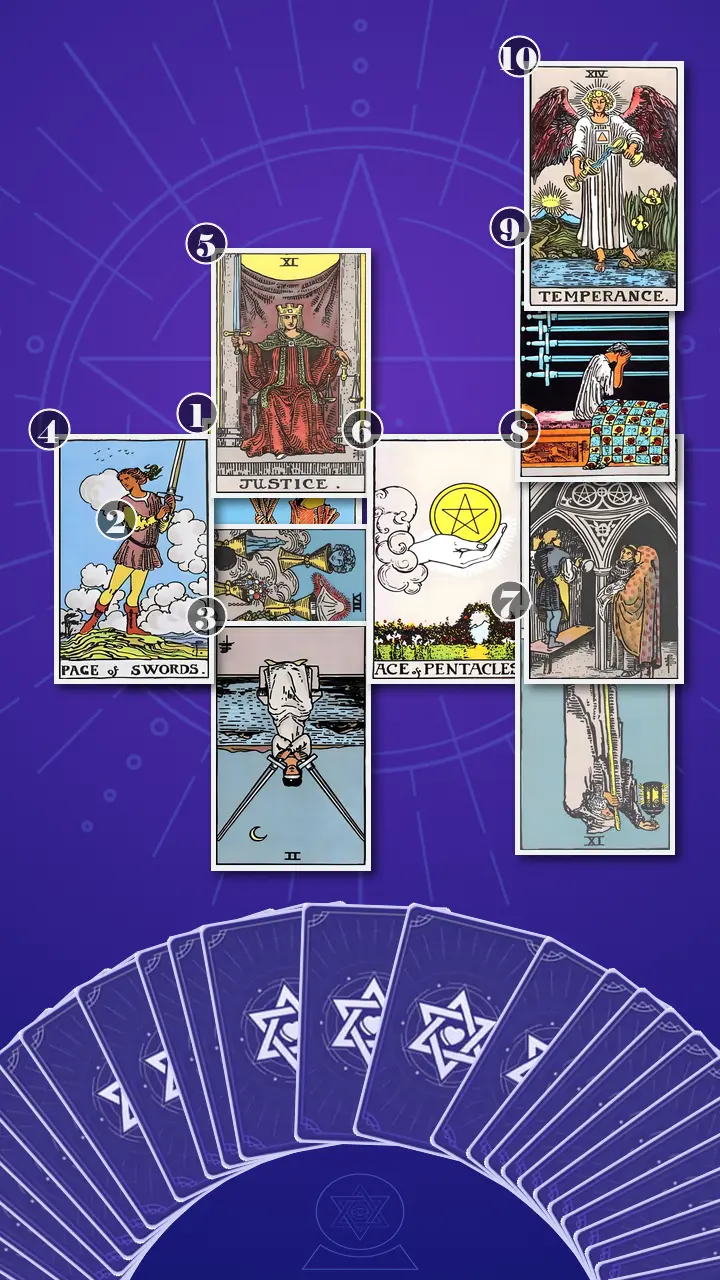
Reading the Map: From Carrying to Choosing
Position 1 — The current stuck point: Ten of Wands (reversed)
“Now turning over is the card that represents the current stuck point in the lit review process—the observable behavior and the felt workload,” I said.
Ten of Wands, reversed.
In modern life, this card is the overstuffed-backpack commute: carrying so much you can’t see where you’re going. And the way it shows up in a Zotero-lit-review life is painfully specific—opening your library and immediately feeling the urge to triage, re-tag, re-file, re-sort, muttering, “This is too much,” and then escaping into low-stakes admin work instead of drafting.
The reversed energy here is a blockage in Fire: not “no effort,” but effort that’s become unsustainable. The load is so self-imposed that it pins you to prep tasks. You’re working, but you’re working under the pile instead of turning the pile into paragraphs.
Taylor let out a short laugh that had a little bitterness in it. “Yeah,” they said. “That’s brutal. Like… too accurate.” Their hand paused mid-click, hovering over a collection name as if their fingers had been caught doing something in plain sight.
“Your Zotero can be immaculate and still be a hiding place,” I said—not as a call-out, but as a relief. A name for the pattern without shame.
Position 2 — The main blocker: Seven of Cups (upright)
“Now turning over is the card that represents the main blocker that keeps reading and organizing from turning into writing—the ‘why it won’t move’ factor.”
Seven of Cups, upright.
This is choice overload in its purest form: too many options, each one shimmering like it could be the key. It’s the academic version of five PDFs open at once, each abstract convincing you it’s urgent, each one asking for highlights, none of them becoming a claim you’re willing to stand behind.
The energy here is excess in Water—possibility flooding the field. The tricky part is that it feels like safety. “If I keep every option open, I can’t be caught missing something.” But the cost is fog. The more you add, the less your brain can run—like keeping 200 browser tabs open because closing any of them feels like a moral failure.
Taylor exhaled—a real, visible one. Their shoulders dropped a fraction. “I keep telling myself I’m being thorough,” they said, quieter. “But it actually feels worse the more I add.”
Position 3 — The deeper mechanism underneath the stall: Two of Swords (reversed)
“Now turning over is the card that represents the deeper mechanism underneath the stall—the hidden decision or belief shaping the loop.”
Two of Swords, reversed.
The modern translation is a micro-scene I’ve seen a thousand times: the cursor hovering over a heading in your outline, dragging sections up and down… and not adding a single sentence. It looks like neutrality. It feels like rigor. But it’s armor.
The reversed energy is a blockage in Air: the mind trying to hold a decision in suspension forever. “If I don’t choose a frame, I can’t be wrong.” But in a lit review, not choosing a frame doesn’t make you objective—it just keeps you invisible on the page.
I said it carefully: “Staying ‘fair to every subfield’ can become a way to avoid the vulnerability of taking a stance.”
Taylor went still for a beat—breath caught, fingers suspended over the trackpad. Then their eyes unfocused like they were replaying a familiar moment. Finally, a small, quiet “Oh.”
“Yeah,” they admitted. “If I choose wrong, it proves I don’t belong.”
Position 4 — The habit that built the backlog: Page of Swords (upright)
“Now turning over is the card that represents the habit or earlier phase that built the current Zotero backlog—how you got here.”
Page of Swords, upright.
This card is your sharp scanning skill: the citation-chain sprint, the Google Scholar “cited by” rabbit hole, the ability to find the right paper fast. In your past, that was a genuine strength. You trained your brain to gather intel quickly, to be alert, to track debates.
The energy is excess in Air again—but not as failure. More like: the Page learned to scout, and no one taught them how to build a house with the wood they bring back.
“Keep that sharpness,” I told Taylor, “but aim it at producing short summaries instead of more downloads.”
Position 5 — The conscious aim: Justice (upright)
“Now turning over is the card that represents what you’re consciously aiming for—your standards, identity, and the ideal you’re trying to meet.”
Justice, upright.
Justice is the part of you that cares about rigor. Proper citations. A review that won’t collapse under committee questions. The scales are your selection criteria. The sword is your willingness to make a clear argument.
The energy here is balance—but it’s also intense. Because if Justice gets interpreted as “I must be exhaustive to be credible,” it turns into a courtroom in your head, and every unread PDF becomes potential evidence against you.
I leaned in: “Credible doesn’t mean exhaustive. Credible means coherent.”
Taylor nodded, but there was a flicker of resistance in their mouth, like they wanted to believe me and didn’t know how yet.
Position 6 — The most helpful next step: Ace of Pentacles (upright)
“Now turning over is the card that represents your most helpful next step in the next 7–10 days—a concrete move that turns inputs into draft output.”
Ace of Pentacles, upright.
This is Earth. Traction. A small deliverable you can hold in your hands. Not “finish the reading,” but “make one brick.”
I described it exactly as the card asks: a single 150-word summary of one core paper plus one sentence that starts with, “So what for my review is…” The click of the keyboard. The satisfaction of one completed paragraph you can scroll to and point at. The difference between an infinite reading plan and one page that exists.
Something softened in Taylor’s face. The tightness in their chest didn’t vanish, but it loosened, like someone unclenching a jaw without realizing they’d been clenching for hours. “Okay,” they said. “That… I can do today.”
Position 7 — Self-stance: The Hermit (reversed)
“Now turning over is the card that represents how you are positioning yourself psychologically—your default coping posture.”
The Hermit, reversed.
In reverse, the Hermit isn’t “wise solitude.” It’s over-isolating and mistaking hiding for progress. It’s staying in research mode because no one can critique what they can’t see.
I kept my tone warm, not preachy: “This can look like telling yourself you’ll share once it’s clean—and then disappearing into reading because being seen in the messy middle feels unsafe.”
Taylor’s eyes flicked away from the screen. Their fingers intertwined, then loosened. “Yeah,” they said. “I ghost my own writing group.”
Position 8 — External scaffold: Three of Pentacles (upright)
“Now turning over is the card that represents external supports and constraints—resources, peers, structures you can use.”
Three of Pentacles, upright.
This is workshop mode. Drafts improving because you put them on the table. Shared standards. A rubric. A supervisor who wants clarity and contribution, not a museum of every paper ever published.
In real terms, it’s a writing sprint channel on Slack or Discord, a 30-minute check-in, or even a single peer who can say, “This throughline makes sense,” before you read 40 more PDFs trying to self-soothe.
“The lit review can be a worksite,” I said, “not a private trial.”
Position 9 — The hope/fear loop: Nine of Swords (upright)
“Now turning over is the card that represents the hope/fear loop that fuels the backlog—what you’re trying to prevent, and what you wish were true.”
Nine of Swords, upright.
This is the 1:07 AM wake-up: you remember one missing citation, grab your laptop, chase a reference chain, and suddenly you’ve downloaded six new PDFs in the dark. Your body feels wired and exhausted at the same time. The mind turns a normal gap into a verdict: “I’m not competent enough.”
The energy is excess in Air—rumination that multiplies tasks. The hope is that more reading will finally quiet the inner critic. The fear is that your draft will expose a gap.
I said one line I’ve watched land for a lot of researchers: “A draft is a tool for finding gaps, not a test you must pass before you’re allowed to start.”
When Temperance Started Pouring: The Two-Sources-One-Claim Moment
Position 10 — Integration principle: Temperance (upright)
“Now turning over is the card that represents how to integrate this into a sustainable lit review workflow—the synthesis principle that makes the whole system workable.”
The room felt quieter when Temperance appeared, like the audio in the call dropped into a lower register. Not dramatic—just that sensation of finally seeing the mechanism instead of only feeling the panic.
Temperance, upright.
This is the lit review card of synthesis: blending sources into a coherent narrative. The angel pouring between two cups is not “more information.” It’s combination. Compare-and-contrast. Theme mixing. Highlights turning into arguments.
Setup (what you’ve been stuck inside): Taylor had been living inside a rule that sounded like rigor: “I must read everything before I write.” So every session began with “just thirty minutes,” and ended with a bigger library and a blank page—because the blank page can’t prove you missed something.
Delivery (the line I wanted to hang in the air):
Stop trying to carry every paper like a burden, and start pouring two sources into one claim—Temperance turns your backlog into a blendable draft.
I let it sit for a breath. In the planetarium, I’ve seen how one clean constellation line can change the whole sky for someone. This was that kind of line—simple, but reorganizing.
Reinforcement (what happened in their body, in layers): Taylor froze first—eyes wide, lips parting like they’d been interrupted mid-argument with themselves. Then their gaze went slightly unfocused, like they were mentally replaying every night they’d chased one more PDF to earn permission to write. Their throat bobbed once. A flush rose in their cheeks. Finally, their shoulders lowered—slowly, like a backpack sliding off after a long walk—and they let out a shaky exhale that sounded half relieved, half angry.
“But… if I do that,” they said, and there was a sudden edge to their voice, “doesn’t it mean I’ve been doing it wrong this whole time?”
I nodded. “It means you’ve been using a strategy that protects you—by keeping you in preparation where you can’t be judged. That strategy worked for scouting. It doesn’t work for synthesis.”
This is where my astronomy brain always kicks in. I told them about something I call Black Hole Focus: in space, an event horizon is a boundary. Inside it, things fall in; outside it, they don’t. “Your Zotero library is acting like a gravity well,” I said. “Every new paper feels like it’s pulling you because you think it equals safety. We need an event horizon for the next week—so your attention can stop collapsing inward and start doing useful work.”
“So… Core 12 is the event horizon,” Taylor said slowly, testing the idea like a new shoe on a sore foot.
“Exactly,” I said. “Inside that boundary, we don’t collect. We pour. Two sources into one claim. That’s the job.”
I gave them a tiny experiment to make it real: set a 10-minute timer, pick any two papers from their Core 12, and write exactly three lines: (1) “Paper A says…” (2) “Paper B says…” (3) “The tension/gap between them is…” Stop when the timer ends—even mid-sentence. No downloading, no re-tagging, no citation-style tweaks until the timer is done.
Then I asked, exactly as I always do when a key card lands: “Now, with this new lens, think back to last week—was there a moment when you opened Zotero and you could have poured instead of carried?”
Taylor’s eyes dipped toward their desk. “Sunday,” they said. “LinkedIn doomscroll. I downloaded three ‘just in case’ papers. I could’ve… done the three lines instead.”
That was the emotional shift in miniature: from overwhelm and self-critique toward cautious momentum through tiny written outputs. Not certainty—traction.
The One-Page Mix: Actionable Next Steps for Your Lit Review
When I looked at the whole spread together, the story was clean: Ten of Wands (reversed) showed the unsustainable load you’ve been carrying; Seven of Cups showed the fog of too many seductive options; Two of Swords (reversed) named the hidden avoidance—neutrality as armor; Page of Swords honored the real skill that built the library; Justice revealed the standard you’re trying to meet; Ace of Pentacles grounded the next step into a physical deliverable; Hermit (reversed) and Three of Pentacles reframed your workflow from isolated proving to collaborative craft; Nine of Swords exposed the fear loop that hijacks your nights; and Temperance gave the integration engine: blend what you have into themes.
The cognitive blind spot was this: you’ve been treating reading more as the only respectable form of rigor, and treating writing a claim as a risk you must earn your way into. But the transformation direction is the opposite: shift from “I must read everything before I write” to “I will write a rough synthesis from a chosen core set, then backfill only what the draft proves I need.”
So I gave Taylor a plan that respects their standards and gives them traction—small constraints, measurable outputs, repeatable rituals.
- Build your Core 12 event horizonTonight, create two Zotero collections: “Core 12 (This Week)” and “Archive for Later.” Move everything except 12 sources into Archive—no deletion. Pick the 12 by one Justice-style criterion: “directly informs my research question” or “frequently cited foundational piece,” not “feels impressive.”Expect your brain to call it “arbitrary.” Say the rule out loud: “Core 12 for three sessions.” If panic spikes, Core 8 is allowed. You’re not losing anything—you’re parking it.
- Make one Ace of Pentacles “Lit Review Brick”In your next session, choose one source from Core 12 and write 150 words summarizing it + one sentence starting “So what for my review is…”. Paste it into a running doc titled “Lit Review Bricks.” Add one label above it: “Theme: ____” or “Tension: ____” (choose just one).This will feel too small—that’s the point. Do not format. Do not fix citation style. If you need, type (Author, Year) placeholders. If it’s not in the draft, it doesn’t exist yet.
- Do the Temperance pour (two sources → one claim)Set a 10-minute timer. Pick any two papers from Core 12 that live in the same theme. Write three lines: “Paper A says… / Paper B says… / The tension or gap between them is…” Then add one sentence stem: “Compared with X, Y assumes… which matters because…”If your inner critic gets loud, that’s not evidence you should read more—it’s evidence you hit the real work. Keep it tiny on purpose. Stop at 10 minutes even mid-sentence.
To make it easier to hold the structure in their mind, I offered one of my own tools—something I use when I teach constellations at the planetarium. I call it a Planetary Memory Palace: put your research question as the Sun in the center of a page, then draw 3–5 “planets” as themes, and assign 2–3 key papers as “moons” orbiting each theme. It’s not aesthetics—it’s retrieval. When you sit down to write, you’re not staring into a void; you’re visiting a planet and describing its moons.
And for those moments when a “missing citation” thought tries to drag you back into downloading, I suggested a boundary trick: Shooting Star Notes. Thirty seconds. Capture the thought in a “Backfill Needed?” note—one line only—then return to the pour. The point is to acknowledge the impulse without letting it hijack the session.

A Week Later: Ownership, Not Certainty
Eight days later, I got a message from Taylor. Not a dramatic transformation. Something better: a small proof that the system had shifted.
“I made Core 12,” they wrote. “I hated it for like… ten minutes. Then I did the three-line pour. Twice. I sent my headings + two claims to my writing group. Nobody yelled at me. My doc isn’t perfect, but it’s not empty.”
They added one more line that felt like Temperance in real life: “I slept a full night. This morning my first thought was still ‘what if I’m missing something?’—but I didn’t open Zotero. I opened the draft.”
That’s the journey I trust: not certainty, but ownership. A smaller curated core. A living draft you refine. Rigor expressed as method, not as fear.
When you’re trying to prove you belong by being exhaustive, every unread PDF starts to feel like a threat—and your draft stays empty because an empty page can’t expose a gap.
If you treated your next lit review session as a tiny mixing experiment instead of a competence test, what are the two sources you’d pour into one rough claim first?