Caught in late-night thesis micro-edits—and a cleaner way to decide

Finding Clarity in the 1:30 a.m. Portal Glow
If you’re a London PhD candidate who keeps opening the thesis extension form like it’s a fire exit—then closing it and going back to micro-edits at 1 a.m.—this is that exact kind of PhD burnout.
Maya (name changed for privacy) sat down across from me with her tote bag still on her shoulder, like she hadn’t fully decided she was allowed to take up space. She lived in the kind of small London flat where the desk is also the dining table, so the thesis is never “put away”—it’s there while you eat, there when you answer messages, there when you pretend to watch something on Netflix and end up thinking about Chapter 4 anyway.
She described Tuesday night at 1:30 a.m. with a precision that made my own shoulders tense in sympathy: laptop warm under her wrists, blue portal glow making the room feel colder, a kettle she forgot to boil sitting like a tiny judge. Five tabs open—thesis draft, extension form, university policy page, citation guide, and a blank email to her supervisor. She toggled between them the way people flick between apps when they’re hoping one of them will hand them a different life.
“I keep starting the extension form,” she said, voice low, like the form could hear her. “I fill in my details… and then I just… stop. I go back to the document. I tell myself I’ll decide when I’ve made more progress.”
What she was really asking was simple and brutal: push through burnout, or ask for more time—without feeling like she’d just submitted evidence that she wasn’t cut out for this.
The exhaustion wasn’t an abstract word in her story. It was heavy eyes that felt gritty like sand, shoulders locked up near her ears, and that wired-but-drained buzz in her chest—the feeling of running on adrenaline with the battery icon flashing red.
“We’re not going to make this a morality play,” I told her. “We’re going to make it a map. The goal today is clarity—so whichever choice you make, it comes from reality, not panic.”

Choosing the Compass: The Decision Cross · Context Edition
I asked Maya to put both feet on the floor and take one slow exhale—nothing mystical, just a nervous system handbrake. Then I shuffled slowly, the sound of the cards a steady little metronome in the room.
“For this,” I said, “I want to use a spread I call the Decision Cross · Context Edition.”
For anyone reading who’s curious about how tarot works in a practical way: I use spreads like structured thinking tools. This one is built for a real either-or decision—push through vs ask for more time—but it also forces the question underneath the question: what’s emotionally pulling you toward one option, and what resource you’re ignoring in the other.
In this spread, the center card shows the current reality (the real burnout on the ground, not the self-judgment). The left and right cards contrast the two options in actual lived behavior—what your week will look like, not what your intentions sound like. Then we look at what makes each path tempting. And the final card is an integration lane: the most sustainable next step that keeps you from ending up right back in the same spiral.
Maya watched me lay the cross. Her gaze kept snapping to the center, like her body already knew the whole reading was going to name something she’d been trying not to name.
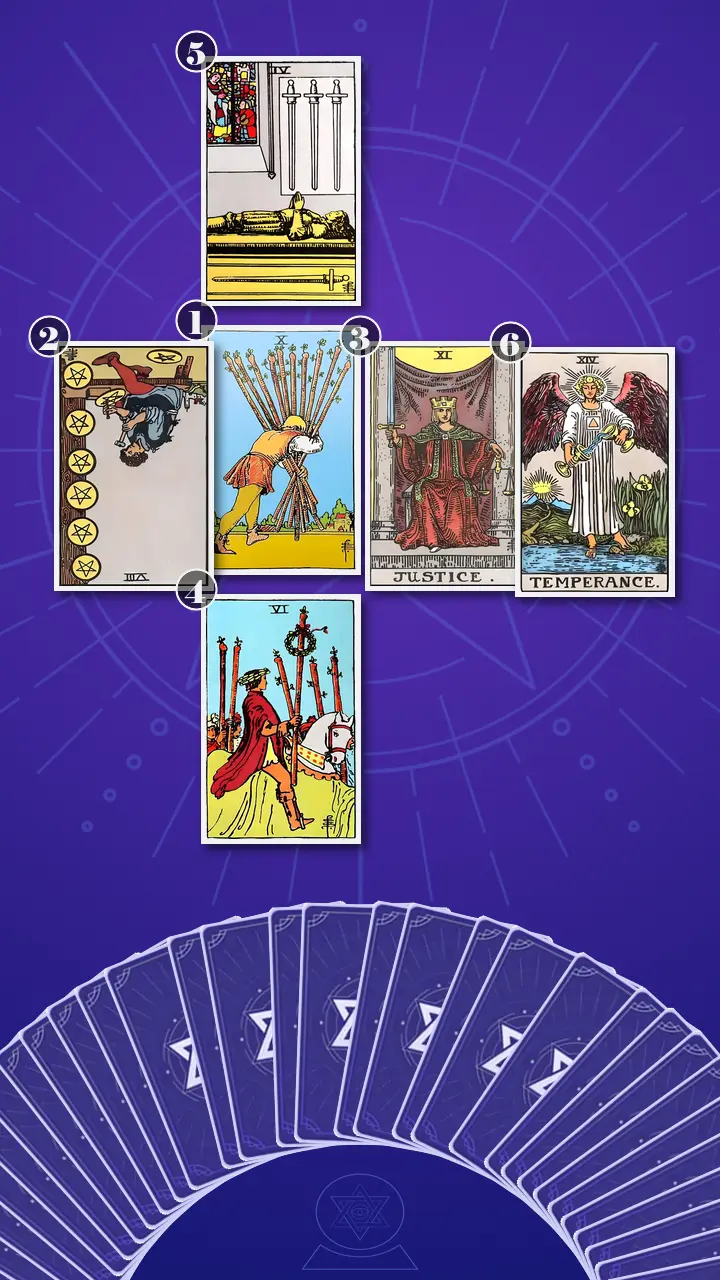
Reading the Map: The Burden, the Loop, and the Clean Ask
Position 1: The Current Reality — Ten of Wands (upright)
“Now flipping over is the card representing the current reality: the most concrete picture of overload/burnout shaping the thesis and the decision pressure.”
Ten of Wands, upright.
I didn’t have to stretch to connect it to her life; it practically introduced itself. It’s late in your tiny London flat where the desk is also the dining table, and the thesis never leaves your eyeline. You’re carrying everything like it’s all equally urgent: argument, formatting, supervisor expectations, money stress, and the unspoken fear that asking for time means you’re not capable. You keep moving—typing, tweaking, checking—yet your load is so heavy it blocks perspective.
This is overload as a posture. Ten of Wands energy, when it’s upright and dominant, isn’t laziness. It’s responsibility taken so far past sustainable that the work starts to block your view of what matters. The energy here is Excess: too much carried, too little delegated, too little cut.
I let my eyes pan across what she’d described—thesis doc, portal policy, citation guide, half-written email—like a slow camera sweep across a tiny set where the same scene replays every night. “Your shoulders are telling the truth,” I said gently. “And your browser is telling the truth too. This is the 40-Chrome-tabs problem. You’re doing things, but the system is overheating.”
Maya gave a small laugh that surprised even her—short, bitter, almost amused. “Why is that so… specific? That’s literally my life.”
I nodded. “And here’s the part I want you to hear: Ten of Wands isn’t a verdict on your character. It’s a data point about load.”
Position 2: Option A (Push Through) — Eight of Pentacles (reversed)
“Now flipping over is the card representing Option A (Push through): what the ‘grind and submit’ approach looks like in practice and how it tends to use your energy.”
Eight of Pentacles, reversed.
Option A looks like you staying up past midnight doing ‘productive’ work that doesn’t change the thesis in a meaningful way: fixing citations, reformatting headings, rewriting the same paragraph three different ways, then reading it again immediately. You tell yourself it’s discipline, but it’s really a detour around the scary decision.
Reversed Eight of Pentacles is effort that’s real—hours are spent—but the effort is misallocated. The energy is Blockage: craftsmanship gets jammed into perfectionism, and perfectionism becomes a defense strategy. Not a personality flaw. A strategy.
I heard my old Wall Street brain click on for a moment—an internal flashback to trading floors where people would work until midnight on the wrong model because it felt safer than presenting an imperfect recommendation. Busy can be a hiding place.
“If it’s 1:30 a.m. and you’re polishing commas, you’re not behind—you’re in the loop.”
Her face tightened, then softened, like she’d been caught and relieved at the same time. She stared at the card, then at her hands. “I hate that I do that,” she said. “I keep thinking—if I just tighten this sentence, I’ll feel allowed to decide.”
“That’s the loop,” I said. “So here’s a grounded question: what changed in the argument… versus what changed in your anxiety level?”
Position 3: Option B (Ask for More Time) — Justice (upright)
“Now flipping over is the card representing Option B (Ask for more time): what the extension request represents psychologically and how it can be handled cleanly.”
Justice, upright.
Option B looks like stepping out of the shame story and into admin reality: you list the facts (current draft status, what remains, your paid work hours, and what quality writing requires), then you fill out the extension form like it’s a process—not a confession. You draft a short email to your supervisor that doesn’t beg or over-explain.
Justice brings Balance in a way anxious people rarely enjoy at first: facts. criteria. consequences. Not punishment—structure. And it made sense that campus portal logins feel like entering a courtroom; when you’re burned out, every rule reads like a verdict.
I leaned in. “Needing time isn’t a moral verdict. It’s a capacity fact.”
Maya’s breath caught—just for a second. Then she exhaled like she’d been holding her stomach in all day. But her eyes flashed with resistance too, a quick spark of anger that had been hiding under the guilt.
“But if I ask,” she said, sharper now, “it’s like… everyone will know. My supervisor will know. They’ll think I mismanaged it.”
I didn’t rush to soothe it away. “That’s an honest fear,” I said. “And Justice doesn’t ask you to overshare. It asks you to be clean.”
Clean means: evidence-based, bounded, specific. A formal process you can respect—even when you’re emotionally raw.
Position 4: What Makes Pushing Through Tempting — Six of Wands (upright)
“Now flipping over is the card representing what makes Option A tempting: the emotional payoff or identity-reward you’re seeking by pushing through.”
Six of Wands, upright.
Under the push-through plan is a very human craving: the moment you hit submit on time and feel the tightness in your chest turn into pride—like you can finally show up in group chat without flinching, like your supervisor will read your email and think ‘she handled it.’ You might even picture the Instagram/LinkedIn announcement, or at least the private relief of not being ‘the one who needed extra time.’
Six of Wands is recognition. And in a PhD environment—especially with WhatsApp cohort chats that oscillate between support and subtle competition—that recognition can become oxygen.
“Part of you isn’t chasing a deadline. You’re chasing the feeling of being seen as capable.”
Her jaw tightened, and she looked away toward the window like she didn’t want the card to see her. That tiny movement—turning her face away—told me the truth landed.
“I saw someone post ‘submitted!!!’ on LinkedIn last week,” she admitted. “I wanted to be happy for them. I was. And then I felt sick.”
“That’s not pettiness,” I said. “That’s comparison fatigue colliding with a nervous system that hasn’t had a protected off-switch.”
Position 5: What More Time Truly Offers — Four of Swords (upright)
“Now flipping over is the card representing what Option B truly offers: the real resource gained by taking more time (not the shame-story about it).”
Four of Swords, upright.
This is the moment you stop treating rest like collapse and start treating it like maintenance: a protected block where you don’t edit, don’t check the portal, don’t ‘just quickly’ polish a reference. Maybe it’s 45 minutes with your phone on Do Not Disturb, laptop closed, lying on the bed with the streetlight leaking through the blinds.
The energy here is Restoration—not as a vibe, but as a strategic container. Four of Swords isn’t telling you to become a new person. It’s saying: you cannot ask a depleted brain to make a fair decision. And you cannot write cleanly from a nervous system that thinks bedtime is a threat.
“Rest isn’t a reward you earn after submission—it’s part of the plan that gets you there,” I said.
Her reaction came in a three-step chain I’ve seen hundreds of times with high achievers: first a brief freeze (her fingers stopped mid-fidget on her sleeve), then cognitive seepage (her eyes unfocused, like she was replaying the last week), then the emotional release (a long, shaky exhale). “I don’t know how to stop,” she whispered. “Even when I’m not typing, I’m… prosecuting myself.”
“Then we build a boundary your body can actually believe,” I said. “Not a promise. A container.”
When Temperance Poured Between Two Cups
Position 6: Integration Advice — Temperance (upright)
I left the final card face down for a beat longer than usual. The room felt quieter—not dramatic, just that particular stillness you get when someone is right on the edge of telling themselves the truth.
“Now flipping over,” I said, “is the card representing integration advice: the most sustainable next step and how to act this week regardless of which option you choose.”
Temperance, upright.
Integration looks like building a week you can actually repeat: clear writing blocks with a defined ‘good-enough’ output, plus real recovery blocks that stop the late-night spiral from swallowing tomorrow. You keep academic standards—but you stop using suffering as proof.
Setup. It was 1:30 a.m. again in her nervous system: the portal open, the draft open, shoulders up by her ears, telling herself one more pass would make the decision easier—like she could edit her way into feeling safe enough to ask for time.
Delivery.
Stop treating burnout as proof you must push harder; start blending clear standards with real recovery, like Temperance pouring between two cups.
I let that sentence sit between us. No extra explanation for a breath.
Reinforcement. Maya’s face changed in layers. First, her brows lifted—micro-shock, like she’d been handed permission and didn’t trust it yet. Then her mouth pressed into a line and she swallowed, hard. Her shoulders didn’t drop immediately; they hovered, defensive, like her body was waiting for the catch. Finally, her hands unclenched. It was subtle: fingers that had been curled tight against her palm opened, one by one, like she was letting go of something she’d convinced herself she needed to hold.
“But if I don’t push,” she said, and her voice cracked on the last word, “what if I just… prove I’m not capable?”
There it was—the core contradiction in its rawest form: endure to feel worthy, or tell the truth and risk being seen.
“Let me use a tool I built back when I was doing finance,” I said. “Not to turn your life into a spreadsheet—just to give your mind something sturdier than shame.”
“I call it my Potential Mapping System. Under pressure, people tend to fall into one of two learning archetypes: a Deep Thinker who needs clean cognitive space to produce quality, or a Sprinter who can push in short bursts without degrading. Burnout happens when you try to force yourself into the wrong archetype.”
I watched her eyes flick up—interested despite herself.
“From everything you described—hyper-analysis, mental fog after midnight, rewriting instead of moving forward—you’re not a Sprinter right now. You’re a Deep Thinker running on fumes. Temperance is basically telling you: stop demanding sprint outcomes from a deep-work brain with no recovery. Blend the cups. Standards in one cup, recovery in the other. That’s competence.”
Then I gave her the specific exercise, exactly as the card demanded: “Do a 10-minute Temperance check-in tonight. Open Notes and write: (1) what’s actually left—three bullets max. (2) your realistic capacity for the next seven days—include work shifts and sleep. (3) one clean next step you can communicate: either ‘I’m submitting by X with Y scope,’ or ‘I’m requesting an extension with a revised timeline.’ If your chest tightens or you start spiralling, stop at 10 minutes. No forcing.”
She nodded, but the nod was trembly—relief mixed with the new vulnerability of responsibility. Clarity doesn’t just soothe; it also asks you to act.
“Now,” I said softly, “with this lens—when in the last week would that have changed how you felt?”
She stared at the table like it was a memory. “Sunday,” she said. “I was on my bed, doom-scrolling submission posts. I opened the portal again. If I’d done this then… I think I would’ve stopped trying to earn permission through suffering.”
That was the shift beginning: from guilt-driven pushing and perfectionism spirals toward paced self-trust and clean, reality-based decision-making.
“A thesis doesn’t need a heroic sprint,” I added, because she needed the line to take with her. “It needs a repeatable week.”
The One-Page Justice Sheet: Actionable Next Steps for the Next 48 Hours
When I looked back over the whole cross, the story was painfully coherent: Ten of Wands showed her carrying the thesis like a whole identity. Eight of Pentacles reversed showed the coping strategy—micro-edits and admin loops that soothe fear for ten minutes but cost her clarity for days. Six of Wands named the reward she was trying to buy with suffering: being seen as capable. Justice offered a clean process that doesn’t require self-punishment. Four of Swords offered the resource her brain had been begging for: a protected pause. And Temperance tied it all together with a sustainable operating system.
The cognitive blind spot was equally clear: Maya had been treating endurance as proof of competence. In other words, she was trying to win a court case (Justice) by staying awake longer, instead of by presenting facts.
The transformation direction was the key shift: from proving you can endure to choosing the most sustainable next step and communicating it cleanly.
I offered her a tiny framework from my own strategy toolkit—something I call my 5-Minute Decision Tools. It’s a tri-axis assessment: Advantage / Risk / Breakthrough. Not to overthink—ironically—but to stop your brain from putting “shame” in every column.
- The Clean Request (6 bullets, not a confession)Set a 7-minute timer. Draft an extension email in ugly bullet points (max 6): current status, what remains, proposed new date, and one sentence on constraints (e.g., part-time work + burnout impact on cognition). Keep it factual; no worth-justifying, no apology tour. Save as a draft if you can’t send it yet.If your body spikes (tight chest/hot face), stop when the timer ends. The win is creating a sendable version, not creating bravery on demand.
- One “Good-Enough Deliverable” (end the Eight of Pentacles loop)For your next writing session, choose one output that moves the argument forward (e.g., draft one subsection without polishing). No citations rabbit-hole. No portal rule-mining. Stop when the deliverable is done, even if it’s messy.Before you start, write at the top of your doc: “No polishing until the argument is stable.” If your brain protests, treat it as a stress reflex, not a fact.
- Three-Night Hard Stop (Four of Swords as a container)Pick a realistic hard stop time for three nights this week. When it hits, close the laptop and physically move it off the table (even onto the floor). Then take a 10–45 minute Four of Swords block: phone on Do Not Disturb, no doc, no portal—walk around the block or lie down with eyes closed.Make it smaller if needed: stop only 30 minutes earlier than usual. The goal is proving to your nervous system that “stop” is allowed.
“And weekly calibration,” I added, because Temperance is a system, not a pep talk. “At the end of the week, you check: What produced clarity? What produced panic? Then you adjust. That’s how you finish without re-creating the Ten of Wands.”

A Week Later: The Quiet Proof
A week later, Maya messaged me—not a long update, not a dramatic breakthrough. Just a screenshot of a draft email with six clean bullets and a subject line that didn’t apologise for existing. Under it she wrote: “I did the 10-minute check-in. I sent it. I didn’t overshare. I feel like I can breathe.”
The bittersweet part showed up too, because it always does: she told me she hit send and then went to a café alone, sat by the window with a tea, and stared at the street for a while. Not celebrating. Just letting her body learn what “after” feels like.
That’s what a real Journey to Clarity usually looks like. Not certainty. Ownership. A nervous system that loosens enough to let you make a clean choice.
When you’re wired at 1:30 a.m. with heavy eyes and tight shoulders, stuck between ‘push harder’ and ‘ask for time,’ it can feel like your worth is on trial—and the extension form is the evidence.
If you didn’t have to prove you can endure, what would your most sustainable next step look like in the next 24 hours—one small action that’s honest, clean, and kind to your nervous system?