From Hovering Over “Join” to a 7-Day Study Blend You Can Repeat

Finding Clarity in the 8:41 p.m. “Join” Button
You open the Discord study-server invite, write a perfectly polite intro, hover over “Join,” then close the tab and tell yourself you’ll do it “once you’re in a better rhythm.”
Taylor (name changed for privacy) said that to me like it was a confession she’d repeated so many times it had turned into a script.
It was 8:41 p.m. on a Tuesday, Toronto darkening early outside her window. Her dining table was also her desk—laptop open, certification notes on the right, the Discord invite on the left. The kettle had clicked off a minute ago, and the room smelled faintly like mint tea. The blue “Join” button sat there like it had a microphone.
“I draft the intro,” she said, rubbing one shoulder as if she could physically knead the tension out. “I reread it like it’s a job application. Then I’m like—nope—and I go back to Notion. I ‘fix the schedule’ for forty minutes and somehow… don’t study.”
I watched her swallow. Her shoulders were inching toward her ears. Her stomach wasn’t just nervous; it was the specific buzzy restlessness of someone bracing for impact—like standing in a subway car right before it jolts forward.
“I want the accountability,” she added, and there was a flash of irritation in it—at the situation, at herself. “But I don’t want to waste time chatting. And if I join and disappear… it’ll be embarrassing.”
What she was really holding wasn’t just a study decision. It was a contradiction with teeth: want accountability and momentum vs fear of distraction and being judged.
I nodded slowly. “That makes a lot of sense. And you’re not avoiding studying—you’re avoiding the moment where your consistency becomes visible.” I let that land gently. “We’re going to turn this into a map. Not a personality test. A map.”
Then I added something I’ve learned to say early, especially to high-achievers who think they need to earn the right to begin: “Hovering over the ‘Join’ button is still effort—it’s just effort spent on self-protection instead of reps.”

Choosing the Compass: The Decision Cross Tarot Spread
I asked Taylor to take one breath that actually reached her ribs—not to be mystical about it, just to get her out of the mental rehearsal loop long enough to tell the truth. While she held the question in her mind—Study server invite: accountability group or solo grind… what’s my next step?—I shuffled.
“Today,” I said, “I’m going to use a spread called the Decision Cross.”
For you reading this: I like the Decision Cross when someone is stuck at a true two-path crossroads—join the accountability group vs study alone—and their brain keeps trying to solve it by adding more complexity. This spread is minimal on purpose. It forces signal out of noise.
The structure is simple: one center card names the freeze (the observable stuck behavior and its emotional weather). Left and right contrast what each option actually creates in real life. The top card exposes the hidden driver—the belief that’s quietly sabotaging both paths. And the bottom card grounds it into a workable next step you can try this week, not a fantasy version of you.
“We’ll start in the center,” I told her, “because that’s where the energy is locked. Then we’ll look at the group path and the solo path. Then we’ll name what’s really powering the hesitation. And we’ll finish with the most non-extreme next step.”
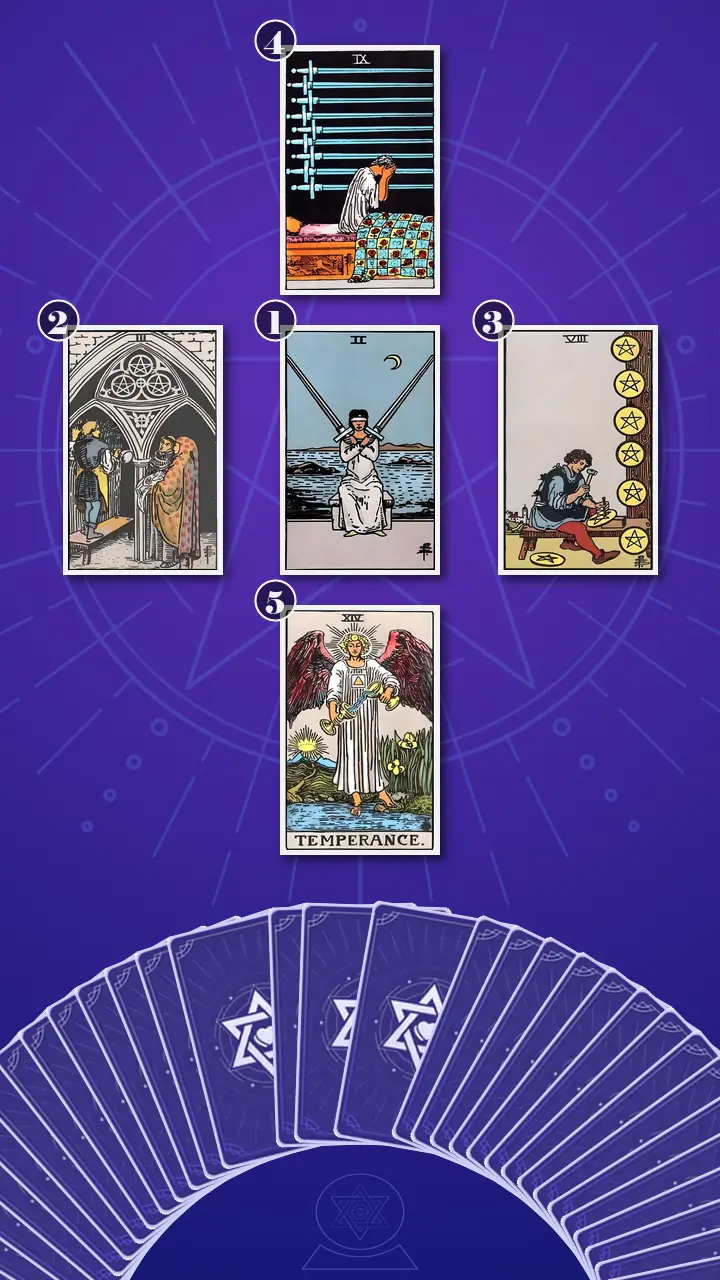
Reading the Map: Discord Accountability vs Solo Deep Work
Position 1 — The Stall Point You Keep Repeating
“Now flipping over,” I said, “is the card representing what the decision is really activating right now: the observable stuck behavior and the emotional tone behind it.”
Two of Swords, upright.
I didn’t need to embellish it; the imagery already does the work. A blindfold. Arms crossed. The whole posture of, if I don’t look, I don’t have to choose.
“This is exactly what you described,” I told her. “Two tabs open: Discord invite on one side, your notes on the other. You draft ‘Hey everyone, I’m studying for…’ and then reread it like it’s going to be graded. Your shoulders creep up, your stomach gets buzzy, and you click away to Notion to ‘fix the plan first’—because staying undecided feels safer than being seen starting imperfectly.”
In energy terms, the Two of Swords is a blockage. Not a lack of discipline. Not a lack of options. It’s protective neutrality that turns into a stalemate.
“I want to say this really clearly,” I added, because this is where people start shaming themselves. “This card isn’t calling you lazy. It’s describing a strategy: if you don’t commit, you can’t regret it. If you don’t join, you can’t fail publicly.”
Taylor made a small sound that surprised me: a quick laugh, bitter around the edges.
“That’s so accurate it’s kind of rude,” she said, half-smiling like she was trying not to wince. Her fingers tapped the table twice—like backspacing in real life—then went still.
I kept my voice calm. “It can feel cruel to have a pattern named. But naming it gives you leverage. And right now, your brain has convinced you that ‘no choice’ equals ‘no exposure.’ That’s the trick.”
Position 2 — Path A: Joining the Study Server (What It Really Feels Like)
“Now flipping over,” I said, “is the card representing Path A: what joining the study server would actually feel like and what it would realistically support.”
Three of Pentacles, upright.
“This isn’t a ‘chatty community’ card,” I told her. “It’s a workshop card.”
I pointed lightly to the table between us, the way I sometimes do when I’m trying to bring a concept into a person’s body. “Joining the server looks less like socializing and more like stepping into a quiet workshop: a #daily-goals channel, a shared cadence, tiny feedback loops. You post: ‘Tonight: 45 min practice questions + 10 min review.’ Nobody needs your life story—just your next rep.”
In energy terms, this is balance—earthy, practical structure. It supports learning through shared standards, not performance. It’s “we show our work,” not “we compete.”
“When it works,” I said, “it solves a specific problem: you stop reinventing the structure alone every night after work. You plug into something that already exists.”
She exhaled—small, but real—and her shoulders dropped maybe half an inch.
“I always picture it like… people will notice me,” she admitted.
“They might,” I said, “but the Three of Pentacles suggests a different kind of noticing. Not judgment. More like: ‘Oh, she’s building. Cool.’”
Position 3 — Path B: Solo Grind (What It Builds, What It Costs)
“Now flipping over,” I said, “is the card representing Path B: what solo grinding would actually create and what it would realistically cost.”
Eight of Pentacles, upright.
“This is the ‘reps over vibes’ card,” I told her. “It’s craft. It’s boring in a good way.”
I translated it straight into her weeknight reality: “Solo grind works when it’s two scheduled 50-minute blocks, same type of drill, same start ritual, minimal decision-making. You track the rep count. You don’t wait to feel like the main character in a productivity video.”
In energy terms, the Eight of Pentacles is balance tending toward excess when anxiety gets involved. Because the same focus that creates skill can also become a hiding place.
“Here’s the cost,” I said, keeping it gentle but honest. “When solo becomes a proof-of-worth project, it turns into polishing flashcards, formatting trackers, and reorganizing notes because ‘real studying’ might reveal you’re behind. The cost isn’t effort. The cost is feedback delay and getting trapped in private optimization loops.”
Her eyes flicked away from the card, like she’d just watched herself do it.
“I literally did that yesterday,” she said quietly. “I spent ages making Anki look… nice.”
“Exactly,” I said. “The Eight of Pentacles can be incredible for you. But only if it’s practice, not penance.”
Position 4 — The Hidden Factor Sabotaging Both Options
“Now flipping over,” I said, “is the card representing the hidden factor: the underlying fear/belief driving the hesitation and capable of sabotaging either option if unaddressed.”
Nine of Swords, upright.
My stomach tightened in sympathy. This card doesn’t whisper; it loops.
“This,” I said, “is the 2:38 a.m. scene.”
And I gave her the modern translation as cleanly as possible: “At 2:38 a.m., you’re in bed with your phone on low brightness, replaying a tiny future scene: you join, you miss a day, the server notices, and it ‘proves’ something about you. Your brain writes a whole comment section that doesn’t exist. In the morning, you feel behind before you’ve even opened your laptop, and the safest move becomes: don’t join, just grind—because at least no one can watch you struggle.”
In energy terms, the Nine of Swords is excess—mental energy flooding the system until it becomes an imagined courtroom. And once you’re in that courtroom, every choice feels like evidence.
Taylor’s body reacted before her words did. A three-step chain: her breathing paused; her gaze unfocused like she was replaying a memory; then she let out a slow, chest-deep exhale that sounded almost like a surrender.
“Yeah,” she said. Her voice got smaller. “It’s not even the server. It’s… the idea that there’ll be a record of me not keeping up.”
That sentence was the hinge. Not group vs solo. Visibility vs shame.
I had a flashback—one I don’t often share out loud, but it informs how I read these patterns. On a trading floor years ago, there were days when a single red number felt like it meant you were incompetent, full stop. The data was neutral; the identity story wasn’t. The mind always tries to make a verdict out of a variable.
“Your mind is doing something very human,” I said. “It’s trying to protect your identity as ‘reliable’ by preventing any scenario where you might look inconsistent. But the protection is also the prison.”
When Temperance Spoke: The Repeatable Blend That Breaks the Freeze
Position 5 — The Next Step You Can Actually Sustain This Week
I slowed down a little. “We’re turning over what I consider the stabilizing base of this reading,” I said. “The card that doesn’t just describe you—it gives you a way forward.”
“Now flipping over,” I said, “is the card representing the next step: the most workable, non-extreme move that builds consistency and self-trust within the next week.”
Temperance, upright.
Even on the table, it felt like the room got quieter. Outside, a car hissed through wet pavement; inside, it was just the soft hum of her laptop fan and the sense of something finally unclenching.
“Temperance is moderation,” I said, “but not in a ‘do less’ way. In a design a system that doesn’t collapse when you’re tired way.”
“And it answers your question with a reframe,” I continued. “You don’t have to pick a personality (group person vs solo person). You need a repeatable blend.”
Her eyebrows lifted, like she’d been waiting for permission she didn’t know she needed.
Here’s where I brought in my signature lens—the one I built after years of watching smart people burn out trying to brute-force decisions with willpower. I call it my Potential Mapping System: I look for energy archetypes in how someone learns, not in what they say they “should” do.
“I’m going to map your learning energy for a second,” I told her. “Not as a label—just as data.”
“You’ve got strong Deep Thinker energy,” I said. “You do well with quiet, protected focus. That’s your Eight of Pentacles. But you also have a Sprinter trigger—short bursts of momentum when there’s a small, visible finish line. That’s the Three of Pentacles check-in.”
“When you force yourself into ‘solo only,’ your Deep Thinker thrives for a day… and then the Nine of Swords starts demanding perfection. When you imagine ‘group only,’ your Sprinter panics because it feels like constant performance.”
“Temperance is your bridge,” I said. “It’s measured visibility: controlled check-ins that regulate shame and keep momentum steady.”
She nodded once, sharply—like something clicked into place and she didn’t want to lose it.
Now I guided her into the aha moment, exactly where her weeknight reality lives.
Setup: It’s 8:47 p.m. on a weeknight. Your tea’s gone lukewarm. The invite is open, your intro is half-written, and you’re bargaining with yourself: “Tomorrow, when I’m more consistent.”
Delivery:
Stop treating productivity as an all-or-nothing identity test and start mixing your inputs like Temperance—small check-ins plus deep solo work.
I let the silence do what it does when the right sentence lands. No rushing to explain it away.
Reinforcement: Taylor’s face went still first—eyes a fraction wider, like she’d been caught mid-spin. Then her shoulders dropped in a slow wave, as if her body had been carrying a backpack she’d forgotten was there. Her hands, which had been lightly clenched on the edge of the table, loosened one finger at a time. She swallowed, and her voice came out thinner than before.
“But… if I do that,” she said, and there was a flicker of resistance—almost anger—beneath the vulnerability, “doesn’t it mean I’ve been making it harder than it needed to be?”
I didn’t contradict her. I redirected her toward kindness and utility. “It means you’ve been trying to solve an emotional safety problem with a planning solution,” I said. “That’s not ‘wrong.’ It’s just… expensive.”
I leaned in slightly. “Now, use this new lens for a second: last week, was there a moment—any moment—where this could’ve helped you feel 5% less trapped? A moment where a small check-in would’ve been enough, instead of waiting to be ‘ready’?”
She blinked fast, like tears were close but not quite invited in. “Thursday,” she said. “I studied for twenty minutes and then stopped because I thought it didn’t count.”
“That’s the identity test,” I said softly. “Temperance would’ve said: twenty minutes absolutely counts. Post the goal. Do the reps. Close the loop. No drama.”
And I named the transformation out loud so her nervous system could hear it clearly: “This isn’t just about deciding between a Discord server and studying alone. This is a move from tight apprehension and self-protective indecision to grounded self-trust—built through a repeatable, moderated system.”
From Insight to Action: A One-Week Blend Experiment You Can Run on Low Battery
I gathered the story the cards were telling into one thread, because clarity isn’t a vibe either—it’s a structure.
“Here’s the logic,” I said. “The Two of Swords shows you freezing at the moment visibility begins—hovering, drafting, backspacing, switching to Notion—because ‘no choice’ feels like ‘no exposure.’ The Three of Pentacles says the server can be a workshop: small feedback loops, shared standards, less reinventing. The Eight of Pentacles says solo deep work is absolutely your foundation, but it has to be reps, not perfectionism cosplay. And the Nine of Swords explains why this decision feels so high-stakes: your brain is running an imagined courtroom where inconsistency equals incompetence.”
“Your blind spot,” I told her, “is thinking you need to choose the perfect mode before you start. That’s the trap. The transformation direction is simpler: move from ‘I must choose the perfect study mode’ to ‘I will run a one-week experiment that blends solo focus with accountable check-ins.’”
Then I switched into the part of my work that comes from my old life in finance—where you don’t marry a forecast; you test a thesis. I used my 5-Minute Decision Tool (my tri-axis assessment: Advantage / Risk / Breakthrough) to make her next step concrete, not inspirational.
“We’re going to treat this like a 7-day free trial, not a one-year contract,” I said. “At the end of the week, you’ll calibrate. Not judge yourself. Calibrate.”
- Soft-launch your presence (one line)Join the server and post a one-line intro: “Hey, I’m Taylor in Toronto—studying for ___ while working full-time. I’ll be posting goals + recaps, not super chatty.” Do it once, then stop editing.Set a 2-minute timer. When it ends, send the simplest version. Limits are part of the practice.
- Turn the server into a “check-in only” toolImmediately mute non-essential channels. Keep only the one check-in channel (e.g., #daily-goals). Your goal is visibility in measured doses, not constant participation.Repeat this phrase if you feel guilty: “Accountability doesn’t require constant access to you.”
- Schedule two solo deep-work blocks (the core)Pick two nights (e.g., Tue + Thu). Put one 50-minute block on your calendar. Open practice questions first, Notion second. Start with reps, not setup.If 50 minutes feels like too much after work, do the 25-minute version. Consistency isn’t a vibe. It’s a system you can run on low battery.
- Close the loop with two micro check-ins (goal + recap)For each solo block, post one “start” line (goal) and one “end” line (recap). Keep it to 2–3 sentences. No explaining, no defending.If posting the recap feels intense, write it in your notes app first. You’re practicing completion, not performance.
- Install a missed-day protocol (so fear can’t hijack you)Write your Nine of Swords sentence: “If I join and miss a day, everyone will see I’m not serious.” Then add: “That’s a fear, not a fact.” Decide in advance: if you miss, you post one neutral restart line the next day: “Back today—doing 25 min to restart.”The point isn’t to never miss. It’s to stop treating a miss as a character verdict.
Before we wrapped, I asked her to do the 5-minute calibration at the end of the week—my tri-axis check—because it keeps the mind from turning everything into a moral story.
“Advantage,” I said. “What got easier?”
“Risk,” I said. “What actually distracted you—notifications, comparison, or the pressure you projected onto it?”
“Breakthrough,” I said. “What surprised you in a good way?”

A Week Later: Ownership, Not Certainty
Six days later, I got a message from Taylor.
“I did the soft-launch intro,” she wrote. “Muted everything except #daily-goals. Did 25 minutes Tuesday and posted the recap even though my brain said it was cringe. Today I did 50. I still feel weird being perceived, but it’s… less loud.”
I could picture it: the same dining-table-desk, the same Toronto weeknight, the same kettle clicking off—except this time, the “Join” button wasn’t a verdict. It was a door she’d already walked through, quietly.
Her proof wasn’t that she’d become perfectly consistent. It was that she’d stopped treating consistency like a personality trait she either had or didn’t. She’d built a small system and run it—imperfectly, on a real adult schedule.
That’s the part I love about a Journey to Clarity: tarot doesn’t hand you a fate. It hands you a cleaner frame. Then you get to choose a next step that fits your actual life.
There’s a particular kind of tightness that hits when you want the momentum of being seen, but you’re bracing for the moment someone might notice you’re human—messy, inconsistent, still learning.
If you treated this as a one-week experiment (not a personality test), what’s the smallest ‘visible’ step you’d actually be willing to take—one low-key check-in, one scheduled session, or one simple intro line?