From Tab-Switching Anxiety to a Bounded TA Reply: Caps and Check-ins

The Tab That Lives on Your Laptop
If you’ve reopened a TA offer email so many times it feels like a browser tab that lives on your laptop now—because replying means choosing between “career signal” and “protect my GPA.”
Jordan (name changed for privacy) slid into the chair across from me in my café, shoulders up like they were trying to hold a backpack on without the straps. Outside, Toronto was doing its late-season gray thing—street noise muffled by a thin drizzle—while inside, the espresso machine hissed and the grinder clicked like punctuation.
They didn’t start with the big question. They started with the scene.
“Tuesday. 9:43 p.m.,” Jordan said, staring at their own hands. “Tiny apartment. Desk lamp way too bright. I’m in sweatpants and one sock is half-off—like, why am I always half-undressed when I’m spiraling?”
I could see it the way they described it: the laptop fan whirring, their phone warm from constant scrolling, three tabs open like three judges—TA offer email, Canvas, Google Calendar—while their chest tightened each time they dragged a study block by thirty minutes as if the perfect schedule could protect them from uncertainty.
“I want to say yes,” they said, voice small but precise, like they’d rehearsed it. “But I don’t want to pay for it with my GPA. And if I choose wrong… it’s going to feel like it says something about me.”
That’s the contradiction, right there: wanting to accept the TA offer to grow professionally vs fearing it will lower your GPA and prove you can’t handle your program.
The anxiety wasn’t abstract on Jordan—it was physical. It sat in their ribs like a too-tight seatbelt, the kind you keep tugging at even though it won’t loosen. Restless energy kept them moving: re-reading, re-planning, re-checking. Like holding two fragile plates in the air and trying to keep them perfectly level while someone insists you take a third.
I leaned in, softening my voice the way I do when someone is trying not to look like they’re drowning. “We can work with this,” I said. “Not by predicting the entire semester. By getting you out of the loop. Let’s make a map—something that turns this from a personality test into a next step you can actually live with. This is your Journey to Clarity.”

Choosing the Compass: The Decision Cross · Context Edition
I asked Jordan to take one slow breath—just one—and to hold the question in plain language: “TA offer email—accept or protect my GPA: next step?” Then I shuffled the deck on the café counter, the cards whispering against each other like pages in a book someone’s nervous to read.
I’m not big on theatrical rituals. For me, the point is focus—like tamping espresso. You’re not summoning magic; you’re creating pressure in the right place so something clear can come through.
“Today I’m going to use a spread called the Decision Cross · Context Edition,” I explained, mostly for you, the reader, because this is also how tarot works when it’s practical. It’s built for a clean two-option dilemma—accept the TA offer versus protect the GPA—but it adds one crucial layer: a card that reveals what’s quietly driving the intensity underneath the logistics.
Here’s the structure, like a compass from pressure into practice:
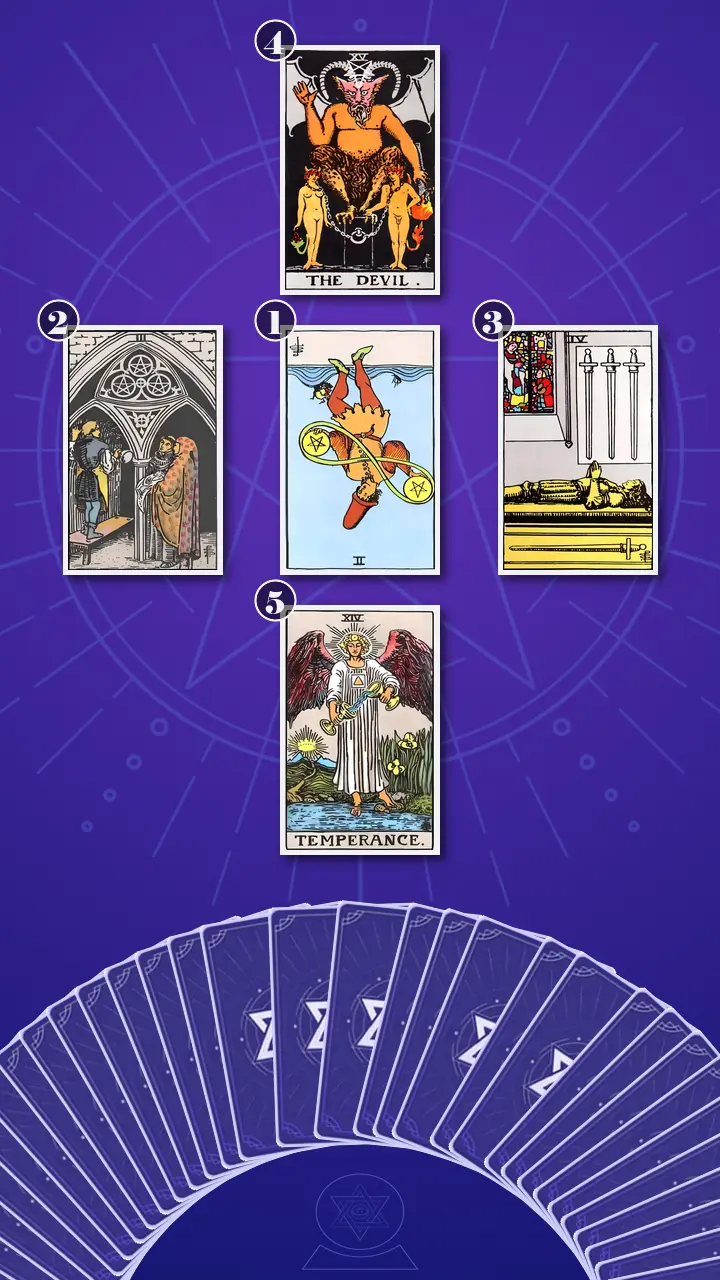
Card 1 goes in the center: the current pressure point—how this shows up in your actual behavior this week. Card 2 goes left: Path A, the TA “yes” path when it’s done well. Card 3 goes right: Path B, what GPA protection really safeguards. Card 4 goes above: the hidden influence (usually the real reason the decision feels like a verdict). Card 5 goes below: the next step—actionable advice that doesn’t require perfect certainty.
Reading the Map: Five Cards, One Real Choice
Position 1 — Current pressure point: The observable way the TA-vs-GPA dilemma steals your bandwidth
Now we turn over the card that represents the current pressure point: the observable way the TA-vs-GPA dilemma shows up in behavior and bandwidth right now.
Two of Pentacles, reversed.
“Okay,” I said, tapping the edge of the card lightly, “this is the classic juggle—except the sea is rough.”
And it landed exactly where Jordan had been living: It’s 10:30 PM and you’re doing the classic juggle: TA offer email open, Canvas open, calendar open. You keep sliding study blocks around because you’re trying to engineer a week where nothing dips—no grades, no sleep, no reputation. But the more you ‘optimize,’ the more unstable everything feels, like you’re balancing on choppy water.
Reversed, this isn’t “you can’t handle anything.” It’s blockage: the balancing skill you do have is being forced to operate in conditions that make “perfect balance” impossible. The infinity loop around the coins? That’s your mental loop: TA vs GPA, TA vs GPA, cycling without closure.
Jordan let out a short laugh—more bitter than amused—and looked away from the card. “That’s… so accurate it’s kind of rude,” they said. “I literally thought I was being responsible.”
I nodded. “You are responsible. You’re not indecisive—you’re trying to buy certainty with planning.”
Position 2 — Path A: What accepting the TA offer supports when it’s structured well
Now we turn over the card that represents Path A: what accepting the TA offer supports and how it tends to function when done well.
Three of Pentacles, upright.
This card doesn’t romanticize suffering. It’s competency through collaboration: apprenticeship energy, mentorship, visible contribution—with a blueprint. In modern life terms, it’s this: Accepting the TA offer looks like treating it as a structured role: you ask what the weekly hours actually are, what training exists, and what ‘good’ looks like (rubric, turnaround time). You’re not proving yourself by suffering—you’re collaborating with defined expectations, like an apprenticeship with guardrails.
Upright, the energy here is balance: productivity that is scoped, supervised, and measurable. It’s the difference between a vague side quest that expands forever and a real job with deliverables.
Jordan’s face changed in a practical way—their eyes sharpened, like their brain finally had something solid to do. The anxiety didn’t vanish, but it stopped sloshing everywhere. “So I’m allowed to ask questions,” they said, half-statement, half-request for permission.
“Not only allowed,” I said, “it’s the professional move. Clarity is a form of self-respect.”
Position 3 — Path B: What protecting GPA really restores (beyond the number)
Now we turn over the card that represents Path B: what protecting GPA prioritizes and what it restores or safeguards.
Four of Swords, upright.
This is the card people misunderstand as “do nothing.” It’s not. It’s recovery as strategy. It’s the quiet room your mind needs to finish one thought.
Translated into Jordan’s week: Protecting your GPA isn’t just ‘saying no’—it’s protecting the mental bandwidth that makes your work sharp. This looks like two real recovery evenings a week (not half-rest, half-scroll), and deep work that actually lands because your brain isn’t stuck in a decision loop at midnight.
The energy here is deficiency—not of discipline, but of restoration. You can’t out-hustle a nervous system that’s living on adrenaline and calendar tweaks.
Jordan’s shoulders dropped maybe half an inch. Not dramatic—just the smallest surrender to reality. “I feel guilty when I rest,” they admitted, like it tasted bad to say it out loud.
“Rest isn’t what you do after you’re safe; it’s part of what makes you safe,” I said.
Position 4 — Hidden influence: The real chain underneath the spreadsheet
Now we turn over the card that represents the hidden influence: the deeper fear or attachment that intensifies the choice beyond logistics.
The Devil, upright.
The café felt warmer for a second—the espresso machine’s steam catching the light like a small torch—and I had that familiar sensation I get with The Devil: not dread, but recognition. This card is rarely about “badness.” It’s about attachment. A metric becoming a leash.
Here’s the modern scene: The hidden driver is that GPA has started feeling like an identity verdict. So the TA email isn’t just an opportunity—it’s a threat: ‘If I say yes and my GPA drops, people will know I’m not actually capable.’ You refresh the grade portal like you’re checking your worth, and the fear quietly makes every choice feel extreme.
I watched Jordan’s throat move as they swallowed. Their breath paused—just a beat—then their gaze went unfocused, like they were replaying a memory of seeing a number on a screen at 1 a.m. Then their hands unclenched on the mug.
“What exact number are you afraid of dropping below?” I asked gently. “Like, write it in the air.”
Jordan blinked hard. “Below 3.7,” they said. “It sounds… ridiculous when I say it.”
“It doesn’t sound ridiculous,” I said. “It sounds human. But I need you to hear this in a clean sentence: A GPA is data. It’s not a verdict. The chain works because it tells you, ‘Obey me and you’ll be safe.’ But the chains in this card are loose. They stay on because you keep tightening them with refreshes and comparisons.”
And I named the split-screen I could feel running in them:
Left screen: the color-coded calendar, frantic motion. “If I just move this block by 30 minutes… if I just plan one more version… if I just read one more r/GradSchool thread…”
Right screen: the hidden chain, fixation. “If my GPA drops, I’m exposed. If I’m exposed, I don’t belong.”
Jordan exhaled—quiet, slightly uncomfortable—like someone stopping mid-sprint and realizing they’ve been running in place.
Position 5 — Next step: A concrete move that doesn’t require perfect certainty
The room shifted when I reached for the final card. Even the background music felt like it stepped back.
Now we turn over the card that represents the next step: a concrete, values-aligned way to move forward without needing perfect certainty.
Temperance, upright.
Temperance is not “choose the middle because conflict is scary.” It’s integration. Measured transfer. One foot on land, one foot in water: practical constraints and emotional truth, together.
And yes—because I’m Sophia, and I’ve been watching people make hard choices over coffee for twenty years—this card always makes me think of pouring: not dumping the whole bag of beans in the grinder and hoping for the best, but dosing carefully. Titration. A shot pulled with intention, not panic.
You know that moment when the TA offer email is still open in one tab, your grades portal is open in another, and you keep dragging calendar blocks around like you can “math” your way into zero risk.
Stop treating this as an all-or-nothing verdict and start pouring your time in measured amounts, like Temperance, with explicit limits that protect both learning and grades.
Jordan’s reaction came in layers. First: stillness—like their body didn’t trust itself to move. Then: their eyes widened a fraction, as if the words had opened a door they hadn’t seen. Then: their shoulders dropped properly, not just a half inch; the tightness in their jaw released, and they rubbed their thumb over the edge of the mug like they were coming back to the present.
“But…,” they started, and there it was—the flicker of resistance. Their brows pulled together. “If I do it this way, doesn’t that mean I’ve been… doing it wrong? Like I’ve been making it dramatic for no reason?”
I kept my tone calm. “No. It means you’ve been trying to survive a system without guardrails. That’s not drama; that’s your nervous system doing its job. Temperance isn’t here to shame you. It’s here to give you a method.”
I slid a small sticky note across the table. “Open a notes app (or use this). Set a 7-minute timer. Write three one-line limits: (1) ‘TA hours cap per week: ___’ (2) ‘Non-negotiable GPA protection block: ___ (day/time)’ (3) ‘Review date: ___ (two weeks after TA starts).’ If your chest tightens and you start spiraling into ‘what ifs,’ pause—put it down and come back later. This isn’t a forever contract; it’s a first draft of boundaries.”
Then I brought in one of my café-born tools—the one I use with students who think more information will finally make them feel safe. “I call this Knowledge Filtration,” I said. “Like a coffee filter. Right now, your brain is letting everything through: the offer email, LinkedIn posts, imagined worst-case grading loads, the number 3.7 glowing like a warning light. Temperance asks: what’s signal, what’s noise?”
Jordan’s eyes filled—not tears spilling, just that bright edge of vulnerability that comes with relief. They nodded once, slowly, like they were agreeing to a new operating system.
“Now,” I asked, “with this new lens, can you remember a moment last week when this would’ve changed how you felt? Even by five percent?”
Jordan stared past me toward the rainy window, replaying. “Wednesday night,” they said. “I opened the portal ‘just to confirm.’ If I’d had a cap and a review date… I think I would’ve closed the tab.”
That was the shift in real time: from metric-driven anxiety and compulsive over-planning to boundary-based self-trust and sustainable pacing. Not perfect confidence—just a steadier center.
“And one more sentence to keep,” I added, because Temperance likes a tagline you can carry: “Make it a bounded experiment, not an identity test.”
The One-Page Settings Menu for Finding Clarity
I pulled the whole story together for Jordan, the way I’d describe a blend to someone tasting coffee for the first time.
“Here’s what the spread is saying,” I told them. “Right now, you’re juggling (Two of Pentacles reversed) in rough conditions, and you’ve been blaming your time-management skills when the real pressure is deeper: a chain to a number (The Devil) that turns a practical workload decision into a worth verdict. But you have two real supports available: structure through collaboration (Three of Pentacles) and performance protection through recovery (Four of Swords). Temperance is the integration capstone—measured commitment plus explicit limits plus a review date.”
The cognitive blind spot is subtle but brutal: you’ve been trying to make the decision only after you can guarantee zero downside. That’s why you keep rebuilding the schedule like an app optimizing battery—except the hidden battery drain is anxiety, not your calendar. The transformation direction is clear: from “prove yourself with a perfect forecast” to “choose with guardrails, then review.”
I offered Jordan three concrete next steps—small enough to do, real enough to matter.
- The Clarity Email Protocol (3 bullets)Send one calm clarification email asking (1) expected weekly hours, (2) training/support, and (3) how grading/office hours are structured—so you’re not mind-reading the workload.Open a draft, write the three bullets, and stop. If it starts turning into a novel, you’re spiraling—filters catch grounds, not water.
- The Three-Limit Reply (Temperance caps + checkpoint)Draft a two-paragraph reply: you’re interested, you can commit to X hours/week, you won’t do TA work after __ PM on weekdays, and you’ll reassess after week 2 / first grading cycle. Save it as a draft and read it out loud once before sending.If your chest tightens, do the “7-minute version” only: write the three limits on a sticky note first, then walk away.
- The GPA Protection Block (rest as strategy)Pick two evenings this week as non-negotiable 90-minute deep-work blocks: phone on Do Not Disturb, one assignment tab open, grade portal and email closed. Then stop when the block ends.Use my café trick: a “Study Blend Aroma.” Make one specific coffee/tea only during this block—same scent, same cue—so your brain learns, “this is focus time,” not “this is panic planning time.”
Jordan nodded, but then—the real world objection. “I don’t have time for a whole new system,” they said. “My week is already packed.”
“Totally,” I replied. “So we don’t build a whole system. We install one setting.”
I offered a tiny add-on from my Focus Period Diagnosis toolbox: “If caffeine makes you wired at night, protect your best cognitive hours earlier in the day. One ‘GPA protection block’ that matches your actual energy—maybe late morning after a small coffee, not midnight after your third tab refresh—will do more than two extra anxious hours.”
That’s the point Temperance keeps making: measured amounts, aligned with reality.

A Week Later, the Reply Doesn’t Feel Like a Verdict
Six days later, Jordan messaged me a screenshot: a sent email with three bullets and a clean hours cap. Under it, they wrote, “I didn’t rewrite it twelve times. I read it out loud once and hit send.”
They also added one line that made me smile: “I still woke up and thought, ‘What if I’m wrong?’—but I had my review date in my calendar, so I… let it be.”
That’s the kind of proof I trust: not fireworks. A quieter nervous system. A choice that doesn’t require self-punishment.
When every option feels like it could expose you, you start chasing a zero-risk plan—refreshing emails, moving calendar blocks, and treating a GPA number like it’s allowed to decide your worth.
If you didn’t need certainty—just a cap, a checkpoint, and one honest email—what would your next step look like in the next 24 hours?