The 11:42 PM Draft Spiral—And the Three Sentences That Made It Sendable

The 11:42 PM Drafts Spiral in Toronto
You know the policy exists, you know you’re allowed to ask, but the moment you type “I’m requesting…” your throat tightens like you’re about to get in trouble for taking up space—classic workplace accommodations guilt.
Alex (name changed for privacy) said that sentence to me with a kind of exhausted precision, like they’d been collecting evidence against themself for days.
They were calling from Toronto; I was still in the dim back corridor of the Tokyo planetarium where I work, the last school group long gone, the air smelling faintly of warm electronics. Alex described their night so vividly I could see it: 11:42 PM at a tiny kitchen table in a condo, laptop open to a draft, phone open to the company policy page—toggling between them like it was a courtroom. Blue light stung their eyes. The fridge hum felt too loud. They typed “I’m requesting…” deleted it, replaced it with “I was wondering if…,” and their shoulders crept up toward their ears.
“I keep rewriting it like I’m trying to prove I deserve help,” they said. “And I don’t want them to think I’m high-maintenance.”
I watched them swallow on the screen. Their throat moved like they were forcing down a stone.
Guilt, for Alex, wasn’t an idea. It was a tight throat and tense shoulders while hovering over the Send button—like their body was bracing for impact before anything had even happened. And underneath it was a contradiction with teeth: they wanted to advocate for legitimate needs at work, but they were terrified of being judged as difficult or less competent.
“I’m not here to tell you what your manager will do,” I said, keeping my voice as steady as the planetarium’s night sky program. “I’m here to help you find clarity about what’s happening inside you while you draft—so you can take a next step that respects you.”
“Because right now,” Alex admitted, “my Drafts folder is basically a shame archive.”
I nodded. “Let’s try to turn this into a map. Not to predict the future—just to help you move from stuck to sendable.”

Choosing the Ladder: How Tarot Works for a Difficult Email
I asked Alex to take one slow breath—not as a ritual, but as a switch. A way to move their nervous system out of “trial mode” and into “data mode.” While they breathed, I shuffled slowly, the way I do before a planetarium show when I want the room to quiet down and listen.
“For this,” I told them, “I’m using a spread I call the Four-Layer Insight Ladder · Context Edition.”
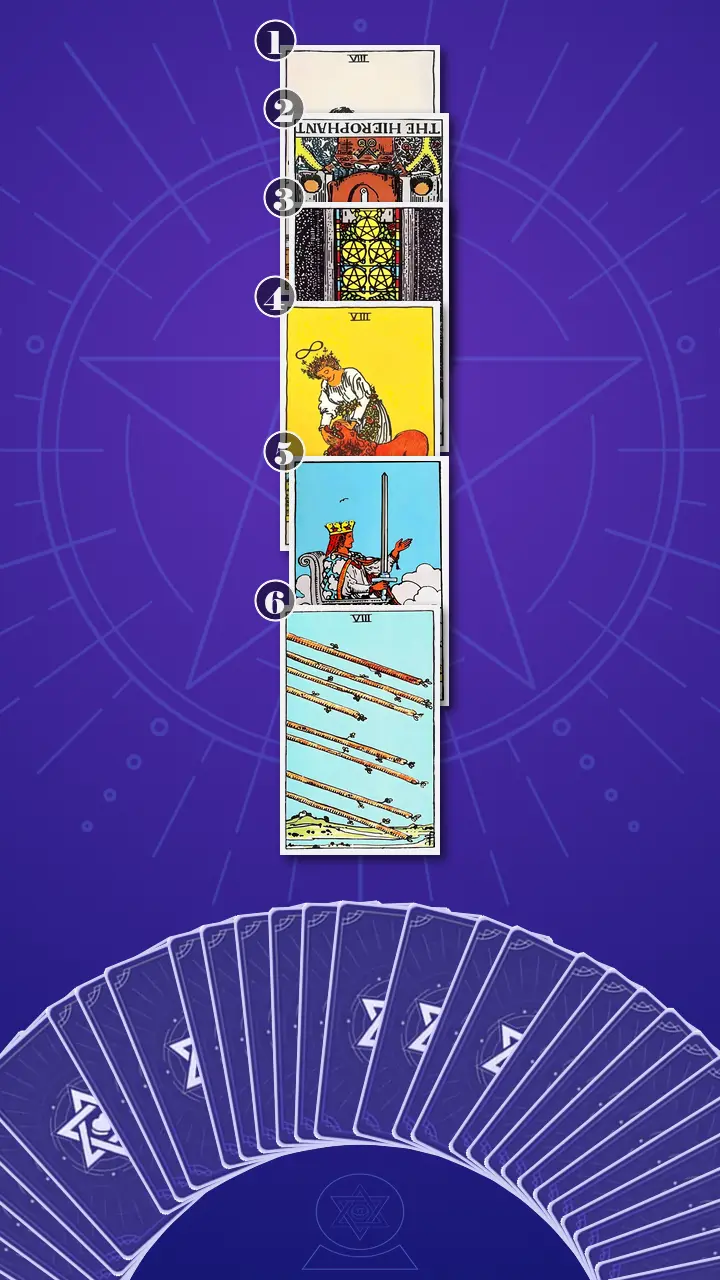
To you, reading along: this is a tarot spread for workplace communication—especially when the problem isn’t that you lack information, but that your body reacts like the email is a social cliff. Six cards is the smallest structure I’ve found that cleanly separates: the visible loop (why you can’t hit send), the internal rulebook behind it, the deeper fear under that rulebook, the inner resource that stabilizes you, the reframe that changes your tone, and a one-week action experiment that gets the request out of Drafts and into reality.
“We’ll read down the ladder first,” I explained, “to understand the trap: what you’re doing on your screen, what standard you’re trying to meet, and what fear is pulling the strings. Then we read up: the steadiness you can access, the communication stance that gives you self-respecting clarity, and the practical next step.”
Alex’s eyes flicked to the bottom of their screen where their unsent draft lived like an open tab in their brain. “Okay,” they said. “A ladder sounds… doable.”
Reading the Map: From the Trap to the Climb
Position 1 — The observable loop: what Alex is doing while drafting, and what the guilt feels like in real time
“Now turning over,” I said, “is the card that represents the observable loop—what you’re doing in real time while drafting, and what the guilt feels like on your screen and in your body.”
Eight of Swords, upright.
Even on camera, Alex’s posture answered before their mouth did. Their shoulders lifted by half an inch, as if the card itself had tightened the room.
“This is the draft sitting in your inbox like a trap,” I said, using the image exactly as it landed. “You keep rewriting the first two sentences because you’re convinced there’s only one socially ‘safe’ way to ask. You delete the direct version, add softeners—‘just,’ ‘if possible,’ ‘no worries’—and the email starts sounding like you’re apologizing for existing. Then you don’t send it, because now it feels even more loaded.”
The energy here is blocked Air: thinking that turns into self-surveillance. The blindfold in the Eight of Swords doesn’t mean you’re actually powerless—it means you’re editing for imagined judgment instead of writing for clarity. And the bindings? They’re not even fully tight. This is a trap you can loosen, but your nervous system doesn’t believe that yet.
I leaned a little closer to the camera. “You’re running the email like it’s a PR crisis instead of a normal work request. Like Google Docs in Suggesting mode—except you’re suggesting edits to your own right to exist.”
Alex let out a short laugh that sounded like it got stuck halfway. “That’s… brutal,” they said, but their eyes stayed on the card. “Also, yeah. I reread the greeting line like twelve times.”
“That’s the blindfold,” I said gently. “You’re trying to pre-rehearse every possible reaction. And it’s keeping you feeling stuck at a career crossroads in the smallest possible place: two paragraphs.”
They winced, then exhaled—a small release of recognition.
Position 2 — The rulebook voice: the internalized standard that says asking is “wrong”
“Now we flip the card for the rulebook voice,” I said. “The internalized standard that labels asking as ‘wrong,’ and the self-protective way you try to stay acceptable.”
The Hierophant, reversed.
“This one is so workplace-real,” I told Alex. “You’re reading the accommodations policy like it’s a moral test. Even though the rules say you can request support, another voice says: ‘Good employees don’t need this.’ ‘Don’t make it complicated.’”
The energy here is over-compliance as a defense. When The Hierophant shows up reversed, it often means the institution is living inside you as shame, not structure—an internal HR manual written in guilt instead of policy. So you try to earn social permission by being extra agreeable: adding evidence, adding context, adding apologies, offering to work longer, shrinking the ask until it barely helps.
Alex’s eyes darted off-screen toward their second monitor. “I literally wrote, ‘I can make up the time elsewhere,’” they admitted. “Like… why did I do that?”
“Because part of you is trying to keep your ‘low-maintenance’ identity intact,” I said. “Not because you’re manipulative or dramatic. Because you learned that being easy to manage felt safer than being human.”
Then I gave them a question I use often, the same way I’ll ask visitors at the planetarium to locate the North Star before we talk about constellations. “Whose standard are you trying to meet when you soften the email—your manager’s, a past job’s, school conditioning, or your own internal voice?”
Alex’s mouth opened, closed. Their shoulders rose, then fell. “Honestly?” they said. “It’s like… a past version of me who never needed anything.”
I nodded. “Guilt isn’t proof you’re wrong—it’s often the sound of an old rulebook flipping open.”
Position 3 — The underlying fear: the request could threaten belonging, credibility, or security
“Now we go one layer deeper,” I said. “This card represents the underlying fear: what the accommodations request threatens in your nervous system—belonging, credibility, security.”
Five of Pentacles, upright.
Alex went still. Not dramatic—just… quiet. Their gaze softened, like it was looking past the webcam at something colder.
“This is the fear underneath the guilt,” I said. “It’s social and material at the same time. You picture your request becoming office subtext—‘they can’t handle it’—and you feel yourself sliding to the edge of the team.”
The Five of Pentacles isn’t just embarrassment. It’s that cold, sinking feeling when you imagine being quietly taken off a project. Rent-day anxiety, but applied to belonging: What if I can’t afford to be seen needing help?
The energy here is scarcity—a belief that support is inside a warm window and you’re on the street looking in. So your body reacts to the email as if it’s a threat to safety, not a logistics question.
Alex’s voice got smaller. “If it went badly,” they said, “it would prove I’m not… worth the effort.”
I let the silence breathe for a beat. In the planetarium, silence is where people finally see the stars.
“Thank you for naming that,” I said. “Because now we’re not arguing with your guilt. We’re understanding what it’s protecting you from feeling directly.”
Position 4 — The stabilizer: what Alex needs to embody to tolerate discomfort without collapsing into apology
“Now we start moving up the ladder,” I said. “This card represents your stabilizer: what you need to embody to tolerate the discomfort of asking without collapsing into apology.”
Strength, upright.
“Okay,” Alex whispered, like they were surprised to see something kind.
“Strength is calm courage,” I said. “Not hype. Not forcing yourself to be ‘confident.’ It’s the ability to feel the guilt spike and not treat it as a command.”
In modern life terms: right before you edit again, you practice steady self-compassion. You keep one calm sentence that names the need without pleading. Soft tone, firm boundary. No bargaining against yourself.
The energy here is balance: a gentle containment instead of force. And as someone who spends her days explaining gravity to kids—how it holds planets in orbit without crushing them—Strength always feels like that to me. Containment that makes motion possible.
“Try something tiny,” I told Alex. “Hand on chest for 30 seconds. Not to make guilt disappear. Just to tell your body: we’re safe enough to write one true sentence.”
On screen, Alex did it. Their palm settled on their chest. Their shoulders dropped a fraction, as if they’d unclenched one notch of an invisible dial.
“This,” I said, “is the moment you stop measuring your worth by how painless you are to manage.”
When the Queen of Swords Spoke: Clean Self-Advocacy and Finding Clarity
Position 5 — The key communication stance: clear, boundaried, self-respecting
I paused before turning the next card. “We’re flipping the core of the reading now,” I said. “The turning point. The best reframe. The communication stance that makes this email clear and self-respecting.”
Queen of Swords, upright.
The card’s direct gaze always changes the air in the room. Even through Zoom, it has that effect—like someone just turned on a brighter, whiter light.
“This is you writing like a professional request, not a personal confession,” I said. “Subject line is clear. The ask is specific. You include one logistics next step. You remove apology lines and replace them with facts.”
I could almost feel Alex’s brain trying to negotiate—trying to slip an extra paragraph back in “just in case.”
Here’s what I know, from studying both tarot symbolism and celestial rhythms: intense gravity makes things orbit the same point over and over. It feels like motion, but you don’t actually go anywhere. That’s why one of my favorite tools is what I call Black Hole Focus—using the idea of an event horizon. Past that boundary, you don’t keep circling. You commit to a direction.
“Your draft has an event horizon,” I told Alex. “If you keep editing past a certain point, you don’t get clarity—you get pulled into the same loop. The Queen of Swords is the boundary line.”
The setup
11:42 PM, you’re back in that draft, flipping between policy language and your own apology-filled paragraphs, trying to find the one tone that won’t make you look “difficult.”
The delivery
You don’t need a perfect explanation to deserve support—you need clear, respectful boundaries in writing.
There was a beat where neither of us spoke. I heard, faintly, the planetarium’s ventilation kick on behind me—an almost cosmic hush, like background radiation.
Stop writing an apology and start writing a clear request, like the Queen of Swords who speaks plainly and lets her boundaries do the work.
The reinforcement
Alex’s reaction came in a chain, not a single emotion. First: a freeze—their breath held, their eyes widening like they’d just seen the sentence that had been haunting them. Second: the cognitive seep—their gaze unfocused for a second, as if replaying every “Sorry to bother you” they’d ever typed. Third: release—a long exhale that lowered their shoulders and softened their jaw.
“But if I’m that direct,” they said, and for a moment their voice sharpened with real anger, “doesn’t that mean I’ve been doing it wrong this whole time?”
It was the kind of pushback I trust—the honest kind. “No,” I said. “It means you’ve been doing what kept you safe. And now you’re choosing something that supports you. That’s not a moral upgrade. It’s a strategy shift.”
I pulled the camera slightly closer so they could see my hands as I demonstrated, like I do when I show kids how a planet’s orbit changes with a tiny nudge. “Open a fresh draft,” I said. “New file. New gravity.”
“Write a three-sentence version,” I continued. “(1) the accommodation you’re requesting, (2) how it supports consistent performance, (3) a concrete next step—like proposing a meeting time or asking a logistics question. Set a 10-minute timer. When it goes off, you’re allowed to stop—even if you feel the urge to keep polishing. If you feel activated, take a breath, step away for two minutes, and come back only if you want to.”
Then I asked the question that turns insight into lived reality: “Now, with this new lens—Queen of Swords clarity instead of Eight of Swords surveillance—can you think of a moment last week when this would’ve changed how your body felt? Even by 5%?”
Alex swallowed, then nodded slowly. “Tuesday,” they said. “When I deleted the one direct sentence and added… like, three apology lines. If I’d left it, I think I would’ve slept.”
“That’s the shift,” I said quietly. “From guilt-tightened self-censorship to calm, boundaried self-respect in professional communication. Not because the world suddenly got safer—because your stance got clearer.”
I added, because it’s true and people need to hear it: “Clarity can feel rude when you’re used to earning permission.”
Position 6 — The one-week action experiment: shrinking the overthinking window
“Last card,” I said. “This represents your practical next step: the simplest concrete action that moves the request from draft to reality.”
Eight of Wands, upright.
“This is momentum,” I said. “Not drama. Just clean movement.”
The modern translation was almost too on-the-nose: you pick a send-time—like 11:10 AM—attach what’s needed, and hit send immediately after a short final pass, before guilt has time to reopen negotiations. The energy here is Fire through action: once the message is ready, it goes.
Alex let their head tip back against the chair. “I hate how much I need a send-time,” they said, but their mouth curved into a half-smile. “It’s like… if I leave it open, I’ll keep rewriting forever.”
“Exactly,” I said. “Don’t wait for the guilt to disappear—shrink the window where it can edit you.”
For Alex, I suggested a tiny add-on from my own toolkit: “If you notice the perfect sentence and then immediately second-guess it, use Shooting Star Notes. Capture it in 30 seconds—one line in Notes app, no formatting, no explaining. That’s your ‘true sentence’ before the people-pleasing autocorrect kicks in.”
Alex nodded, more solid now. “Okay. I can do 30 seconds.”
The Clean Ask Draft: Actionable Advice for an Accommodations Email
I looked at the ladder as a whole and told Alex the story it was clearly telling.
“Here’s why this got so heavy,” I said. “In the present, Eight of Swords shows you stuck in an email drafting loop—rewriting, softening, apologizing, delaying—because your attention narrows to ‘How will I be perceived?’ Under that, Hierophant reversed shows the internal rulebook: you’ve learned to chase an A+ in being easy to manage, even when policy already grants you practical permission. Beneath that, Five of Pentacles is the core vulnerability: a fear that asking will cost belonging or credibility. Strength is the stabilizer that keeps you steady with discomfort. Then Queen of Swords reframes the whole thing: facts over self-justification, clear boundaries in writing. And Eight of Wands says: when it’s ready, move. Hit send.”
“Your cognitive blind spot,” I added, “is treating guilt like a verdict—like it means your request is unreasonable. But in this spread, guilt is an old alarm system. It goes off when you break the ‘be low-maintenance’ rule, even when you’re doing something normal.”
“The transformation direction is simple, but not easy,” I said. “Shift from writing to prove you deserve help to writing to clearly state what helps you do your work well.”
Then I gave Alex what they actually came for: next steps they could do in a real week, in a real office, with a real calendar.
- The “Clean Ask Draft” (3 sentences only)Open a brand-new email draft titled Clean Ask Draft. Write only: (1) the accommodation you’re requesting, (2) how it supports consistent performance, (3) a concrete next step (e.g., “Could we meet for 15 minutes this week to confirm logistics?”).If you feel the urge to add context, paste it into a separate note labeled “Extra,” not into the email. This keeps clarity from getting buried.
- The No-Apology Pass (swap apologies for logistics)Do one quick scan and delete phrases like “sorry,” “only if,” “no worries if not possible,” and “I hope this isn’t too much trouble.” Replace one of those lines with a logistics line: a proposed date/time, an attachment mention, or a simple question about process.Expect it to feel “too direct” for about 90 seconds. That discomfort is not a sign you’re being rude; it’s your old rulebook protesting.
- The 10-Minute Send Window (your event horizon)Pick a specific send-time in the next 7 days (e.g., Wednesday at 11:10 AM). Set a 10-minute timer for final edits, then send immediately when it ends. No reopening the draft afterward.If you catch a “perfect sentence,” use Shooting Star Notes: capture it in 30 seconds, paste it in, and keep going. Momentum is humane when it’s time-boxed.
Alex stared at the list like it was both too small and exactly enough. “The timer part scares me,” they said. “Because what if it’s not perfect?”
“Then it’s still sendable,” I said. “And sendable is the whole point. The Queen of Swords isn’t aiming for perfect. She’s aiming for clear.”

A Week Later: Ownership, Not Certainty
Six days later, I got a message from Alex while I was setting up a noon show—kids arriving, teachers counting heads, the star projector warming up like a quiet engine.
“Sent it,” their text said. “Three sentences. No apologies. I felt like I was going to throw up, but I hit send at 11:10.”
They followed it with another line: “I slept a full night after. Woke up and my first thought was still ‘what if I messed up?’—but this time I laughed, like… okay, that’s just my brain doing the old thing.”
That’s what a real Journey to Clarity looks like. Not a dramatic personality rewrite. A small, clean action that proves you can ask without abandoning yourself.
And if tonight you’re hovering over “Send” with a tight throat and tense shoulders, it’s not because your request is unreasonable—it’s because part of you is bracing to lose credibility or belonging for needing anything at all.
So I’ll leave you with the same question I left Alex with—because it’s where the next step begins: If you didn’t have to prove you deserve support, what’s the smallest, clearest sentence you’d let yourself send this week?