'No Worries' Wasn't a Verdict: How I Learned to Treat Tone as a Hypothesis

Finding Clarity in the Two-Word Reply
If you’re a London early-career office person who can handle a brutal inbox but spirals when someone texts “no worries,” you’re not alone—this is the texting subtext spiral in real time.
Jordan (name changed for privacy) appeared on my screen with that particular kind of stillness that isn’t calm—it’s bracing. Like they were holding their breath in their own living room. They were 28, London-based, non-binary, the kind of competent you can hear in someone’s voice even when they’re tired.
They described an ordinary night with the precision of someone who’s replayed it so many times it’s started to feel like evidence. “Tube home. Northern line. Headphones in, nothing playing. I got a WhatsApp notification—‘no worries.’ And it was instant.”
I could almost see it: carriage lights flickering, that faint metallic Tube smell, their phone warm from being gripped too long. The moment the two words landed, their body reacted like it had missed a step on the stairs—tight chest, stomach drop—followed by a restless, jittery energy that made it impossible to put the phone down.
“I reread it like… ten times,” they said, eyes darting slightly off-camera, as if the chat thread was hovering there. “Then I go into Notes and write three versions. They all start with ‘Sorry, I just meant…’ even though they didn’t ask for any explanation. And then I send the longest one because I’m trying to sound considerate, not needy. And after that, I just—orbit my phone. Like read receipts are a performance review.”
What they were asking me wasn’t really about the phrase “no worries.” It was about the contradiction underneath it: wanting closeness and clear communication, while fearing conflict and rejection if they ask for clarity—or if they get it wrong.
Hypervigilance has a texture. With Jordan, it sounded like a mind running spellcheck on someone else’s mood, using punctuation as “evidence.” It felt—through the screen—like watching a smoke alarm scream because someone toasted bread.
I kept my voice low and steady. “I’m really glad you brought this in. We’re not going to shame your sensitivity. We’re going to map it. Let’s see what taught you to hear anger inside neutral words—and what your next step looks like when you want clarity without spiraling into mind-reading.”

Choosing the Compass: The Four-Layer Insight Ladder
I asked Jordan to put their phone face-down for a moment—not as a dramatic ritual, just as a nervous system cue. “Three slow breaths,” I said. “Let your body know we’re not replying to anyone right now.” While they breathed, I shuffled—slowly, the way I do when I’m trying to help someone move from alert mode into observation mode.
“Today,” I told them, “I’m going to use a spread I call the Four-Layer Insight Ladder · Context Edition.”
For readers who wonder how tarot works in a case like this: we’re not trying to predict what “no worries” means. This is a deep-pattern reading—more therapy-adjacent than fortune-telling. This spread is built to move in a clean line: from the visible texting behavior, to the learned conflict script underneath it, to the shadow projection that fills in the blanks, and then forward into a practical reframe and a steady next step. It’s designed to turn tone-reading into reality-checking.
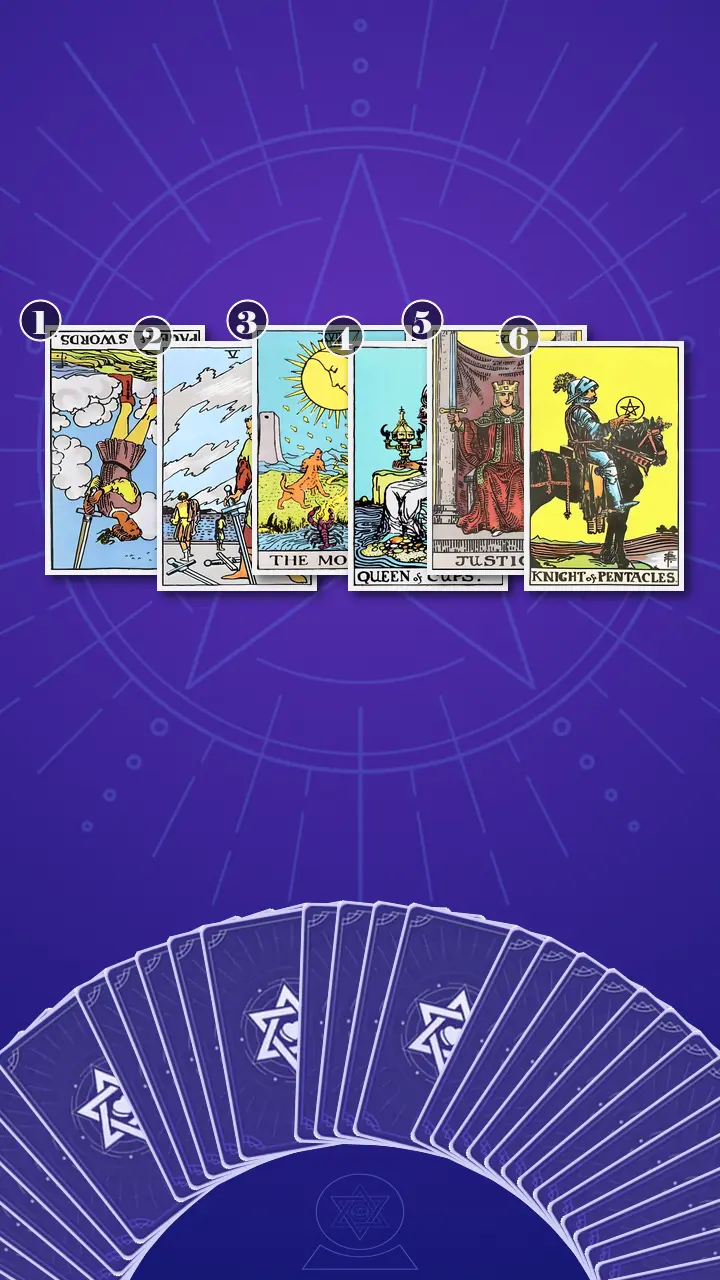
I laid six cards in a straight horizontal line, left to right—like walking down a hallway from a noisy notification toward a well-lit exit. “The first card shows what happens in real time,” I said. “The second shows what taught your body this rule. The fifth is the turning point—the pivot that changes the whole interpretation. And the sixth is the habit that makes the pivot stick.”
Reading the Map: From the Chat Bubble to the Backstory
Position 1: The Behavior Loop in Real Time
“Now flipping over,” I said, “is the card that shows the most observable present-day behavior: how you respond to ‘no worries’ in real time—re-reading, over-explaining, reassurance loops.”
Page of Swords, reversed.
In the modern-life version of this card, it’s painfully specific: you get a two-word text while commuting home, and your brain turns into a live fact-finding operation. You reread the thread, scan punctuation, compare response times, draft three versions in Notes, then send an over-polished apology to prevent anger you haven’t confirmed—after which you keep checking your phone for the verdict.
The reversed Page is Air energy in excess and distorted—attention whipping around like it’s caught in gusty wind. It’s not “you’re dramatic.” It’s a system that’s learned that ambiguity can be dangerous, so it starts scanning for smoke.
I described what I was seeing in a screen-recording style, because that’s what the Page of Swords reversed feels like: thumb hovering, switching between WhatsApp and Notes, deleting and rewriting the same sentence while your brain runs the same loop—If they’re mad, it’s my fault → if it’s my fault, I have to fix it → if I fix it fast, I’m safe.
Then I said the line I’ve learned people need early, before they can do anything different: “A nervous system spike is real; it’s just not a reliable translator.”
Jordan let out a short laugh that didn’t reach their eyes—more like a release of pressure. “That’s… brutal,” they said. “But yeah. That’s exactly it. Two words and my brain becomes MI5.”
I nodded. “And because you’re smart, you make the surveillance feel like ‘research.’ The card’s reminding you: the only thing that actually happened is a two-word text. Everything else is weather in your head.”
Position 2: What Taught You This Template
“Now flipping over,” I said, “is the card that reveals what taught you to hear anger in neutrality—the relationship script where words were used indirectly or competitively.”
Five of Swords, upright.
In modern terms: you learned in a past dynamic that words could be a weapon. Someone would say “fine” or “all good” and then go cold later—withdraw, punish you with clipped texts, make you feel like you should’ve known.
This card’s energy is conflict framed as win-lose. Not honest disagreement—more like leverage. The cost isn’t just the argument. It’s the aftermath: the two figures walking away. The imprint your body remembers is disconnection after conflict, without direct communication.
I watched Jordan’s shoulders lift slightly, like their body recognized the shape of it before their mind named it. “I had someone like that,” they said quietly. “It was never ‘fine.’ It was… a trap.”
“Exactly,” I said. “So now your nervous system treats asking a clarifying question like ‘starting a fight,’ because historically clarification led to escalation. That’s not you being ‘too much.’ That’s you being trained.”
Position 3: The Shadow—What Gets Projected Into the Blank Space
“Now flipping over,” I said, “is the card that names the projection mechanism—what fills in the blanks with threat.”
The Moon, upright.
Texting is low-information by design: no facial expression, no tone, no context. The Moon is what happens when your brain can’t stand the not-knowing, so it supplies a high-drama voiceover. In Jordan’s language: you don’t just read “no worries”—you hear, ‘I’m annoyed, but I won’t say it.’
The Moon’s energy isn’t “you’re irrational.” It’s uncertainty intolerance. It’s night mode on your phone turning everything slightly distorted—same message, different lighting.
“Here’s the hard part,” I said, keeping my voice very plain. “Under The Moon, feelings feel like facts. But they’re not always facts. And when you treat them as facts, you start building a case against yourself.”
I paused, then offered a boundary-like reframe before we moved on: “Don’t convict yourself on vibes.”
Jordan swallowed, eyes flicking down. “That’s what it feels like,” they admitted. “Like I’m both prosecutor and defendant in the chat thread.”
That line landed in me because I’ve spent ten years guiding people through a planetarium where the sky looks close enough to touch—beautiful, persuasive, and not always what it seems. Under certain domes of light, your brain insists two stars are near each other when they’re not. The Moon card is that dome: it makes distance, intent, and meaning look different than they are.
Position 4: The Resource You Can Lean On
“Now flipping over,” I said, “is the card that identifies the emotional capacity you can lean on to self-soothe and stay connected without chasing reassurance.”
Queen of Cups, upright.
This is the resource Jordan already has—even if they don’t trust it in the heat of the moment. The Queen’s gift is emotional containment: feeling deeply without urgently spilling the feeling into the chat.
I used the image I love most in this card: the closed cup. “Not everything needs to be poured into the chat immediately,” I said.
I asked Jordan to try something with me right then, because advice that stays theoretical doesn’t help a nervous system. “Hand on your chest,” I said. “Three slow breaths. And then, one sentence in Notes—not to send to anyone. Just to tell your body you’re on your side: ‘What I feel is real; what it means is not confirmed yet.’”
The shift was small—like five percent less urgency—but it was visible. Their jaw unclenched. Their gaze softened. “That’s… weirdly calming,” they said, almost surprised. “Not fixed. Just… less frantic.”
“That’s the Queen,” I said. “She doesn’t erase emotion. She holds it, so you can choose what to do next.”
When Justice Spoke: Tone as Hypothesis, Not Verdict
Position 5: The Turning Point Reframe
I slowed down before turning this card. “This is the turning point,” I said. “The central cognitive pivot: how to replace mind-reading with fair evidence, clear questions, and self-trust.” The room—my little Tokyo office behind the planetarium exhibits, their London flat across the world—felt briefly quieter, like we’d stepped into a different kind of air.
Justice, upright.
Justice is clarity without cruelty. It’s the part of you that refuses to let fear masquerade as certainty. The scales say: weigh facts versus assumptions. The sword says: one clean question—direct, respectful, not a paragraph of self-defense.
And this is where my own framework slid in naturally, because it’s how I think as someone who studies both celestial motion and human closeness. In my work, I sometimes call it Cosmic Redshift Communication: early signs of distancing can be real, but they’re subtle—and the only way to know if a shift is meaningful is to measure it against a baseline, not against panic. One clipped text isn’t a redshift. It’s one data point in a noisy universe.
Justice asks for a tiny, practical fact-check—like a “unit test” in code: (1) What did they actually say? (2) What did I assume? (3) What evidence do I have?
Jordan nodded fast, then hesitated—an unexpected flicker of resistance. “But if I ask,” they said, voice tightening, “I’ll look insecure. And if they are mad, I’ll have… started something.”
I held that with them instead of pushing past it. “That fear makes sense,” I said. “Because Five of Swords taught you that questions can be punished. But Justice isn’t interrogation. Justice is self-respect. It’s you saying: I’m allowed to ask for clarity without turning myself into a defendant.”
The Aha Moment
For a second I could see the exact trap they were in: they were on the Tube home again in their body, thumb hovering, rereading “no worries” like it was a hidden message. Chest tight. Brain already drafting an apology they didn’t fully understand.
Stop treating a two-word text as a verdict; start weighing the facts and asking one clear question, like Justice holding the scales steady.
Jordan’s reaction came in a small chain—three beats, one after another.
First: a freeze. Their breath caught, just slightly, like their ribs forgot how to expand for a second. Their eyes widened, not dramatically—more like something had clicked into a sharper focus.
Second: the thought sinking in. Their gaze drifted off-camera, unfocused, as if they were replaying a specific chat thread. I watched their fingers curl and uncurl against their own knee, like they were resisting the muscle memory of grabbing their phone.
Third: the release. A slow exhale, almost a shaky laugh. Their shoulders dropped a fraction. “I hate how true that is,” they said. “Verdict. That’s what it feels like. Like two words decide whether I’m safe.”
I let the silence do its work for a moment. Then I asked, gently but directly: “Now, with this new lens—facts, not fear—can you remember a moment last week when you got a short reply and your body jolted? If you’d treated that tone as a hypothesis instead of a verdict, what would you have done differently in the next ten minutes?”
They blinked, eyes shining just a little. “I would’ve… not sent the apology novel,” they said. “I would’ve asked, ‘All okay?’ Or honestly, maybe nothing. Because I didn’t even need clarity—I just wanted relief.”
That was the emotional transformation arriving in real time: not from sensitivity to numbness, but from hypervigilant tone-scanning and self-blame to calm, evidence-based reality-checking. A steadier adult stance that still honors feeling.
And here, I named it plainly for them: “Tone is a hypothesis, not a verdict.”
Position 6: The Habit That Makes It Stick
“Now flipping over,” I said, “is the card that translates the reframe into a concrete communication pace and habit you can sustain over the next week.”
Knight of Pentacles, upright.
This is Earth energy—steady, boring on purpose. The Knight doesn’t sprint after reassurance. He sends one grounded reply and returns to his life. He builds self-trust through repetition, not perfect phrasing.
I described it as a habit loop, because that’s what it is: send one short reply, put the phone face-down, do one tangible task—kettle, dishes, quick walk—so your body learns, physically, that you can move on even before you get the “okay.”
I gave Jordan a line to keep, because sometimes a mantra is just a handle you can grab in the moment: “One question. One reply. Then back to your life.”
Actionable Advice for Texting Anxiety: The Moon-to-Daylight Check
I stitched the whole reading together for Jordan, the way I’d explain a night sky tour to someone who thinks they’re “bad at astronomy” when they’re really just looking without a map.
“Here’s the story the cards told,” I said. “In the present, Page of Swords reversed shows your mind going into surveillance the moment ambiguity hits—re-reading, drafting, polishing, monitoring. Underneath that is a Five of Swords imprint: you learned that ‘fine’ could be weaponized, and that withdrawal could follow even when no one said the truth out loud. The Moon shows what happens now: your nervous system fills in missing tone with an old threat story. The Queen of Cups is the bridge—contain the feeling first. Then Justice brings the pivot: facts over fear, one clear question. And the Knight of Pentacles makes it real by slowing your pace until your body trusts it.”
“Your blind spot,” I added, “is that you’ve been treating urgency as love and mind-reading as emotional intelligence. But the transformation direction is different: from interpreting tone as proof to treating it as a hypothesis you gently test with one clear question.”
I offered Jordan a small plan—low-stakes, repeatable, and designed for real life in a busy city where WhatsApp and Slack are basically the infrastructure of relationships.
- Queen of Cups Pause (90 seconds)When a short reply hits (“no worries,” “ok,” “all good”), put one hand on your chest and take three slow breaths before typing anything. Then write one line in Notes: “What I feel is real; what it means isn’t confirmed yet.”If it spikes you at first, do the five-minute version: three breaths only, then stand up and drink water. You’re training your body, not proving you’re chill.
- The Justice Question (One-Question Clarity Check)Once this week, use one simple template—no apology padding, no interrogation: “Just checking—are we good?” or “All okay on your end?” Ask once, stop after one edit, and let their reply be the data.Before sending any follow-up apology, list two neutral explanations (busy, literal, distracted) alongside the scary one. You’re weighing scales, not chasing relief.
- Knight of Pentacles Rule (20 Minutes + One Reply)For 7 days, practice a one-reply rule: send one grounded response, then put your phone face-down for 20 minutes. Do one tangible task right after (kettle, bins, shower, quick walk) so your nervous system learns it’s safe to move on.Start in low-stakes chats first (friends, group chats). If you slip and send the long apology, don’t punish yourself—note it, then return to the rule next time. Consistency beats intensity.
Because I can’t help being who I am—a planetarium guide who thinks in rhythms—I added one optional layer from my own toolkit, but kept it grounded: “If you want,” I said, “we can treat your week like a Social Star Map. Pick one or two evenings when you’ll be more sensitive—late nights, Sunday Scaries—and decide ahead of time: those are Queen-of-Cups nights. You don’t do big clarification talks at 11:30 p.m. in blue light. You do them in daylight, when your nervous system isn’t in Moon mode.”

A Week Later: The Quiet Proof
A week later, Jordan messaged me—short, which felt like its own little victory. “Got a ‘no worries’ from someone I’m seeing,” they wrote. “Chest did the thing. I did the hand-on-chest breaths, waited, sent ‘All okay?’ once. Then I put my phone down and washed a mug. They replied: ‘Yep all good 😊 just on the bus.’ I still felt wobbly after, but I didn’t spiral.”
Clear, but not perfect—the kind of clarity I trust. They’d slept a full night, and in the morning their first thought was still, What if I’m wrong?—but this time, they noticed the thought, smiled a little, and got on with their day.
This is what a real Journey to Clarity looks like in modern relationships: not turning off sensitivity, but upgrading the method. Neutral words can be neutral. And when they’re not, you don’t have to mind-read—you can ask, calmly, like an adult who deserves steadiness.
When a two-word text makes your chest tighten, it’s not because you’re “too much”—it’s because you want closeness so badly that ambiguity feels like the first step toward being left behind.
If you treated the next weird-feeling message as a hypothesis instead of a verdict, what’s the one simple, respectful question you’d actually want to ask?