From Peer-Eval Dread to Bounded Honesty: A 7-Minute Reset at Work

Finding Clarity in the Tab That Never Closes
If the peer eval link has been sitting open in a browser tab for days because you’re trying to sound “likable and competent” at the same time, you’re not alone in the Sunday Scaries version of career anxiety.
Jordan (name changed for privacy) told me they’d had the form open so long it felt like part of their desktop—like a weather widget they couldn’t delete.
As they described it, I could see the scene without trying: 11:33 p.m. on a Wednesday in a Toronto apartment. Laptop warm on their thighs. The overhead light too bright in a way that makes everything feel exposed. Fridge hum loud enough to sound accusatory. Peer-eval form in one tab, Slack in another, both glowing like they’re keeping score.
“I rewrite one sentence three times,” they said, rubbing at their jaw like they could unclench it manually. “Confident, then humble, then… weirdly grateful. I just want to look competent without giving anyone a reason to be annoyed with me.”
What sat underneath their words wasn’t vanity. It was the specific kind of fear that makes your stomach feel lightly electrified: wanting to be seen as capable and easy to work with, while also fearing that honest feedback will expose you as not good enough to belong.
Their anxiety wasn’t abstract. It was like holding a Slack draft open like a live grenade—constantly adjusting the wording so it won’t “blow up,” even though the stress is coming from gripping it for hours, not from sending it.
“We can work with this,” I told them, keeping my voice steady. “Not by pretending you don’t care, and not by trying to control what other people write. But by getting you to clarity—what’s driving the loop, and what your next step is when the form is open and your nervous system starts treating it like a trial.”

Choosing the Compass: A 2×3 Grid for a Workplace Trigger
I guided Jordan through one slow inhale and exhale—not as a mystical ritual, just a clean transition. The body needs a signal that we’re moving from spiraling into observing. I shuffled while they held the question in mind: What people-pleasing loop drives me when peer evals open—and what’s my next step?
“I’m going to use something I call the Transformation Path Grid (6) · Context Edition,” I said. “It’s a 2×3 grid—like a before-and-after contact sheet.”
For a narrowly timed trigger like peer-eval season, this spread gives enough structure to show the full loop (behavior → blockage → root fear) and a realistic plan (catalyst → next step → integration). A bigger spread would over-expand the question; a 3-card pull would under-specify the mechanics. This grid is meant to be actionable advice, not an abstract mood.
“Top row,” I explained, “shows what happens when the form opens: what you do, what blocks you, and the deeper fear it hooks into. Bottom row is your pivot: the turning point, the practical next step, and how to keep the loop from restarting the same night.”
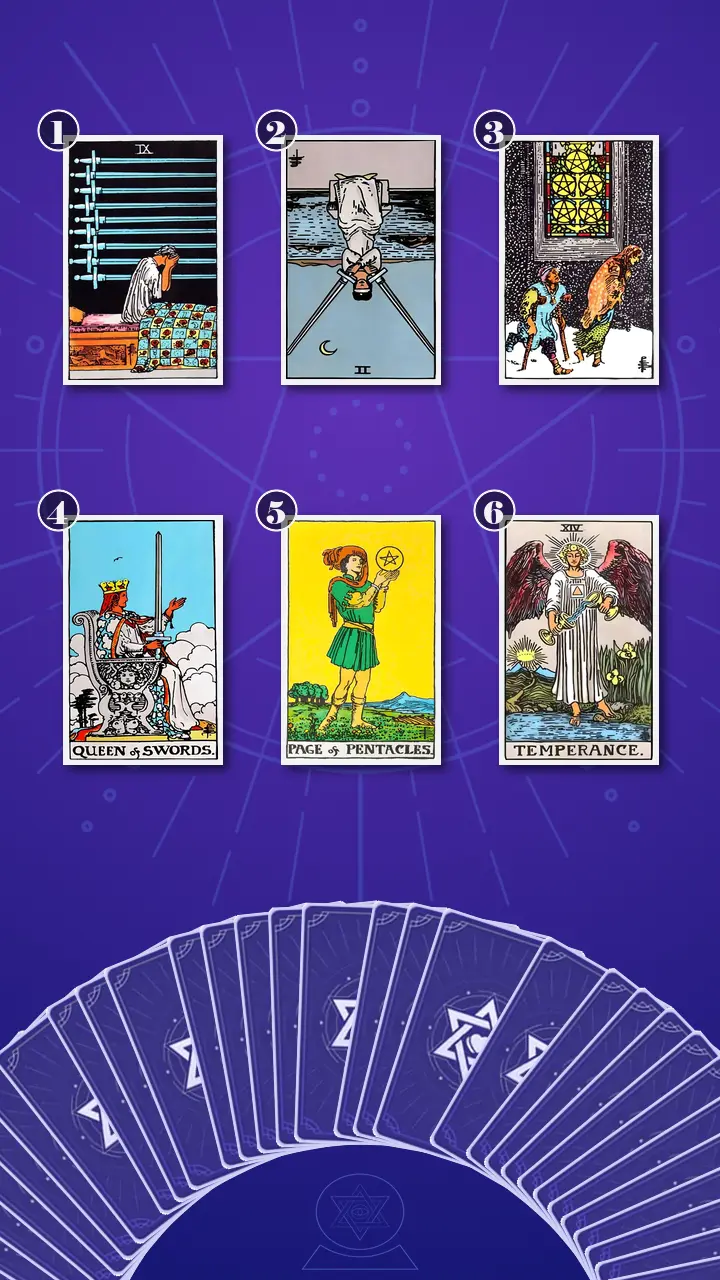
Reading the Map: Card Meanings in Context
Position 1 — Surface reality: what shows up when the peer evaluation form is open
“Now we’re turning over the card that represents your surface reality—the most observable behavior and inner monologue that shows up when the peer evaluation form is open.”
Nine of Swords, upright.
I didn’t even need to reach for poetic language; this card speaks in midnight sentences. “It’s after midnight and you’re still awake because the peer-eval form exists,” I said. “You’re not even writing anymore—you’re replaying every meeting moment like evidence. Your brain is building a worst-case narrative, and you keep tweaking wording to outrun a critique that hasn’t even arrived.”
This is excess Air energy: thinking that’s sharp, restless, and self-punishing. It’s not problem-solving; it’s negative previewing. The Nine of Swords keeps you working when rest would actually help you show up better—because your mind treats sleep like “giving up your case.”
Jordan let out a small laugh that didn’t sound amused. More like a wince with audio. “That’s… too accurate,” they said. “It’s kind of brutal.”
“Brutal, yes,” I agreed gently. “But also useful. It means we’re not guessing. When your jaw locks and your stomach goes wired-tired, your mind starts acting like a courtroom. Our goal is to step out of the courtroom.”
Position 2 — Primary blockage: the mental habit that keeps the people-pleasing loop running
“Now we’re turning over the card that represents your primary blockage—the specific mental habit that keeps the loop running in the peer-eval context.”
Two of Swords, reversed.
“This is like you trying to write a self-eval that makes everyone comfortable,” I said. “So you blur your own point. You draft three versions—super modest, quietly confident, extra appreciative—like you’re A/B testing your personality in real time. None feel safe because you’re outsourcing your internal ‘yes’ to imagined reactions.”
Reversed, the Two of Swords is blocked clarity. The energy isn’t “calm neutrality.” It’s a stalemate that’s cracking and leaking pressure. You can’t feel your own stance, so you keep adjusting to hypothetical feedback—tone-policing yourself into vagueness, then compensating with more labor.
Jordan nodded, but it wasn’t an empowered nod. It was that recognition-with-discomfort nod—the one that comes with a tiny stomach drop. Their eyes flicked to the side the way people do when they realize they’ve been spending hours on something they can’t defend rationally.
“I keep thinking, ‘Which version of me is safest?’” they admitted. “And then I’m… exhausted. But also still not done.”
“Exactly,” I said. “Avoiding discomfort now turns into carrying anxiety for days.”
Position 3 — Root driver: the belonging fear the peer-eval process activates
“Now we’re turning over the card that represents the root driver—the fear about belonging, worth, or safety that peer evals activate.”
Five of Pentacles, upright.
“This one stings,” I said, and I meant it without drama. “A neutral comment—‘meets expectations,’ ‘solid’—hits like rejection. You don’t just hear information; you hear distance. You start over-working to buy warmth: extra coverage, extra check-ins, extra ‘happy to help!’”
The Five of Pentacles is scarcity energy, but not only money scarcity—belonging scarcity. It’s the feeling of standing outside a warm office party in your own head, watching everyone ‘inside,’ assuming you don’t have an invite. It turns peer feedback into proof of whether you’re allowed to stay.
Jordan’s shoulders lifted toward their ears before they noticed. Their throat moved like they were swallowing words they didn’t want to say out loud.
“I hate how true that is,” they said quietly. “It’s like… if I’m not warmly liked, I’m at risk.”
I kept my tone calm. “People-pleasing here isn’t a personality flaw,” I said. “It’s safety-seeking. And this is the pivot point I want you to hear: you’re not writing an eval—you’re negotiating for belonging. That’s why it feels life-or-death.”
When the Queen of Swords Lifted Her Blade
Position 4 — Key turning point: the mindset and boundary that interrupts impression-management
When I reached for the next card, the room seemed to get quieter—like the way a planetarium audience hushes right before the stars come on. This was the turning point card, the antidote.
“Now we’re turning over the card that represents your key turning point—the mindset and boundary that interrupts impression-management and returns self-trust.”
Queen of Swords, upright.
“This is you writing like someone who respects themself,” I said. “Not mean—clean. You state what you did, why it mattered, and what you’re working on next. Then you stop. No extra paragraph to manage feelings.”
Here’s where I brought in my own lens—because my day job is literally teaching people to find their place in a moving sky. “In astrophysics, there’s a concept called an event horizon,” I said. “I call this Black Hole Focus. Inside the horizon is what you can still influence. Outside is what you can’t retrieve—no matter how many extra sentences you add.”
I tapped the edge of the card lightly. “Your coworkers’ private impressions? Outside the horizon. Your clarity, your specificity, your boundaries in language? Inside the horizon. The Queen of Swords draws that line.”
Jordan’s face tightened—then they pushed back a little, unexpectedly. “But if I’m that direct,” they said, “won’t they think I’m cold? Like… difficult?”
“That fear makes sense,” I said. “But I want to offer you a reframe you can test. Clarity is not cruelty. It’s containment. It keeps your self-respect intact.”
Setup: I could feel Jordan’s familiar loop trying to kick in—the one where they’re on the couch at 11:30 p.m., peer-eval tab open, Slack glowing, rewriting one sentence because they’re trying to sound confident, humble, grateful, and unproblematic all at once.
Delivery:
Not ‘say it perfectly so nobody can judge you,’ but ‘say it clearly with the sword upright’—because self-respect is the boundary that makes feedback survivable.
I let it sit there for a beat, like a star held steady in the center of a projector dome.
Reinforcement: Jordan froze first—breath paused, fingers hovering like they were about to reach for backspace in the air. Then their eyes unfocused for half a second, like their brain was replaying a highlight reel of every “Just wanted to gently flag…” Slack draft they’d ever written. And then: a long, quiet exhale that seemed to come from their chest, not their mouth. Their shoulders dropped a fraction. Their jaw unclenched like it had been holding a secret.
“It’s… permission,” they said, sounding almost annoyed at how relieved they felt. “Like I don’t have to pad everything.”
“Exactly,” I replied. “So let’s make it practical.”
“Set a 7-minute timer,” I coached. “Open a blank doc—not the eval form. Write exactly three bullets: (1) ‘I contributed ___ and the impact was ___.’ (2) ‘I collaborated by ___.’ (3) ‘Next cycle I’m improving ___ by ___.’ When the timer ends, stop. No softening paragraph.”
Jordan’s chest rose fast, then slowed as they followed me. “And if you feel your chest tighten or your jaw clench,” I added, “place a hand on your sternum, one slow breath, and tell yourself: Specific is safe. If it spikes your anxiety, scale down to three keywords per bullet and come back later. This is a practice, not a performance.”
I watched them absorb that—relief, yes, but also a new kind of vulnerability: the dizzy moment after you stop gripping something you didn’t realize you were holding. This was the shift from peer-eval-triggered rumination toward clean self-respect and bounded honesty—one small, survivable step toward treating feedback as information instead of a verdict.
“Now,” I asked softly, “using this new lens—can you think of one moment last week where clarity would’ve helped you feel different? One message you padded, one task you over-volunteered for?”
Jordan blinked and nodded. “Yesterday,” they said. “I offered to take something on that wasn’t mine. I didn’t even want to. I just wanted… insurance.”
“That’s the loop,” I said. “And now you have a clean interruption.”
Position 5 — Next step: a low-drama action to complete the eval without self-erasure
“Now we’re turning over the card that represents your next step—one practical, low-drama action to take this week so you can complete the eval without disappearing inside it.”
Page of Pentacles, upright.
“This is the antidote to vibes,” I said. “You treat the self-eval like a small deliverable. You make an evidence list: two outcomes, two collaboration examples, one learning edge with one next-step. You set a timer, fill the form from the list, review once, submit.”
The Page of Pentacles is balanced Earth energy: modest, measurable, grounded. It doesn’t ask you to feel fearless. It asks you to build a repeatable structure that your anxious mind can’t hijack as easily.
Jordan’s expression changed here—less haunted, more practical. The look people get when they can finally picture doing something in under fifteen minutes. “An evidence list,” they said. “That actually sounds… doable.”
“That’s the point,” I told them. “We’re not chasing a perfect inner state. We’re building a process.”
Position 6 — Integration: how to metabolize feedback so the loop doesn’t restart
“Now we’re turning over the card that represents integration—how you metabolize feedback and stabilize after submission so the loop doesn’t restart the same night.”
Temperance, upright.
“After you submit,” I said, “you need a completion cue. Not a pep talk. A physical, sensory signal that the task is done.”
Temperance is regulated blending energy: taking what’s useful, releasing what’s noise. It’s the difference between processing feedback and moving in with it. It tells your nervous system, “We’re not in danger,” even if your mind wants to refresh Slack like it’s weather radar for your status.
Jordan’s hands, which had been fidgeting, went still. They swallowed once, then nodded. “I always keep scanning,” they admitted. “Like if I just check enough, I’ll feel safe.”
“Temperance says: mark ‘done’ without earning safety through more effort,” I replied. “Process the feedback—don’t move in with it.”
The One-Page Pivot: Actionable Advice for Peer Evaluation Anxiety
I gathered the whole grid into one narrative for them—simple, but exact. “When the eval form opens, your mind goes into Nine of Swords mode: courtroom at midnight. The blockage is the reversed Two of Swords: you blindfold yourself by trying to be liked by everyone at once, so your own stance disappears. Underneath is the Five of Pentacles: the fear that lukewarm feedback means you don’t belong. The pivot is the Queen of Swords: one clean, bounded truth. Then the Page of Pentacles makes it real with evidence. Temperance keeps you from spiraling after you hit submit.”
“Your cognitive blind spot,” I said, “is believing that safety comes from being un-criticizable. But the spread points to a different transformation direction: from managing impressions to practicing clean, bounded honesty. You can be kind without being porous.”
- The Queen’s Clean SentenceIn your self-eval, write exactly one sentence: “This cycle I delivered X, which resulted in Y.” End it with a period. Do not add a second sentence to soften it.If your jaw clenches, put one hand on your sternum and breathe once. Tell yourself, “Specific is safer than perfect.”
- The Evidence-List Self Eval (Planetary Memory Palace)Create a note titled “Peer Eval Evidence List.” Use five bullets and file them like a tiny solar system: 2 “Mars” bullets (deliverables/outcomes), 2 “Venus” bullets (collaboration behaviors), 1 “Saturn” bullet (one learning edge + next measurable behavior). Then set a 12-minute timer and fill the actual form using only that list.Keep it boring on purpose. If you want to add more than five bullets, that’s the people-pleasing loop trying to buy warmth with volume.
- Submit-and-Close Ritual (Temperance)Right after you submit: physically close the laptop and put it out of reach for 30 minutes (drawer, backpack, another room). Then do a 10-minute walk (or stand outside) and name 5 things you see + 3 sounds you hear.Make it sensory, not motivational. The goal is to tell your nervous system “the task is complete,” even if your thoughts lag behind.

A Week Later: Ownership, Not Certainty
A week later, Jordan messaged me. Not a paragraph—just a screenshot of their “Peer Eval Evidence List” with five plain bullets and, underneath, one line: “I hit submit and didn’t reopen the tab.”
They added, “The morning after, my first thought was still, ‘What if I sounded arrogant?’—but I didn’t spiral. I made coffee, stared out the window for a minute, and it passed.”
That’s what I mean by a journey to clarity. Not certainty. Not instant confidence. Just a steadier self-respect that shows up in small, repeatable choices—clean sentences, real evidence, and an actual ending to the night.
When the peer-eval form is open, it can feel like you’re trying to earn belonging by being both impressive and completely non-demanding—so you erase your own edges until you’re exhausted and still not sure you’re safe.
If you let yourself write one sentence that’s simply true (not perfectly likeable), what would you name as your real contribution this cycle—without adding a second sentence to soften it?