From Boundary Guilt to Fair Limits: Rewriting the 'Good Daughter' Script

The Sunday Text That Rewrites Your Week
You’re 29, living in Toronto, doing the hybrid-office shuffle—and your nervous system still reacts to a “Dad” text like it’s a fire drill.
Taylor said it like she was confessing something she’d already tried to talk herself out of.
When she arrived for our session, she didn’t look dramatic. She looked… organized. The kind of person who always has an extra phone charger and knows which TTC stop to get off at without checking. But as she described it, I could hear the strain underneath the competence.
“It’s always Sunday,” she told me. “Like, the Sunday Scaries are already loud, and then my phone buzzes and it’s his name. And I’m up. I’m sitting upright. I’m already rearranging Monday. I haven’t even read the message.”
I pictured the scene because it’s so specific it’s practically universal: 8:39 PM, kitchen light too bright, a couple dishes still in the sink. Half in sweatpants, half in work-brain. The phone vibrating against the coffee table like it’s louder than it should be. And that body-jolt—tight chest, shoulders creeping toward your ears—before your mind has any facts to work with.
Taylor’s question was blunt, and honestly, brave: “How do I stop becoming the default caregiver every time Dad texts?”
She paused, then added, quieter: “I want to be supportive. I just… I don’t want to run his life. And every time I even think about not responding right away, there’s this voice: ‘Selfish.’”
The guilt she described wasn’t an abstract feeling. It sounded like a physical alarm that went off in her ribs—like her body had been trained to treat his notification as a pager, not a phone.
I leaned in and softened my voice. “I believe you. And I want to normalize something right now: a text isn’t a summons. You’re allowed to choose your response time.”
“Today,” I continued, “we’re not going to argue with your care for him. We’re going to map the system that turns care into compulsion—so you can find clarity and choose a response that you can actually sustain.”

Choosing the Compass: The Celtic Cross · Context Edition
I’m Luca Moreau. I trained as a perfumer in Paris—fifteen years of learning how tiny invisible notes can change a whole room, a whole mood, a whole decision. Tarot, for me, works the same way. Not as fate. As pattern-recognition. As a way to catch the moment before your nervous system hits “autopilot.”
I asked Taylor to take one slow breath—not as ritual theater, just a practical gear shift. While she breathed, I shuffled. The sound of the cards was dry and papery, grounding. “Hold the question in your mind,” I said. “Not to force an answer. Just to keep us honest about what we’re looking at.”
“We’re going to use the Celtic Cross · Context Edition,” I explained.
For anyone reading: Celtic Cross is ideal here because this isn’t one decision—it’s a repeating relational loop. You need a full diagnosis: the present pattern, what crosses it, the root rule driving it, what’s been reinforcing it lately, what you’re aiming for, and then—crucially—your next real-life ‘Dad text’ moment as a practice pivot. This version keeps the classic 10-card skeleton and avoids fortune-telling; it focuses on actionable boundary work and finding clarity.
I pointed to the layout as I built it: “Card 1 is the moment Dad texts—the pattern you automatically step into. Card 2 crosses it: the challenge that locks you in. Card 3 is the deeper root, the internal rule that makes you feel responsible. And Card 5—right above—shows what you’re trying to build instead.”
Taylor nodded, but I noticed her hands were clasped too tight, like she was bracing for a verdict.
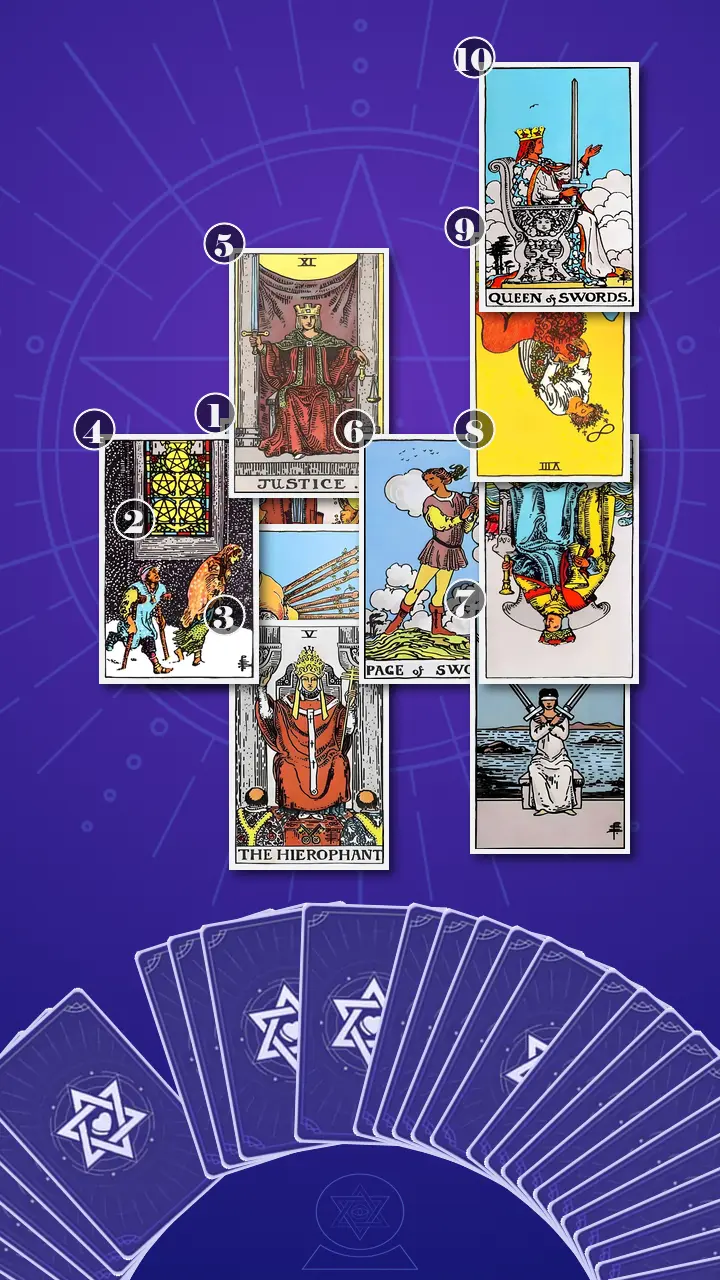
Reading the Map: When Help Turns Into Labor
Position 1: The current pattern in the moment Dad texts
“Now flipped over,” I said, “is the card representing the current pattern in the moment Dad texts—what you automatically step into.”
Six of Pentacles, reversed.
“This is the moment your brain treats his text like an automatic responsibility transfer,” I told her. “You don’t just answer—you start managing. Calling places. Scheduling. Researching. Tracking details. Anticipating emotions. It’s like he hands you a small coin of a request, and you end up paying with an entire hour of your day and your nervous system.”
I watched her face change—barely, but it was there. A quick, bitter little laugh that didn’t reach her eyes.
“Okay,” she said. “That’s… rude. Accurate, but rude.”
That was our first catalyst—an unexpected reaction that was actually a kind of relief. When someone laughs like that, it’s often the moment they realize they’re not uniquely broken; they’re in a pattern.
“Reversed,” I continued, “this card is an imbalance in giving and receiving. The energy is skewed: your help becomes expected labor instead of a chosen act. You end up in the authority position by default—the one holding the ‘budget’ of solutions.”
Her fingers loosened and tightened again around her mug—like her body was remembering the notification jolt while we talked about it.
Position 2: The core challenge that locks you into being the default caregiver
“Now we open the card representing the core challenge that locks you into being the default caregiver.”
Ten of Wands, upright.
“One text becomes ten tasks,” I said. “You’re carrying his problem, your job, your plans, and the emotional temperature of the conversation—all at once—until you can’t see what you actually want anymore. The burden blocks your view, so urgency picks for you.”
Upright, the Ten of Wands is excess—over-functioning. Too much responsibility in one pair of hands.
Taylor exhaled through her nose, the way people do when they’re trying not to cry but also trying not to make it a big deal. “The worst part,” she admitted, “is I feel relief when it calms down. And then I’m mad at myself. And then next time I’m even nicer so he won’t be upset.”
“That’s the loop,” I said gently. “Short-term relief trains the pattern. Long-term resentment punishes you.”
Position 3: The deeper root—the internal rule or conditioning
“Now we flip the card representing the deeper root: the internal rule that makes you feel responsible.”
The Hierophant, upright.
“Inside you is an invisible family rulebook that loads instantly when Dad texts,” I said. “Good daughters respond fast. Good daughters smooth things over. Good daughters don’t make parents feel alone. Even if he doesn’t explicitly demand it, the rule feels sacred—so boundaries feel like wrongdoing.”
Upright, The Hierophant is structure—but in this position, it’s structure you didn’t consciously choose. It’s the inherited script that turns a simple delay into a moral trial.
Taylor stared at the card for a long moment. “I literally proofread my boundaries,” she said. “Like they have to pass… I don’t know, an ethics committee.”
“That’s The Hierophant’s voice,” I said. “Not evil. Not even wrong in its original purpose. Just outdated for your adult life.”
Position 4: The recent history that trained this reflex
“Now we open the card representing the recent history that’s been reinforcing this reflex.”
Five of Pentacles, upright.
“Your recent weeks have trained your rescue reflex with moments that felt like real scarcity—Dad sounding stranded, anxious, or shut out,” I said. “So when a text arrives, you instantly picture him alone in the cold emotionally, and you rush to be the warm window—even before you check what other supports exist.”
Upright, this is fear-based contraction: the energy of ‘if I don’t help, he’ll be alone.’ It makes stepping back feel cruel, even when it’s actually creating room for shared responsibility.
Taylor’s jaw worked once, like she was chewing on an old memory. “He’s not… helpless,” she said. “But the way he texts makes it sound like he is.”
I nodded. “And your brain fills in the worst-case scenario before you’ve asked a single clarifying question. That’s why your body reacts like the snowstorm is already happening.”
When Justice Spoke: The Scales on Your Lock Screen
Position 5: Your conscious aim—what you’re trying to create instead
I slowed down before turning the next card. The room went quieter in that particular way it does when someone is about to hear the sentence they’ve been needing—but also fearing.
“Now we’re flipping the card representing your conscious aim: what you’re trying to create instead—your boundary ideal.”
Justice, upright.
“In real life,” I said, “this looks like putting the request on the scales: what’s being asked, what it costs you, what belongs to him, and what you can honestly offer—then responding without treating the text like a moral trial.”
Justice upright is balance. Proportional responsibility. Truth without cruelty. It’s the opposite of ‘prove your love by burning yourself out.’
And this is where I brought in my diagnostic lens—the one I’ve seen change family patterns fastest.
“Taylor, I want to use something I call Family Energy Diagnosis,” I told her. “It’s not mystical. It’s sensory psychology. Your body knows your family roles before your brain does—and scent is one of the quickest ways to find the hidden emotional flow.”
She blinked. “Okay…?”
“When Dad texts, what’s the first smell your mind pulls up?” I asked. “Not because it’s logical—because it’s linked.”
Her eyes unfocused for a second—like she was scrolling a private internal feed. “Clinic smell,” she said immediately. “Like antiseptic. And… that stale hallway smell in his building.”
“Yes,” I said softly. “That’s your nervous system tagging his message as ‘medical / emergency / you’re needed.’ Now: what smell makes you feel like your life is yours? Like you have breath?”
She surprised herself with how fast she answered. “Citrus. Like grapefruit. Or that shampoo smell after a shower.”
“Beautiful,” I said. “Justice is grapefruit energy. Not because it’s cheerful—because it’s clear. It cuts through fog.”
Setup (the moment before the pivot): Sunday night, Dad’s name lights up your screen, and your body reacts before your mind has facts—tight chest, instant triage, the feeling that waiting is dangerous. You’re stuck in the old equation: reply now = good; wait = selfish.
Delivery (the hook):
Stop treating every text like a moral verdict; start using the scales to choose a response that’s fair to both of you.
There was a beat of silence after I said it. Not dramatic. Just… real.
Reinforcement (what changed in her face and body): Taylor’s breath stopped for half a second—like a screen froze. Her fingers, which had been gripping her mug, hovered open. Then her gaze went slightly unfocused, the way it does when someone replays ten different Sundays at once. A flush climbed her cheeks. And then—unexpectedly—her shoulders dropped, not all the way, but enough that her neck looked less braced for impact.
“But if I don’t respond,” she said, and there was a flash of anger in it, “doesn’t that mean I’ve been doing it wrong this whole time?”
I held her gaze. “No. It means you’ve been doing what worked to belong in that system. Justice isn’t here to shame you. It’s here to update the terms.”
I let the words land, then added the line I never rush: “Fairness includes you—otherwise it’s not sustainable love, it’s an imbalance.”
Her eyes went glossy, and she laughed once—small, disbelieving. “I’ve never… put myself on the scale,” she whispered.
“Right,” I said. “And now I want you to try something that makes this practical.”
“Open your Notes app,” I told her. “Two columns: ‘What he’s asking’ and ‘What it costs me (time/energy/derail).’ Keep it factual. Not dramatic. We’re building a fair ledger.”
She did it with shaky thumbs.
“Now,” I asked, “with this new lens—using the scales—think of last week. Was there a moment when this insight could’ve changed your next 15 minutes?”
She swallowed. “Tuesday. In the PATH. I was literally speed-walking, and I stopped in the middle like I’d been summoned. I could’ve waited. I could’ve… checked my capacity. I didn’t even think I was allowed.”
That was the shift: from guilt-driven urgency toward deliberate choice. Not perfect. Just real.
And I named it for her: “This isn’t only about your dad. It’s you moving from over-responsibility to grounded self-respect—care without becoming the system that runs his life.”
The Next Text Moment: Practice, Not Perfection
Position 6: The next ‘text moment’ where you can practice a different response
“Now we flip the card representing the next text moment where you can practice a different response—not a prediction, a pivot.”
Page of Swords, upright.
“The win isn’t a perfect boundary,” I said. “It’s a different pattern on your screen. You write a short reply, ask one clarifying question, name one limit, and offer one time-limited option. You send it without rewriting it into a guilt-proof essay.”
Upright, Page of Swords is skill-building. It’s the energy of an MVP: functional first, not perfect first.
Taylor gave me a look that was half hope, half suspicion. “I rewrite everything like ten times.”
“Of course you do,” I said. “Because you’re trying to control the interpretation. But here’s the thing: warm and brief beats nice and endless. Endless reads like negotiation—even when you don’t mean it to.”
I saw her shoulders rise, then drop again, like her body wanted to argue but also wanted the simplicity.
Position 7: Your inner stance—how you hold decisions, guilt, and self-trust
“Now we open the card representing your inner stance in this dynamic.”
Two of Swords, upright.
“This is that freeze,” I said. “You hover over ‘reply’ like it’s a bomb-defusal mini-game. Reply now and lose your evening, or wait and feel like a villain.”
Two of Swords upright is blockage—not lack of intelligence. Self-protection. A blindfold moment where urgency chooses for you because choosing feels too loaded.
I used the exact frame her body already knew: “TTC ride home. Phone warm in your hand. Text unread for 30 seconds. Shallow breathing. Split-screen in your head: ‘Reply now = I’m good’ vs ‘Wait = I’m selfish.’ And then the stalemate ends not through choice—but through discomfort-avoidance. Fixer mode is the fastest painkiller.”
Taylor’s reaction came in three tiny steps: first, a stillness—like she forgot to blink. Then her eyes shifted away from me, unfocusing as if she was replaying that streetcar window fog. Then, finally, a quiet exhale that loosened her jaw. “That’s… exactly it,” she said. “I thought I was being dramatic. But it’s like my body can’t tolerate the waiting.”
“Your body learned that waiting equals danger,” I said. “We’re teaching it something new: waiting can be choice.”
Position 8: The external field—Dad’s communication style and the environment
“Now we flip the card representing the external field: your dad’s communication style and the environment around these texts.”
King of Cups, reversed.
“This is the emotional weather report,” I said. “Texts that aren’t clear requests, but big feelings in a small container. Vague urgency. Pressure to reassure. And you get positioned as the stabilizer.”
Reversed, this card is spillover. Emotional intensity that pulls you into regulation work.
“This is where my intergenerational decoding brain kicks in,” I added. “A lot of parents text in short bursts that imply, ‘Call me now,’ because that’s how they understand urgency and care. You respond with essays because you’re trying to prevent escalation. Same desire—connection—different dialect.”
I gave her the sentence that changes this whole position: “Validate the feeling. Don’t inherit the responsibility.”
Taylor nodded slowly. “So I can say, ‘I hear you,’ without making three calls.”
“Exactly,” I said. “Validation is not obligation.”
Position 9: What you secretly hope for—and what you fear will happen if you set limits
“Now we open the card representing what you hope for, and what you fear, around setting limits.”
Strength, reversed.
“This is the fear that you won’t be able to hold your boundary with compassion,” I said. “That firmness equals cruelty. That if you don’t answer immediately, you’re being mean.”
Reversed Strength is deficiency—not lack of strength, but lack of trust in your strength. It’s typing ‘I can’t call tonight,’ deleting it, and replacing it with an apology essay because you’re trying to be un-hurtful enough to survive your own guilt.
Taylor’s throat bobbed. “I do that. Every time.”
“Then we don’t aim for one perfect boundary,” I said. “We aim for one calm limit repeated consistently. Gentle strength. The repetition is what makes it real.”
Position 10: Likely integration if you practice consistently
“Now, the final card—representing the integration you can build if you practice boundaries consistently.”
Queen of Swords, upright.
“This is you, not as a cold person,” I said, “but as a clear one. Short, respectful messages that name what you can do, what you can’t, and what he can do next—without a paragraph of justification.”
Upright Queen of Swords is clean clarity. Not harshness. Not shutting down. It’s adult-to-adult relating: compassion with terms.
Taylor let out a breath that sounded like someone setting down a heavy bag they didn’t realize they’d been carrying into the room. “That’s what I want,” she said. “I want to be loving without being… absorbed.”
“You can,” I said. “You can care without becoming the system that runs his life.”
The One-Page Fairness Rule: Turning Justice Into a Script
I drew the whole spread into one simple story for her, so it didn’t stay abstract.
“Here’s what the cards are saying,” I told Taylor. “Right now, help is sliding into an unequal exchange (Six of Pentacles reversed). That imbalance turns into exhaustion because you carry more than your share (Ten of Wands). Underneath, there’s an inherited rulebook that makes boundaries feel like wrongdoing (The Hierophant), and recent moments of perceived need have trained your rescue impulse (Five of Pentacles). The way out is not disappearing. It’s Justice: fairness and proportional responsibility. Then you practice it with actual words (Page of Swords) while your body learns to tolerate the pause (Two of Swords). You’ll be tested by emotional tone (King of Cups reversed), and your fear will be ‘I’ll be cruel’ (Strength reversed). But with repetition, you integrate as Queen of Swords: warm, brief, consistent boundaries.”
“Your cognitive blind spot,” I added, “is that you treat speed as proof of love. And you treat guilt as evidence of wrongdoing. In this dynamic, guilt is often just the withdrawal symptom of changing a role.”
“The transformation direction is clear,” I said. “Shift from automatic rescuing to intentional responding: pause, name your limit, offer only what you can actually sustain.”
Then I offered her concrete next steps—small enough to start this week, structured enough to hold her when guilt flared. I also used one of my communication tools as a practical anchor.
- Pager-to-Phone Pause (20 seconds)Before you open Dad’s text, put one hand on your chest, inhale once slowly, and say: “I’m allowed to choose my response time.” Then read it and decide whether you’re responding now or later.If your body spikes, add a scent anchor: keep a calming roller (neroli or lavender) by your phone. One swipe on your wrist = your nervous system learns “this is not an emergency.”
- “Dad Reply Scripts” in Notes (copy-paste)Create a Notes snippet with 3 two-sentence options. Use this structure: 1) mirror one feeling, 2) name one limit + one offer. Example: “I hear this is stressful. I can’t handle calls tonight, but I can talk tomorrow 6:00–6:20—what’s the one decision you need to make?”Keep it under 25 words. Warm and brief beats nice and endless. Send it, then put your phone face-down for 10 minutes.
- Justice Fairness Check (1 minute daily for 7 days)In Notes, make two columns: “What he’s asking” vs “What it costs me (time/energy/derail).” Do it once a day for a week so the invisible labor becomes measurable—and negotiable.When your mind says “selfish,” answer with the Justice frame: “Sustainable love requires proportional responsibility.” Facts calm the guilt spiral.
Taylor immediately raised a practical obstacle—because real life always does. “But I can’t always do the pause,” she said. “Sometimes I’m in a meeting, or on the streetcar. And if I don’t reply fast, I feel like I’m abandoning him.”
I nodded. “Then we use an exit mechanism. One neutral bridge text: ‘I saw this. I’m tied up right now and will reply later tonight.’ That’s not a no. It’s you reclaiming timing.”
And because I don’t do advice without kindness: “If you slip,” I added, “no punishment. The goal isn’t perfection. It’s pattern change.”

A Week Later: Ownership, Not Certainty
Eight days later, Taylor texted me a screenshot.
Dad: “Can you call me? It’s important.”
Her reply—two sentences, no essay: “I hear this is stressful. I can’t call tonight, but I can talk tomorrow 6:00–6:20—what’s the one thing you need to decide?”
Underneath, she wrote: “My hands were shaking when I sent it. Then I put my phone face-down and made dinner anyway.”
That was the proof. Not that her dad suddenly became easy. Not that guilt vanished. Just that she didn’t abandon herself to earn belonging.
The bittersweet part, she admitted, was the morning after. She slept through the night for the first time in weeks—then woke up and her first thought was still, “What if I was mean?” Only this time, she read her script again and her shoulders didn’t climb up to her ears.
That’s what a Journey to Clarity often looks like: not certainty, but ownership. You stop letting adrenaline and old rules write your responses for you.
And if you’re reading this with your own chest tightening—because a parent’s text hits and it can feel like you’re choosing between being loving and being “selfish,” so you rescue fast just to stop the guilt, even as your own life quietly gets pushed aside—let this be your permission slip to pause.
If you didn’t have to earn belonging by replying instantly, what would a fair, two-sentence response—one you could actually sustain—sound like the next time his name pops up?