From Speakerphone Humiliation to Boundary-First Talk: Learning a Clean Line

The Speakerphone Ambush in a Too-Bright Kitchen
If you’ve ever been mid-argument and someone casually goes, “Wait, you’re on speaker,” and your throat instantly tightens like you just stepped onto a stage—welcome to triangulation.
Jordan (name changed for privacy) sat across from me with their shoulders slightly lifted, the way people do when they’re still bracing for impact even though the moment is already over. They’re 29, Toronto-based, the kind of early-career professional who’s known at work for being “composed,” which—up close—often means they’ve gotten good at swallowing a lot of heat and calling it calm.
They described Tuesday night like a scene that kept replaying by itself: 8:47 p.m., leaning against the kitchen counter in their high-rise, speakerphone on. The call echoed off tile. The LED under-cabinet light was so bright it made everything look a little too sharp, a little too exposed. Their phone was warm in their palm. Then—faint, unmistakable—someone laughed in the background on the other end.
“I felt it,” they said, fingertips tapping once against their thigh as if to prove the timing. “Like… my throat. My jaw. It’s like I swallowed a pebble. And suddenly I’m talking like I’m being recorded.”
Humiliation has a very specific texture in the body. With Jordan, it sounded like a sentence that kept trying to be brave but came out careful: “I didn’t agree to have an audience.” And underneath that: anger, confusion, then the familiar self-doubt—am I about to look dramatic—even as they were the one being put on blast in the most polite, adult way possible.
What they wanted from me wasn’t a “winning script.” It was clarity: how to respond when triangulation shows up on speakerphone—how to protect a boundary without escalating, without getting framed as the problem in front of whoever’s listening.
“Let’s make this simple,” I told them, keeping my voice steady on purpose. “We’re not here to perfect your phrasing so it can survive a group chat. We’re here to choose the container. We’re here to find that clean line that protects your dignity in real time.”

Choosing the Compass: The Relationship Spread · Context Edition
I asked Jordan to take one slow breath—not as a mystical thing, just as a practical reset. Then I shuffled, the soft rasp of cards mixing with the faint, familiar scent of my studio: paper, cedar shelving, and a bright top note of bergamot that always makes the air feel a little more honest.
“Today,” I said, “we’ll use something I call the Relationship Spread · Context Edition.”
For anyone reading along and wondering how tarot works in a situation like this: I don’t use the cards to tell you what someone else is secretly thinking. I use them as a clean framework for what’s already happening—so you can see the pattern without being inside the pattern.
This spread works especially well for speakerphone conflict and triangulation dynamics because it maps five layers clearly: (1) your automatic response when the conversation turns public, (2) their conflict approach, (3) the core relationship dynamic being activated, (4) the hidden third presence—audience, roommate, group chat energy—and (5) the most empowered next step that restores agency.
“We’ll start with what your nervous system does in the first ten seconds,” I told Jordan. “Then we’ll name what their style is reinforcing. Then we’ll go deeper—what this says about respect and consent to the format. And we’ll end with a concrete response you can actually say with a tight throat.”
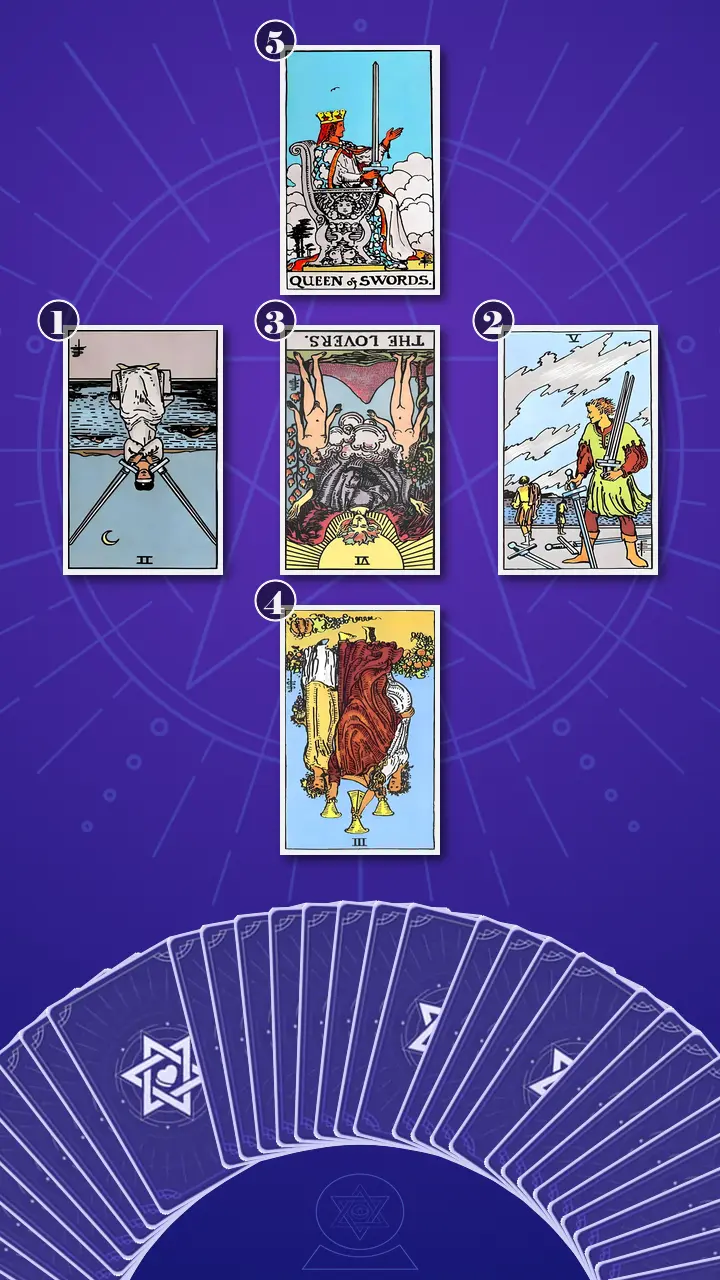
Reading the Map: When Air Gets Contaminated
Position 1 — Your in-the-moment response when you realize the argument isn’t private
“Now flipped,” I said, “is the card that represents your in-the-moment response pattern when you realize the argument is not private.”
Two of Swords, reversed.
I nodded at the image, then at Jordan. “This is the blindfold slipping. And the crossed swords held tight to the chest.”
And I gave them the translation exactly as it lands in modern life: You’re mid-argument and you catch a background sound—someone shifting in a chair, a second voice, the clink of dishes. Your entire tone changes. You stop saying what you mean and start saying what won’t be weaponized. You can feel your jaw clamp as you search for sentences that can survive being repeated.
“That’s blocked Air,” I said—Air as in communication. “Not absent, not weak—blocked. The energy is there, but it’s trapped behind the need to protect yourself.”
Jordan’s mouth twitched. Then they let out a small laugh that didn’t reach their eyes. “That’s… so accurate it’s kind of rude,” they said, and it came out with that bitter little edge people get when they feel seen and exposed at the same time.
I watched their body do the micro-scene in real time: shoulders slightly up, voice dropping half an octave as if it could make them less audible to the room; their face staying composed while their throat did that lockdown thing. I could almost hear the inner monologue behind their calm: Say less. Give them nothing quotable. Don’t react.
“And the temptation,” I added gently, “is to overcorrect—suddenly over-talking, laying out every detail to regain control. But it gives them more material to cherry-pick. Two of Swords reversed is telling you the first move isn’t content. The first move is: name the setting.”
I asked the question I always ask when I see this card in a speakerphone scenario: “What’s your tell that you’ve been put on speaker—do you hear a background voice, or do you just feel your tone change?”
“Both,” Jordan said. “But the tone change is faster. Like my body knows before my brain catches up.”
Position 2 — Their conflict approach and what speakerphone reinforces
“Now flipped,” I said, “is the card that represents the other person’s approach—what they’re reinforcing by using speakerphone or bringing in a third person.”
Five of Swords, upright.
“This is conflict-as-performance,” I said plainly. “It’s the gotcha version of conflict: collecting clips, not building clarity.”
Then I grounded it in the modern scene the card insists on: The vibe on the call isn’t ‘let’s understand each other.’ It’s ‘let’s see who looks right.’ You can feel them steering toward gotchas—tiny moments they can later retell as proof. It’s less about solving the issue and more about controlling the scoreboard and the audience’s verdict.
“Five of Swords energy is excess Air,” I explained. “Too sharp. Too strategic. It’s not ‘we’re in a relationship and we’re trying to repair.’ It’s ‘this is a comments section and I’m trying to win.’”
Jordan’s eyes flicked to the side, like they were seeing the last call again. “That’s the worst part,” they said quietly. “I can feel them trying to get a quote.”
“Exactly,” I said. “And when you sense quote-mining, your nervous system does what it’s supposed to do: it clamps down.”
Position 3 — The core relationship dynamic being activated
“Now flipped,” I said, “is the card that represents the core relationship dynamic—what’s really happening between you beyond the surface argument.”
The Lovers, reversed.
I didn’t rush this one. The room felt quieter, even with the city noise outside my window—streetcar bells, the soft rise and fall of Toronto traffic. The Lovers reversed is never just about romance. It’s about alignment. It’s about integrity under pressure.
So I translated it as it shows up in Jordan’s life: This stops being a question of ‘what should I say?’ and becomes ‘what kind of relationship am I in?’ You’re choosing between keeping peace through performance (staying on speaker, staying ‘cool’) and staying aligned with your values (privacy, directness, consent to the format).
“This is the values test,” I told them. “And I’m going to say something that tends to land hard, but it’s clean: Privacy isn’t drama. It’s basic consent to the format.”
Jordan went still for a beat. Not rigid—more like the kind of stillness that happens when a truth hits the part of you that’s been negotiating too long. Their gaze lowered to the edge of the card.
“I keep thinking,” they admitted, “if I ask to be taken off speaker, they’ll say I’m hiding something.”
“That’s the reversal,” I said. “You start measuring your integrity by their optics. You start asking, ‘How do I sound calmer?’ instead of asking, ‘Is this how we do hard conversations?’”
And because I’m a perfumer before I’m anything else, I offered the metaphor that came naturally: “In fragrance, the formula matters. But the bottle matters too. If someone keeps taking the cap off and waving it around in public, the scent doesn’t get more ‘true.’ It just evaporates faster. You’re not asking for special treatment. You’re asking for a container that lets the truth have a chance to exist.”
Position 4 — The triangulation mechanism: the third presence shaping the fight
“Now flipped,” I said, “is the card that represents the hidden influence—the triangulation mechanism, the third presence.”
Three of Cups, reversed.
I didn’t soften it. “This validates you,” I said. “Because it says: the speakerphone dynamic isn’t neutral. It changes everything.”
Then I used the lived translation: The argument has a third person in it—even if they never speak. The room is there. The friend is there. The future group chat recap is there. You can feel yourself performing for people who aren’t even talking, and the conversation becomes about optics instead of repair.
“This is the group chat screenshot economy,” I said, using the phrase the way people actually live it. “Triangulation turns feelings into content.”
Jordan’s face tightened at the edges; you could see that stomach-drop reaction register without them naming it. Their jaw shifted once, as if they were trying to loosen it and couldn’t.
“I hate that I care,” they said. “But I can literally feel… the recap happening.”
“That makes sense,” I replied. “You live in overlapping circles. In a city where friend groups collide. It can feel like trying to do a performance review while someone live-tweets your quotes into Slack.”
And I added the practical warning this card always carries: “The overcorrection here is campaigning—over-sharing, defending yourself to mutuals, sending screenshots. It feels vindicating for a minute. But it expands the audience and keeps you on the stage.”
When the Queen Lifted Her Sword
Position 5 — Your most empowered, actionable response (the boundary move)
When I reached for the last card, the atmosphere shifted—the way it does right before a decisive sentence. Even the shuffle sounded different, like the deck knew we were done negotiating.
“Now flipped,” I said, “is the card that represents your most empowered, actionable response—the move that restores dignity and clarity.”
Queen of Swords, upright.
I let Jordan take in the image: the raised sword, the open hand, the gaze that isn’t pleading and isn’t performing. Just clean.
And I gave the modern-life scene the card insists on: You don’t try to out-argue a stage. You change the stage. You name the condition—private, one-on-one—and if it’s not met, you end the call. Not as punishment, but as self-respect: you’re available for real conversation, not public sparring.
“This is balanced Air,” I said. “Not blocked, not weaponized—disciplined. The Queen isn’t trying to be un-misrepresented by crafting a flawless paragraph. She’s protecting the conditions under which the truth can be spoken.”
Setup: the moment your throat tightens
Jordan’s eyes were on the card, but I could tell their mind was back in that kitchen: the tinny speaker sound bouncing off a countertop, the under-cabinet light too bright, the split-second calculation of what could be clipped and retold. They’d been trapped in the loop of “I must do this perfectly” because the cost of one imperfect sentence felt like social exile.
Not “I need the perfect argument,” but “I need a clean line”—raise the Queen’s sword by naming the boundary and ending the call if it stays on speaker.
Reinforcement: relief, then nerves, then choice
Jordan’s reaction came in layers—a three-step chain I’ve learned to watch for. First, a tiny physiological freeze: their breath paused, like their body was checking if it was safe to agree. Second, a cognitive seep-in: their gaze unfocused for a moment, as if they were replaying the last call but editing the scene at the format level instead of the wording level. Third, the emotional release: a slow exhale that loosened the line of their mouth, and—surprising to them—a flicker of grief across their face, the kind that says, Oh. I’ve been trying so hard to be “reasonable” that I forgot I’m allowed to have conditions.
“I’m scared it’ll look dramatic,” they said, voice quiet but clearer. “Like… hanging up feels aggressive.”
“That’s the old script,” I told them. “The one that says you must stay on stage to prove you’re stable.” I tapped the Queen of Swords lightly. “This card doesn’t argue your innocence. It assumes your dignity. It gives you a stop button.”
Then I asked the question that turns insight into memory: “Now, with this new lens—privacy first—can you think of a moment last week when this would’ve changed how your body felt? Even by five percent?”
Jordan swallowed. Their jaw unclenched a fraction. “When I heard the laugh,” they said. “I could’ve just… asked. ‘Are we on speaker?’ And stopped talking.”
“Yes,” I said. “That’s the shift: from humiliation-driven PR-mode self-editing to calm self-respect and boundary-led communication. Not louder. Not meaner. Cleaner.”
From Insight to Action: The Clean Line Protocol
I gathered the spread into a single story for them, because clarity isn’t five separate meanings—it’s one coherent map.
“Here’s what the cards say,” I summarized. “When the conversation becomes public, your system goes into lockdown (Two of Swords reversed). The other person’s style rewards soundbites and social leverage (Five of Swords). Underneath that, the real issue is values: do you both believe conflict deserves privacy and consent to the format (The Lovers reversed)? And the destabilizer is the audience itself—literal or implied—contaminating the emotional space (Three of Cups reversed). The solution is not perfect phrasing. It’s the Queen: you enforce the container.”
“Your cognitive blind spot,” I added, “is thinking you can manage optics by controlling language. But in triangulation, more language often creates more ammunition. The transformation direction is the opposite: less explaining, more structure.”
Because I work with scent for a living, I also named what I call the Air Rule—my Relationship Vitality Assessment in plain clothes: “Healthy connection treats shared air as sacred. Who gets access to your voice, in what setting, matters. The moment someone recruits an audience, they’re changing the air on purpose. Your job is not to perfume the air with better words. Your job is to close the bottle.”
Then I gave Jordan low-barrier next steps—things they could do even with a tight throat and shaking hands.
- Install the “Container-First” questionSave one text shortcut on your phone (example: /private → “I can talk about this when it’s private—are we on speaker or is anyone else listening?”). Use it as your first sentence the moment you suspect an audience.If your chest locks up, don’t add explanations. Ask the question once, then let silence do the work.
- Use the Queen of Swords stop buttonIf the answer is anything but a clear no, say: “I’m not continuing this on speaker. Call me back one-on-one.” Repeat once if they push. Then end the call.Expect resistance and guilt. That doesn’t mean you’re wrong—it means you’re breaking the performance script. Keep it to one sentence.
- Do a 10-minute “Container Check” rehearsal (and anchor it with scent)Before your next call—or right after a shaky one—open Notes and write: “I don’t do conflict on speaker.” Under it, write your exit line in your voice. Set a 60-second timer and say it out loud twice, slowly. If it spikes anxiety, whisper it or read it silently.As a perfumer, I’ll add one practical nervous-system hack: pick a single, simple scent you already own (hand cream, rollerball, even your shampoo) and use it only during boundary practice. Over time it becomes a cue: “I’m safe, I’m clear.” This is first impression management with signature scents—but the impression is for your body, not their audience.

A Week Later: The Quiet Proof
A week later, Jordan sent me a message at 9:13 p.m. It was short—almost shockingly short for someone who’d been writing Notes app novels titled “Draft (DO NOT SEND).”
“It happened again,” they wrote. “I heard someone in the background. I asked, ‘Are we on speaker?’ They dodged. I said the line. I hung up.”
Then: “My hands were shaking after. But I didn’t spiral. I just… made tea and sat there. It felt lonely for a minute. Then it felt clean.”
That’s what a real Journey to Clarity looks like most of the time—less fireworks, more quiet un-clenching. Not certainty. Ownership.
When you realize you’re on speaker, your whole body goes into lockdown—not because you’re “too sensitive,” but because you can feel the moment turning into a public trial where one wrong sentence becomes the story.
If you didn’t have to win the narrative, what would it feel like to simply choose the container—one small, clean line that says “private or not at all”?