From Notes-App Essays to One-Line Boundaries After Their Mom Texts

The Text That Turned Into a Group Chat
You’re a 20-something project coordinator in Toronto who can write a flawless client update—but one text from your partner’s mom about “you two” sends you into a Notes-app spiral, deep in Sunday Scaries-level dread on a random Tuesday.
Taylor (name changed for privacy) said it like she was embarrassed that it was true. She’d come into my little Italian café just after the dinner rush, when the street outside was all wet slush and streetlights, and the inside smelled like orange peel and espresso beans warming in the grinder.
“It popped up while I was commuting,” she told me, thumbs still hovering like the phone might buzz again. “I’m just worried about you two… can we talk? And I felt my stomach drop. Like… immediately.”
I watched her jaw clamp as if she was holding a penny between her molars. Her shoulders were slightly lifted, the way people sit when they’ve been bracing all day without realizing it. Every few seconds her fingers did that restless, half-automatic motion toward the screen—open the thread, reread, close, repeat—like touching a sore tooth to check if it still hurts.
“I don’t want to be mean,” she said, voice lower, almost like she didn’t want the words overheard. “But I also don’t want this to become a family discussion. If I say one wrong thing, it’s going to turn into a whole story about me.”
The unease in her wasn’t abstract. It had weight. It was the feeling of trying to write on a moving streetcar—every bump making your pen slip—except the pen is your nervous system, and the paper is your relationship.
I nodded, letting a beat of quiet settle between the hiss of the espresso machine and the soft clink of cups behind the counter. “That makes so much sense,” I said. “Triangulation stress can make a single text feel like you’ve been pulled into a meeting you didn’t schedule. Let’s not chase the ‘perfect’ reply tonight. Let’s map your cleanest boundary—one that’s respectful and protects your privacy. This is your Journey to Clarity, and we’ll take it one card at a time.”

Choosing the Compass: A 6-Card Spread for Third-Party Boundaries
I asked Taylor to take one slow breath with me—not as a ritual for luck, but as a switch from reaction to choice. I shuffled while she kept her question simple and specific: “After their mom texts me about us, what boundary do I set?”
“Today, we’ll use a spread I call the Transformation Path Grid (6) · Context Edition,” I said. “It’s built for moments exactly like this—when the problem isn’t romance or compatibility, but third-party interference, pressure, and how to respond over text without spiraling.”
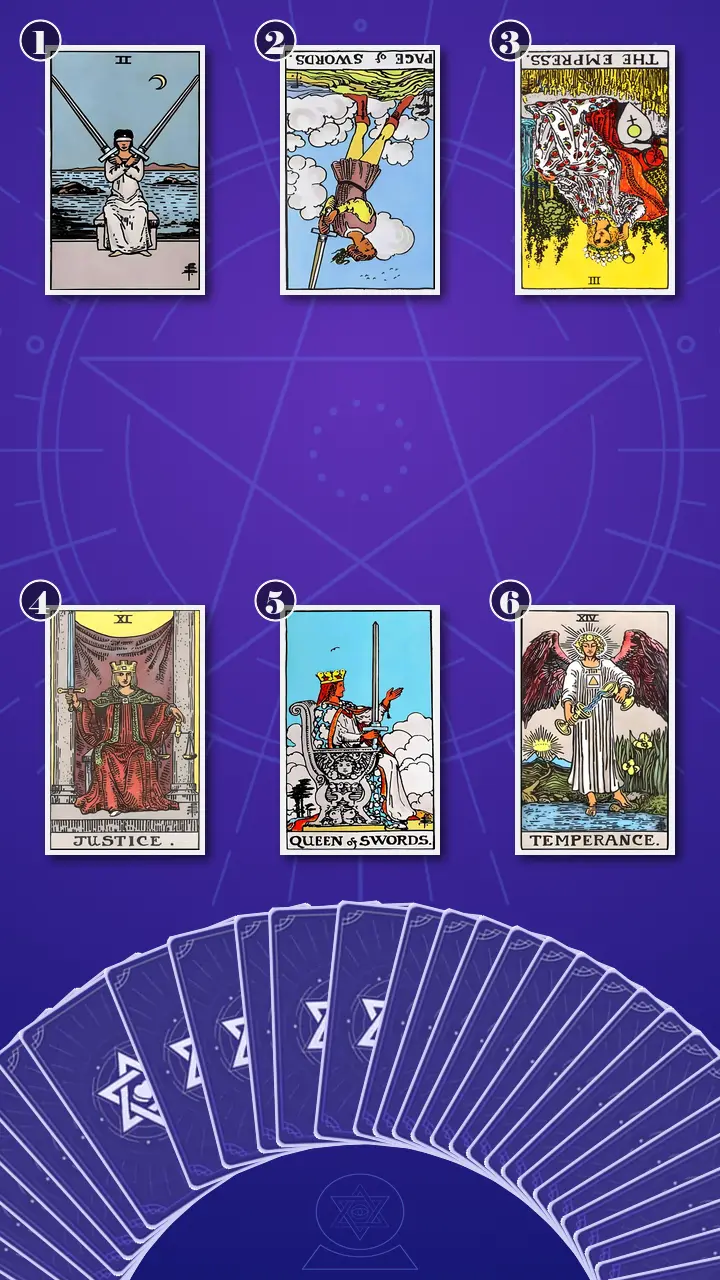
To you, reading along: this spread works because it doesn’t try to predict what the mom will do next. It shows (1) your immediate freeze, (2) the communication habit that keeps you looping, (3) the deeper family-role dynamic under the text, (4) the principle that unlocks clarity, (5) the exact boundary voice to use, and (6) how to stay regulated afterward so you don’t get pulled back into managing reactions in real time.
I placed the cards in a clean 2x3 grid—top row first (the draft row), bottom row second (the send row). It looked, honestly, like a messaging template: diagnose, then deliver.
Reading the Map: The Draft Row
Position 1 — Surface reaction: the stuck move right after her text
“Now we turn over the card for your surface reaction—the exact stance your nervous system takes in the first minute after the text hits,” I said.
Two of Swords, upright.
It’s the classic image of a blindfolded figure with two swords crossed over the chest: self-protection through neutrality. In modern life, it’s painfully specific: you reread the message like it’s a puzzle you can solve if you stare hard enough. You draft a reply that is polite, technically reasonable… and doesn’t actually set a limit.
“This is the freeze,” I told Taylor. “Not because you don’t know what to do, but because choosing clarity feels like choosing conflict. The Two of Swords tries to stay neutral so nobody can accuse you of being the problem.”
I named the energy for what it was: blocked Air. Thought is there, language is there, but it’s held tight—like you’re holding your breath while typing.
Taylor gave a small, humorless huff. “That’s… brutal,” she said, and her mouth twitched like she wanted to laugh and didn’t. “Because I keep telling myself I’m being thoughtful, but I’m really just… stuck.”
Position 2 — What’s blocking a clean response: the habit that keeps the loop alive
“Now we turn over the card for what’s blocking a clean response—the communication habit that turns one text into an all-night loop,” I said.
Page of Swords, reversed.
This card is vigilance. Upright, it’s curiosity and quick thinking. Reversed, it’s the mind on guard—words turned into a shield.
In Taylor’s life, it’s the exact scene she’d already described: treating the text like it’s going to be cross-examined. Notes app open. Three paragraphs. Five versions. Softer, clearer, more apologetic, more firm. Pre-answering questions that haven’t been asked yet.
“This is your brain acting like it’s prepping for a hostile deposition,” I said, keeping my tone gentle but plain. “The inner monologue goes: If I just add one more clarification, they can’t twist it—and then the next line is the relief: I’m not here to win; I’m here to set access.”
I saw it land: Taylor’s shoulders lifted for a second, then dropped on a quick exhale. She winced—small, involuntary—and for the first time since she sat down, her thumb paused above the screen instead of reopening the thread.
“I hate that you just called it ‘deposition,’” she murmured, half-laughing. “Because that’s exactly what it feels like.”
Position 3 — Root dynamic: why her “worry” feels loaded
“Now we turn over the card for the root dynamic—the deeper pattern that makes this text heavier than the words on the screen,” I said.
The Empress, reversed.
I’m always careful with this card in relationship readings, because it’s easy for people to hear “mother archetype” and jump straight to villain stories. That’s not what we’re doing here. The Empress reversed isn’t about declaring someone bad—it’s about naming a boundary blur where care starts to behave like access.
In modern translation: her “checking in” lands like a subtle claim on the relationship. Like she gets a seat in the “us” conversation by default. The expectation is soft on the surface—I’m just worried—but the undertone can feel like: report to me.
“Part of you thinks: If I don’t reassure her, I’m ungrateful,” I said. “And then another part of you thinks: Her feelings are real; her access isn’t automatic. That’s the triangle pressure.”
Taylor rolled her eyes, but not in a mean way—more like a tired recognition. She let out a tight laugh. “Warmth with a price tag,” she said. “That’s… yeah.”
Clarity Is Not a Mood—It’s a Decision
Position 4 — The pivot: the principle that unlocks the boundary
“Now we turn over the card for the pivot—the one piece of clarity that unlocks your decision without needing to predict everyone’s reaction,” I said.
Justice, upright.
Justice is my favorite card for boundaries because it doesn’t ask, “How do I make this go smoothly?” It asks, “What is fair and appropriate?” It’s the scales—balanced tone—and the sword—decisive line.
“Think of this like permission settings,” I told her. “Who gets access to what, by default? Your relationship details are not public. Not because you’re punishing anyone. This isn’t punishment; it’s structure.”
My mind flashed to the morning rush behind my counter: five orders shouted, milk steaming, someone asking for an oat cappuccino “but make it extra hot,” and the only way the whole thing doesn’t turn into chaos is simple structure—clear tickets, clear boundaries, no improvising your values with every new request.
“You don’t need a perfect text,” I said. “You need a repeatable one.”
Taylor nodded—slow, relieved. “If it’s a policy,” she said, “I don’t have to… audition.”
When the Queen of Swords Cut Through the Noise
Position 5 — The boundary to set: the message you can actually deliver
I held my breath for half a second before I turned this one. The café felt unusually quiet—like even the grinder had decided to pause and listen.
“Now we turn over the card for the boundary to set—the tone and structure of the message you can actually deliver,” I said.
Queen of Swords, upright.
Setup: Taylor was caught in that exact couch moment: reopening the thread for the fifth time, shoulders creeping up, trying to write a message that can’t be screenshot into a “gotcha.” Her mind wanted a paragraph. Her body wanted privacy. Her fear wanted approval.
Delivery:
Stop trying to write the perfect message that keeps everyone comfortable; speak one clean truth like the Queen of Swords and let your boundary be the blade that ends the loop.
Reinforcement: Taylor went still in a way I recognize from people right before they stop people-pleasing—not dramatic, just precise. First, a tiny physiological freeze: her breath caught, and her fingers stopped their buzzing hover over the phone. Then the cognitive shift: her gaze unfocused for a second, like she was replaying every late-night Notes-app essay she’d ever written and realizing how much of it was a performance to be un-criticizable. Then the release: a long exhale that seemed to come from the bottom of her ribs, and her shoulders dropped—maybe a centimeter, but it was real. Her jaw unclenched the way a fist unclenches when it realizes it’s allowed to open.
She blinked, eyes a little shiny, but her voice was steadier than it had been all evening. “I can be polite without being available,” she said, like she was trying the sentence on for size.
I nodded. “Exactly. The Queen of Swords doesn’t do cruelty. She does clarity.”
Then I gave her the three-part Queen script—the one that makes “kind” non-negotiable without making it porous:
(1) Acknowledge: “Thanks for checking in.”
(2) Limit: “We’re keeping relationship details between us.”
(3) Close: “Thanks for understanding.”
“Here’s my café-owner translation,” I added, letting my voice soften into something friend-level. “If Justice is your policy, the Queen is your drink order. She’s not a sugary latte with ten extra modifiers. She’s an espresso: short, clear, and exactly what it is. That’s my Relationship Stage Diagnosis in action—when a situation calls for boundaries, you don’t pour foam to make it feel nicer. You pour the shot.”
I paused, then asked her the question that turns insight into lived change: “Now, with this new lens—when in the last week did you feel your body tighten like this? A moment when this one clean sentence could’ve made you feel different?”
Taylor looked down at her phone, then away, like she was seeing the whole dynamic from above for the first time. “Yesterday,” she said quietly. “I started typing ‘I’m sorry if…’ before I even knew what I was apologizing for.”
“That’s the shift,” I said. “This isn’t just about a text. It’s from tight vigilance and tone-policing over text to calm, principled privacy with a short, repeatable boundary. You’re moving from managing perception to managing access.”
Position 6 — Integration: how to hold the line and regulate after you send
“Now we turn over the card for integration—how you hold the line afterward so you don’t get pulled back into explaining, defending, or monitoring,” I said.
Temperance, upright.
Temperance is the nervous system learning it doesn’t have to refresh the thread to stay safe. It’s pacing. It’s one foot on land, one in water—head and heart both included.
In Taylor’s life it looks like this: if there’s a follow-up text, your heart jumps, you feel the urge to innovate a new explanation… and you copy-paste the same line instead. Verbatim. Then you make tea. You do dishes. You come back to your evening.
“In coffee terms,” I said, “this is Conflict Sedimentation. We let the grounds settle. We don’t shake the cup to prove the water is clear. One sentence, repeated, is what lets the emotional impurities drop to the bottom.”
Taylor’s mouth curved into a real smile for the first time. “Send it,” she said, half to herself. “Close the thread. Come back to my life.”
The One-Page Boundary Plan: Polite, Firm, Repeatable
Here’s the story the whole grid told me, start to finish: the mom’s text triggered a Two of Swords freeze—Taylor trying to keep peace by going neutral. The Page of Swords reversed kept her trapped in a courtroom-style drafting loop, writing a Notes-app essay to prevent backlash. Underneath it all, the Empress reversed named the real weight: “concern” that carries an expectation of access. Justice offered the pivot—treat privacy like a principle, not a mood. And the Queen of Swords delivered the clean boundary voice: kind, final, minimal. Temperance made it sustainable: repeat the same line and regulate your body so you don’t get dragged into real-time emotional labor.
The cognitive blind spot was simple and common: Taylor had been trying to be un-criticizable instead of simply clear. But the transformation direction was even simpler: from explaining and soothing to one clear boundary sentence—then repeating it without adding extra details.
- Save Your “Policy Sentence”Open Notes (or your phone’s text shortcuts) and save: “I’m not discussing relationship details with anyone outside the relationship.” Title it “Privacy Rule.”If your fingers itch to add disclaimers, that’s the Page-of-Swords spiral. Reduce the surface area: keep it one sentence.
- Send the Two-Sentence Boundary (Queen of Swords Style)Text: (1) “Thanks for checking in.” (2) “We’re keeping relationship details between us.” Then add: “Thanks for understanding.” No questions. No context.Read it out loud once. If it sounds like you’re opening a negotiation, shorten it.
- Close the Thread + Do a 60-Second Body ResetAfter you send (or choose not to send tonight), put the phone face-down or in another room for 15 minutes. Press both feet into the floor. Unclench your jaw. Take three slow breaths with a longer exhale than inhale.If anxiety spikes, wait 20 minutes—then send the same short line (not a longer one). A boundary doesn’t have to be immediate to be real.

A Week Later: Ownership, Not Certainty
A week after our reading, I got a message from Taylor while I was wiping down the counter before the morning rush. “I sent it,” she wrote. “Two sentences. No essay. I put my phone in the hallway and took a shower. I still felt shaky, but I didn’t spiral.”
Clear—but not magically fearless. She told me she slept through the night, then admitted her first thought in the morning was still, What if I sounded rude? She paused, then added: “But it passed. And I didn’t go back and rewrite my life.”
That’s the quiet proof tarot can offer when you use it as a tool: not a prediction, but a shift—from tight vigilance and tone-policing to calm, principled privacy with a short, repeatable boundary. Not certainty. Ownership.
When someone texts you about “us,” it can feel like your whole relationship just turned into a group chat—so you start drafting a message that proves you’re not the problem, even as your chest tightens because what you really want is privacy.
If you trusted that one calm sentence could be enough, what would your cleanest, most repeatable boundary sound like—without adding a single extra detail?