From Shared-Doc Self-Doubt to Draft Momentum: Learning to Post V1

The 8:47 p.m. Cursor Blink
If opening a shared Google Doc/Notion page makes your body tense—because everyone can see your work in real time—and you suddenly start obsessing over wording instead of writing, you’re not alone (hello, Comparison Fatigue).
Jordan (name changed for privacy) showed up on my screen from a small Toronto apartment at 8:47 p.m. on a Tuesday, laptop balanced on their knees. I could hear the radiator ticking through their mic like a metronome that refused to soothe. The Google Doc was open beside our call—someone else’s clean subheadings already in place, neat as a freshly reset Notion template. Under Jordan’s name, the cursor blinked like a tiny, bright judge.
Their shoulders had climbed toward their ears without them noticing. Their jaw looked like it was holding back a whole speech. Every few seconds, their fingers did that restless trackpad dance: highlight a sentence, swap “however” to “yet,” then swap it back, like the right verb could finally make them safe.
“I’m stuck in this loop,” they said. “I keep rewriting my section in private notes. I want to contribute like a normal teammate, but the second I can be seen… I act like every sentence is a referendum on whether I’m competent.”
The self-doubt wasn’t abstract; it had a texture. It sat on them like tight winter layers indoors—too hot to breathe, too uncomfortable to move, but somehow still “necessary.”
I nodded slowly, letting the silence do some work. “That makes sense,” I said. “A shared doc can feel like writing in a room with glass walls. Let’s not try to brute-force confidence tonight. Let’s do what I do in the planetarium—dim the noise, map the sky, and find clarity by seeing the pattern.”

Choosing the Compass: A Five-Card Map for Shared-Doc Anxiety
I asked Jordan to take one breath that was a little slower than their usual. Not as a ritual for mystery—more like a threshold. The body can’t exit “I’m on trial” mode if the lungs are still sprinting.
Then I shuffled and explained what I was doing in plain terms: “Today we’ll use a Five-Card Problem-Solution tarot spread. It’s a simple line—present behavior, root pattern, blind spot reframe, next step, and integration.”
For a problem like over-editing and procrastinating in a shared Google Doc because real-time visibility triggers fear of being judged, I like this spread because it’s compact and diagnostic. It doesn’t pretend to predict your teammates’ reactions. It shows the mechanics: why the loop is happening, then it gives you an experiment-sized way out. Think of it like troubleshooting—not your personality, but your system.
“Card one,” I added, “will show what your freeze looks like in real time. Card two goes underneath that—what worthiness story is driving the perfectionism. The center card is the hinge: what you’re misreading about being seen and about feedback. Then we’ll get concrete with what to do this week, and what changes internally when you do.”
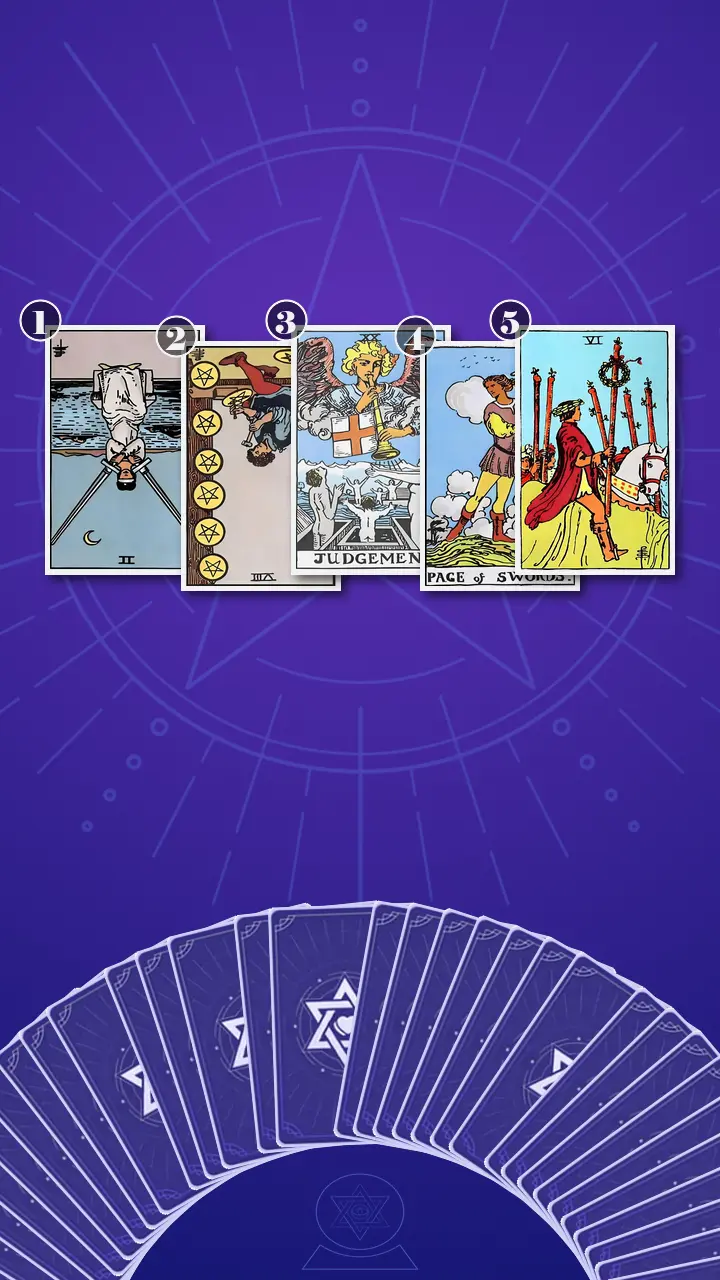
Reading the Line: The Freeze and the Hidden Loop
Position 1 — The observable stuck moment: what you do when you’re about to contribute and freeze
“Now flipped,” I said, “is the card that represents the observable stuck moment in the shared document: what you do when you’re about to contribute and freeze.”
Two of Swords, reversed.
“This is the exact energy of having the shared doc open in one tab and your private notes in another,” I told them, using the most literal translation. “You toggle between them—editing tiny phrases, swapping headings, adjusting spacing—because posting a real draft would force you to be visible. The doc looks ‘in progress,’ but nothing you do gives your teammates something to react to.”
Reversed, the Two of Swords isn’t calm thinking. It’s blocked Air—a defensive, stalled mind trying to stay safe by staying uncommitted. The blindfold is the refusal to choose a version. The crossed swords are protection held to the chest: “If I don’t publish a draft, nobody can touch it.”
To make it real, I mirrored it back as a split screen—because that’s how this pattern lives in modern life: (A) a shared doc full of other people’s confident paragraphs, already there, already public; (B) your Notes app with 17 nearly identical versions that nobody can build with. And underneath it, the thought that lands like a stone: “If I post it messy, it’s not just messy—it’s me.”
Jordan let out a small laugh that had no joy in it. Their mouth curved, but their eyes didn’t. “That’s… brutal,” they said. “Like, accurate. But brutal.”
“I know,” I said softly. “And I’m not here to shame that reflex. That reflex kept you safe somewhere in your life. We’re just checking whether it’s still helping now.”
Position 2 — The worthiness story underneath the over-editing
“Now flipped,” I continued, “is the card that represents the worthiness story and habit loop underneath the over-editing: the pattern that keeps you revising instead of sharing.”
Eight of Pentacles, reversed.
“This one is perfectionism disguised as productivity,” I said. “It’s real effort—Earth energy—but it’s misused. You treat your shared section like it’s a permanent portfolio piece. You add extra sources, rewrite into a more formal tone, polish every transition… while the actual argument stays narrow and the section doesn’t grow.”
Reversed, the Eight of Pentacles becomes what people online call productivity cosplay: the formatting looks busy, the citations look responsible, but the draft doesn’t actually move forward. And the worthiness story underneath it is harsh: “I only count if my output is flawless.”
Jordan’s fingers had been clenched around their mug. As the meaning landed, their grip loosened a fraction. Their shoulders didn’t drop yet, but their breath got less shallow, like they’d stopped trying to hold their body perfectly still.
“It’s like… if I’m not impressive, I’m not allowed to take up space in the doc,” they whispered.
“Exactly,” I said. “You’re not behind—you’re stuck in ‘prove-it’ mode.”
When Judgement Sounded Like a Slack Notification
Position 3 — The blind spot: what you’re misreading about being seen
I paused before turning the third card. Even through a screen, I could feel Jordan bracing—the way someone braces before opening an email they already assume will be bad news.
“Now flipped,” I said, “is the card that represents the blind spot: what you’re misreading about being seen, feedback, and what ‘judgement’ actually means in collaboration.”
Judgement, upright.
Setup (the stuck thought): You’re alone at your kitchen table with the group doc open, cursor blinking like it’s judging you. You keep toggling between “Edit” and “Suggesting,” tweaking one verb, one heading, one citation—because posting anything unfinished feels like being seen too clearly.
Delivery (the hinge sentence):
Not a courtroom of perfection—answer the trumpet call with a real first draft, and let it rise through feedback.
I let that line sit between us like the quiet after a planetarium show when the stars fade and people remember they have bodies again.
Reinforcement (what changed in their face and chest): Jordan froze for a beat—breath paused, eyes fixed on a spot just past the camera. Then their gaze softened, unfocusing the way it does when someone’s memory replays at 2x speed: every “Comment added,” every red underline, every moment tracked changes felt like evidence. Their jaw unclenched slightly, then clenched again, like their nervous system didn’t trust the relief yet.
“But… if that’s true,” they said, and there was a flash of irritation under the words, “doesn’t it mean I’ve been doing it wrong the whole time?”
I didn’t rush to soothe it. “It means you’ve been doing it protectively,” I replied. “And now you might be ready to do it collaboratively.”
I leaned into the modern metaphor that Judgement always asks for: “You’ve been treating feedback like a courtroom cross-exam. But in most teams, comments are an async review thread. ‘Comment added’ isn’t a sentence. It’s information.”
Then I brought in my own lens—because this is where my work across astronomy and tarot becomes practical. “In my planetarium job, I think a lot about event horizons,” I said. “I call this Black Hole Focus. When something crosses the event horizon, you don’t get it back—not because you’re weak, but because the physics of attention changes.”
“Your over-editing loop has an event horizon, too. The moment you start polishing for worthiness—verbs, headings, citation formatting—you get pulled into a gravity well where time disappears and the doc doesn’t grow. The goal isn’t to never feel fear. The goal is to notice the threshold and choose the other orbit: a visible V1 that your teammates can respond to.”
Jordan swallowed. Their eyes got glassy, not dramatic—more like the body’s version of, oh, that’s been expensive. Their shoulders finally dropped, and then, right after, they rubbed their sternum as if the looseness felt unfamiliar.
“Okay,” I said gently. “Now, with this new frame—response, not performance—think about last week. Was there a moment when a comment or a ping could have been ‘data’… but you treated it like a verdict?”
They nodded once, small. “A teammate wrote, ‘Can you clarify this sentence?’ I reread it five times like I was being called out. I fixed it quietly and didn’t reply.”
“That’s the shift,” I said. “This card is you moving from glass-walled self-monitoring into grounded confidence built through visible iteration and ordinary feedback. Not overnight. But structurally.”
Wind in the Trees: Turning Anxiety into a Question
Position 4 — The practical shift to try this week
“Now flipped,” I said, “is the card that represents the practical shift to try this week: how to share earlier and turn the doc into a feedback loop instead of a performance.”
Page of Swords, upright.
“This is ‘learning out loud,’” I told them. “The Page doesn’t enter a room pretending they already know everything. They enter alert, curious, and willing to ask clean questions.”
I connected it straight to their shared-doc moment: “You post a short, imperfect draft early and add a direct question in a comment: ‘Is this the right angle, or should we lead with X?’ Instead of silently polishing, you invite collaboration. Your section becomes a conversation thread—your thinking sharpens because it’s interacting with real feedback, not imagined critique.”
“So it’s not ‘prove,’” Jordan murmured, “it’s ‘test.’”
“Exactly,” I said. “One bold sentence + one question. Small blade of truth, not a whole polished sword.”
Position 5 — Integration: recognition after participation
“Now flipped,” I said, “is the card that represents integration: what changes internally when you practice the new approach and let recognition come from participation.”
Six of Wands, upright.
“This is visibility in a healthier form,” I explained. “Not the spotlight you fear, but the kind of being seen that happens after you show up. It’s mundane and real: a teammate reacts with a thumbs-up, adds a sentence, says, ‘This helps—thanks.’”
In the Six of Wands, Fire isn’t ego. It’s momentum. It’s the warmth that comes when your nervous system gets evidence: you can share earlier, receive ordinary feedback, revise, and still be respected. Your confidence comes from follow-through, not flawless first drafts.
Jordan exhaled, and this time it sounded like their lungs actually reached the bottom.
From Insight to Action: The V1-in-Public Experiment
I looked back across the line of cards and stitched the story together for them in one clear thread: The Two of Swords reversed shows the freeze—your mind protecting you by refusing to commit in public. The Eight of Pentacles reversed shows the engine underneath—achievement-linked self-worth that turns collaboration into performance, so you polish to feel safe. Judgement flips the meaning of being seen: feedback isn’t a verdict; it’s the project’s way of becoming real. The Page of Swords turns fear into a question. And the Six of Wands promises not perfection, but earned ease: recognition that comes from participating, revising, and staying in the thread.
The cognitive blind spot was simple and brutal: you’ve been assuming that comments mean “you failed,” instead of “we’re building.” And the transformation direction was equally simple: shift from earning worth through polish to using collaboration as iteration—post a Version 1 early and let feedback shape it.
“Let’s make it stupidly doable,” I said. “No new personality required.”
- 20-Minute V1 DropOpen the shared doc and, within 20 minutes, paste 3–5 sentences under your section header. Title it “V1 (rough)” so your teammates know it’s a draft cycle, not a final submission.Expect the urge to “just make it cleaner first.” Treat that urge as the cue. If it spikes too hard, post only the header + 2 bullet points and still label it “V1 / rough.”
- One Comment That Directs the HelpAdd one inline comment that begins: “Feedback I’m looking for:” and choose one: structure / tone / missing point. (Example: “Feedback I’m looking for: Is this the right angle, or should we lead with X?”)You’re not asking to be evaluated—you’re asking for data. Keep it specific so your brain can’t translate it into “they’re judging me as a person.”
- Post Without Self-SurveillanceSend one non-apologetic chat message in Slack/Teams: “Added a V1 for my section—would love quick thoughts on [specific question].” Then put your phone face down for 5 minutes.That 5-minute pause teaches your nervous system that posting doesn’t require immediate monitoring. Collaboration works even when you’re not watching the comment bubbles in real time.
Before we ended, I offered one optional tool from my own communication toolbox—something I use with students who get overwhelmed by “too much to hold in mind.” “If your brain sparks with ideas and then loses them in the editing gravity well,” I said, “try Shooting Star Notes: a 30-second capture. One line only. No polish. Just a streak of light you can come back to later.”
Jordan nodded. “That feels… less like I’m trying to be a different person,” they said. “And more like I’m changing the structure.”

A Week Later: The Quiet Proof
Six days later, I got a message from Jordan: “Did the V1 (rough). I posted the header + bullets at first, chest was tight, but I did it anyway. Two teammates replied in like ten minutes. One said, ‘This helps—thanks.’ I didn’t die.”
I pictured them reading that phone buzz in a coffee shop—sitting alone by the window, not exactly celebrating, but not trapped either; the world moving outside, their shoulders lower than last Tuesday, the smallest, real proof that the glass walls weren’t a courtroom after all.
This is the part of the Journey to Clarity people underestimate: clarity isn’t the moment you become fearless. It’s the moment the meaning changes. A draft becomes data. A comment becomes collaboration. And your worth stops being negotiated line by line.
When the shared doc is open and everyone can see your cursor, it can feel like every sentence is a vote on whether you belong—so you keep polishing until you’re exhausted, because ‘unfinished’ feels like ‘unworthy.’
If you treated your next draft as a response—not a performance—what’s the smallest ‘V1’ you’d be willing to let exist in public today?