The Co-Signer Offer Expired Today—So I Switched From Vibes to Terms

Finding Clarity in the “Expires Today” Notification
You’re an early-career city person staring at a “co-signer” checkbox like it’s an identity test, and the email literally says “expires today.”
Jordan (name changed for privacy) found me on a wet Toronto morning, the kind where the hallway fluorescents feel too bright and every sound gets amplified—elevator cables humming, someone’s Keurig sighing behind a condo door, their own phone buzzing again. It was 8:57 a.m. in their building corridor, and they kept half-watching the elevator numbers climb like the digits might tell them what to do.
When they sat down across from me, they didn’t launch into the numbers first. They went straight to the sensation. “My jaw’s been like… locked,” they said, pressing their tongue to the back of their teeth as if testing the hinge. “I can’t get a full breath when I look at the application. I keep opening the TD app, then Notes, then the portal, then back again.”
The surface question was practical: a co-sign offer that expired today. Take their help or go solo.
But the problem had teeth because it didn’t feel like paperwork. It felt like a label. Jordan’s thumb kept rubbing the edge of their phone case, a restless metronome. “I know it’s just paperwork,” they said, “but it feels like a verdict on whether I’m actually capable.”
The anxiety in the room wasn’t abstract. It was like standing at a crosswalk button that won’t change faster no matter how many times you press it—except the button was their inbox, and the countdown timer was the deadline.
“Okay,” I said gently, meeting their eyes and then, deliberately, looking down at the table so the moment could breathe. “We’re not here to force a perfect feeling. We’re here to make a decision you can stand behind. Let’s map the fog until it becomes something you can navigate—clarity you can actually use today.”

Choosing the Compass: The Decision Cross Spread
I asked Jordan to take one slow inhale—nothing mystical, just a clean nervous-system reset—and to hold the question in plain language: “If this offer expires today, what do I need to make explicit so I don’t lose myself in the choice?” While I shuffled, I watched their shoulders: still high, still braced, like they were preparing for impact from a message that hadn’t even been sent.
For this kind of time-sensitive yes/no crossroads, I use a spread that behaves like a street map rather than a fortune-teller: the Decision Cross.
And for you, reading along: the rationale is straightforward. When the question is binary (co-sign vs go solo) and the deadline is hard, a long timeline spread can become another way to procrastinate. A Decision Cross holds the freeze at the center, places each path left and right so you can compare them cleanly, then adds a clarifying “terms and truth” lens above and an integration step below—so the reading doesn’t collapse into shallow pros/cons.
I told Jordan what to expect: “The first card shows the exact shape of the stalemate in your body and behavior. The next two compare the two paths. Then we look at what must be clarified today—terms, boundaries, consent. And the last card gives the next action that makes the choice livable tomorrow morning.”
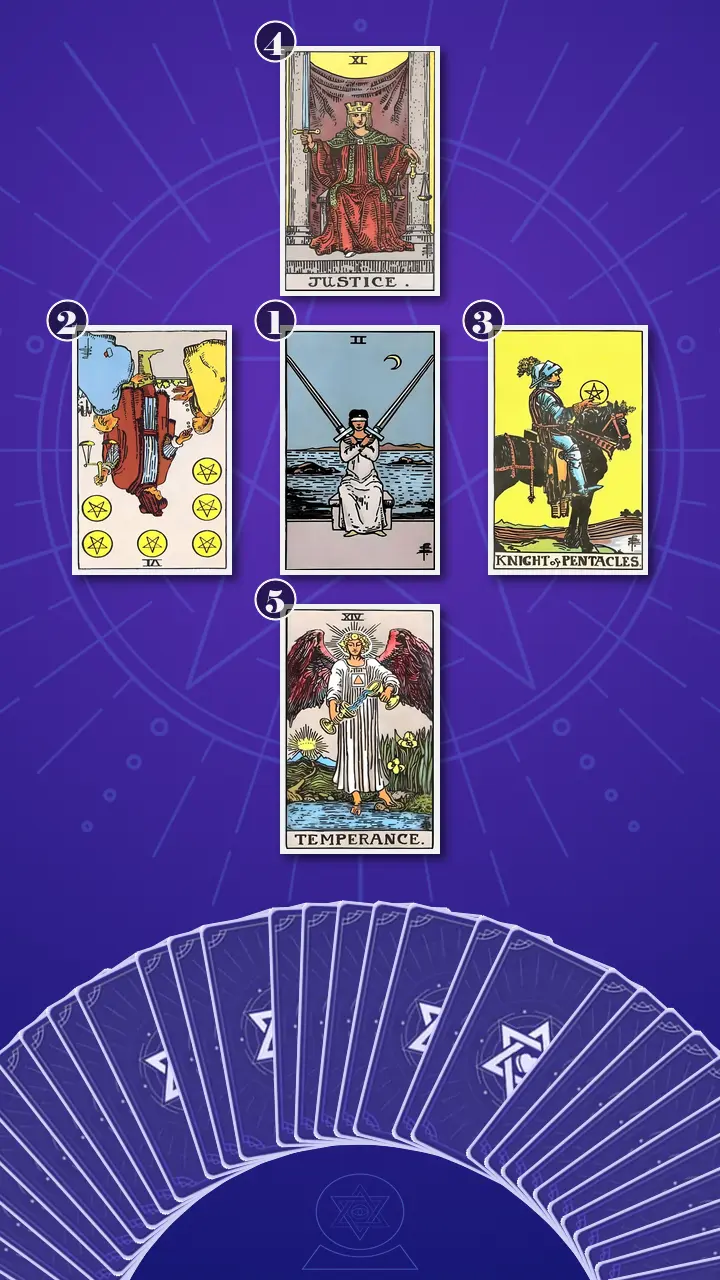
Reading the Map: Where the Freeze Lives
Position 1: The immediate stalemate (how the deadline shows up in your nervous system)
“Now, the card we turn over represents the immediate stalemate: the specific way the deadline-triggered choice shows up in behavior and nervous system,” I said.
Two of Swords, upright.
I nodded toward the image’s blindfold and the crossed blades. “Your translation for this card is painfully modern,” I told Jordan, and then I used the exact life-scene it points to: “You’ve got the application open in one tab and your text drafts in another, and you keep doing one more pass through the budget because as long as you don’t send a clear yes/no, you don’t have to feel the sting of what the choice seems to say about you. The deadline makes it feel like you’re standing at an intersection with a countdown timer, gripping your phone like it’s a steering wheel.”
“That’s it,” Jordan said, and then an unexpected sound slipped out—a quick laugh with an edge to it. “That’s… too accurate. Almost cruel.”
“Not cruel,” I said, keeping my voice even. “Protective.”
In energy terms, the Two of Swords is a blockage: not a lack of intelligence, not laziness—an active pause that keeps you from feeling the vulnerability of choosing. It’s the logic loop that says: If I don’t choose, I can’t be wrong versus If I don’t choose, I lose the option. Under a countdown timer, that loop tightens like a knot you keep testing with your teeth.
Jordan’s shoulders moved in a way I always notice: a tiny drop, just a few millimeters, like their body recognized itself in the description. A long exhale followed—quiet, involuntary. The kind of “oh… yeah” that isn’t agreement so much as relief at being named precisely.
Position 2: Path A (Take the co-sign) — the power dynamics you’re sensitive to
“Now, the card we turn over represents Path A: what accepting help would feel like in practice, including the power dynamics you’re sensitive to,” I said.
Six of Pentacles, reversed.
“This one is about support,” I said, “but reversed, it’s about support that feels emotionally priced.” Then I anchored it in the scenario it’s describing: “You consider accepting the co-sign, but your mind immediately jumps to the invisible price tag: future opinions, subtle pressure, or the ‘after everything I did’ comment you never want to hear. So you stall instead of negotiating. This card reversed looks like pre-emptive resentment—your nervous system bracing for strings—unless you turn it into a clear conversation about expectations, boundaries, and what this co-sign does and does not authorize.”
Jordan’s mouth tightened, and their eyes flicked up toward the ceiling like they were watching a scene play out over our heads.
“I can literally hear it,” they said. “Like… brunch. Casual. Half-joking. ‘After everything I did…’ And my stomach drops before it even happens.”
“Exactly,” I said. “That’s the reversed Six: you start pre-writing your future defense speech instead of writing today’s boundaries.”
Energetically, this is a distortion of balance: receiving doesn’t feel mutual; it feels like a hierarchy. And that’s the honest fear underneath your pride. Not, ‘Will I survive financially?’ but, ‘Will I still own my timeline?’
Position 3: Path B (Go solo) — the pace, tradeoffs, and sustainability
“Now, the card we turn over represents Path B: what self-reliance looks like here, including the pace, tradeoffs, and sustainability requirements,” I said.
Knight of Pentacles, upright.
“This card is the opposite of a dramatic declaration,” I told them, and I tied it to the modern translation: “If you go solo, it’s not about proving you can ‘tough it out’ in one intense day. It’s about choosing the slow, repeatable route: a realistic rent cap, a paced timeline, and credit-building actions you can sustain. The solo path works when it’s built like a routine, not a flex.”
In energy terms, this is balance through consistency. It’s not fast. It’s not glamorous. But it’s real. The Knight doesn’t sprint because the Knight is thinking in seasons, not in Instagram Stories.
Jordan nodded, but it wasn’t a full yes. It was more complicated: a half-nod that carried both pride and grief. “I want that,” they said. “I just hate that the solo plan feels like… the boring option.”
“Boring is often what survives,” I said, and I felt an old professional flashback rise—one I didn’t fight. In field archaeology, the heroic diggers are the ones the documentaries love. But the excavations that actually produce truth are the slow ones: measured grids, careful cataloguing, and notes you can audit later. Drama doesn’t preserve. Process does.
When Justice Took the Blindfold Off
Position 4 (Key): What must be clarified today — terms, boundaries, consent
“Now,” I said, letting the room go quieter on purpose, “we’re turning over the card that represents what must be clarified today: the non-negotiable truths, terms, or boundary conversations that make either path ethical and workable.”
Justice, upright.
Jordan’s eyes sharpened as if their brain had finally found something it could grip. And I could see the setup playing out exactly as the spread intended: they’d been at their kitchen table with the application open, flipping between their bank app, a Notes budget, and a text draft they couldn’t send—watching a “simple” yes/no become an identity test the second it said “expires today.”
Before I went deeper, I said the sentence I’ve learned people need to hear when money decisions get moralized: “A co-sign isn’t a verdict. It’s a contract.”
Stop treating the co-sign as a verdict on your independence; start treating it like a Justice-scale agreement where clarity and consent decide the weight each person carries.
I let the line sit there, like a gavel that isn’t punishment—just structure.
Jordan’s reaction arrived in a three-part chain I’ve watched a hundred times in different bodies: first, a brief freeze—breath paused mid-chest, fingers hovering above their phone as if the screen had turned hot. Second, the cognitive shift—eyes unfocused for a second, like they were replaying every imagined future argument and noticing how it all began with vagueness. Third, the release—air left their lungs in a shaky exhale, and their shoulders dropped in a way that made the chair creak softly.
“But if I do that,” they said, and there was a flash of defensiveness—almost anger—“doesn’t it mean I was wrong? Like I made this whole thing… bigger than it is?”
“It means you were trying to stay safe,” I said. “And you were using the only tool you had: control through overthinking. Justice doesn’t shame you for that. Justice just replaces it with something stronger: explicit terms.”
This is where my work as a historian gives me a particular lens—what I call Historical Case Matching. Civilizations don’t collapse because they accept an alliance. They collapse because they accept an alliance with unwritten expectations, fuzzy obligations, or no exit clause. Rome didn’t become powerful by refusing every treaty; it became powerful by codifying terms, rights, responsibilities, and enforcement. Autonomy isn’t solitude. Autonomy is having a charter.
I leaned forward slightly. “Name it. Define it. Put it in writing. That’s not you asking for permission. That’s you designing consent.”
“Now,” I continued, using the Justice lens the way I would use a field grid, “with this new perspective, think back over the last week: was there a moment when you felt your jaw clench—maybe staring at the ‘co-signer’ section—when this could’ve helped? When you could’ve asked, not ‘What does this say about me?’ but ‘What are the responsibilities, timeline, and exit?’”
Jordan blinked hard, eyes a little glossy. “Yesterday,” they said. “I drafted a text and deleted it because I couldn’t find the perfect tone. If I’d just… named the terms, it would’ve been adult instead of emotional.”
That was the pivot: from deadline-driven anxiety and identity-loaded indecision toward calm commitment grounded in boundaries and self-trust. Not certainty. Just a structure their nervous system could live inside.
Temperance and the Livable Plan
Position 5: Integration and next step — the balanced action that reduces pressure
“Now, the card we turn over represents integration and next step: the most balanced action you can take immediately that reduces pressure and increases self-trust,” I said.
Temperance, upright.
Temperance doesn’t demand a purity test. It demands calibration. And the modern-life translation is unambiguous: “Instead of a binary identity battle, you build a balanced system. If you accept the co-sign, you set a check-in date and a refinance/reassessment timeline so support doesn’t become control. If you go solo, you choose a smaller commitment now and a staged upgrade later. Temperance looks like making the decision gentle enough for your nervous system to live with tomorrow—not just dramatic enough to ‘count’ today.”
Energetically, Temperance is integration: not excess, not deficiency—adjustment until it’s livable. Like turning down your screen brightness until your eyes stop straining. Small changes, huge relief.
Jordan swallowed. “So I don’t have to ‘win’ the decision,” they said, quieter now. “I have to sustain it.”
“Exactly,” I said. “Make it sustainable, not heroic.”
From Vibes to Contract: Your Next 60 Minutes
I pulled the whole cross together for Jordan in one sentence-story: the Two of Swords showed the protective freeze (stalling to avoid the identity sting), the reversed Six of Pentacles named the fear of strings and leverage, the Knight of Pentacles offered a real solo path built on repeatable behavior, and then Justice and Temperance arrived like architecture—terms first, balance second. Not “What does this mean about me?” but “What system can I consent to and maintain?”
The cognitive blind spot was also clear: Jordan had been treating vagueness as protection. But vagueness is exactly where leverage grows. Pride and guilt are loud. Terms are quiet—and they work.
I offered them a practical framework using one of my own field methods—my Time Stratigraphy Method: “We separate the layers,” I explained. “Layer one is the impulse—pride, panic, comparison fatigue. Layer two is the lasting value—stability, autonomy, clean agreements. Decisions get calmer when you stop letting the topsoil write the blueprint.”
Then I gave Jordan steps they could do today, under a deadline, without needing a personality transplant:
- Write the 3-sentence “Justice Text”Set a 10-minute timer. In your Notes app, draft one message: (1) thank them plainly, (2) define what the co-sign does and doesn’t mean (e.g., “This is to meet approval requirements; it doesn’t change who decides my timeline”), (3) propose a concrete check-in date (e.g., “Let’s revisit in three months / after approval / on May 30”).If you feel your jaw clamp while writing, put the phone down and do three slow exhales. Don’t force clarity—create it.
- Use the Terms–Timeline–Exit checklist (before you hit send)Screenshot the offer/portal page. Make a micro-list with four bullets: responsibilities, payment plan, “what happens if X,” and exit plan. Highlight only what affects your day-to-day life.Keep it brutally short. The point is not a legal dissertation—it’s informed consent.
- Choose one Temperance “integration lever”Pick one adjustment that makes the choice livable: timeline, amount, or commitment size. Example: accept the co-sign but set a refinance/reassessment date; or go solo but choose a smaller commitment now and a staged upgrade later.If you notice yourself trying to perfect the compromise, stop at “good enough for this week.” Calibration isn’t endless tweaking.

A Week Later: The Quiet Proof
A week later, Jordan messaged me from a coffee shop near the PATH—nothing cinematic, just a photo of their Notes app. Three sentences. Clean terms. A check-in date. Under it, they wrote: “Sent it. I was shaking a bit, but it didn’t turn into a fight. I slept.”
They added one more line: “I still woke up thinking, ‘What if I’m wrong?’ But it was quieter. Like I’m choosing a system, not begging for a feeling.”
That’s the real Journey to Clarity I watch again and again: not a lightning-bolt certainty, but a small loosening—moving from pride/guilt storytelling to consent-based agreements and sustainable planning. The blindfold comes off. The decision becomes yours again.
When a money decision lands on a same-day deadline, it can feel like you’re not choosing a logistics step—you’re choosing whether your life is still yours if you accept help.
If you trusted that support only has power when it’s vague, what’s one term, boundary, or timeline you’d want to name today—just so your choice stays yours?