My Spreadsheet Hit Twelve Columns—Then I Wrote a 4-Sentence Reply

Finding Clarity in the 10:32 p.m. Lease Thread
If you’ve drafted the lease renewal email three times, left it in your drafts, and told yourself you’ll reply after ‘one more’ commute check—welcome to deadline-driven choice paralysis.
Taylor (name changed for privacy) appeared on my screen from a Boston studio that looked exactly like late-semester survival: one lamp off, one laptop on, a charger cable snaking across the bed like it had given up pretending to be tidy. Somewhere behind her, a radiator ticked in that metronome way that makes silence feel louder. The glow from her screen turned her face a little too pale, and her phone—warm from constant scrolling—kept lighting up with the same apps: Maps, Zillow/HotPads, and the landlord thread she couldn’t stop reopening.
“I just need to send the email,” she said, and I watched her jaw tighten like she was bracing for impact. “But I don’t want to regret it tomorrow. I want stability… but I’m terrified renewing will trap me in that commute grind. The commute isn’t just time—it’s my energy leaking out every day.”
The pressure in her wasn’t an abstract feeling. It was a physical buzz, like an over-caffeinated brain trying to run a spreadsheet on a cracked phone battery—everything technically still working, but hot to the touch and one notification away from overheating.
I set my own mug down on the café counter beside me—my little Italian place where espresso has woken the block for twenty years—and I kept my voice simple. “You’re not being dramatic. Your body is treating that subject line like an alarm because it represents a commitment, not just a housing choice.”
“So here’s our goal tonight,” I added, leaning closer to the camera the way I do when I want someone to feel less alone: “We’re going to turn this fog into a map. Not a perfect answer—clarity. Something you can act on.”

Choosing the Compass: The Decision Cross · Context Edition
I asked Taylor to take one slow breath in—like you’re smelling coffee before you taste it—and one slow breath out—like you’re letting the day unclench. Then I shuffled my deck on the worn wooden table by the espresso machine. The sound is soft, practical. Not mystical. More like setting a timer before you start a task: a signal to your brain that we’re switching modes.
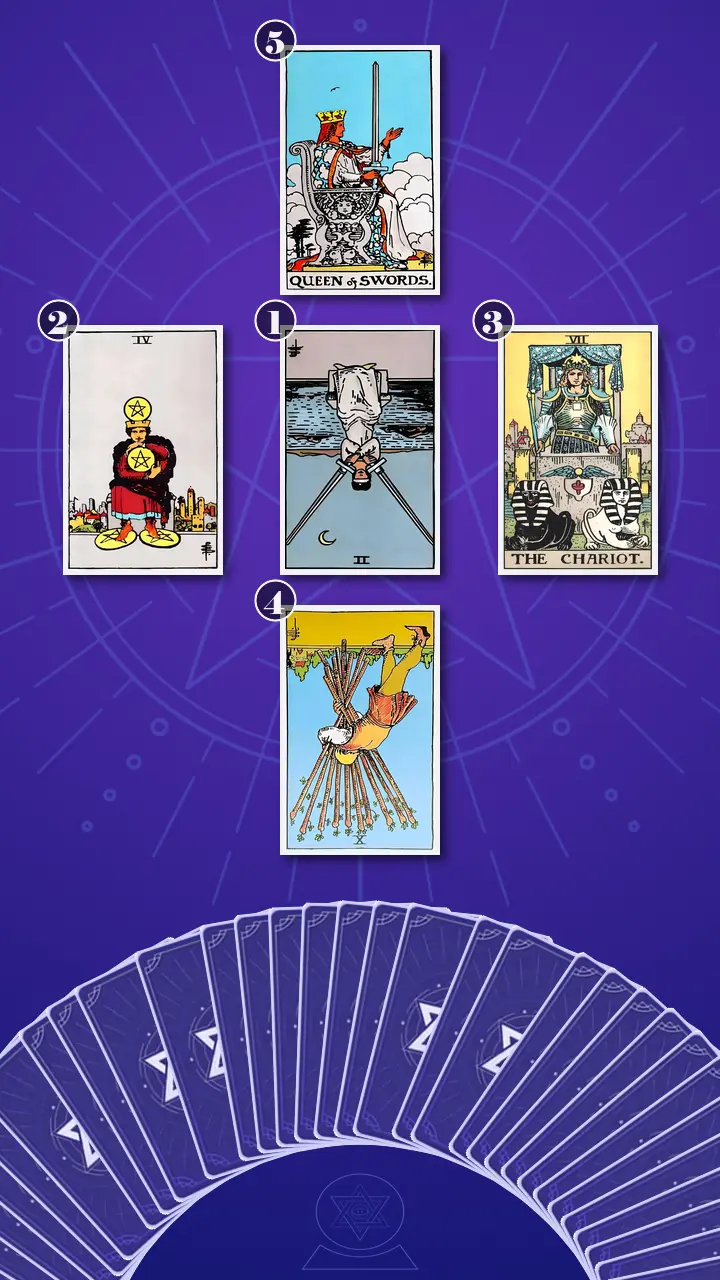
“Today we’ll use a spread called Decision Cross · Context Edition,” I told her. “It’s built for a two-option dilemma—renew and commute versus move closer to campus—especially when there’s a reply-by date turning everything into a high-stakes moment.”
For anyone reading along: this is one of the most useful ways to see how tarot works in real life. Instead of predicting a fixed future, the spread forces a side-by-side comparison of two paths, then surfaces the hidden driver underneath the math—usually time, energy, or emotional bandwidth. It’s basically a structured way to stop spiraling and start deciding.
“We’ll put one card in the center for what’s keeping you stuck right now,” I said. “Left is Option A—renewing and commuting. Right is Option B—moving closer. One card below shows what’s really driving the urgency underneath everything. And the card above gives you your next step—what to do this week, including what to say in that email.”
Reading the Map: A Crossroads Between Comfort and a Livable Week
I laid the first card down in the center. The café around me was quiet—late-night quiet—only the occasional hiss of the espresso machine settling like a sigh. On Taylor’s end, the radiator kept ticking, like it was counting down to her deadline.
Position 1 — The immediate stuck point: what you’re doing (or not doing) right now
“Now we turn over the card for the immediate stuck point: what you’re doing (or not doing) right now with the lease renewal decision.”
Two of Swords, reversed.
I nodded at the image as if it were a familiar customer. “This is the classic stalemate card—except reversed, it’s not stable anymore. The ‘I’ll decide later’ pose is collapsing into overwhelm.”
“In modern life terms,” I said, keeping my voice grounded, “it’s exactly that 10:30 p.m. ritual: lease email open, Maps open, listings open. You tell yourself you’re gathering information, but each new data point spawns a new ‘but what if…’ branch. You’re not failing to decide—you’re trying to avoid the discomfort of choosing without total certainty, so you stay in a stalemate until the deadline makes it feel like an emergency.”
Energetically, the reversal reads like a blockage turning into a flood: too much Air (thought) with nowhere to land. The mind is trying to solve a values problem with more information.
I watched Taylor’s eyes flick to a second monitor off-screen. A tiny movement, but I knew it: tab-hunting, like checking one more listing might make the fear go away.
“Let me say it the way I say it in a café,” I told her. “When you keep adding more grounds, you don’t get a clearer cup—you get sludge. More tabs won’t give you certainty—standards will.”
She gave a half-laugh that was sharp with recognition, then winced like the laugh surprised her. “That’s… so accurate it’s kind of mean,” she said, and then her shoulders dropped a fraction, as if being called out gently made the weight less personal. The stall wasn’t a character flaw. It was a pattern.
Position 2 — Option A energy: renewing the lease and commuting
“Now we turn over the card for Option A energy: renewing the lease and commuting—what it supports and what it costs day-to-day.”
Four of Pentacles, upright.
“This card doesn’t villainize stability,” I said immediately, because I could feel the shame hovering around her like static. “It validates it. This is the known setup.”
I translated it into the montage the card carries: “Renewing looks like keeping the apartment that already works—you know the rent, the landlord’s patterns, the neighborhood routines, the corner store run, the auto-pay. There’s real comfort in not spending brainpower on moving.”
Energetically, this is balance tipping toward excess: security is real, but the grip can get tight. The shadow isn’t ‘you’re boring.’ The shadow is ‘you might be holding on partly because disruption scares you—then the commute becomes the silent price you pay for feeling safe.’
Taylor’s face softened. Her eyes went a little distant, like she could hear her own radiator and feel her own familiar key in her pocket. Then her mouth tightened again when I said, “daily price.”
“I know exactly what you mean,” she said quietly. “It calms me down to think I could just… not move. But then I picture the Green Line delays and I want to scream.”
Position 3 — Option B energy: moving nearer to campus
“Now we turn over the card for Option B energy: moving nearer to campus—what it supports and what it requires from you.”
The Chariot, upright.
This card always changes the temperature in a reading. It doesn’t promise ease; it promises direction.
“Moving closer,” I said, “is the moment you stop asking, ‘Which option is perfect?’ and start asking, ‘Which option makes my week livable?’ You pick a radius near campus, set a budget cap, choose a decision date, and treat the move like a manageable plan instead of a chaotic leap. You don’t need a flawless apartment—you need a direction you can steer.”
Energetically, The Chariot is momentum—not frantic, but intentional. A lot of people think moving is a vibe. This card says moving is a project plan: tour, apply, deposits, moving day, utilities. The two sphinxes are those two pulls you keep trying to “merge” in your Notes app: money versus time.
Taylor sat up straighter. The jaw tension didn’t disappear, but it relocated—less panic, more concentration. “That actually feels… doable,” she said. “Like it’s work, but not chaos.”
“Exactly,” I replied. “This isn’t fate. It’s steering.”
Position 4 — Hidden driver: the underlying strain you must include
“Now we turn over the card for the hidden driver: the underlying strain, priority, or constraint you must include in the decision.”
Ten of Wands, reversed.
I didn’t rush this one. Outside my café windows, the streetlights made the pavement shine like it had been polished. On Taylor’s side, the screen glare made her blink harder, eyes dry from too many late-night checks.
“Under the rent math,” I said, “you’re carrying a load you stopped naming: long commutes, shifting campus hours, late-night catch-up work, constant micro-planning. You tell yourself it’s normal, but your body keeps the receipts—tension, irritability, restless pacing.”
Then I gave her the line that always lands because it’s true: “Cheaper rent can still be expensive—if it costs your mornings.”
Energetically, reversed Ten of Wands is the moment the burden becomes negotiable. It’s a release card, not a punishment card. It says: you’re allowed to put some of it down—and the decision gets clearer when you admit you’re over-capacity.
Taylor nodded once, hard. Then again, smaller. Her fingers, which had been gripping a pen, loosened and set it down like it was heavier than it looked.
“I keep telling myself, ‘it’s fine, lots of people commute,’” she admitted. “But I get to campus and I already feel behind. Like… Severance-level, my life belongs to a system.”
“That’s the hidden driver,” I said. “Not just the dollars. The bandwidth tax.”
When the Queen of Swords Cleared the Desk
I reached for the final card—the one placed above the center, the one meant to lift the reading out of rumination and into action. The café felt extra still, as if even the espresso machine was listening.
Position 5 — Next step: the most empowering, practical action you can take this week
“Now we turn over the card for the next step: the most empowering, practical action you can take this week—especially how to respond to the email.”
Queen of Swords, upright.
I felt Taylor inhale and hold it without meaning to, the way you do right before you click ‘send.’
“This is you closing the twenty tabs,” I said. “Writing two non-negotiables—max commute, max monthly total—and drafting a short, respectful email that matches them. Not a manifesto. Not an apology tour. Just: here’s the decision (or extension request), here are the dates, thank you.”
Energetically, the Queen is clean Air—not blocked, not flooded. Discernment. Self-respect. Boundaries in communication. She’s the exact opposite of that Two of Swords reversed spiral, because she’s not trying to be neutral. She’s trying to be clear.
Setup (the moment before the pivot)
It was easy to see Taylor back in that exact loop: 10:34 p.m., laptop glow as the only light, flipping between the lease thread and Google Maps like it’s a slot machine. Shoulders creeping up. Jaw locking. The thought that always sounds responsible in the moment: One more check, then I’ll know.
I softened my tone—partner, not judge. “You don’t need to feel certain first—you need a clear standard, and then a clean message that honors it.”
Not more tabs and ‘what-ifs’—pick your standard and raise the Queen’s sword by sending the clean, direct email.
Reinforcement (where the body finally believes it)
For a second, Taylor froze—like her whole nervous system went quiet to process what it would mean to stop bargaining with uncertainty. Her eyes unfocused, not in confusion, but like she was replaying a week of late-night spirals at 2x speed. Then her throat moved in a swallow that looked almost painful, and her face shifted: first tightness, then a small crack of relief.
Her shoulders lowered in slow motion. The jaw unclenched, but not all at once—more like a hand opening after holding a too-hot mug. She exhaled, and the sound had a tremble to it, the kind that says, Oh. I can do that… but it means I have to stop hiding.
“But if I do that,” she said, voice sharper for a moment, “doesn’t it mean I’ve been… wrong? Like all this time I’ve been wasting?”
“It means you were protecting yourself,” I replied. “The tabs were armor. And armor is useful—until it keeps you from moving.”
Then I brought in my signature lens, the one that’s made my tarot practice feel like daily life instead of theater: Knowledge Filtration. “In my café, a good filter doesn’t give you ‘the perfect bean.’ It simply decides what gets through. Your brain has been letting everything through—every hypothetical, every listing, every commute simulation. Tonight, we choose the filter: two non-negotiables. Everything else becomes negotiable.”
I made it concrete, exactly as the Queen of Swords would want:
“Set a 10-minute timer. Write two lines on paper: (1) your max commute minutes door-to-door, (2) your max monthly total you can live with. Then open the email and draft a 4-sentence reply that matches whichever option fits those two lines. You can stop when the timer ends—no fixing, no explaining. If your body spikes (tight jaw/shoulders), pause and come back later; the goal is a first draft, not bravery.”
I paused, letting the quiet do some work.
“Now,” I asked, “with this new lens—standard over certainty—think back to last week. Was there a moment when this would’ve changed how you felt?”
Taylor blinked fast, then nodded. “Sunday night,” she said. “I had twelve columns in my spreadsheet and I still felt like I was failing.” She let out a small, almost embarrassed laugh. “If I’d just picked the two criteria… I could’ve slept.”
That was the shift, right there: from deadline-driven panic and analysis paralysis to grounded, criteria-led confidence and clean communication. Not because the universe changed—because her method changed.
The One-Thread Reset: Actionable Advice for the Next 48 Hours
I leaned back and let the whole spread click into a single story. “Here’s what your cards are saying in plain language,” I told her. “You’re stuck because you keep trying to find a risk-free, perfect housing choice (Two of Swords reversed). One path offers real nervous-system comfort and predictability, but risks becoming rigidity with an ongoing commute tax (Four of Pentacles). The other path offers steerable change and a week designed around your actual life, but it requires structure and a plan (The Chariot). Underneath, the real pressure isn’t just money—it’s overload you’ve normalized (Ten of Wands reversed). And the exit ramp is the Queen: choose a standard, then communicate cleanly.”
“Your cognitive blind spot,” I added gently, “is treating this like an engineering proof you can ‘solve’ with enough comparisons. It’s not. It’s a values decision under constraints—time, money, rest. The transformation direction is simple: optimize less, decide more. Choose based on your top two non-negotiables and commit to a time-bound next step.”
Then I gave her the practical plan—small enough to actually do, sharp enough to cut through the noise. (And yes, I brewed this like a blend: strong, simple, and meant for real mornings.)
- Two-Nonnegotiables Filter (Time + Money)On paper (not in your spreadsheet), write: (1) your max door-to-door commute minutes, (2) your max monthly total you can live with. Put the paper where you can see it when you open your laptop.If your brain protests “That’s not enough info,” label it: “tabs-as-armor.” Then stop. The point is filtration, not perfection.
- The 10-Minute Queen Draft (4 sentences)Set a 10-minute timer and draft the lease renewal email: (1) Thanks + acknowledgment, (2) Your decision or request (renew / not renew / extension), (3) One logistical detail (dates), (4) Clean close. No over-explaining.“A clean email is a boundary, not a personality test.” When the timer ends, you’re allowed to stop—first draft only.
- Energy Line Item (3 Campus Days)For your next three campus days, rate your commute drain 1–10 when you arrive, and note one thing you skipped because of it (breakfast, studying, gym, plans). Add that to your decision like it’s a real cost.Keep it scrappy—Notes app is fine. If you start building a tracking system, you’ve slipped back into avoidance.
Before we ended, I offered one more tool from my café life—my Focus Period Diagnosis. “If you can,” I told her, “don’t make this decision at 10:30 p.m. when your nervous system is already fried. Pick a time when your brain is actually absorbent—late morning, or right after lunch. Decisions need daylight.”
“And if you want a ridiculous-but-effective memory anchor,” I added, “use my Latte Memory Technique: write your two non-negotiables on a sticky note like it’s foam art—big, simple, impossible to ignore. ‘25 minutes max.’ ‘$X max.’ That’s your filter.”

A Week Later: The Quiet Proof
A week later, Taylor messaged me a screenshot: one email thread, closed. Four sentences. Polite. Direct. No essay. No apology. “I hit send,” she wrote. “I still felt nervous for like… ten minutes. But then my shoulders dropped and I actually ate breakfast the next morning.”
She added one more line that felt bittersweet in the honest way real change is: “I slept through the night—then woke up and thought, ‘What if I’m wrong?’ But this time I laughed a little. Like… okay, I can adjust.”
That’s the journey I trust the most—when clarity arrives as a pressure drop, not a fireworks show. When you stop trying to control the future and start respecting your own time, energy, and communication.
When you’re staring at that lease renewal thread, it can feel like any choice that isn’t perfect will turn into a daily, private “I messed up” you have to live through on every commute.
If you let yourself pick just two non-negotiables—one about time, one about money—what would the next email you send sound like?