I Kept Reopening Three Apps—Until One Low-Drama Step Broke the Freeze

Finding Clarity in the 8:41 p.m. Tab-Switch Spiral
If you’re a Toronto student juggling a part-time job and classes, and one overdraft alert turns your whole day into a freeze spiral (adulting pile-up), this is for you.
Jordan (name changed for privacy) sat down across from me like they’d been carrying something heavy all day—and in a way, they had. They were 22, non-binary, a university student with a job schedule that changed week to week, and their phone felt less like a tool and more like a tiny courtroom that kept calling their name.
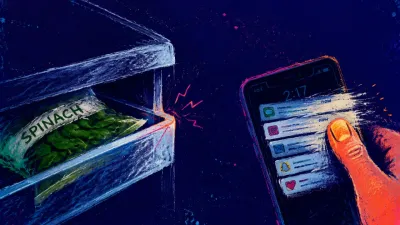
They described a scene so specific I could practically see it on a screen: 8:41 PM on a Wednesday in a tiny Toronto bedroom. They’re sitting cross‑legged on the bed, laptop open to Brightspace, phone screen warm from switching between the bank app and Messages. The overhead light has that faint buzz, and their mouth tastes like mint gum they’ve been chewing too long. Their chest tightens. Their shoulders go heavy—like an overstuffed backpack strap digging in all day. Each tab feels like a confrontation, so they close everything and stare at the wall.
“It’s like… I’m trying to fix money, then school, then texts,” they said. “But the second I open one, I remember the other two, and then my brain just… stops choosing.”
Overwhelm, for Jordan, wasn’t an abstract feeling. It was their jaw clenching when Messages showed 17 unread. It was a hot flush of shame when the banking app went negative. It was that buzzing-light, tight-chest moment where you swear you just need one quiet hour to catch up—and somehow it never comes.
I nodded, keeping my voice steady and warm. “We’re not here to judge you for having a nervous system,” I said. “We’re here to find one next step past overwhelm—something low-drama, doable, and real. Let’s make a map through the fog.”

Choosing the Compass: The Energy Diagnostic Map Spread
I invited Jordan to take one slow breath—not to “calm down” on command, but to mark a transition: from being chased by notifications to looking at them on purpose. While I shuffled, I asked, “What’s the notification that instantly makes your chest tighten—bank alert, missed class, or unread texts?”
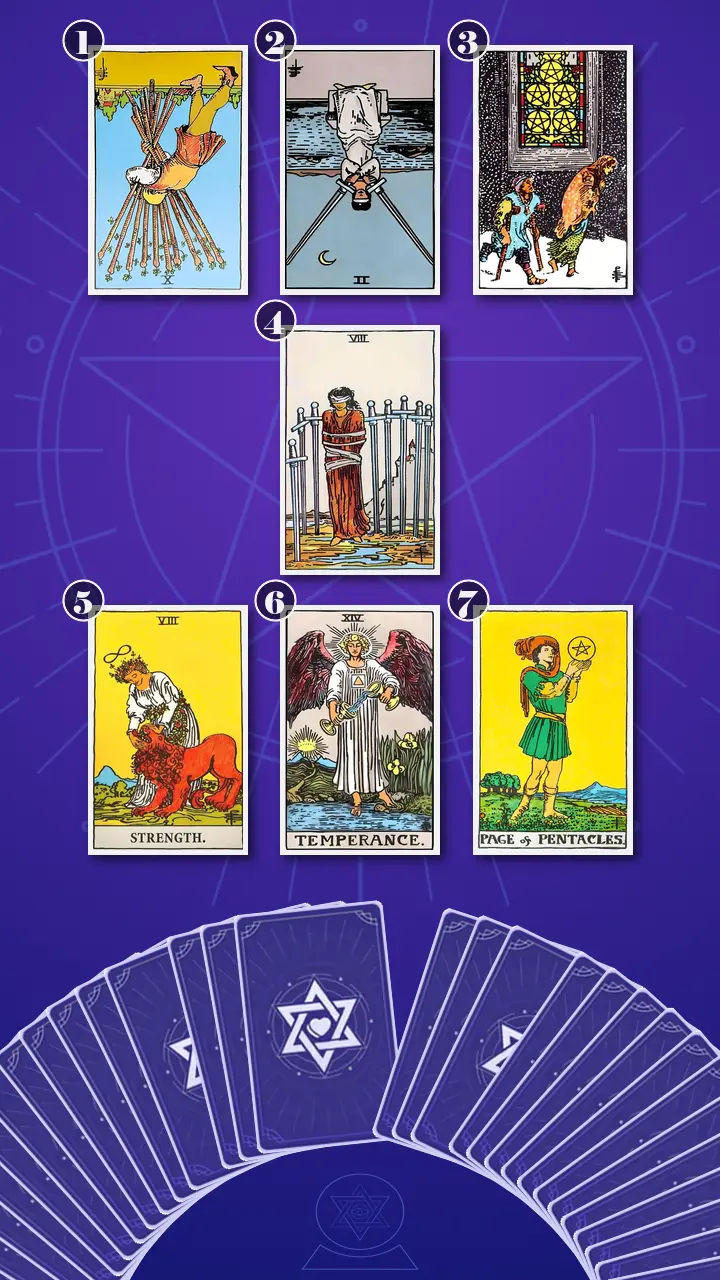
For this reading, I chose my own 7-card layout: Energy Diagnostic Map (7) · Context Edition.
Here’s why this spread works when you’re stuck in a classic “money + school + messages” adulting pile-up: it separates what’s visible on the surface from what’s happening internally, names the outside pressure that’s actually real, and then points toward a resource, a key mindset shift, and one concrete next step. It’s practical tarot—less “prediction,” more “pattern recognition + actionable advice.”
I told them (and, honestly, I tell every reader): “We’ll look at the top row first—how the pile-up shows up in real time. Then we’ll go to the center: the core blockage. Then we’ll move to the bottom row: the way out, in small steps.”
Reading the Map: Card Meanings in Context
Surface overwhelm: what your day looks like when it’s too much — Ten of Wands (reversed)
“Now flipped over is the card representing Surface overwhelm: what your day looks like when it’s too much.”
Ten of Wands, reversed.
I didn’t have to reach far to translate it into Jordan’s actual life. I said, “This card is literally that moment where the weight isn’t one problem—it’s the bundle.” Then I echoed the scene the card was already describing:
“It’s 9:12 PM in your Toronto bedroom: laptop open to your course portal, phone bouncing between your bank app, Calendar, and Messages. You’re trying to carry ‘fix money + catch up class + reply like a normal person’ all in your head at once. After twenty minutes of tab-switching, your shoulders creep up to your ears, you close everything, and tell yourself you’ll deal with it ‘after dinner’ even though you know dinner is just going to turn into doom-scrolling.”
Reversed, the Ten of Wands is an overload energy that’s collapsing. Not “you’re lazy.” More like: you’re carrying too much internally, and your system drops the whole bundle because it can’t keep white-knuckling it.
Jordan let out a small laugh that landed somewhere between bitter and relieved. “That’s… actually brutal,” they said. “Like, why is that exactly what I do?” Their fingers worried the edge of their phone case, like it might confess on their behalf.
Inner tug-of-war: what you’re mentally doing that keeps you stuck — Two of Swords (reversed)
“Now flipped over is the card representing Inner tug-of-war: what you’re mentally doing that keeps you stuck between tasks.”
Two of Swords, reversed.
I leaned in a little. “This is decision fatigue,” I told them. “Not because you have no options—because every option feels like it carries social risk.”
And again, the modern translation was already written in their week:
“You draft three versions of the same text—delete them all—then open the bank app to ‘just check’ again, then open the course site to see the missed lecture… and you freeze. Inside, it feels like you’re trying to pick the ‘correct’ order to fix money vs school vs friendships, because picking wrong feels like exposing yourself. So you do the only option that feels safe: you don’t choose at all.”
Reversed, this is the blocked Air energy of overthinking—thoughts multiplying instead of clarifying. It’s the mental version of cutting between scenes too fast. Like a frantic montage where the camera never settles long enough for the character to actually do anything.
Jordan’s eyes flicked up to mine, then down again. “Yeah,” they said quietly. “If I pick the wrong one first, it’s like I’m proving I’m irresponsible.”
External pressure: what the environment is demanding — Five of Pentacles (upright)
“Now flipped over is the card representing External pressure: what the environment is demanding.”
Five of Pentacles, upright.
“This card validates something important,” I said. “Some of this isn’t in your head. Money pressure is real.”
I spoke it in Jordan’s language, the way stress actually arrives:
“The overdraft alert isn’t just a notification—it’s a whole body moment. You’re on the TTC, phone screen dimmed, doing quick math in your Notes app: rent, groceries, PRESTO reload, that subscription you forgot about. Even if it’s a small negative balance, your brain jumps straight to fees and consequences. You feel weirdly alone with it, like everyone else got the ‘how to not be broke’ manual and you missed that class too.”
This is Earth energy under strain: scarcity weather. It makes everything feel urgent, personal, and isolating. The danger here isn’t that you’re “bad at budgeting.” It’s that the fear of being seen struggling convinces you to stop seeking tools, options, and support that are actually nearby.
Jordan swallowed. Their shoulders rose, then dropped a fraction. “I hate how fast it goes to shame,” they said. “Like my face gets hot even though nobody knows.”
Core blockage: the belief that turns stress into paralysis — Eight of Swords (upright)
“Now flipped over is the card representing Core blockage: the belief or constraint that turns stress into paralysis.”
Eight of Swords, upright.
The room got quieter in that way it does when you’ve reached the center of something. Even outside my studio window, the city noise felt like it moved a step farther away.
“Your to-do list isn’t a character test,” I said. “But this card shows the story that keeps turning it into one.”
Then I mirrored it exactly, with the sensory details that make it real:
“Your real trap isn’t the tasks—it’s the story that says every task is a character test. ‘If I reply now, they’ll know I’m flaky.’ ‘If I show up after missing class, I’ll look like a mess.’ ‘If I open the bank app and it’s still negative, I’ll feel stupid.’ So you keep yourself ‘safe’ by staying stuck: unread texts, missed lecture, overdraft still sitting there. The paralysis is protective, but it quietly multiplies the consequences you were trying to avoid.”
That’s the Eight of Swords’ blocked energy: your own mind trying to protect you by narrowing your options until none of them feel safe. The trap feels total, but it isn’t. The bindings are loose.
I let my voice stay gentle but clear. “Avoidance feels like safety, then charges interest,” I said. “Not as punishment. Just… as math.”
Jordan’s gaze went unfocused for a second, like they were rewatching the moment they put their phone face-down and opened Netflix instead. Their breathing paused—then came back. “So what,” they asked, “I’m just scared of being exposed?”
“You’re scared,” I agreed, “and also trying very hard to be competent. That’s not nothing.”
Available resource: the strength you can access right now — Strength (upright)
“Now flipped over is the card representing Available resource: the strength or support you can access right now.”
Strength, upright.
Strength is not hype. It’s regulation. It’s the moment your nervous system stops acting like every notification is a siren.
I described it as a micro-scene, not a pep talk:
“This looks like you putting your phone down gently (not face-down like you’re ashamed), taking one slow breath, and talking to yourself like a person you actually care about: ‘I’m overwhelmed. I’m not incompetent. I can do one thing.’ Then you choose the smallest possible move—reply to one text honestly, or email the TA, or transfer $10—without waiting to feel confident first.”
This is balanced fire: power held without panic. The lion isn’t the overdraft. It’s the surge of self-attack that arrives with it.
Jordan’s shoulders softened in a way you could actually see. Their phone—still in their hand—tilted screen-up, not hidden. “That feels… possible,” they said, like they were surprised by their own voice.
When Temperance Poured Between Two Cups
Key transformation: the mindset shift that turns overwhelm into forward motion — Temperance (upright)
“Now flipped over is the card representing Key transformation: the mindset shift that turns overwhelm into forward motion.”
Temperance, upright.
I could feel Jordan brace before I even finished saying the name—like part of them expected the answer to be “try harder.” I’ve seen that flinch in a hundred different faces, and I know it well from my own life: the moment you think clarity is going to arrive as a verdict.
Temperance didn’t feel like a verdict. It felt like a method.
“Instead of a dramatic ‘I’m fixing my whole life tonight’ reset,” I said, “you build a calm sequence like pouring water from cup to cup: one money action (small and complete), then one school action (small and complete), then one relationship action (small and complete). You’re not trying to be impressive—you’re trying to be steady. You stop treating your to-do list like a moral scoreboard and start treating it like a queue you can move through in small, connected sips.”
I paused, then brought in one of my own tools—the way I think when I’m stuck. “I want to run an Einstein-style thought experiment with you,” I said. “Not physics. Just a clean rule.”
“Imagine the universe where you’re not allowed to fix everything tonight. You get one tiny action per category—money, school, text—and you’re done. In that universe, what would you choose?”
Jordan’s mouth tightened. For a beat, they looked almost angry—not at me, but at the idea. “But if I do something small,” they said, “it won’t be enough. And then I’m still… me.”
That was the setup, exactly: 9 PM on the bed, three flashing alarms, tight chest, heavy shoulders—brain insisting you need one perfect hour to fix everything.
You don’t need a perfect reset tonight; you need to blend one small step with the next, like Temperance pouring from cup to cup until your nervous system steadies.
I let the sentence sit in the air for a second, the way you let a film’s most honest line land before the next scene starts.
Jordan’s reaction came in a chain—three small tells, in order. First: their breathing hitched, like their body didn’t know whether to accept relief. Second: their eyes went distant, unfocusing toward the corner of the room as if replaying every “I’ll handle it after dinner” night. Third: their shoulders dropped, not dramatically, but unmistakably—like someone finally set a bag down. Their lips parted and they let out a shaky exhale that sounded half like a laugh and half like grief.
“So I don’t have to feel calm first,” they said. “I can… do the small thing, and that makes me calmer.”
“Exactly,” I said. “What if calm isn’t the prerequisite for action—what if action is what creates calm?”
I leaned forward just a touch. “Now, with this new lens—Temperance as sequence—think back to last week. Was there a moment where this would’ve changed your night by even five percent?”
Jordan rubbed their thumb over their phone screen, then nodded. “Friday. I had Netflix paused and the group chat open, and I kept drafting and deleting. If I’d just sent a two-sentence ‘I’ll reply tomorrow’… I think I would’ve slept.”
And there it was: the shift from overwhelmed self-critique toward grounded, prioritized momentum. Not perfect. But real.
Next step: one concrete action that creates stability in the next 24–72 hours — Page of Pentacles (upright)
“Now flipped over is the card representing Next step: one concrete action that creates stability and momentum in the next 24–72 hours.”
Page of Pentacles, upright.
This card always makes me think of apprentices in old paintings—hands steady, attention fully on one object. Not dramatic. Just devoted.
“You pick one ‘single-pentacle’ task that you can finish today,” I said. “Open the bank app once and turn on low-balance alerts, schedule a $5–$20 transfer if you can, or message your professor/TA with a clean, simple subject line (‘Missed class today—next steps?’). You’re not solving everything—you’re proving to yourself that you can do a real, measurable step that makes tomorrow slightly easier.”
This is Earth energy in balance: single-tasking as self-trust. Pick the step that’s measurable—not the one that’s dramatic.
Jordan nodded, and this time it wasn’t the frantic kind of nod that begs the world to stop. It was slower. Like they could actually picture doing it.
The Low-Drama Stabilizer: Your Next 48 Hours
I pulled the whole spread together for them like a short story with a clear plot: the top row is the stormy dashboard—overload (Ten of Wands reversed) plus decision fatigue (Two of Swords reversed) under real scarcity pressure (Five of Pentacles). The center is the cage—Eight of Swords, where tasks become a morality test and avoidance pretends to be safety. The bottom row is the workbench—Strength to steady your nervous system, Temperance to turn chaos into a calm sequence, and Page of Pentacles to prove it with one measurable step.
The blind spot here is subtle but powerful: you’ve been treating “showing up imperfectly” as the same thing as “being unreliable.” That belief is what turns a manageable mess into paralysis. The transformation direction is the opposite: from “I need to fix everything right now” to “I will complete one concrete, low-drama stabilizing step, then reassess.”
Here are the next steps I gave Jordan—practical, timer-based, and designed for anyone who’s feeling stuck in notification overwhelm.
- The Single-Pentacle Money Step (10 minutes)Set a 10-minute timer. Open your bank app once. Write down the exact negative amount. Turn on low-balance alerts or find the overdraft protection info—then stop.Expect your brain to say, “This is too small to matter.” That’s resistance, not truth. When the timer ends, you’re allowed to stop even if you feel pulled to keep checking.
- The One-Sentence Reality + One Question EmailSend one email with the subject line: “Missed class today—next steps?” Body: one sentence naming reality (“I missed today’s lecture and I want to catch up.”) + one question (“Is there anything specific I should do first?”). Hit send.If you start editing it into a novel, you’re back in the Two of Swords. Keep it plain. Clear and timely beats perfect and late.
- The Two-Sentence Repair TextReply to the most time-sensitive thread with: “Hey—today got away from me and I’m catching up. I’ll reply properly by tomorrow afternoon.”A “good-enough” reply is still a reply. You’re buying time without ghosting, and that’s real care.
To make it even easier to start, I offered Jordan one of my studio tricks—something I use when my own head gets loud. “If the fear sentence is looping,” I said, “try Manuscript Mindmaps: write the fear line in your Notes app for 60 seconds, but in mirror writing—backwards. It forces your brain to slow down and externalize the thought instead of obeying it.”
We also agreed on one boundary: phone on Do Not Disturb for 15 minutes, screen-up (not hiding), and if it helps—put on one calm track. Jordan laughed when I suggested Mozart K.448 like I was being dramatic, but they also admitted they needed something that didn’t sound like a panic soundtrack.

A Week Later: The Quiet Proof
Six days later, I got a message from Jordan. No essay, no apology spiral—just a screenshot of a sent email with the subject line exactly as we’d written it, and a second screenshot: low-balance alerts turned on. Underneath, they wrote: “I still felt weird doing it. But it was… done.”
They didn’t tell me their life was fixed. They told me they slept through the night for the first time in a while—then admitted, in the morning, their first thought was still, “What if I mess it up again?” Only this time they said they caught themselves, exhaled, and did one small step anyway.
That’s the Journey to Clarity I trust: not certainty, but ownership. A calm sequence. One cup to the next.
When money, school, and messages all flash red at once, it can feel like one visible slip will prove you’re not competent—so you freeze, not because you don’t care, but because you care and you’re trying not to be exposed.
If you trusted that you don’t have to fix everything to be worthy of showing up, what’s one small, measurable step you’d be willing to complete first—just to make tomorrow a little less loud?
Every reading at AceTarot is a Journey to connect with inner wisdom and empower next step.
Learn more about our Journey to Clarity.