From Funding-vs-Mentor Anxiety to a Fair Decision: Choosing Grad School

The 12:38 a.m. Offer-Email Spiral
If you’ve re-read two grad school offer emails at 1 a.m. and compared the stipend line and the advisor name like they’re stock tickers, welcome to funding vs advisor decision paralysis.
Jordan (name changed for privacy) sat across from me in my small Midtown office, hoodie sleeves pulled over their hands like they were trying to keep their nerves from escaping. They were 25, finishing a research-heavy undergrad, and living the very NYC version of “career crossroads”: everything important, everything expensive, and every deadline somehow louder at night.
They described their last Wednesday at 12:38 a.m. in a tiny bedroom—laptop glow on an unmade bed, radiator hissing like it had an opinion, the MTA’s distant hum threading through the window. They’d been flipping between YNAB, a Google Sheet literally titled “Grad Decision,” and a faculty bio tab, while an acceptance email draft sat open like a dare. Their phone was warm from scrolling, their jaw tight, and the deadline lived in their chest like a dumbbell they couldn’t put down.
“I keep thinking the right answer should feel obvious by now,” Jordan said. “If I choose the money, I’m scared I’ll settle. If I choose the mentor, I’m scared I’ll be stressed about money the whole time. I’m not asking for certainty… I’m just asking for one decision I won’t regret.”
I could hear the core contradiction underneath every sentence: wanting financial security and a clean, sensible plan vs fearing you’ll miss the mentor who could shape your future. And I could see what their body was doing with it—jaw clamped, chest held like they were bracing for impact.
“That tight jaw?” I said gently. “That’s not you being ‘bad at decisions.’ That’s your nervous system trying to make one email prove you’re competent. Let’s not do that to you. Let’s make a map that gets you to clarity—clear enough to take the next step, even if it’s not perfect.”

Choosing the Compass: A Pros & Cons Tarot Spread for Funding vs Mentor
I asked Jordan to take one slow breath in, one out, and then another. Not as a mystical ritual—more like closing a few mental browser tabs so we could actually see what was open.
“Today we’ll use a spread called Pros & Cons,” I told them, shuffling. “It’s built for exactly this: two good options that trigger decision fatigue.”
For readers who’ve ever wondered how tarot works in a grounded way: spreads are simply structured questions. This one works because it mirrors the real-life comparison process (funding vs advisor) without letting it become infinite. It gives each offer a lived benefit and a hidden cost, then forces an integration card—so the reading can’t get stuck in endless weighing.
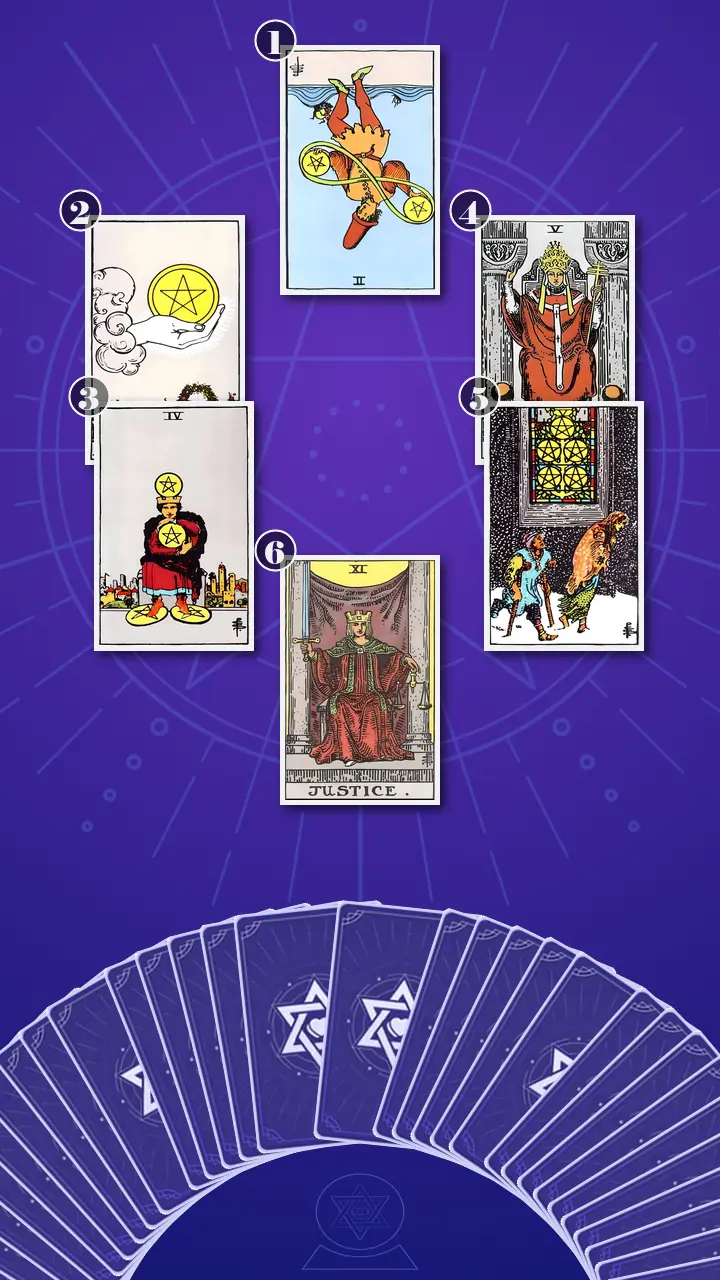
I pointed to the layout as I dealt: “The first card is the current decision knot—the habit loop keeping you stuck. Then we’ll read Offer A (money): benefit and trap. Offer B (mentor): benefit and strain. The last card is integration: the principle you use to decide, and the clean action you can take next.”
Reading the Map: Pros, Cons, and the Parts You Don’t Put in the Spreadsheet
Position 1: The current decision knot (the observable behavior loop)
“Now we’re turning over the card that represents the current decision knot: what you’re doing that keeps the choice stuck,” I said. “Two of Pentacles, reversed.”
In context, this card meaning is painfully modern: it’s 11:47 p.m. and Jordan is ping-ponging between a budgeting app, a “Grad Decision” spreadsheet, and three faculty bio tabs. Their hands keep moving (scroll, refresh, recalc), but nothing actually resolves (no email sent, no criterion chosen).
Reversed, the Two of Pentacles is a blockage of rhythm. The juggling that’s supposed to help you manage reality becomes cognitive overload—constant switching that drains focus instead of creating clarity. It’s the infinity ribbon of “just one more pass,” except the ribbon is made of browser tabs.
I mirrored it back exactly, the choreography almost like a little sad dance: “Budget app → spreadsheet → faculty page → email draft. And somewhere in there a caption runs: ‘If I just run it one more time, it’ll turn into certainty.’ That’s control masquerading as clarity.”
Jordan let out a quiet laugh that sounded half embarrassed, half relieved. “Okay,” they said, shaking their head. “That’s… too accurate. Like, kind of brutal.” Their fingers twitched toward their phone as if they wanted to close a few tabs in real life.
“Brutal in the way an honest mirror is brutal,” I said. “And useful. Because once we can name the loop, we can build a stopping rule.”
Position 2: Offer A (money) — the real benefit in lived daily terms
“Now we’re turning over the card that represents Offer A’s real benefit: what the money offer gives you day-to-day,” I said. “Ace of Pentacles, upright.”
This card’s modern translation is simple and surprisingly tender: Jordan pictures waking up on a random Tuesday and not immediately doing rent math in their head. It’s fewer panic spirals, fewer side hustles, and more consistent energy for reading, writing, and showing up to class like a real human.
Energetically, the Ace is balance—a single solid coin you can hold. And I said the line I knew Jordan needed permission to believe: “Funding is not just money—it’s mental bandwidth.”
They blinked, like their eyes had been holding tension too. “Yeah,” they admitted. “I hate how much space money takes up in my brain.”
Position 3: Offer A (money) — the hidden cost (security becoming rigidity)
“Now we’re turning over the card that represents Offer A’s hidden cost: how security can become rigidity,” I said. “Four of Pentacles, upright.”
If Jordan chooses the funded program mainly to avoid financial vulnerability, this is the posture it can create: holding so tightly to “being responsible” that you stop moving. Safe projects only. Staying quiet in seminars. Choosing not-messing-up over learning. Stability quietly turns into a tight grip: responsible, but slightly closed.
Energetically, this is excess control. The resource isn’t the problem; the fear-based clenching is. “This is the part where ‘being responsible’ turns into a subscription you can’t cancel,” I told them. “Not because you’re boring—but because your nervous system starts treating risk like a moral failure.”
Jordan’s mouth tightened, then softened. “I can see myself doing that,” they said. “Like… I’d be grateful, but also a little dead inside.”
Position 4: Offer B (mentor) — the real developmental upside (guidance, container, network)
“Now we’re turning over the card that represents Offer B’s real developmental upside: mentorship as a resource,” I said. “The Hierophant, upright.”
This is the mentor offer as apprenticeship: consistent advisor meetings, sharper feedback, introductions to the right people, and a clear standard for what ‘good work’ looks like. Not admiration as a mood—structure as a pathway.
“Mentorship isn’t magic,” I said, and watched Jordan’s shoulders drop by about half an inch. “It’s a container—with terms. Office hours. Lab norms. ‘Here’s how we do it.’ A living feedback loop.”
This is where my old-world analyst brain and my tarot work overlap. I used my Potential Mapping System—a way I profile learning energy. “Jordan, from what you’re describing, you’re a Deep Thinker, not a Sprinter,” I said. “Deep Thinkers don’t just need freedom; they need a cadence of feedback so they don’t spiral alone in their own drafts. That doesn’t mean you outsource your authority. It means you choose a structure that supports how you actually learn.”
Jordan exhaled, small and genuine, like they’d been holding their breath around the word “mentor” because they were scared it sounded naïve. “I’ve been trying to pretend I don’t care about that,” they said quietly. “But I do.”
Position 5: Offer B (mentor) — the strain that must be planned for (sustainability and support)
“Now we’re turning over the card that represents Offer B’s pressure point: what needs a real plan to be livable,” I said. “Five of Pentacles, upright.”
Choosing the mentor path could mean real scarcity moments: splitting groceries, counting subway rides, delaying healthcare, saying yes to too many side commitments. The emotional part is feeling ‘outside’ support—like everyone else has a cushion. This card doesn’t say ‘don’t do it’; it says ‘do it with a plan, and don’t isolate.’
I painted the montage, because fantasy collapses when you show Tuesday: rent autopay notifications, the health insurance portal, the grocery total, the winter coat you didn’t plan to replace. Then I pointed to the stained-glass window in the card. “See that?” I said. “Resources exist. But they don’t walk out and find you. You have to knock. Aid office. Fellowships. Current students. Roommate options. Boundaries.”
Jordan nodded, sober. Less “vibes,” more reality. “I keep telling myself I’ll figure it out,” they said. “But I don’t actually have… a plan.”
“And that’s the difference between courage and white-knuckling,” I replied. “We’re not debating your desire. We’re building the supports that let your desire survive.”
When Justice Held the Scales
Position 6: Integration and next step (the decision principle + clean action)
“We’re turning over the card for integration and next step: the decision principle to use, and the clean action you can take now without needing total certainty,” I said. The radiator hiss seemed to pause for a beat, like the room itself wanted to listen. “Justice, upright.”
Setup: Jordan was caught in that specific late-night trap: couch at 12:38 a.m., cost-of-living calculator open, mentor bio open, half-written acceptance email open—believing that if they could just find the objectively best program, they’d never have to feel the vulnerability of owning a trade-off.
Delivery:
Stop juggling for the ‘perfect’ answer and make a fair ruling with clear scales—then let the sword be the email you finally send.
Reinforcement: Jordan’s body reacted before their words did—an entire three-step chain I’ve learned to respect. First: a tiny freeze, like their breath got caught at the top of an inhale and their hands stopped fidgeting mid-air. Second: their gaze unfocused, not distracted, but inward—like their brain replayed every time they’d asked three friends for opinions and still felt emptier afterward. Third: a slow release. Their shoulders lowered. Their jaw unclenched in a way you could almost hear. Then they swallowed, voice softer. “So… I don’t need the perfect answer,” they said, as if testing the sentence for sturdiness. “I need something I can stand behind.”
I nodded. “You don’t need a perfect answer. You need a fair ruling you can live with.”
Justice is the antidote to the Two of Pentacles reversed. It doesn’t ban weighing—it completes it. The scales are transparent criteria. The sword is follow-through. In my Wall Street life, we’d call this the moment you stop refreshing the market and write the investment memo: given these facts, given these constraints, here’s the decision, and here’s the risk plan. Fair doesn’t mean painless. Fair means accountable—and kind enough to your future self that you can actually move.
“Now,” I asked them, “with this new lens—can you think of a moment last week when you were about to reopen your spreadsheet, and this would’ve helped you feel different?”
Jordan’s eyes flicked to their phone, then back to me. “Sunday night,” they said immediately. “I had the draft email open. I stared at it for like… an hour. I kept thinking if I sent it, it would prove something about who I am. But if it’s a ruling… it’s just a direction. I can live with a direction.”
That was the shift right there: from anxiety-driven optimization loops and outsourced certainty to values-based clarity, grounded self-trust, and clean follow-through. Not certainty. Clarity.
The Justice Memo: Actionable Next Steps in the Next 48 Hours
I pulled the whole spread together for Jordan in one clean narrative, because this is where tarot becomes practical. “Here’s what I see,” I said. “Your mind is stuck in an optimization loop (Two of Pentacles reversed): more data, more tabs, more opinions—because it briefly gives you control. The money offer is real support (Ace of Pentacles): bandwidth. But the shadow is gripping so hard you stop growing (Four of Pentacles). The mentor offer is a real training container (Hierophant): structure, feedback, network. But the strain is also real (Five of Pentacles): it needs a sustainability plan, not hope. Justice says: name your minimum needs and your values, then make a fair ruling you agree to uphold—and let the sword be the send button.”
“Your cognitive blind spot,” I added, “is thinking the decision has to prove you have good judgment. That’s why you’re chasing perfect information. The transformation direction is simpler and harder: move from optimizing to a values-based decision with a concrete support plan for the trade-offs.”
Then I brought in my own intervention framework—my 5-Minute Decision Tools. “We’ll do this like a calm analyst, not a panicked prosecutor,” I said. “Three axes: Advantage, Risk, Breakthrough. Justice loves a clean structure.”
- Two-Line Criteria (Non-Negotiable + Negotiable)Open Notes (not your spreadsheet). Write one non-negotiable minimum need (e.g., “I need a funding floor that covers rent + basics without panic”) and one negotiable (e.g., prestige ranking, exact city, or a specific perk). Keep it to two lines.Expect your brain to say “not enough data.” That’s the point—you’re practicing self-trust. Once you pick the non-negotiable, don’t renegotiate it for 48 hours; if anxiety spikes, write it down, don’t reopen the weights.
- Two 20-Minute Decision Windows + a Parking LotSchedule two 20-minute windows this week (timer on). During the window, you’re allowed to compare offers. Outside the window, every new thought goes into one note titled “Decision Parking Lot”—no actions, no extra emails, no spreadsheet edits.If you catch yourself opening r/gradadmissions “for data,” redirect it into the Parking Lot note. Capture, don’t act.
- The 10-Minute Justice Ruling (Decision Memo)Set a 10-minute timer. Write: (1) your non-negotiable, (2) your negotiable, (3) one sentence verdict: “I’m choosing ___ because ___.” Then stop when the timer ends—no edits. Optional: add three bullets under my tri-axis headings: Advantage / Risk / Breakthrough.If your chest tightens, take three slow breaths and remind yourself: this is a draft for clarity, not a forever contract. Version 1.0 counts.
I looked at Jordan. “This is the part where the ‘sword’ becomes real,” I said. “Once you have the memo, the next clean admin step is the email. Not the perfect email—the sent email.”

A Week Later: Ownership, Not Certainty
A week later, Jordan texted me a screenshot—cropped tight, names blurred. At the top were two lines (their non-negotiable and negotiable). Under it: one sentence that began, “I’m choosing…” And below that, a sent email confirmation.
They added: “Slept through the night for the first time in a month. Woke up and immediately thought ‘what if I’m wrong?’—and then I laughed. Like… okay, I can be wrong and still be okay.”
That’s what a real Journey to Clarity tends to look like. Not fireworks. More like a jaw unclenching. A decision becoming a direction. A person realizing they can choose without turning the choice into a referendum on their worth.
When you’re stuck between the funded offer and the mentor offer, it can feel like you’re not choosing a program—you’re choosing whether you’re allowed to be safe or allowed to become who you want to be, and your body holds that like a tight jaw and a clenched chest.
If you didn’t need this decision to prove you’re ‘good at life,’ what would a fair, livable next step look like for you this week?