From Degree-Audit Overwhelm to a Livable Plan: One Check-In Rule

Finding Clarity in the 8:47 p.m. Kitchen Glow
You’ve had your degree audit open for hours, but somehow you’re still not enrolled in anything—just rearranging the same semester in five different tabs like it’s going to reveal the one “correct” answer.
Jordan said that to me like a confession and a roast at the same time. They were 22, Toronto, final year—smart, capable, the kind of person who can build a color-coded Google Calendar that looks like modern art. But their eyes had that specific, screen-tired shine I’ve seen a thousand times: the look you get when you’ve been negotiating with yourself for too long.
I could picture it without them even trying: 8:47 p.m. on a Sunday in an apartment kitchen, laptop open on the counter beside a half-cold tea. Degree audit in one tab, enrollment cart in another, and a calendar app filled with neon blocks. The fridge hums like it’s judging you. The screen light feels harsh on your face. Your shoulders crawl up toward your ears as you whisper, “If I move this course to Winter, does it mess up everything?”
Jordan’s hand hovered in the air as if they were still dragging courses around an invisible timetable. “I keep thinking there’s a schedule that makes everything work,” they said. “Graduate on time… but also not crash. And if I don’t graduate on time, it means I messed up.”
Overwhelm doesn’t always look like tears. Sometimes it’s a buzzy, restless stomach—like you drank coffee at 9 p.m. and now your body is stuck in ready mode while your brain runs mental math loops that never pay out.
I slid a small glass of water toward them and kept my voice gentle. “That makes sense,” I said. “When a tool starts feeling like a scoreboard, your nervous system treats every click like a verdict. Let’s try something different today. Let’s make a map that gets you out of the infinite recalculation and into one grounded next step—finding clarity without needing perfect certainty.”

Choosing the Compass: The Decision Cross Tarot Spread
In my café, we start readings the same way we start mornings: with a pause that gives your attention somewhere safe to land. I asked Jordan to take one slow breath—nothing mystical, just a clean transition out of panic-planning and into observation—while I shuffled.
“For this,” I told them, “I’m using a Decision Cross tarot spread.”
And because I’m always talking to the reader in the room and the reader reading this later: the reason this spread fits is simple and ethical. Jordan isn’t asking me to predict some cosmic outcome. They have two explicit options—graduate on time versus take a lighter course load—and what they need is self-knowledge: capacity, constraints, values, and a way to stop treating the degree audit as an identity test.
The Decision Cross keeps the focus on compare-and-contrast, then lands in an actionable next step that turns uncertainty into a bounded experiment. No fortune-telling smoke. Just a clean structure for a messy moment.
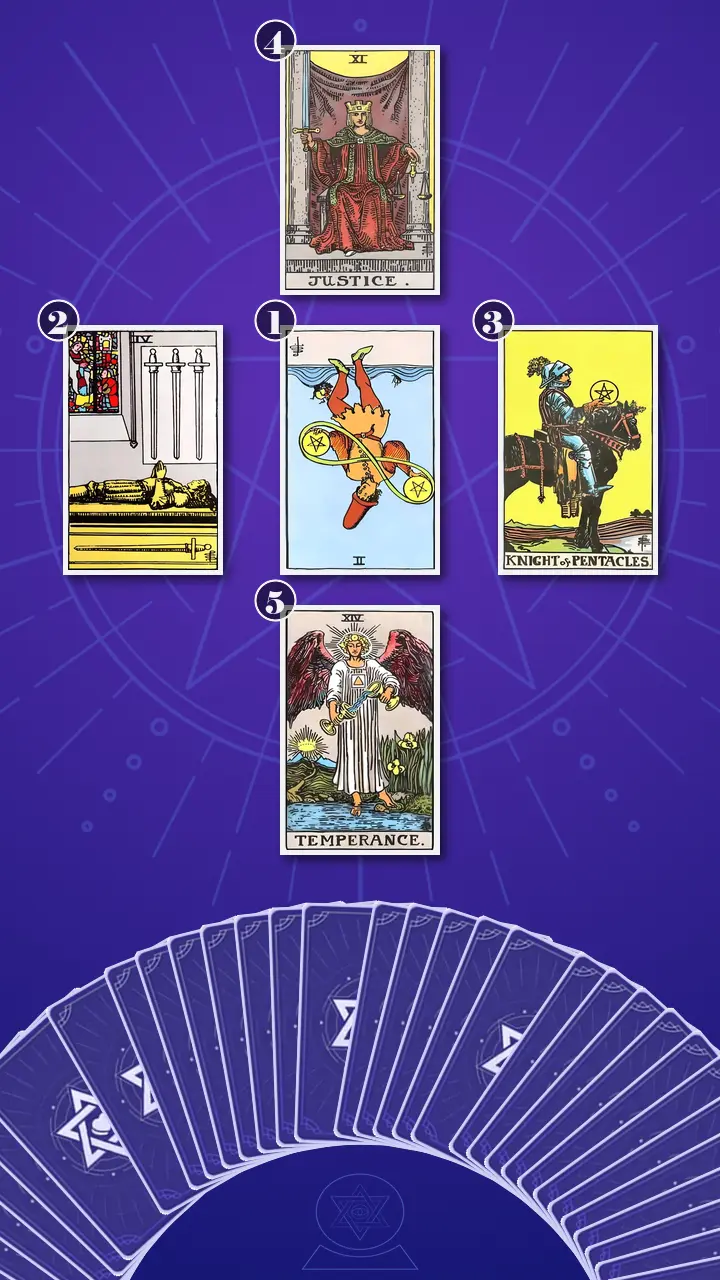
I gestured to the layout as I placed the cards: “Center card is the current pressure point—what the audit is really triggering. Left is Path A: lighter load. Right is Path B: graduating on time. Above is the deciding factor—the one constraint you have to be honest about. And below is the next step you can take this week.”
Jordan nodded, the way people nod when they’ve been craving structure but are scared to admit it.
Reading the Map: From the Degree-Audit Spiral to Criteria
Position 1 — The current pressure point: what your degree audit is really triggering
“Now flipped over,” I said, “is the card representing the current pressure point: what your degree audit is really triggering in your day-to-day behavior and attention.”
Two of Pentacles, reversed.
I didn’t even have to dramatize it. This card does it for me: the infinity-loop ribbon, the unstable stance, the sense of trying to keep two worlds from tipping.
“This is 11:40 p.m. energy,” I said. “You’re juggling the degree audit, the course catalog, your enrollment cart, and a spreadsheet with three different graduation timelines—like if you rotate the same pieces enough times, one arrangement will magically remove all risk. You’re trying to keep ‘graduate on time’ and ‘don’t burn out’ both perfectly afloat, and the moment one requirement line looks messy, your brain goes into emergency re-optimization instead of choosing a plan.”
I watched Jordan’s shoulders tighten on cue, like their body had been waiting for permission to admit it.
“Energetically,” I continued, “reversed Two of Pentacles is blockage. Not because you’re lazy. Because you’re carrying too many negotiables. Everything becomes adjustable—sleep, meals, sanity—so the plan can look ‘perfect.’ And that creates the loop: short-term relief when you check one line again, long-term cost because you never get real information—advisor input, actual course availability, your real energy limits.”
Jordan let out a small laugh that had a bitter edge to it. “Okay,” they said, half-smiling. “That’s… kind of mean. But yes. That’s me.”
I softened my tone. “It’s not mean. It’s precise. And here’s the thing I want you to hear early: A degree audit is data, not a verdict. This card is the part where optimization can be a form of avoidance when you’re scared to choose.”
Position 2 — Path A: what a lighter load supports in you (and what it asks you to accept)
“Now we look left,” I said, “at the card representing Path A: what a lighter load supports in you, and what it asks you to accept.”
Four of Swords, upright.
“Choosing a lighter course load looks like giving your brain an actual recovery lane,” I said. “Fewer credits so you can sleep, absorb the material, and think clearly—especially in a city week where commuting, work shifts, and life admin are already consuming bandwidth.”
I tapped the image gently. “This isn’t ‘giving up.’ It’s strategic pause. The single sword below the resting figure matters: the graduation goal stays present, but you’re not holding it like it’s on fire.”
“And because I need to say it out loud,” I added, meeting their eyes, “Rest isn’t falling behind. It’s how you stay able to keep going.”
Jordan’s jaw unclenched a fraction—like a zipper finally moving after you’ve been forcing it.
“The uncomfortable acceptance,” I said, “is that a lighter load might mean letting go of the fantasy that you can do everything at full intensity without paying for it somewhere. It asks you to stop treating capacity as a moral issue.”
Position 3 — Path B: what graduating on time requires from you (and what it costs)
“Now we look right,” I said, “at the card representing Path B: what graduating on time requires from you—and what it costs.”
Knight of Pentacles, upright.
“Graduating on time looks like committing to a steady, repeatable routine,” I said. “Same study blocks each week. Clear boundaries around work and social time. Less daily renegotiation. It’s the ‘boring but effective’ path—progress that comes from consistency, not panic-fueled overwork.”
“The still horse is the whole message,” I continued. “This path is not built for frantic re-checking. It’s built for ‘I chose, and now I execute.’ The cost is that you can’t keep re-opening the question every night like it’s an A/B test.”
Jordan’s gaze dropped to the card, then drifted toward the window where the streetlights were turning the snow into a dull glow. “That part scares me,” they admitted. “The committing. Like… what if I commit and then realize I chose wrong?”
“That fear makes sense,” I said. “But we’re going to answer it with structure, not with more tabs.”
Position 4 — The deciding factor: the one truth, constraint, or boundary you need to be honest about
“Now we go above the center,” I said, “to the card representing the deciding factor—the one truth or boundary you have to be honest about to choose wisely.”
Justice, upright.
This card always makes the room feel a little quieter. Maybe because it’s so allergic to drama. Or maybe because it’s the first adult in the room.
“This,” I said, “is the moment you stop asking the audit to tell you your worth and start using it like a decision tool: what’s required, what’s optional, what deadlines are real, what courses are only offered once a year, and what your actual constraints are—time, money, energy.”
I spoke more crisply now, like I was reading a policy document that would save someone’s sanity. “Scales: weigh facts and tradeoffs. Sword: make a clean decision instead of leaving everything half-open.”
Jordan inhaled sharply, then slowly let it go. It wasn’t relief yet. It was the first notch of de-escalation—like their body finally believed it could stop sprinting.
“Here’s where my café brain kicks in,” I said, letting myself have one small, honest flashback: twenty years of mornings, watching people think the answer is always ‘more.’ More espresso, more hustle, more input. “I have a skill I call Knowledge Filtration. Coffee only tastes clear because the filter does one job: it separates what’s essential from what’s noise.”
I pointed at Justice. “Justice is your filter. REQUIRED versus PREFERRED. Facts versus fear-thoughts. No extra credit for suffering.”
Jordan nodded, slower now. “Turning vibes into a rubric,” they murmured, like it was new language they’d been needing.
When Temperance Poured Between Two Cups
Position 5 — Next step: an actionable way to move forward this week without needing perfect certainty
“Now,” I said, and I let my hands slow, “we’re flipping the card for Next step: an actionable way to move forward this week without needing perfect certainty.”
Temperance, upright.
The image landed like warmth: pouring between cups, one foot on land and one in water, the sunrise path. Not a dramatic win. A sustainable one.
Jordan leaned forward before I even spoke, like their body recognized the shape of the answer.
First, I did the setup—the moment I knew they lived in.
They were still trapped in that TTC-or-kitchen-counter headspace: audit open, jaw tight, thinking, “If I don’t get this exactly right, I’m going to mess up my future.” The fear underneath wasn’t really about one class—it was about control. Choosing wrong felt like proof they didn’t have it.
Stop treating the degree audit like a pass/fail verdict, and start mixing your workload like Temperance pours—measured, intentional, and sustainable.
I let the sentence hang there for a beat, like crema settling.
Jordan’s reaction came in a chain—three small movements that told me more than any speech could. First: a freeze. Their breath paused mid-chest; their fingers stopped fidgeting with the sleeve of their hoodie. Second: a kind of inward replay. Their eyes unfocused, like they were watching last Sunday night on the kitchen counter from a distance—seeing the calendar blocks, the red requirement line, the hovering cursor over “enroll.” Third: a release that surprised them. Their shoulders dropped, not all the way, but enough to change the angle of their whole posture. Their voice came out quieter, a little rough around the edges.
“But… if I mix it,” they said, “doesn’t that mean I’m admitting I can’t handle the full thing?”
There it was—the unexpected reaction. Not relief. A flash of anger at the implication. Like the old story wanted to defend itself.
I kept my tone steady and peer-level. “No,” I said. “It means you’re admitting you’re human. And that you’re choosing a plan you can live, not a plan you can perform for the audit.”
“Temperance is not ‘less ambition,’” I continued. “It’s integration. Credits plus commute plus work shifts plus meals plus sleep plus buffer time. It’s building a schedule that can survive a bad week. Not just a schedule that looks impressive on paper.”
“And here’s the part that usually breaks the spell,” I said. “You don’t need a perfect plan—you need a plan with limits and a check-in date.”
Jordan swallowed and blinked hard, like they were trying not to let it become a bigger thing than it was. “Okay,” they said. “But I still… I still don’t know which path is ‘right.’”
I nodded. “Temperance isn’t asking you to know forever. It’s asking you to choose for now, inside a container.”
I leaned in slightly. “Now, with this new lens—measured, intentional, sustainable—think back over the last week. Was there a moment when you were spiraling on the audit, and this idea could’ve changed how your body felt? Even a little?”
Jordan exhaled, long and shaky. “Tuesday,” they said. “I was on Line 1, trying to fit a full load around my shift. I kept thinking if I just rearranged it enough, I’d feel okay. But I didn’t.”
“That’s the shift,” I said softly. “This isn’t just about a schedule. It’s your nervous system moving from chaotic overplanning and overwhelm to grounded agency and a sustainable, reviewable plan.”
The One-Page Justice Split: Actionable Next Steps That Break the Loop
I gathered the reading into one story, the way I’d blend beans for someone who thinks they need the strongest roast when what they really need is balance.
“Here’s what your cards are saying,” I told Jordan. “Right now, the reversed Two of Pentacles has you stuck in an infinity loop—endlessly juggling both options open because you’re trying to avoid the feeling that comes with committing. Path A (Four of Swords) isn’t failure; it’s recovery as strategy. Path B (Knight of Pentacles) is doable, but only if you stop renegotiating with yourself daily and build ‘boring’ consistency. Justice is your deciding factor: turn anxiety into criteria. And Temperance is your next step: mix a sustainable blend, with one non-negotiable wellbeing constraint and a review point, so you’re not asking one decision to carry your whole identity.”
“Your cognitive blind spot,” I added, “is that you’ve been treating capacity as negotiable and certainty as required. That’s why you keep reopening tabs. But more tabs won’t create certainty—one small commitment will create information.”
Then I moved us into action—clean, doable, and small enough to start this week.
- The 20-Minute Justice SplitOpen one doc and make two columns: REQUIRED (to graduate by your target term) vs PREFERRED (nice-to-have/ideal version/“just in case”). Only write facts you can verify from the audit or catalog. If a thought is a worry, park it under a third header: FEAR NOTES.Set a timer for 20 minutes and stop when it ends—unfinished is allowed. You’re building clarity, not a courtroom transcript.
- Choose One Non-Negotiable Capacity RulePick one constraint you will not bargain away and write it at the top of your planning doc like a header (examples: “7 hours of sleep on weeknights,” “No more than 2 heavy-reading courses,” or “Two evenings a week are protected recovery”).If you’re not sure what to pick, use my Focus Period Diagnosis: notice when caffeine still hits you at night (that buzzy stomach is data). If late coffee wrecks sleep, make “no caffeine after 2 p.m.” or “sleep window protected” part of the rule—because a plan that depends on a fried nervous system isn’t a plan.
- Temperance Prototype Week + Check-In DateDraft one realistic week for the schedule you’re considering: classes + commute + meals + work shifts + study, plus two buffer blocks. If it doesn’t fit, adjust credits before you adjust sleep. Then schedule a 30-minute calendar event for Week 2 or Week 3: “Course load check-in.”Use a “two-tab rule” while you draft: degree audit + course catalog only. No RateMyProfessors deep dives, no Reddit threads, no group chats—filter first, optimize later.
Jordan stared at the list like it was the first time someone had offered them a door instead of a maze. “This feels… annoyingly reasonable,” they said.
“That’s the point,” I replied. “Reasonable is underrated when you’re dealing with decision fatigue.”

A Week Later: The Quiet Proof
A week later, between the morning rush and the afternoon lull, I got a message from Jordan.
“Did the Justice Split,” it read. “It was weirdly calming. I picked a rule: 7 hours of sleep on weeknights. Prototyped the week. Dropped one elective that was only there to prove something. Set a Week 3 check-in. Still nervous, but I hit enroll on one required course as an anchor.”
I could practically see it: not a cinematic transformation—just a quieter kitchen counter, fewer neon blocks, one decision made on purpose. Clearer breathing. A plan that could survive Tuesday.
That’s the real Journey to Clarity I love: not certainty, but ownership. Not “I solved my entire future,” but “I stopped treating the audit like it could grade my worth.”
Because when the degree audit feels like a scoreboard, it makes sense that your shoulders lock up and your mind starts chasing the one perfect schedule—because you’re not just planning classes, you’re trying to prove you’re still in control.
If you let this be a bounded experiment—not a forever verdict—what’s one non-negotiable constraint you’d build into your plan this week, just to see how it changes the way your body feels when you look at the audit?
Every reading at AceTarot is a Journey to connect with inner wisdom and empower next step.
Learn more about our Journey to Clarity.