From Thesis Topic Anxiety to Steady Work: A 14-Day Micro-Pilot

The 11:56 p.m. Tab-Switching Spiral
If you’re a thesis-track master’s student in a city like Toronto and your advisor just emailed you two perfectly viable topics, but your brain treats it like a high-stakes IQ test and you’re stuck in analysis paralysis—yeah. I know exactly why you booked.
Jordan showed up to our call with the kind of tired that isn’t sleepy—it’s wired. They angled their laptop camera down for a second like they were embarrassed by the evidence: two open outlines under a desk lamp’s harsh circle of light. “Topic A” in Google Docs. “Topic B” in Overleaf. The laptop fan doing that steady little whine. Their phone lighting up with a department Slack notification like a tiny judge: Submitted my proposal!
“I keep dragging the same three bullet points up and down,” they said, voice tight like they’d been holding it all day. “I keep telling myself I’m being careful. But I’m not writing. I’m… rearranging.”
The feeling in their body wasn’t abstract. It sat right behind the sternum—like a seatbelt pulled one notch too far—while their foot tapped under the chair as if it could outrun the deadline.
And there it was, clean and brutal: wanting to choose the right thesis topic vs fearing that a wrong pick will waste time and expose you as not competent enough.
“Okay,” I told them gently, “let’s not try to win against that fear with more tabs. Let’s try something different. We’ll make a map. Not a verdict—clarity.”

Choosing the Compass: The Decision Cross Spread
I asked Jordan to take one slow breath—not as a mystical thing, just as a nervous-system reset—then to hold the question in one sentence: “Two thesis topics from my advisor—how do I pick the right one?”
I shuffled while they watched, the way I used to watch numbers roll on a trading screen: not for destiny, but for signal. Tarot works best, in my experience, as a pattern-mapping tool. It doesn’t replace your judgment; it shows you the feedback loops your judgment is trapped inside.
“Today we’ll use a spread called the Decision Cross,” I said. “It’s built for exactly this—two options that are both ‘good,’ plus the invisible pressures that make choosing feel dangerous.”
For you, the reader: the reason I like this spread for thesis-topic paralysis is that it does what spreadsheets can’t. It separates the options from the system you’re choosing inside. The cross layout makes the tug-of-war visible: what you’re doing day-to-day (center), what each topic asks of you (left/right), what the institution is whispering (above), what your fear is screaming at night (below). Then it gives you a pivot principle and a first-week action—so you leave with actionable advice, not just “interesting card meanings.”
“Card one is your current stuck pattern,” I previewed. “Cards two and three are Topic A and Topic B. Card five goes straight to the fear story. Card six is the pivot—your decision principle. Card seven is your first-week plan.”
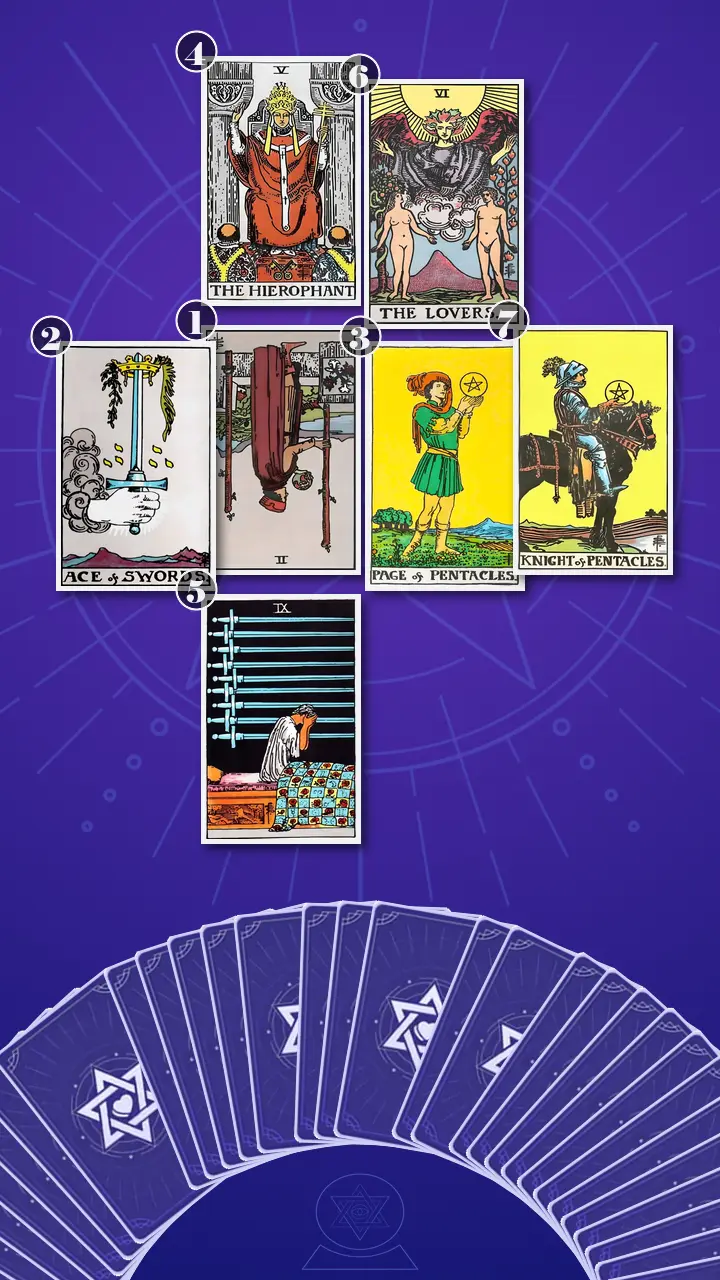
Reading the Map: What the Cards Say About Your Choice
Position 1 — The Observable Stuck Point
“Now flipping over the card that represents your current decision state and how the indecision is showing up day-to-day,” I said, “the observable stuck point.”
Two of Wands, reversed.
This one always makes me think of the moment before you hit “send.” The figure holds the globe—big picture, career implications, PhD prospects, publications, employability—and yet he doesn’t move. One wand is fixed to the wall: the safe plan. The other wand is the one he could carry forward, if he chose.
In modern life, this is Overleaf + Google Docs ping-pong as a whole personality. Two outlines open. Committee questions imagined. LinkedIn comparisons running in the background. You keep “zooming out” because zooming out feels safer than writing the first imperfect page someone could respond to.
Here’s the split-screen I described to Jordan:
Left screen: you at 1 a.m., building the ultimate pros/cons sheet like it’s a recommendation algorithm. If you feed it enough criteria—publishability, novelty, committee fit—it will output certainty.
Right screen: a single, boring deliverable. One-page research question plus scope. Something that could exist by Friday.
And the inner monologue underneath it is not about logic. It’s about exposure.
If I choose, I’m exposed. vs. If I don’t choose, I’m stuck.
I named the energy dynamic plainly: “This is blocked Fire. Initiative is there, but it’s jammed at the edge of action. Planning becomes protection.”
Jordan let out a sharp exhale and then—unexpectedly—laughed. Not happy. Almost offended.
“Okay,” they said, rubbing a trackpad smudge with their thumb like they wanted to erase the last month. “That’s… rude. It’s accurate, but it’s rude.”
“Good,” I said. “Recognition means we’re touching the real loop. And also—if choosing feels like exposure, you’re not indecisive—you’re protecting your worth.”
Position 2 — Topic A’s Mental Demand
“Now flipping the card for Topic A: what this option asks of you mentally and what it could develop in you.”
Ace of Swords, upright.
Topic A has a clean blade to it. A sharp claim. Crisp definitions. A proposal that looks tight on paper. This is the kind of topic that rewards logic, rigor, and the pleasure of a well-structured argument.
But the crown on the sword matters. It can turn the thesis into a performance: be undeniably right. If Jordan’s self-worth is tied to being “smart and efficient,” this card can tempt them into over-identifying with being the smartest person in the room every time they draft a paragraph.
I told them: “Ace of Swords is balanced Air when it’s clarity. It’s excess Air when it becomes ‘I must win this topic.’ Ask yourself: does this topic become clearer the more precisely you define terms… or does it get brittle? Like any imperfect sentence is failure?”
Jordan’s eyes flicked away from the camera, toward their screen. “It feels… clean,” they admitted. “And also like a trap.”
Position 3 — Topic B’s Practical Path
“Now flipping the card for Topic B: what this option asks of you practically and what it could develop in you.”
Page of Pentacles, upright.
Topic B reads like an apprenticeship. Learn by doing. Progress is trackable through tangible outputs: a dataset cleaned, a method tried, a draft iterated. It might not deliver instant ‘brilliant’ vibes, but it can deliver something more sustaining: quiet competence.
Earth energy like this is rarely dramatic. It’s not the adrenaline of a perfect idea; it’s the steady satisfaction of “I made something real this week.”
“This Page is looking at the pentacle the way you look at a skill you’re about to earn,” I said. “It trains you to become a builder. Not because you’re less smart—because the topic measures progress in artifacts.”
Jordan’s shoulders lowered a fraction, almost involuntarily. “That sounds… calmer,” they said. “Like I could just… do it.”
“Exactly,” I said. “Not exciting every day. But doable on a random Tuesday.”
Position 4 — The External Framework (The ‘Rules of the Game’)
“Now flipping the card for external framework: advisor/department expectations and the ‘rules of the game’ influencing how you define a good choice.”
The Hierophant, upright.
Institutional pressure has a sound. Sometimes it’s literally a Teams notification. Sometimes it’s the quiet in a departmental hallway that makes you whisper. Sometimes it’s a calendar invite that feels like judgment: committee meeting, Tuesday 2 p.m.
The Hierophant is that invisible rubric you’re trying to satisfy even when nobody asked you to suffer for it. The crossed keys on the card say: “There is a gate. There is a correct way to belong.”
I said, “Even with a supportive advisor, this decision is happening inside a system. Part of you is trying to pick the topic that sounds most acceptable—most legitimate—so you can feel safe.”
Jordan nodded once, quick. “I keep hearing what a ‘real thesis’ should look like.”
“Right,” I said. “And the trap is: your thesis stops being about learning, and starts being about belonging.”
Position 5 — The Fear Story That Makes Choosing Feel Dangerous
“Now flipping the card for the underlying fear: the specific mental story that makes choosing feel dangerous and irreversible.”
Nine of Swords, upright.
I didn’t have to dramatize this one. Jordan already lived in it.
At night, the phone glow turns blue and sharp. The room is dark except for the Notes app with a half-written email draft: “Hi Professor—thanks for the options. I’m leaning…” Then nothing. The cursor blinking like a metronome for panic. And the brain becomes an invisible committee.
I said what I hear in this card, in plain language: “Your mind is rehearsing worst-case scripts. ‘If I choose and it’s hard, I’ll be exposed.’ Exhaustion becomes evidence: you wake up foggy, ride Line 1 with cold coffee, and your brain goes, ‘See? Not ready.’”
Jordan’s nod was heavy, like it had gravity. Their jaw flexed once, then released. No tears—just the quiet intensity of someone who’s been doing this in private for too long.
“I keep thinking,” they said, “if I could just find the correct choice, I wouldn’t have to feel like this.”
“That’s the spell,” I said softly. “And here’s the thing: you can’t spreadsheet your way into self-trust.”
When The Lovers Flipped the Frame (Finding Clarity Without Certainty)
Position 6 — The Decision Principle (Your Inner Compass)
I let the silence sit for a moment—like a room after the last email notification finally stops. Then I said, “We’re turning over the pivot card. This is the one that changes how you’re making the choice.”
“Now flipping the card that represents your decision principle: the internal compass that helps you choose without needing total certainty.”
The Lovers, upright.
Setup. I named the exact moment I could feel Jordan trapped in: two thesis outlines open, fourteen tabs buzzing, midnight approaching, and the belief that if they just rearranged the structure one more time, the right answer would reveal itself—like the perfect outline could choose for them.
Delivery.
Stop treating this like a logic problem you must solve perfectly; make a values-based commitment and step forward under The Lovers’ invitation to choose and own your choice.
I didn’t rush past it. I let it hang in the air the way a hard truth does—clear, almost quiet.
Reinforcement. Jordan’s reaction came in three small waves.
First: a physical freeze. Their breathing stopped for half a beat; their shoulders lifted like they were bracing for impact.
Second: the cognition sinking in. Their eyes unfocused, not on the card, not on me—like they were replaying every late-night “one more paper” moment with a new subtitle.
Third: the emotion, complicated. Their shoulders dropped, then they frowned—not relief yet, more like grief mixed with anger.
“But if that’s true…” they said, voice sharper, “does that mean I’ve been doing it wrong? Like I wasted all this time?”
I stayed with that question, because it was honest. “No,” I said. “It means you were using the only tool that ever made you feel safe: being the smart one. In academia, that tool gets rewarded. But right now, it’s costing you sleep and momentum.”
Then I brought in the practical exercise the card was begging for—micro, real, body-aware. “Set a 10-minute timer,” I told them. “Write two headings: ‘Topic A — what I’m actually committing to this week’ and ‘Topic B — what I’m actually committing to this week.’ Under each, list exactly three deliverables that would count as progress by Friday. If your chest tightens or your thoughts speed up, shorten the deliverables until your body says, ‘Okay. I can do that.’ You’re not locking your life in. You’re choosing next week’s experiment.”
And this is where I used my own framework—what I call my Potential Mapping System. It’s a way of identifying learning archetypes through energy profiling: are you a Deep Thinker (thrives on conceptual depth) or a Sprinter (thrives on quick feedback and tangible wins), or a blend that needs a specific sequence?
“The Lovers isn’t asking you to pick the topic that makes you look smartest,” I said. “It’s asking you to pick the topic that matches how you actually learn under pressure.”
I watched Jordan’s hand come up to their chest without them noticing—like they were finally checking in with the part of them that had been left out of every spreadsheet.
“This,” I said, “is the shift from ‘tense overthinking’ to ‘uncomfortable commitment.’ And it’s the first step toward steadier confidence—not because you found certainty, but because you chose a principle you can live with.”
They inhaled, slower this time. “A thesis topic isn’t a personality test,” they said, as if testing the sentence for truth. “It’s… a daily commitment.”
“Exactly,” I said. “A thesis topic is a daily relationship, not a one-time IQ test.”
Position 7 — The First-Week Action That Turns Anxiety Into Evidence
“Now flipping the card that represents your first-week action: a concrete, low-drama next step that turns the choice into evidence and momentum.”
Knight of Pentacles, upright.
If you’ve ever built anything that lasted—strength, savings, a skill—you know this energy. It’s not vibes. It’s a recurring calendar block.
“This Knight is boring on purpose,” I told Jordan. “It’s the plowed field. The repeatable schedule. It says: certainty is not a prerequisite. A cadence is.”
In my old life on Wall Street, there was a rule that saved people from spiraling: you don’t get to re-litigate a decision every hour. You set a structure, you define risk, and you review on schedule. When I looked at this Knight, that memory flashed—rows of monitors, the comfort of a plan you could execute even on a bad day.
“Your thesis wants Earth,” I said. “A routine that keeps moving even when your brain tries to reopen the debate at 11:58 p.m.”
From Insight to Action: Your Next 7 Days (No More ‘Research as Avoidance’)
I summarized the story the spread was telling, so Jordan could feel how it connected end-to-end.
Two of Wands reversed showed the loop: forecasting as avoidance, planning as protection, staying on the battlement with the globe so you don’t have to step into visible work. Ace of Swords and Page of Pentacles showed the true difference between the topics: Topic A trains a sharp thinker and can become performance pressure; Topic B trains a steady builder and can become sustainable competence. The Hierophant explained why this feels like an identity test—because the department’s invisible rubric is sitting in the room with you. Nine of Swords named the cost: insomnia, rumination, and catastrophic scripts. The Lovers became the load-bearing beam: values-based commitment over approval-chasing. And the Knight of Pentacles? The landing. The way you prove the choice through doing.
The cognitive blind spot I named for Jordan was simple: they were trying to get “decision relief” from prediction. But relief was only going to come from evidence—small, time-boxed work that builds self-trust.
“So,” I said, “we’re not picking a topic that guarantees you’ll never be judged. We’re picking a topic you can show up for on a random Wednesday.”
Then I gave them a low-drama plan. I pulled from my own 5-Minute Decision Tools (a tri-axis assessment: Advantage/Risk/Breakthrough, with weekly calibration) and blended it with what The Lovers and the Knight were already demanding: values plus cadence.
- Do the “Values Triad” (10 minutes)Write your Top 3 Thesis Values on a sticky note where you draft (examples: “daily interest,” “finishable scope,” “skill I want to build”). Score Topic A and Topic B from 1–5 on each value (no decimals). Pick the higher total, then stop scoring.If you catch yourself choosing approval-disguised values (“impressive,” “publishable”), translate them into calendar-truth (“clear claim,” “weekly output,” “scope I can defend in 12 pages”).
- Run a 7-day thesis micro-pilot (90 minutes/day)For 7 days, work on ONE topic only at the same time each day. Allowed inputs: one anchor paper + your notes. Required output by Day 7: a one-page research question + scope paragraph (Topic A) OR a one-page “what I will build/measure” plan + draft outline (Topic B).If 90 minutes feels impossible, do 25 minutes and still count it. Consistency beats intensity. When your brain says “too simplistic,” reply: “I’m collecting evidence, not proving brilliance.”
- Send the two-sentence commitment email (5 minutes)Draft: “I’m choosing ___. This week I’ll produce ___ and ___ to confirm scope. Can we check in on (date)?” Save it, read it once out loud, then hit send.If sending spikes anxiety, schedule it: set a calendar event for tomorrow at 11:00 a.m. called “Send the email.” The Knight of Pentacles loves a time slot.
Before we ended, I offered one more support for the Nine of Swords nights—because night-time anxiety is not a personality flaw; it’s a system running without a stop button.
“Before sleep,” I said, “write the feared sentence verbatim. Then list three realistic supports you’d use if it came true—office hours, narrowing scope, methods consult, writing center, advisor check-in. End with one boundary: ‘I’m allowed to learn in public without it meaning I don’t belong.’”

A Week Later: The Quiet Proof
Five days later, Jordan messaged me a screenshot: their calendar with one bland, beautiful block repeating all week—Thesis (90). Under it, a tiny note: One-anchor-paper rule.
They wrote, “I picked Topic B. I’m not euphoric. But I wrote the one-page plan and… I slept. Not perfectly, but I slept.”
The bittersweet part was there too—because real change is rarely cinematic. They admitted they celebrated by sitting alone in a coffee shop near campus for an hour, just letting the silence land. Their first thought the next morning was still, What if I’m wrong? But this time, they didn’t open fourteen tabs. They opened the document.
That’s the Journey to Clarity I trust: not certainty, but ownership. Not a perfect prediction, but a routine that turns worry into evidence.
When a thesis decision turns into a nightly trial in your chest, it’s usually not because you’re incapable—it’s because you’ve been trying to pick a topic that guarantees you’ll never be judged.
If you trusted your future self to handle a few bumps, what’s one small, values-aligned step you’d be willing to take this week to let the work—not the worry—tell you which topic fits?
Every reading at AceTarot is a journey to connect with inner wisdom and empower your next step. The stories shared here are psychological mirrors, not private records—crafted to reflect universal emotional loops and help you find your own clarity. Learn more about our Journey to Clarity.
Author Profile