From Enrollment-Deadline Pressure to a Grounded Choice You Can Sustain

Finding Clarity in the 11:43 p.m. Enrollment Tab Spiral
You’re an early-career professional in Toronto with a calendar that’s already full, but you keep reopening the enrollment portal like it’s a slot machine that will eventually spit out certainty (hello, decision paralysis).
That was Jordan—27, calling me from her condo living room on a Wednesday night. On my screen, I could see the enrollment portal reflected in her glasses like a second set of eyes. Her laptop was open, her phone was warm in her hand from scrolling reviews, and the whole room had that sharp-blue glow that makes every decision feel like a verdict.
In the background, her fridge hummed. Outside her window, Toronto looked like it was holding its breath too—streetlights blurred in a thin drizzle. She kept her jaw tight in a way I’ve learned to recognize: not anger, not stubbornness—more like her body was trying to physically clamp down on uncertainty.
“Enrollment closes soon,” she said. “I keep thinking the better option will become obvious if I just research a bit more.”
I watched her cursor hover over Pay deposit, then jump away like it had touched a hot stove.
“I don’t want to waste money on the wrong format,” she added. “Online would fit my schedule. In-person would keep me accountable. And somehow… not choosing feels safer than choosing wrong.”
The way she said it—soft, almost embarrassed—told me the real fear wasn’t tuition. It was identity. Like the click would lock her into a version of herself she might not live up to.
I leaned in, not as a mystic, but as someone who’s sat in enough high-stakes decision rooms to know what a nervous system does when it wants certainty in a world that doesn’t hand it out.
“You’re not avoiding the program,” I said gently. “You’re avoiding the feeling of being stuck with the ‘wrong’ version of yourself. Let’s not force a perfect answer tonight. Let’s try something better: let’s draw a map—something that gives you clarity you can actually use.”

Choosing the Compass: The Decision Cross Tarot Spread
I’m Lucas Voss. Before I read Tarot full-time, I worked on Wall Street after Oxford Business School. That background doesn’t make me “more rational” than anyone else—it just means I have deep respect for how messy real choices are when time, money, and pride are all on the line.
For Jordan’s question—online vs in-person, enrollment open, what’s my next step?—I didn’t want a spread that drifted into vague predictions. I wanted something that works like an A/B decision framework.
“Take one slow breath,” I told her. “Unclench your jaw if you can. Just for two seconds.”
I shuffled slowly, not as an occult ritual, but as a focusing tool—like clearing a desk before you do the work. “Hold the question in your mind,” I said, “but don’t try to solve it while I shuffle. Let the cards show us what your brain is doing—and what your week can actually support.”
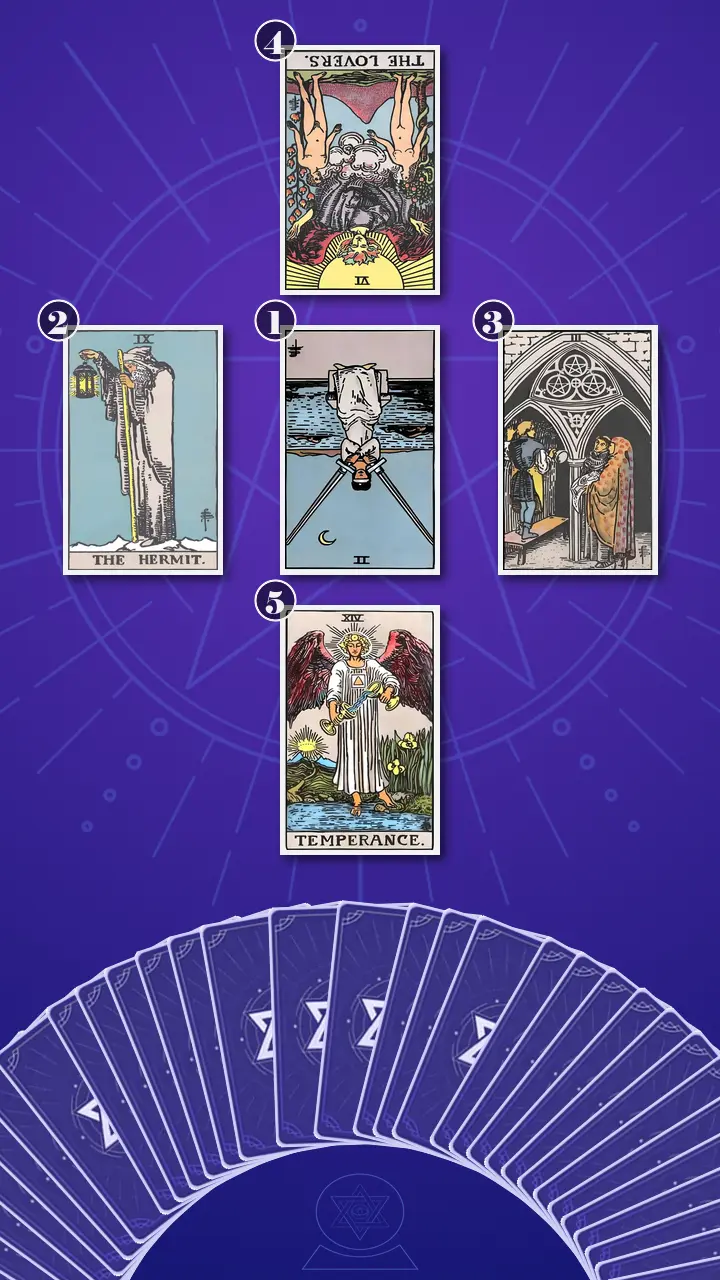
“Today we’ll use something called the Decision Cross—a Decision Cross tarot spread for an online vs in-person enrollment decision,” I explained. “It’s built for clean comparisons under pressure.”
For you reading this: the rationale is simple. When someone is stuck in choice paralysis when enrollment is open, more information rarely helps—because the issue isn’t the data. It’s the internal criteria. The Decision Cross lays out (1) the current knot, (2) Option A dynamics, (3) Option B dynamics, (4) the hidden driver (the fear or value quietly steering everything), and (5) the next step that creates movement this week.
“We’ll read the center first,” I told Jordan, “because that’s the heartbeat of why you can’t click enroll. Then we’ll look left and right—online and in-person—so you can stop romanticizing and start seeing what each option requires. Then we’ll look at what’s influencing you from beneath the surface. And finally, we’ll land on a concrete next step that doesn’t demand perfect certainty.”
Reading the Map: How Tarot Works When You’re Stuck at a Career Crossroads
Position 1: The current decision knot — Two of Swords (reversed)
“Now flipping over is the card that represents the current decision knot: what your mind is doing that keeps you stuck at the enrollment step.”
Two of Swords, reversed.
I didn’t even need to reach for poetic language—this card is basically a screenshot of modern analysis paralysis. The scene it translates to is painfully specific: It’s late, you’re on your couch with the enrollment page open, and you keep toggling between “online could fit my schedule” and “in-person would keep me accountable.” You open Reddit, then LinkedIn, then the tuition page again. You don’t make a move—you just keep your options crossed in front of you so you can’t be wrong.
Reversed, this isn’t calm neutrality. It’s a stalemate that’s started to leak. The energy is blocked and overloaded—too much Air, too many arguments, not enough grounding.
“This card is self-protection,” I said. “Not choosing is the way your nervous system avoids regret. But the cost is that the pressure rises behind you anyway. Like… you stay ‘neutral’ while the deadline tide comes in.”
Jordan gave a short laugh—sharp, almost bitter—and then exhaled like she’d been caught on camera. “That’s… so accurate it’s kind of mean,” she said, but she wasn’t offended. She sounded relieved to have the pattern named.
I kept my voice steady. “No judgment. This is an incredibly common loop: the enrollment countdown triggers the fear, and the fear triggers the tabs. It feels like responsibility. But it’s actually postponing the one thing that creates real clarity.”
Then I asked the question this position always demands: “What’s the exact moment you stall—hovering over ‘Submit,’ seeing the deposit amount, picturing the commute—and what’s the sentence your brain uses to justify opening one more tab?”
She didn’t answer right away. Her eyes flicked up and left, like she was replaying a clip. “It’s… ‘If I pick wrong, I’ll have to live with it.’”
I nodded. “Good. That sentence is the knot.”
Position 2: Online learning path — The Hermit (upright)
“Now flipping over is the card that represents the online learning path: what it supports in you and what it requires from you.”
The Hermit, upright.
In real life, this card looks like: headphones on, a single module open, your phone in another room. No commute. No performative hustle. Just quiet competence building—one page, one video, one assignment at a time.
The Hermit’s energy is balanced in its focus, but it can become deficient in accountability if you don’t design for it. Online works best when you have what I call a “lantern”—a small, repeatable routine that lights the next step without requiring a whole personality overhaul.
“Online isn’t ‘easier,’” I told Jordan. “It’s quieter. It’s efficient. It’s flexible. But it requires you to be your own accountability system.”
Her head nodded—yes, that’s me—then she paused, the nod slowing, like the second half of the truth was landing. She stared past the screen toward her kitchen, where the silence can feel supportive… until it feels like hiding.
“Be honest,” I said, letting a slightly wry tone soften the intensity. “When you picture ‘online,’ what’s the first thing you’re scared you’ll do—ghost the program, or get lonely?”
“Ghost,” she said immediately. Then she winced at her own honesty.
“That’s not a character flaw,” I said. “That’s a systems design problem. We can design for that.”
Position 3: In-person learning path — Three of Pentacles (upright)
“Now flipping over is the card that represents the in-person learning path: what it supports in you and what it requires from you.”
Three of Pentacles, upright.
This is the opposite of the tab spiral. The modern translation is: walking into a room where expectations are real—a facilitator, a cohort, a deadline. You ask one question and get an immediate answer. You leave with a specific assignment and a clearer sense of ‘I can do this’—not because it’s easier, but because your progress is witnessed and shaped.
The energy here is Earth as stabilizer. Less theory. More craft. It’s the difference between reading fifty gym reviews and actually showing up to a class where someone learns your name.
I watched Jordan’s shoulders drop a fraction. Not “everything is solved,” but “okay, that’s practical.”
“In-person gives you scaffolding,” I said. “And I want to be really clear: accountability isn’t a cage—it’s scaffolding. It holds you up while you build the skill.”
Then I gave her a simple before/after contrast, because this card thrives on proof: “Before is: tabs and theories. After is: one campus tour, one Q&A, one real conversation, and you walk away with an actual next step.”
She swallowed, like she was imagining herself in that room. “I do feel… more motivated when I picture being seen,” she admitted. “Which is annoying, because I wish I could just be disciplined.”
“Wanting support isn’t annoying,” I said. “It’s information.”
Position 4: Blind spot and deeper driver — The Lovers (reversed)
“Now flipping over is the card that represents the blind spot and deeper driver: the value or fear quietly steering the choice.”
The Lovers, reversed.
When this card is upright, it’s values and alignment. Reversed, it’s misalignment—borrowed criteria, optics pressure, choosing for an imagined audience.
The modern translation is blunt: You’re not only choosing a format—you’re choosing what looks legitimate. Part of you imagines the LinkedIn post, the resume line, the vibe of being ‘serious.’ Then you second-guess: would online make you look less committed? Would in-person prove something? The more you think about optics, the less you can hear what your actual week can sustain.
Jordan’s face did the tiny flinch people do when something hits a nerve. Her eyebrows lifted, then pinched together. She looked down at her hands like she’d suddenly noticed how tightly she’d been gripping her phone.
“Oof,” she said quietly. “Yeah.”
I didn’t rush past it. “This is the part that makes the Two of Swords reversed so sticky,” I told her. “Because if the criteria are partially borrowed—if the question is ‘Which choice makes me look serious?’—your brain will keep arguing forever. You’ll never win. There’s no final proof.”
Then I asked the question that usually unlocks the room: “When you picture telling someone your decision—who are you secretly trying to manage? And what do you want them to believe about you?”
Jordan stared at the enrollment page again, and I could almost see the invisible audience behind it. “I want them to think I’m… on track,” she said. “That I’m not falling behind.”
I nodded. A small, controlled inner flashback flickered through me—my old trading desk, the way a room full of smart people can turn one decision into a referendum on competence. I remembered how exhausting it was to feel watched by an imaginary jury even when no one was speaking.
“The decision gets easier,” I said, “when it stops being a referendum on your self-worth.”
When Temperance Poured Between Two Realities
Position 5: Next step — Temperance (upright)
“Now we’re turning over what I consider the anchor card,” I said, and even through Zoom I felt the shift—like the room got quieter. “This represents your next step: a concrete way to move forward this week without needing perfect certainty.”
Temperance, upright.
Here’s the modern translation: Your next step isn’t a perfect decision—it’s a workable blend. You choose one format today, then immediately build a realistic rhythm around it: two short study blocks, one buffer for commute/life admin if needed, and one recovery window so you don’t burn out. The decision becomes something you can live with, adjust, and succeed inside.
Setup: You know that moment: laptop open on the enrollment page, five tabs of reviews, jaw clenched—then you refresh again, like one more opinion will finally make the choice feel safe. That’s the loop we’re breaking, not with a grand identity statement, but with a week you can actually live inside.
Stop trying to pick the option that looks best; choose the option you can actually blend into your week, like Temperance pouring two realities into one workable routine.
For a second, Jordan didn’t move. Her breath stopped mid-inhale—like her body wanted to argue, then realized it didn’t have to. Her eyes unfocused, not glazed-over, but distant—the way they get when someone is replaying a memory in fast-forward.
Then the three-step reaction chain rolled through her, clear as day: first the freeze (her shoulders stayed high, her mouth slightly open); then the cognitive seep (her gaze dropped to her calendar tab, as if the truth had been there the whole time); then the release—an exhale that seemed to come from her ribs, not her lungs. Her shoulders lowered. Her hands unclenched. She pressed her fingertips into her own palm like she was checking she still had a body.
“But if I pick,” she said, and her voice tightened with a flash of anger, “doesn’t that mean I was wrong every other time I didn’t pick? Like I just wasted all this time?”
It was a real reaction—protective, human. I respected it.
“No,” I said. “It means you’ve been trying to buy certainty with research. That’s a rational strategy in a world where mistakes are expensive. But more research won’t give you certainty—only lived evidence will.”
Then I brought in my own toolkit—the one I built after years of watching smart people stall under pressure. “I’m going to use what I call my Potential Mapping System here,” I told her. “It’s basically energy profiling for learning. Most people have two learning archetypes inside them: a Deep Thinker who loves quiet mastery, and a Sprinter who thrives on deadlines and being seen. Your spread is literally showing both.”
“The Hermit is your Deep Thinker,” I said. “The Three of Pentacles is your Sprinter. Temperance isn’t asking you to kill one and crown the other. It’s asking you to blend them into a sustainable weekly rhythm.”
I gave her the practical exercise—calendar-level, not vibes-level. “Set a 10-minute timer,” I said, “and design a Two-Cups Week in your calendar: (1) one fixed learning block you can protect (even 30 minutes), and (2) one recovery buffer (walk, dinner, nothing). If you feel your chest tighten or you start bargaining—‘I’ll do it when it’s perfect’—pause. Your only job is to make it doable, not impressive.”
Then I asked her, right on cue: “Now, with this new lens—can you think of a moment last week where this would’ve changed how you felt?”
Jordan blinked hard, like tears were almost present but not quite. “Sunday,” she said. “I was doing Google Calendar Tetris. I tried to shove a three-hour study block into Tuesday and it bumped everything. I panicked and closed the whole thing.”
“Temperance would’ve said,” I replied, “pick the option you can sustain on a Tuesday, not the one you can romanticize on a Sunday. That’s how you rebuild trust.”
And I named the shift explicitly, because naming it makes it real: “This isn’t just about choosing online vs in-person. This is you moving from enrollment-deadline anxiety and comparison-fueled indecision to lived-evidence clarity and self-trusting commitment—one week at a time.”
The One-Week Proof Test: Actionable Advice That Ends the “Can’t Click Enroll” Loop
I pulled the whole spread together for her the way I’d summarize a deal memo—except the deal was her own energy.
“Here’s the story the cards tell,” I said. “Right now, Two of Swords reversed shows your mind trying to protect you by refusing to commit—so you keep reopening tabs and outsourcing the decision. The Hermit shows online can absolutely work if you build a lantern routine, but it requires you to design accountability. Three of Pentacles shows in-person gives you support and feedback loops—external structure that reduces the chance you disappear. The Lovers reversed reveals the blind spot: you’ve been trying to choose in a way that manages optics and validation, not in a way that supports your real week. Temperance is the remedy: you’re not choosing a personality type. You’re choosing a weekly rhythm.”
The cognitive blind spot was clear: Jordan was treating the choice like a test of character—disciplined vs irresponsible—instead of a systems question—what container will I actually follow? That’s why every pros/cons list kept collapsing under its own weight.
“Your key shift,” I told her, “is moving from perfect-choice hunting to a bounded experiment: a one-week proof test that creates lived evidence. Not certainty. Evidence.”
Then I offered the smallest next steps I could—because momentum beats intensity almost every time.
“Let’s make this painfully practical,” I said. “I’m also going to borrow from my 5-Minute Decision Tools—a tri-axis check: Advantage, Risk, Breakthrough. We’re not trying to be poetic. We’re trying to choose a format you can sustain without burning out.”
- Run one “proof action” within 48 hoursAttend one live online info session (camera off is fine) or visit the campus/building for 15 minutes at the time you’d realistically commute. Immediately afterward, write one line: “My attention felt ___ / My body felt ___.”Your brain will call this “not enough” and ask for more research. Keep the boundary: the goal is evidence, not certainty. If anxiety spikes, do the 5-minute version.
- Build the Two-Cups Week (structure + recovery)Pick one format today—even provisionally—and put one repeating block in Google Calendar for the next 7 days (e.g., Tue/Thu 7:30–8:15 p.m.). Add one recovery buffer in the same week (walk, dinner, nothing).Make it boring on purpose. If you miss a day, the rule is to restart with 15 minutes the next day—not redesign your life.
- Write a two-sentence values filter (and actually use it)On a sticky note or phone note: “This program choice supports me because ____.” “It does not require me to ____.” Then choose one non-negotiable (e.g., “I won’t schedule learning on my longest workday”) and eliminate any option that violates it.If you catch yourself drafting how it will look on LinkedIn, pause and read the filter out loud once. That’s you coming back from optics to alignment.
I watched her take a breath that looked like it reached her stomach for the first time all call.
“Okay,” she said, voice quieter. “That’s… doable. It’s not a forever choice. It’s a week.”
“Exactly,” I said. “We calibrate weekly. You don’t need a perfect plan—you need a plan that survives a messy Tuesday.”

A Week Later: The Quiet Proof
Six days later, Jordan texted me a screenshot of her calendar. Two small blocks, nothing dramatic. Under it she wrote: “I went to the campus lobby at 6:30 like I’d commute. I didn’t hate it. And I attended the online Q&A too. The weird part is… after doing both, the decision felt less like a test.”
She did choose—without fireworks. The bittersweet part, she admitted, was that after she clicked submit, she just sat alone at a coffee shop for a while, not celebrating, just letting her nervous system catch up to the fact that nothing exploded.
That’s the kind of clarity I trust: not the adrenaline kind, but the steady kind. The kind you build when you stop demanding certainty and start gathering lived evidence—then you commit to a sustainable rhythm that makes learning inevitable.
When enrollment is open, it’s not just a form—you can feel your shoulders lock up because choosing a format starts to sound like a test of whether you can trust yourself.
If you didn’t need to prove anything to LinkedIn, what’s one tiny “lived evidence” step you’d be willing to try this week—just to see what your real life actually supports?