From Tab-Switch Overwhelm to Grounded Focus: Choosing One Step

Finding Clarity in the 9:38 p.m. Sunday Kitchen
If you’ve ever had your design canvas, your calendar, and your bank app open at the same time—and somehow felt less in control with every tab switch—you know the specific flavor of tab-switch paralysis.
That’s the exact look I saw on Alex (name changed for privacy) when our video call connected: the slightly too-bright laptop glow on their face, the tight half-smile that says I’m fine while their body clearly isn’t buying it.
It was 9:38 p.m. on a Sunday in their Toronto apartment kitchen. The overhead light had that faint electrical hum you stop noticing until you’re already tired. Their laptop was open to a blank Figma frame—the canvas. Google Calendar was in week view, blocks stacked like Tetris pieces that never clear. Their phone sat face-up, warm from refreshing the bank app. They took a sip of iced coffee that had gone flat hours ago, and I watched their jaw clench like it was trying to hold the whole week in place.
“I have three urgent things open,” they said, eyes flicking between screens, “and somehow I’m doing none of them.”
They weren’t asking for a grand life overhaul. They were asking for one thing: one clear next step past overload. But under that was the fear that choosing one priority meant dropping something important—missing a meeting, messing up money, falling behind at work—and losing control.
The overwhelm wasn’t abstract. It sat on them like a too-heavy backpack you can’t take off on the subway: shoulders creeping up, jaw locked, hands restless on the trackpad even while they tried to sit still.
I kept my voice gentle and plain. “You’re not lazy,” I told them. “You’re stuck in a loop where checking feels safer than choosing. Let’s not try to solve your whole life tonight. Let’s make a map—something that gets you from ‘everything is open’ to ‘one thing is done.’ That’s what finding clarity looks like in real life.”

Choosing the Compass: The Energy Diagnostic Map (7)
I asked Alex to take one slow breath—nothing mystical, just a nervous-system handoff from spiraling to noticing. While they breathed, I shuffled. I like the sound of cards in a quiet room: it’s tactile, steady, and it interrupts the algorithm in your head that keeps screaming refresh.
“For this,” I said, “we’ll use the Energy Diagnostic Map (7) · Context Edition.”
And for you reading this: the reason I chose this spread is simple. Alex’s problem wasn’t a clean either/or decision. It was a whole system overload—creative work, time management, and money anxiety feeding each other until there was no obvious next move. This spread is designed to move from what’s loud on the surface, into the central bottleneck, and then down into practical next steps. It’s a tarot spread for overwhelm, analysis paralysis, and decision fatigue—especially the “I can’t start until I’m sure” mindset.
I previewed the map the way I’d preview a gallery layout before hanging work. “The top row will show what’s happening day-to-day: overload, internal juggling, external pressure. The center card is the core blockage—the belief that freezes action. The bottom row is the remedy: one usable resource, the key transformation, and then the most realistic next step for the coming week.”
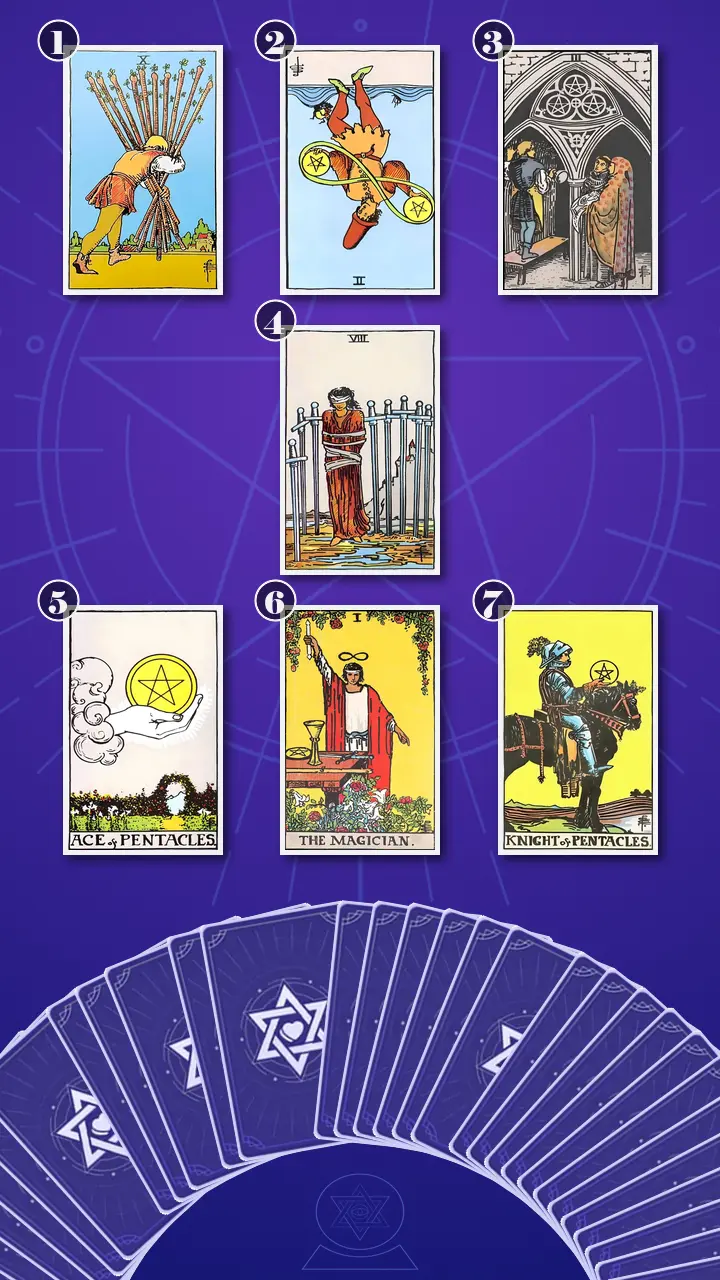
Reading the Dashboards: What’s Actually Happening
Position 1 — Surface overload: what your day-to-day looks like when everything is open at once
“Now I’m turning over the card that represents Surface overload—what your life looks like when everything is open at once.”
Ten of Wands, upright.
In the card, someone staggers forward under a bundle so big it blocks their view. I didn’t have to reach for symbolism; Alex’s screens were already doing it for me.
“This is you at the end of the day,” I said, “carrying meetings you need to prep for, expenses you’re tracking, and a creative deliverable you care about—all at once. You keep all three open because closing any one feels irresponsible. But the more you hold, the less you can see what to do next.”
Energetically, the Ten of Wands is excess: responsibility pushed past its useful limit. Not because you’re weak—because you’re trying to be the kind of person who doesn’t drop things.
Alex let out a short laugh that had a little bitterness in it. “Okay,” they said. “That’s… too accurate. Like, kind of rude.”
I nodded. “It’s not a character judgment. It’s a load problem. And load problems get solved by redistribution, not by shaming yourself into carrying harder.”
Position 2 — Inner tug-of-war: the internal juggling pattern that keeps you switching between tasks and apps
“Now I’m turning over the card that represents your inner tug-of-war—the pattern that pulls you into switching, tweaking, and rebalancing.”
Two of Pentacles, reversed.
“This is the feeling of toggling between your calendar and bank app like you’re keeping two plates spinning,” I said. “Reversed, it’s not flexible juggling. It’s re-juggling the same two things over and over. Reschedule, re-categorize, re-check. Brief relief. Then the wobble returns.”
Energetically, this is a blockage of steadiness. Motion has become reassurance. Your brain is using micro-adjustments like a DJ trying to beat-match anxiety into silence.
I asked, “When you feel pressure, which one do you juggle first—time or money?”
Alex didn’t answer right away. Their fingers went to their mug, then stopped, like they’d forgotten what their hands were doing. “Time,” they said finally. “If the calendar looks bad, I panic. Then I check money because… I don’t know, like I need another dashboard to tell me I’m not failing.”
“That makes sense,” I said. “But it’s also the loop.”
Position 3 — External pressure: where timelines, expectations, and professional standards amplify the stress response
“Now I’m turning over the card for External pressure—the context that turns the volume up.”
Three of Pentacles, upright.
In this card, work is happening in a place that feels like a cathedral: craft under observation, plans held up for review. “You’re not overwhelmed in a vacuum,” I told Alex. “Your work lives inside other people’s standards, calendars, and feedback. You’re in a role where what you do gets discussed, scheduled, and evaluated.”
Energetically, this is balance with a sharp edge: structure can support you, but it can also make everything feel like performance. It explains why you hover in planning mode—Slack status, meetings, check-ins—because it feels safer than producing a draft that can be seen and judged.
Alex swallowed. “Yeah. If I’m ‘available,’ I feel reliable. If I’m heads-down, I feel like someone’s going to think I’m slacking.”
“That’s real,” I said. “And it’s also why we’ll need boundaries that don’t require you to be fearless—just intentional.”
Position 4 — Core blockage: the belief or mental rule that freezes action and creates “no next step”
“Now I’m turning over the card at the center—the core blockage. This is the bottleneck that makes it feel like there is no next step.”
Eight of Swords, upright.
I slowed down here, because this card doesn’t hit like a headline. It hits like recognition.
“Here’s the rule,” I said quietly. “You feel like you can’t start until you have total certainty. So you keep checking the calendar and bank app as if they’ll finally grant permission. The trap is the rule: ‘I’m not allowed to choose until I’ve accounted for every risk.’”
I painted it in their city, in their body, the way it actually happens: Toronto at night, the kitchen dim except for three rectangles of light—Figma, Calendar, bank app. Jaw tight. Thumb hovering over the app switcher. The inner monologue goes: If I just check the bank one more time, I’ll feel safe enough to start. Then: If I just adjust tomorrow, I’ll feel safe enough to start. But starting is the only thing that actually changes the feeling.
Energetically, the Eight of Swords is deficiency of agency disguised as caution. The bindings are loose, but your nervous system treats them like steel.
Alex’s reaction came in a chain: first their breathing paused, like a small freeze. Then their eyes unfocused for a second, like they were replaying a specific moment from Tuesday morning on TTC Line 1—calendar in one hand, bank app in the other, scanning but not acting. And then the exhale: a long, tired sigh that softened their shoulders by a millimeter. “Yeah,” they said. “Checking isn’t the same as moving.”
“Exactly,” I said. “So let’s find the lever.”
When The Magician Took Back the Desktop
Position 5 — Usable resource: the simplest practical lever you can pull right now to reduce load
“Now I’m turning over the card that represents your usable resource—the simplest lever you can pull without fixing your whole life.”
Ace of Pentacles, upright.
“This is the antidote to monitoring mode,” I said. “Not a better plan—a touchable proof. One email draft. One expense to categorize. One 20-minute design stub. One specific bill paid. Something you can send, save, pay, or submit.”
Energetically, the Ace of Pentacles is balance in Earth energy: practical, measurable, finishable. “Your nervous system needs a receipt,” I told them. “One small ‘done.’ That’s how you start building calm that isn’t dependent on refreshing a dashboard.”
Alex nodded, and for the first time their face looked less hunted. “Okay,” they said. “That… feels doable. Like I could finish something small without reorganizing the universe first.”
Position 6 — Key transformation: the mindset/skill that turns planning into action without needing certainty first
“We’re flipping the key card now,” I said, and the room on my end went strangely quiet—no sirens outside my New York window, no radiator click, like the city itself paused to listen.
The Magician, upright.
“This is your turning point,” I said. “You already have the tools. Overload just scatters your attention across them. The Magician is agency: one tool, one outcome. Your desktop becomes the Magician’s table. When everything is open, nothing is chosen.”
Then I reached for one of my own mental tools—the one I use when a problem needs to be made simple enough to move. “Can we do a quick Einstein-style thought experiment?” I asked. “Not to be cute—just to see the mechanics.”
Alex blinked. “Sure?”
“Imagine a rule existed—like gravity,” I said. “For the next ten minutes, you’re only allowed to have one tool open. Not because the other two don’t matter, but because the body can’t steer three dashboards at once. Which tool would you pick if the goal was not ‘perfect,’ but ‘proof’?”
Setup. I could see them land back in that kitchen-table moment: Figma blank, calendar yelling, bank app one swipe away. The familiar panic logic was already revving—If I pick wrong, I’ll regret it all day—and the old hope that one more refresh would provide certainty.
Delivery.
Stop treating every open app as an emergency and start using your tools like The Magician: one wand raised, one decision made, one action grounded.
I let the sentence hang there for a beat.
Reinforcement. Alex’s reaction wasn’t instant relief. It was layered. First: a tiny flinch in their cheek, like the idea had touched a bruise. Then their eyebrows pulled together and they went still—breath caught, fingers hovering above the keyboard as if the app switcher might lunge at them. Then the resistance: “But if I stop checking,” they said, voice sharper than before, “doesn’t that mean I’m just… ignoring reality?”
I kept my tone steady. “No,” I said. “It means you’re sequencing reality. Sequence beats simultaneity. The Magician isn’t careless. They’re deliberate.”
Something shifted. Their shoulders dropped, not dramatically—more like a jaw unclenching you didn’t realize you were holding. Their eyes got wet in that annoyingly human way that isn’t exactly tears, just pressure releasing. “I hate how much I needed permission to do one thing,” they whispered.
“You’re allowed,” I said. “And you don’t have to believe it forever. Just notice: your body responds to choice.”
Then I invited them into the moment that makes the insight real: “With this new lens—one tool, one decision—think back to last week. Was there a moment when you toggled between apps, and this would’ve changed the feeling?”
Alex stared past the camera. “Thursday,” they said. “I had a draft I could’ve exported, but I kept adjusting meetings like it was a moral test. I could’ve just sent the rough version.”
And right there, in the middle of their messy kitchen Sunday, you could see the transformation starting: from tab-switch paralysis and overwhelm-driven monitoring to grounded focus and practical self-trust built through one finishable completion.
Position 7 — Next step: the most realistic, grounded action style for the coming week that prevents relapse into tab-switching
“Now I’m turning over the card for your next step—how to proceed in a way that prevents the relapse into constant toggling.”
Knight of Pentacles, upright.
“This is the boring hero,” I said, and Alex gave a small smile. “The Knight of Pentacles is slow, steady execution. Minimal switching. Clear boundaries. Completion over optimization.”
Energetically, this is balance with Earth: not intensity, but consistency. Like a Beethoven symphony, it’s not all cymbals and climax. It’s movements. You don’t play every instrument at once and call it music. You choose a line, repeat it, let it build.
Alex nodded, then frowned. “I get it. But… I can’t do a 60-minute block. My calendar is chaos. And Slack—if I disappear for an hour, it’s a thing.”
There it was: the real-world obstacle, the one that makes advice either useful or useless.
“Perfect,” I said. “Then we don’t do 60. We do the Knight’s version of reality: a smaller container you can actually keep. If your work requires responsiveness, we build a block that’s short enough to be safe and still long enough to create a ‘done.’”
The One-Tool Plan: Actionable Advice for Overwhelm and Decision Fatigue
When I zoomed out, the story the cards told was painfully coherent. The Ten of Wands showed Alex carrying too much while their vision was blocked—like a screen full of pinned tabs and half-finished drafts. The Two of Pentacles reversed revealed the coping strategy: keep juggling time and money so stillness never has to happen. The Three of Pentacles explained why it spikes—work under observation, standards, timelines, visibility. And the Eight of Swords named the bottleneck: the certainty rule that says you can’t move until you can see every risk.
Then the remedy arrived in Earth: the Ace of Pentacles offering one tangible completion, The Magician restoring agency through sequencing, and the Knight of Pentacles turning that agency into a repeatable rhythm.
The cognitive blind spot was subtle but brutal: Alex had been treating monitoring like the same thing as moving. Planning, checking, and optimizing were masquerading as progress because they reduced anxiety for a minute. But they didn’t produce proof—and without proof, the fear got louder.
So the transformation direction was clear: shift from “I have to hold all priorities at once” to “I choose one next physical step that reduces load, then reassess.”
I gave Alex a short set of next steps—small enough to start tonight, structured enough to hold their attention. If you’re wondering how to stop tab switching and actually finish one task, this is the spine of it:
- Pick a One-Coin Task (20–30 minutes)Choose one finishable deliverable you can complete in one sitting: export one rough draft for review, pay one specific bill, submit one expense report, or draft one Slack/email message to 80% and hit save/send.If resistance says “too small to matter,” lower the bar on purpose. The point is a nervous-system receipt: one small ‘done.’
- Write a 30-Second Sequence Decision (First / Then / Later)On a sticky note, write: “First = ____ (canvas/calendar/bank). Then = ____. Later = ____.” Put it where you can see it while you work.Try my “Manuscript Mindmaps” trick: write the sequence once normally, then rewrite it once in mirror writing. It forces your brain to slow down and makes the sequence feel like a chosen plan, not a panicked impulse.
- Run the 10-Minute “One Tool, One Step” ResetPick ONE tool for the next 10 minutes (canvas OR calendar OR bank). Close the other two apps fully. Write one sentence: “In 10 minutes, ‘done’ looks like ____.” Work imperfectly for 8 minutes, then spend 2 minutes saving/sending/marking complete.If you feel your chest tighten and want to reopen tabs, pause and say out loud: “Not now—after the timer.” If it spikes anxiety, stop early. The win is practicing choice.
- Build a No-Switch Work Block (15–45 minutes)Set a timer. Close two apps completely. If you suddenly “need” information from calendar or bank, write it on paper and keep going. Check it only when the timer ends.Make it boring on purpose. If Slack is the issue, set a status like “Heads down until 11:00” and do the 25-minute version. Consistency beats intensity.
Before we ended, I offered one optional support that fits Alex’s vibe: “If you want a sensory container,” I said, “put on Mozart K.448 quietly during the block. Not because it’s magic—because it signals to your brain: this is the same ritual every time.”
Alex laughed, softer this time. “Okay, that’s… very on-brand for you.”
“Guilty,” I said. “But it works because it’s structural. Tonight isn’t about becoming a new person. It’s about giving your nervous system one undeniable piece of evidence that you can move without perfect certainty.”

A Week Later: Proof, Not Panic
Six days later, Alex messaged me a screenshot: a sticky note that said First = Canvas. Then = Calendar. Later = Bank. Next to it was one checked box and a timestamp.
“Did the 10-minute reset,” their text said. “Exported a rough wireframe. Sent it. Didn’t die. Also… I slept.”
They added a second message a minute later: “Woke up and still had the thought, ‘What if that was the wrong priority?’ But this time I just… smiled and started the next 10 minutes.”
That’s the quiet proof I care about. Not perfection. Not a permanently empty calendar. Just a shift from panic-checking to grounded choosing—one finishable step at a time.
When everything is open at once, it can feel like choosing one thing means betraying the rest—so you keep checking and re-checking, carrying the whole week in your shoulders, hoping certainty will finally give you permission to start.
If you didn’t need the perfect plan first, what’s the one small, finishable step you’d be willing to complete today—just to give your brain some proof that you’re safe to move?