From Tab-Switching Panic to a Workable Midterm Week: One Lane First

The 9:12 p.m. Desk That Wouldn’t Sit Still
If you're a Toronto undergrad staring at lecture slides at 9:12 p.m. with Canvas open, a group chat pinging, and Sunday Scaries already sitting in your chest before the week even starts, this is probably your nervous system.
It was 8:46 p.m. on a Tuesday in the third-floor library at U of T when Jordan (name changed for privacy) slid into the chair across from me with a tote bag digging into one shoulder. Their laptop was open to lecture slides, a sleep app sat in another tab, and their phone kept warming up in the palm of their hand every time it buzzed. The fluorescent lights hummed overhead. The air smelled like stale coffee and printer paper. Jordan's shoulders were up near their ears, and every time they tried to study, the night split into fragments.
'I just need to get through this week,' they said. 'But if I focus on midterms, I feel like I'm wrecking sleep. If I protect sleep, I panic about school. And if I answer friends, I fall behind on everything.'
What they described had the exact shape of a finals-week tote bag: laptop, charger, leftovers, and guilt all doing emotional labor at once. It felt like trying to hold three spinning plates with one tired hand.
I looked at the way they were holding their jaw and said, gently, 'We are not going to solve your whole life tonight. We are going to find the first lane that needs protecting, and then let the rest of the week stop acting like a single emergency.'

Choosing the Celtic Cross for a Week That Keeps Wobbling
Before I touched the cards, I asked Jordan to take one slow breath, put the phone face down, and let the room get a little quieter. Then I shuffled slowly, not as a ritual for drama, but as a way to give their nervous system one clean minute to stop tab-switching.
For a problem like this, I reached for the Celtic Cross tarot spread. I chose it because this is not a simple yes-or-no question; it is a layered midterm overload pattern where current strain, hidden recovery deficit, internal pace, outside noise, and the next workable adjustment all matter at once. A shorter spread would miss the fact that the wobble is not only about time management. It is also about energy, rest, and the fear that one boundary will make the whole week fall apart.
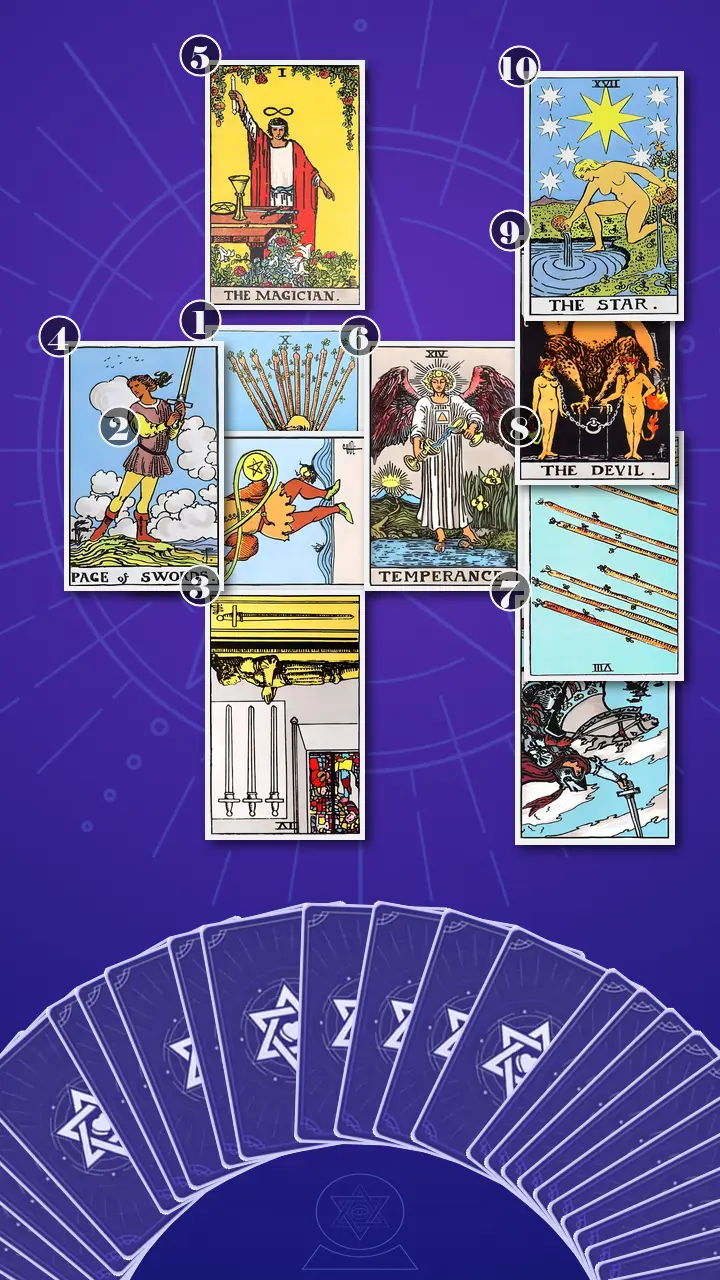
In this spread, the first card names the visible load, the second shows the crossing wobble, the third reveals the hidden foundation, and the sixth card shows the next workable opening. Then the vertical staff on the right lets me see how Jordan is moving from their own pace into the pressure around them and finally toward the outcome. It is a map built for clarity, not a verdict.
The Weight Already in the Backpack
Position 1 — What is already heavy
Now I turned over the card for the visible overload: Ten of Wands, upright. This is the part of the week that already feels too heavy before anything else gets added.
In real life, this card looks like walking out of the library with your tote cutting into one shoulder, a cold coffee in hand, and three deadlines already living rent-free in your head. The modern scenario is not 'too much work' in the abstract. It is the feeling that school, sleep, and social life have been stacked into one overloaded pile, and your body is the one carrying it.
Energetically, this is excess. Not because Jordan is doing something wrong, but because the load has grown past what one nervous system can keep carrying without strain. I told them that when simple tasks start to feel unusually heavy, the question is not 'Why am I weak?' The question is 'What have I been carrying out of habit rather than necessity?'
Jordan gave a short, bitter laugh and looked away from the table. 'Okay,' they said. 'That's annoying because it's true.'
That tiny reaction told me the card had landed. Their shoulders stayed tight, but the laugh cracked the surface just enough for me to keep going.
Position 2 — The wobble in the juggling act
On the crossing position, I pulled Two of Pentacles reversed. This is the unstable juggling act between school, sleep, and social time. It shows where the balancing act is costing more energy than it saves.
The modern life picture is painfully familiar: dragging classes, sleep, and a social plan around in Google Calendar like they can all stay stable if you just shuffle harder. But the card says the problem is not effort. It is over-switching. Every time Jordan moved from Canvas to a sleep app to a group chat, they were spending energy on the switch itself, and the schedule never got the chance to settle.
In energy terms, this is blockage and instability. The juggling is real, but the rhythm is broken. I told them, 'You are not failing to juggle because you don't care enough. You are losing traction because nothing gets long enough to land.'
Jordan's eyes flicked to their phone, then back to the cards, then down to the table. They did not argue. They just breathed out through their nose like someone recognizing the sound a stuck wheel makes.
Position 3 — The rest that never fully lands
Underneath the whole spread, I flipped Four of Swords reversed. This is the recovery deficit underneath the overload, the hidden root sitting under all the visible scrambling.
The modern scenario is brutal in its ordinariness: studying in bed with the phone face-up on the pillow, telling yourself 'I'll sleep after this,' and then realizing that 'after this' keeps sliding past midnight. The body lies down, but the nervous system never powers down. The laptop fan closes, but the mind stays open. That is not rest; that is collapse with a charger still attached.
I watched Jordan's breathing change as I said it. First, a small freeze in the chest. Then their eyes lost focus for a second, like they were replaying every night they had called half-rest 'good enough.' Finally, their shoulders dropped a fraction, and they let out a low, embarrassed sound that was halfway between a sigh and a wince.
'That is the part nobody sees,' they said quietly.
Exactly. This card is deficiency: not of willpower, but of restoration. And without real recovery, every other part of the system has to compensate.
Position 4 — The mind on alert
In the recent past, I turned over Page of Swords upright. This card showed the habit of staying alert to every deadline, every message, and every class update as if vigilance itself could prevent panic.
The modern translation is simple: refreshing the course page, rereading the same slide deck, keeping an eye on the group chat because staying informed feels safer than starting. It can look responsible from the outside, and sometimes it is useful. But here it has tipped into constant monitoring rather than settled attention.
The energy is active, bright, and a little too sharp. It is not the calm focus of study; it is scanning. I said, 'This is the version of you that keeps one eyebrow raised even when nothing new has happened. It gives you the feeling of control, but it also keeps your body on alert.'
Jordan made a face that said they hated how accurate that was.
Position 5 — The wish to be capable again
Above everything, the crown card was The Magician upright. This is Jordan's conscious wish to feel capable, organized, and back in control.
The modern scene here is a perfectly built Notion dashboard, colour-coded Google Calendar blocks, and that little surge of 'I can do this' that appears when a plan looks clean from the outside. I told them the shadow side is that competence can quietly turn into pressure to perform competence at all times. The Magician can become the part of the self that believes if the system is flawless, the fear will disappear.
My inner flash of association went immediately to a score sheet from a Beethoven symphony: every instrument has its entrance, but none of them are meant to play the whole piece at once. That is how I knew the issue here was not lack of intelligence. It was overload trying to masquerade as mastery.
Jordan nodded once, slowly. 'I keep trying to make the plan look like proof,' they said, and I could hear how tired they were of that standard.
Position 6 — The next workable opening
Then we reached the card that changes the temperature of the whole spread: Temperance upright. This is the next workable adjustment and the bridge out of the scramble.
When I saw it, I let the room go quiet for a beat, because this is where the reading stops being about damage and starts becoming about design. The modern scenario is not glamorous. It is a real bedtime. It is one concrete study block. It is one chosen social check-in rather than a night where everything is improvised and then regretted. It is the week breathing again because it is no longer being asked to equalize everything at once.
Sequence, don't equalize: protect one lane first and let the week reorganize around it.
And then I used my Symphonic Revision lens, because Temperance always feels to me like the place where a week becomes a score instead of a sprint. A Beethoven symphony works because each movement has its own shape, its own tempo, its own rests. If every instrument tries to be the finale, the music turns into noise. That was the insight I wanted Jordan to hear: their week did not need more volume. It needed movement, pacing, and rests written on purpose.
Jordan went still. First came the physiological freeze: their fingers stopped tapping the edge of the chair. Then the cognitive shift: their eyes moved from the card to the table, as if they were seeing the last two weeks replay in a different frame. Then the release: a long exhale that seemed to come from somewhere below the ribs, followed by shoulders that dropped in a way I could actually see.
'So I'm not supposed to make every part of the week win equally,' they said, almost suspiciously.
'No,' I said. 'You are supposed to stop asking every lane to be equally loud.'
You do not need to prove discipline by running yourself dry; you need to blend your time and energy more deliberately, like Temperance pouring one cup into another until the mix is livable.
I let that line sit there. When it did, their face changed in layers: a blink, then a small pull at the mouth, then a look that was almost annoyance because the truth arrived so neatly. Their shoulders sank another inch. Their breathing slowed. And underneath the relief, I could see something more vulnerable: the brief, dizzy feeling that comes when a person realizes the old rule they have been living by was never the only rule available.
Then I asked, softly, 'Now, using this new frame, think back to last week. Was there one moment when everything felt different only because you tried to protect one lane first?'
They closed their eyes for a second. 'Yeah,' they said. 'The one night I actually stopped at midnight instead of 'just one more hour.' I felt guilty, but the next morning wasn't a disaster.'
That was the key. Not perfection. Evidence.
Position 7 — The pace Jordan brings from the inside
Next I turned to Knight of Swords reversed. This is how Jordan is approaching the week from the inside: fast, forceful, and mentally driven.
The modern life scene is the late-night sprint where you tell yourself you can still fix it if you just go harder. Tabs open, caffeine nearby, notes half-marked, mind racing so quickly that you start confusing urgency with effectiveness. I told them this card does not say they are lazy. It says their inner tempo is so fast that it starts to sharpen into self-pressure.
In the language of energy, this is excess speed. The horse is charging, but the rider is not really seeing the field. That is why the work gets sloppier, not sharper, when they push at 1 a.m.
Position 8 — The outside noise that keeps breaking the thread
On the environment position, I laid down Eight of Wands reversed. This showed the external tempo of deadlines, messages, and interruptions.
The modern scenario looked like notifications, due dates, and social invites all hitting at once, so that a clean evening turns into fragments of half-finished replies and broken concentration. This is where the room itself becomes part of the problem: not because it is hostile, but because it rewards reactivity.
I could almost hear it in the silence between the radiator clicks. In a way, the environment was shouting while pretending to be ordinary.
'So even when I try to focus,' Jordan said, 'the day just keeps splitting.' That was the exact feeling the card named.
Position 9 — The chain that looked like control
Then I turned over The Devil upright in hopes and fears. This card named the fear of being trapped in a grind loop, and the hope that staying locked in will somehow protect everything.
The modern translation is the one that stings: caffeine, comparison, and pressure starting to feel like the same loop. It is the finals-week version of 'sleep is for the weak,' except it is dressed up as responsibility. The fear underneath is not just falling behind. It is what falling behind might seem to prove about competence, worth, and control.
I said, 'This card shows where discipline has quietly turned into self-punishment.' Jordan did not answer right away. They stared at the table, then at their own hands, and I could see the tiny muscle in their jaw working as they swallowed the reaction.
That silence mattered. It meant the card had found the chain, not just the habit.
Position 10 — The softer landing
At the outcome position, I placed The Star upright. After all the heat, this card felt like the room reopening a window.
The modern scene is a quiet reset: one good night's sleep, a clear plan, and one small check-in with a friend that does not leave you wrung out. It does not promise a perfect week. It promises a livable one. Cleaner attention. Softer self-talk. A steadier relationship with energy and expectations.
In the language of the spread, this is a return of water after too much fire and air. Not a dramatic rescue. A humane rhythm.
Jordan looked at it for a long time, then let out the kind of breath people make when they realize they were braced for an ending and got offered a recalibration instead.
From Pressure to a Protected Lane
When I stitched the cards together, the story was clear. Jordan's week was not collapsing because they lacked discipline. It was wobbling because they were carrying too much, switching too often, and borrowing from sleep to keep the illusion of control alive. Page of Swords and The Magician explained the urge to stay alert and stay perfect. Knight of Swords and Eight of Wands showed how fast pace met a noisy environment and turned everything into fragments. Four of Swords reversed revealed the hidden choke point: rest that never actually landed.
The transformation direction was just as clear: from frantic multitasking and guilt-driven overextension to measured pacing and steadier self-trust. The blind spot was believing that equal attention to every lane would somehow preserve all of them. In reality, that belief was creating more damage than the choice it was trying to avoid.
Temperance changed the whole reading because it offered sequencing instead of equalizing. Protect sleep first. Narrow the study target. Let social time be chosen instead of stolen. That is not lowering standards; it is building a system that can survive contact with a real week.
Here is the practical version I gave Jordan:
- Protect sleep as the first laneSet one bedtime for tonight, and set one alarm 30 minutes before it. Put the phone across the room before the alarm goes off, and when it rings, stop studying even if the page is unfinished.If stopping feels irresponsible, shrink it to a 10-minute version. The goal is not perfection; it is proving that rest is part of the system, not the reward.
- Narrow the study targetChoose one lecture, one reading, or one problem set to finish tonight. Write the single next action at the top of the page, and keep only the materials for that task open.If the task still feels huge, use my Manuscript Mindmaps trick: write that next step once in mirror writing before you begin. It slows the hand just enough to break the panic loop.
- Mute the noise for one protected blockTurn on Do Not Disturb for one 45-minute study block. Put your phone face down and out of reach, and check messages only after the block ends.If silence feels too sharp, let one person through and mute the rest. Less fragmentation is the win.
When I suggested the 45-minute block, Jordan immediately said, 'But I literally have to answer people, and I keep checking because if I don't, I fall behind socially too.'
I nodded. 'That is exactly why the block matters. You are not disappearing. You are making one window safe enough to do real work in.'
That distinction mattered because it turned the advice from a rule into a boundary.

A Week That Finally Exhaled
Two days later, Jordan sent me a screenshot: one 45-minute block kept, one lecture outline finished, one real stop time honored. Then they wrote, 'I still felt weird stopping, but my brain wasn't exploding at 1 a.m. like usual.'
That was enough for me. Not because everything was solved, but because the first proof had arrived: a small, real shift from survival math to livable rhythm. They had not become a different person. They had simply stopped asking every lane to carry the same weight at the same time.
If tonight, your own week feels like lecture slides, a sleep app, and a buzzing group chat all fighting for the same breath, remember what Temperance showed Jordan: sequence, don't equalize. One lane gets protected first, and the rest of the week can begin to reorganize around it.
When midterms, sleep, and your social life all start pulling in different directions, it can feel like your chest stays braced even after the laptop closes, as if one imperfect choice might quietly prove you can't handle your own life. If one lane got to stay protected first this week, which lane would feel like the most honest place to start?