When Grades Feel Like a Verdict—And How to Turn Mistakes Into Data

The 2:06 a.m. Portal Refresh
I’ve learned that test anxiety rarely announces itself as “anxiety.” It shows up as a very specific behavior: the quiet, compulsive click you can’t quite stop.
Jordan—23, a university student in Toronto—said, “I keep refreshing the learning portal ‘just to check,’ and my chest tightens like the number is about who I am, not what happened.”
She told me this while sitting cross-legged on her desk chair, laptop open but untouched, like it was both a tool and a threat. She’d promised herself she’d sleep. Instead, she’d done the thing so many students do when a single low quiz score lands like a verdict: she’d chased control.
“It’s 2:06 a.m.,” she said, describing the scene like it was still happening. “My room is dark except for my phone. Blue light. I refresh. I already know the score is there. My stomach drops anyway. Then I open my laptop to ‘fix it’—but I just rewrite notes. I don’t do a single practice question.”
I watched her fingers as she talked—jittery on the trackpad, tapping the same spot like her body was trying to shake off electricity. Her shoulders crept higher with every sentence, like the weight of that one number was physically pulling her upward into tension.
What she wanted was competence, control, proof that she belonged in her program. What she feared was that one imperfect score meant she’d never belong at all.
The feeling in the room wasn’t just stress. It was the sensation of trying to read your future in a glitchy notification—like your whole life was a GPA calculation that could refresh itself into disaster.
“I know I studied,” she said, voice flat with frustration. “So why did my brain go completely empty?”
I nodded, not as reassurance, but as recognition. “Let’s not treat this like a moral failing,” I told her. “Let’s treat it like a system that’s giving us a signal. We’re going to build you a map—something practical, something you can use the next time the portal refresh tries to write your story for you. We’re here for clarity.”
Choosing the Compass: The Celtic Cross · Context Edition
I asked Jordan to take one slow breath—not as a mystical ritual, just as a hard reset for her nervous system. Then I shuffled while she held the question in mind: Low quiz score—how is my past feeding test anxiety, and what’s next?
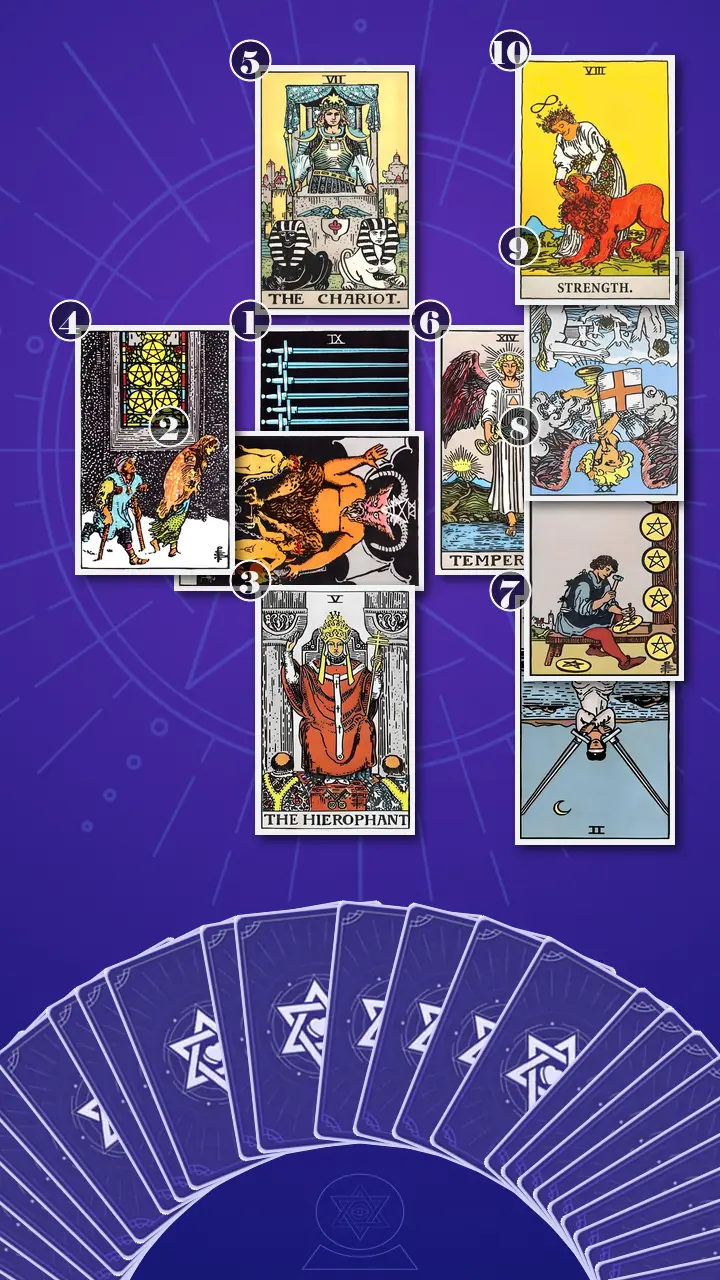
“Today I’m using a spread called the Celtic Cross · Context Edition,” I said, partly to her, partly to the invisible third person in the room: the reader who wants to know how tarot works when life gets real.
The reason I like this spread for academic pressure is simple. A low score isn’t just a present-moment problem—it’s a chain: what got triggered, what belief snapped on, what coping habit took over, what the environment reinforces, and what next step actually breaks the loop. The Celtic Cross is built for that cause-and-effect storyline.
And because I’m ethical about agency, I read the final position not as a fixed fate, but as integration: the most empowering direction if you keep engaging the pattern honestly. Especially for test anxiety, “outcomes” aren’t destiny—they’re training effects.
I pointed to the structure we’d follow. “The first card shows what’s happening right now in your body and behavior. The crossing card shows the main force intensifying it. Then we’ll go to the root—what got learned—and the past residue that still stings. And at the end, we’ll land on the most usable next step.”
Jordan swallowed and nodded, like hearing “usable” mattered more than hearing “insight.”
Reading the Map: Card Meanings in Context
Position 1 — Presenting symptom in real life: what the low quiz score triggered right now
“Now flipped,” I said, “is the card representing the presenting symptom in real life—what this low quiz score triggered in your thoughts, body, and study behavior right now.”
Nine of Swords, upright.
I didn’t have to dramatize it. The image does it on its own: someone sitting up in bed, head in hands, a dark room, nine swords lined up like intrusive thoughts.
“This is the 2:07 a.m. moment,” I said. “Laptop glow. Portal refresh. Group chat pings in the background. Your brain turns one quiz into a full-length documentary called ‘Everything That’s Wrong With Me.’”
And I used the translation that actually fits modern student life: “It’s like your brain has 37 tabs open. The knowledge is in there, but the system is overloaded. So you end up doing what feels safe—rewriting notes, reorganizing headings, perfecting a plan—instead of doing timed practice that would show you what you know under pressure.”
Energy-wise, the Nine of Swords is excess Air: too much cognition, not enough rest. Not “thinking” as intelligence—thinking as self-interrogation.
Jordan let out a short laugh that didn’t reach her eyes. “That’s… honestly kind of cruel,” she said, and then her mouth tightened like she regretted admitting it.
“I hear you,” I said. “But notice what’s cruel here. It’s not you. It’s the loop.”
Position 2 — The main force intensifying test anxiety
“Now flipped,” I said, “is the card representing the main force intensifying your test anxiety—the attachment that turns a score into a bigger threat.”
The Devil, upright.
On Wall Street, we used to talk about risk like it lived in markets. But the longer I worked there, the more I saw it lived in contracts—the ones you sign, and the ones you never realized you agreed to. Looking at The Devil, my mind flashed to a familiar feeling: the fine print you didn’t write, but you obey anyway.
“This card is the self-worth contract,” I said. “The terms and conditions you never meant to sign: ‘I’m only worthy if I perform.’”
I pointed to the loose chains around the figures’ necks. “The trap is real—but it’s also adjustable. The chains are looser than they look. With test anxiety, The Devil shows up as compulsive checking, comparison, bargaining for certainty. It’s you trying to earn safety through a perfect outcome.”
Then I anchored it in her reality, in the way her week was actually unfolding. “This is when you tell yourself you can’t relax until you’ve ‘earned it’ with a better score, so you keep checking the portal like it’s a social feed. You’re not studying for knowledge—you’re studying for a verdict.”
Jordan didn’t answer right away. She did the exact response I see when someone has been named precisely: a quiet wince, then a long exhale, then a small nod like, Yep. That’s the loop.
“I hate that you’re right,” she said softly. “Because it means I’m doing it to myself.”
“Not quite,” I said. “It means the pattern is happening in you, but it didn’t start from you. Let’s go to the root.”
Position 3 — Deep root from the past: learned rule/internalized standard
“Now flipped,” I said, “is the card representing the deep root from the past—the learned rule that feeds the anxiety loop.”
The Hierophant, upright.
“This is the Gatekeeper,” I told her. “The part of you that believes there’s one correct way to learn, one correct way to succeed, and mistakes aren’t just errors—they’re violations.”
I translated the symbolism into modern school conditioning. “Maybe it’s the voice of a teacher you liked. Maybe it’s a rubric you never got to write. But it’s that old, legacy operating system running in the background: ‘Follow the rules perfectly, and you’ll be safe.’”
Jordan’s eyes flicked away from the card, as if eye contact with it felt too intimate. Her throat moved as she swallowed. “I was always the kid who wanted to do it the right way,” she said. “Like… if I didn’t, I’d get found out.”
The Hierophant’s energy is structure, but in excess it becomes rigidity. In the context of test anxiety, it can make practice feel illegal unless you feel ready first.
Position 4 — Past emotional residue: earlier experience of inadequacy/exclusion
“Now flipped,” I said, “is the card representing the past emotional residue—an earlier feeling of not being enough that gets reactivated by evaluation.”
Five of Pentacles, upright.
The image is blunt: two figures in the snow outside a lit window. Warmth exists. Help exists. But the belief is, it’s not for me.
“This doesn’t have to be one huge traumatic story,” I said gently. “Sometimes it’s a hundred tiny moments: being behind in a class, getting a look that made you feel stupid, watching other people ‘get it’ faster. The emotional residue is the same—being outside the warm window.”
Jordan’s fingers curled around her mug. “Office hours,” she said, almost to herself. “I literally stand near the door and then I leave.”
“That’s Five of Pentacles,” I said. “Support available, but your nervous system reads it as proof you don’t belong.”
Position 5 — Conscious aim: what you think you must do next to regain control
“Now flipped,” I said, “is the card representing your conscious aim—what you think you must do next to regain control.”
The Chariot, upright.
“This is the part of you that says, ‘Fine. I’ll lock in. I’ll grind. I’ll push through.’ And honestly—there’s something admirable in that.”
Then I added the part that matters for timed assessments. “But with test anxiety, The Chariot can become white-knuckle control. You grip the wheel so hard your body stays in fight-or-flight. And in that state, recall gets worse, not better.”
Jordan gave a tight smile. “That’s me. I go full military mode.”
“Right,” I said. “And the goal isn’t to become less driven. It’s to become more accurate about what you can steer: process, practice, pacing—not the outcome of every score.”
Position 6 — Near-term shift: the helpful direction in the next couple of weeks
“Now flipped,” I said, “is the card representing the near-term shift—the most likely helpful direction if you keep engaging this honestly.”
Temperance, upright.
Jordan visibly softened at the image, even before she could explain why. Temperance is a different rhythm: water poured between two cups, one foot on land, one in water, a path toward a rising sun.
“This is the recipe card,” I said. “Not an all-nighter. Not a shutdown. A mix.”
I spoke in the practical montage voice students actually need: “Twenty minutes. Five questions. One walk around the block. Cold water bottle. TTC stop announcement in your ears as you breathe slower than you think you need to. Temperance says: mix practice with recovery until your body learns that evaluation isn’t danger.”
Energy-wise, Temperance is balance. It’s what interrupts chaos. It’s also what makes the next card possible—because clarity doesn’t come from more input. It comes from a repeatable rhythm.
Jordan’s shoulders dropped a fraction. “That… feels doable,” she said, sounding surprised that “doable” could exist in the same sentence as “timed practice.”
Position 7 — Self-position: your current inner stance and mental pattern
“Now flipped,” I said, “is the card representing you in the situation—your inner stance and the specific mental pattern keeping you stuck.”
Two of Swords, reversed.
“Planning feels safe,” I said. “Practice feels real.”
The blindfold in this card is self-protection—if I don’t choose, I can’t be proven wrong. Reversed, the protection breaks down into overload: more tabs, more resources, more ‘research,’ less output.
“This is the three-tabs moment,” I told her. “Syllabus, notes, a study method video. You tell yourself you’re being responsible. Twenty minutes later you feel flooded and you close the laptop. And then the guilt buzz starts.”
As an energy dynamic, this is blockage: choice is blocked, so motion is blocked. And without motion, confidence can’t form.
Position 8 — External supports and demands: what your environment offers
“Now flipped,” I said, “is the card representing your environment—supports, resources, and also the demands around you.”
Eight of Pentacles, upright.
“This is apprenticeship,” I said, and I meant it. “Reps. Feedback. Craft.”
I connected it to her actual campus life: office hours, rubrics, study groups, tutorial sessions, past quizzes, the kind of environment that rewards steady practice more than perfection.
“The world around you is set up for skill-building,” I said. “But your nervous system keeps treating it like court.”
Eight of Pentacles is balance in Earth: slow, measurable progress. It’s the antidote to the Nine of Swords because it gives your brain evidence it can trust.
Position 9 — Hope/fear knot: evaluation sensitivity around review and feedback
“Now flipped,” I said, “is the card representing your hopes and fears—how evaluation sensitivity shows up, especially around review and feedback.”
Judgement, reversed.
“Review feels like court, not coaching,” I said, using the mirror language because this card needs to be named plainly.
“This is you hovering over ‘View Results’ and closing the tab,” I continued. “Because looking closely at a mistake feels like self-condemnation. Like you’re about to hear a final verdict.”
Jordan’s eyes went glassy for a second—not tears, just that brief faraway look people get when they recognize a pattern they’ve been living inside for months.
“A missed question is a skill label, not a character verdict,” I said. “Judgement reversed is asking you to separate assessment from identity.”
When Strength Spoke: The Gentle Hand on the Lion
Position 10 — Integration and next step: the most empowering way forward
When I reached for the final card, the room got quieter—not dramatic quiet, just the kind that happens when both of us know we’re at the hinge of the story. This is the card that answers “what’s next?” without pretending life is certain.
“Now flipped,” I said, “is the card representing integration and next step—the most empowering way forward to reduce test anxiety and rebuild self-trust without relying on perfect scores.”
Strength, upright.
Jordan stared at the image: the woman with her hands on the lion, not fighting it, not dominating it—steady, calm, present.
Setup. I leaned in slightly. “If you’ve ever stared at a timer counting down and felt your brain go weirdly blank—even on stuff you literally reviewed an hour ago—you know it’s not always about knowledge. It’s about how your nervous system reads ‘being evaluated.’”
Delivery.
Stop trying to dominate your fear with force, and start calming it with consistency—the lion responds to a gentle hand, not a whip.
I let the sentence sit there. No extra commentary. Just air and time.
Reinforcement. Jordan’s reaction came in a chain—fast, physical, honest.
First, a freeze: her breath snagged like she’d been tapped on the sternum. Her fingers stopped moving entirely on the mug.
Then, the cognition seeped in: her eyes unfocused for a beat, like she was replaying every moment she’d tried to “white-knuckle” herself into confidence—Pomodoro timers as punishment, all-nighters as penance, Notion templates as armor.
Then the emotion landed: her shoulders dropped, not as relief exactly, but as release. The corners of her mouth trembled with a tiny, disbelieving smile. “So… I don’t have to be mean to myself to be responsible,” she said, and her voice cracked on the word “mean.”
“Exactly,” I said. “Strength isn’t soft in the way people dismiss. It’s soft like good leadership is soft—steady enough that panic doesn’t have to drive.”
This was the moment I brought in my own diagnostic lens—the one I built after years of business decisions where emotion was always present, even when people pretended it wasn’t.
“I want to use a tool I call my Potential Mapping System,” I told her. “It’s not mystical. It’s an energy profile.”
“Right now, your studying looks like a Deep Thinker under threat,” I said. “Deep Thinkers try to regain safety by understanding everything—more notes, more planning, more analysis. It’s intelligent. But under pressure, it becomes a loop that delays the one thing that builds test-day confidence: retrieval under mild time.”
Jordan blinked, like I’d just described her browser history.
“Strength is asking you to shift from proof to practice,” I continued. “From ‘I need certainty before I start’ to ‘I build capability through imperfect reps.’ That’s how your nervous system learns you’re safe while the timer exists.”
Then I asked the question that anchors the insight into her actual week. “Now, using this new lens, can you think of a moment last week when you were about to do a timed set—and you switched to note-rewriting instead? What would it have felt like to do a gentle pressure rep instead of a perfection ritual?”
Jordan looked down at her hands. They were unclenched now, resting open on her thighs. “Tuesday,” she said. “Robarts. I had the timer open. I… couldn’t hit start.”
“That’s the exact moment Strength wants to retrain,” I said. “Not by yelling at you. By practicing the start.”
In that moment, I named the transformation out loud, so it wouldn’t stay abstract. “This isn’t just about one quiz,” I told her. “This is you moving from shame-driven overcontrol to grounded self-trust—building calm recall through repetition.”
The One-Page Plan: Actionable Advice for the Next 7 Days
I summarized the spread for Jordan the way I would summarize a business case—because her mind needed a coherent story, not ten disconnected symbols.
“Here’s the chain,” I said. “A low score triggers Nine of Swords: late-night rumination and the urge to fix your identity. The Devil shows why it sticks: you’ve fused performance with worth. The Hierophant explains the origin: old rules about ‘the right way’ to be a good student. The Five of Pentacles shows the emotional residue: the fear of being outside belonging, which makes you avoid support. The Chariot is your conscious push—driven, capable, but too tense. Temperance offers the near-term medicine: a repeatable mix of practice and recovery. Two of Swords reversed is the bottleneck: over-input and indecision. Eight of Pentacles is the environment’s offer: apprenticeship, reps, feedback. Judgement reversed is the fear knot: review feels like court. Strength is the integration: gentle persistence that trains your nervous system to stay present under pressure.”
“Your cognitive blind spot,” I added, “is thinking intensity equals preparation. But your spread is basically saying: intensity without repetition doesn’t build trust. And without trust, the timer becomes a threat.”
“The direction of change is clear,” I said. “You’re shifting from ‘I need proof I’m capable’ to ‘I build capability through imperfect practice and steady repetition.’”
Then I gave her something she could actually do—small steps, measurable, kind. I also folded in my 5-Minute Decision Tools strategy, because when anxiety is loud, you don’t need a 40-minute planning session. You need a quick way to choose and start.
- The Gentle Pressure Rep (10 minutes total)Today, set a timer for 6 minutes. Do 4–6 practice questions closed-book (anything small). When you miss one, place one hand on your chest, exhale slowly once, and say quietly: “That’s information.” Then spend 4 minutes writing three lines: What I knew / What I guessed / One micro-skill for tomorrow.If your body spikes (shaky hands, tight chest, urge to bail), you can stop after question 2—stopping is still a rep of choosing safety over spiraling.
- The 5-Minute Decision Tool (Advantage / Risk / Breakthrough)Before you study, take 5 minutes and write three bullets: Advantage (what this session will build), Risk (what anxiety predicts), Breakthrough (the smallest action that would prove you can start). Then choose one timed set (even 5 questions) as your Breakthrough and do it first—before notes.Weekly calibration: after 7 days, circle what actually helped recall under time and keep only that. Delete the rest like you’re cleaning out unused apps.
- The One-Question Office Hours ApproachGo to one TA help session or office hour with one missed question (screenshot is fine) and ask: “I got tripped up by X—what pattern should I practice, and what is the rubric rewarding?” Leave after one question.Draft the question in your Notes app right after you miss a practice question so you don’t have to “get brave” later.
“These aren’t punishment,” I told her. “They’re training. And they’re designed for the exact moment your brain wants to run: the timer.”

A Week Later: Ownership, Not Certainty
Eight days after our session, Jordan sent me a message that was shorter than any of her anxious paragraphs.
“Did the 6-minute timed set before notes,” she wrote. “Hated it for 90 seconds. Didn’t die. Did the three lines. Went to office hours with one question. TA literally said, ‘This is a common mistake.’ I felt… normal. Weird.”
It wasn’t a dramatic transformation montage. It was something better: a tiny, repeatable proof that her nervous system could learn.
She added one more line: “I slept a full night before my next quiz. Woke up and still thought, ‘What if I blank?’ But it didn’t feel like doom. More like… a weather report.”
That’s what a real Journey to Clarity looks like in the wild: not certainty, but ownership. Not zero fear, but a gentle hand that keeps going anyway.
When one low score makes your chest tighten like it’s not just a quiz but a verdict, it’s easy to start gripping harder—until even studying feels like you’re trying to earn the right to belong.
If you didn’t need the next quiz to prove you’re worthy—what’s one tiny “practice rep” you’d be willing to try this week just to build calm recall, not certainty?
Every reading at AceTarot is a Journey to connect with inner wisdom and empower next step.
Learn more about our Journey to Clarity.