From Offer-Email Spirals to Grounded Confidence: Ask, Then Commit

The 8:47 p.m. Robarts Spiral
You’ve rewritten the first two sentences of your reply email five times—and then reward yourself by opening the campus job board “just to compare,” which somehow becomes an hour of career pivot anxiety.
Jordan (name changed for privacy) sat down across from me at my little Italian café near campus, still wearing her tote bag like she hadn’t fully taken off the day. Even before she spoke, I saw it: her jaw set like a clenched lid, her shoulders hovering up toward her ears as if her body was bracing for an impact that was… an email.
She described Wednesday at 8:47 p.m. in a Robarts Library study nook—iced coffee sweating onto a stack of printouts, fluorescent lights humming, and a half-finished Google Sheet titled “RA vs Campus Job” open beside her inbox. “I reread the lab offer like it’s a contract I’m scared to sign,” she said, staring at her hands. “And I keep thinking: picking a job shouldn’t feel like picking a future. But it does.”
The pressure didn’t show up like a dramatic panic. It showed up like a held-breath feeling in her chest—like her lungs were waiting for permission. Like clarity was a door with a heavy handle, and she was afraid she wasn’t strong enough to pull it open.
I poured her a small coffee—nothing fancy, just warm and steady—and kept my voice equally simple. “Okay,” I said. “We’re not going to treat this like a verdict on who you are. We’re going to treat it like a decision at a career crossroads: two real paths, real constraints, and one next email. Let’s make a map that gives you clarity you can actually use.”

Choosing the Compass: Decision Cross · Context Edition
I always start the same way—less like a ritual, more like a nervous-system reset. I asked Jordan to put both feet on the floor and take one slow breath that actually finished. While she did, I shuffled the deck the way I tamp espresso grounds: steady pressure, not rushed, not theatrical—just enough to bring focus into the room.
“For this,” I told her, “we’ll use a spread called Decision Cross · Context Edition.”
And for you reading this—if you’ve ever wondered how tarot works in a practical way—this is exactly why I like this spread for an offer-email dilemma. It doesn’t try to predict which job you “should” pick. Instead, it turns a two-path decision into a sequence: what’s freezing your response, what each path actually develops in you (beyond résumé headlines), what hidden pressure is steering you, and what next step will reduce uncertainty this week. It’s built for getting unstuck, not getting mystical.
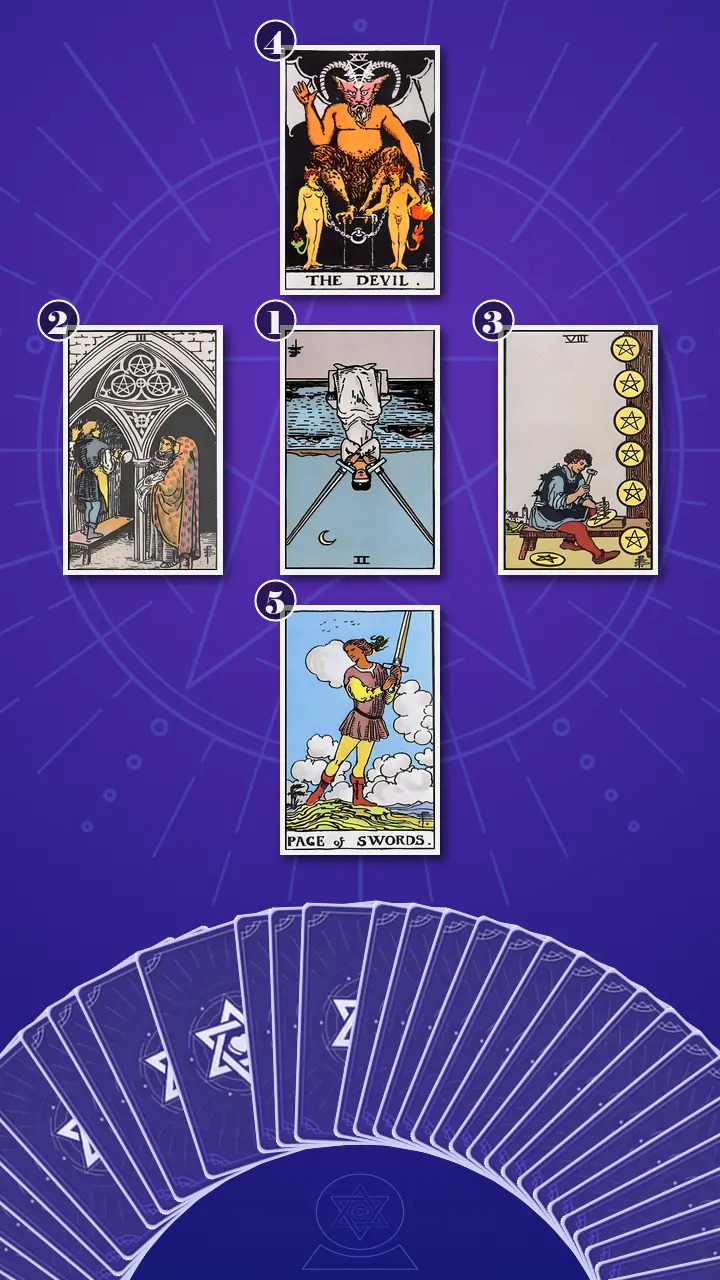
I tapped the table lightly where the cards would go. “Card 1 is the freeze-frame—what happens in your brain and body when you try to reply. Card 4 is the hidden driver—the pressure that’s grabbing the steering wheel. And Card 5 is the best next step you can take within seven days to regain agency, especially through communication.”
Reading the Map: From ‘Research’ Tabs to Real Constraints
Position 1: The stuck point right now — Two of Swords (reversed)
“Now flipped over,” I said, “is the card that represents the stuck point right now: what’s happening behaviorally and mentally when you try to take the next step after the offer email.”
Two of Swords, reversed.
Even before I explained it, Jordan’s mouth tightened in recognition—like her body had already read the card. I pointed to the blindfold and the crossed swords held tight at the chest. “This is the unsent email loop,” I said. “It’s 11 p.m., you’ve got the offer email on one side of your screen and the draft on the other. You type a polite opener, then freeze—because once your words exist, it feels like you’ve committed. So you ‘stay responsible’ by opening more tabs: lab site, campus job listings, pay guesses, Reddit anecdotes.”
“The weird part,” I added, “is you’re doing a lot of work, but it’s not the work that moves anything forward. It’s effort as avoidance.”
In terms of energy, this is Air—thinking—stuck in a blockage. Too much simulation, not enough contact with reality. The blindfold is the big tell: you’re trying to decide without letting real constraints (hours, training, pay, schedule) into the conversation. And those crossed swords? That’s the held breath. That’s the jaw lock. That’s your nervous system trying to prevent risk by preventing movement.
Jordan let out a short laugh that sounded like it had a bitter edge. “That’s… painfully accurate,” she said. “Like, too accurate. Kind of brutal.”
I nodded. “Brutal isn’t the goal. Precision is.” I softened my voice. “You’re not behind—you’re just trying to decide with your eyes covered.”
Then I leaned in just a bit. “Here’s the reframe the reversed Two of Swords is offering: if the blindfold is ‘I need to be 100% sure,’ the first move isn’t choosing perfectly. The first move is taking the blindfold off by asking for one piece of clarity. Something that would make this 30% easier.”
Position 2: Path A (Research assistantship) — Three of Pentacles (upright)
“Now flipped over,” I said, “is the card that represents Path A: what the research assistantship is likely to develop in you if you engage it intentionally.”
Three of Pentacles, upright.
“This card is so much less glamorous than people expect,” I told her, tracing the image with my fingertip. “It’s not ‘prestige.’ It’s apprenticeship. It’s a small team, learning how things are actually done, getting feedback, building credibility through tangible contributions—notes, data cleaning, protocols, literature summaries. It develops your ability to learn in public.”
I watched Jordan’s eyes shift—not wide with panic, more… focused. The echo here is the worksite vibe: check-ins, someone reviewing your work, a plan held up for discussion. “The key symbol,” I said, “is that moment of review. You’re allowed to ask: What does success look like? What training do I get? Who do I report to day-to-day? That isn’t weakness. That’s how collaboration works.”
Energy-wise, this is Earth in balance: measurable progress, real skill-building, confidence that comes from feedback—not from trying to look effortlessly impressive. I saw a small softening in Jordan’s shoulders, like the lab path became less of a myth and more of a process she could actually evaluate.
She swallowed and said quietly, “I keep thinking I’m supposed to already be good at it.”
“And the Three of Pentacles is saying,” I replied, “‘No—your job is to learn.’”
Position 3: Path B (Campus job) — Eight of Pentacles (upright)
“Now flipped over,” I said, “is the card that represents Path B: what the campus job is likely to develop in you if you engage it intentionally.”
Eight of Pentacles, upright.
“This one,” I said, “is predictable shifts, clean clock-out, and the kind of work where your brain finally quiets down because the work has edges—start time, end time, paycheck cadence. It’s competence through repetition and routine.”
Jordan exhaled so subtly I might’ve missed it if I wasn’t looking for it—like her body recognized the relief before her mind could argue with it. That’s the echo of this card: your nervous system wants a container.
And then came the guilt, right on schedule. She made a face like she’d tasted something too sweet. “But if I pick that,” she said, “it feels like… I’m choosing less.”
“Stability isn’t a failure,” I told her. “It’s a container.”
Energy-wise, the Eight of Pentacles is Earth in a healthy excess—it can be wonderfully steady, unless you’re choosing it purely to avoid fear. The distinction matters. Not morally. Practically. If you choose it intentionally, it can protect your sleep, your study blocks, your budget—your actual life, not your LinkedIn life.
When The Devil Loosened the Chains of Résumé Optics
Position 4: The hidden driver — The Devil (upright)
I didn’t rush this one. The espresso machine hissed behind the counter, then quieted. For a moment, it felt like the whole café held still with us.
“Now flipped over,” I said, “is the card that represents the hidden driver: the pressure, fear, or attachment shaping the decision more than you want to admit.”
The Devil, upright.
Jordan’s fingers curled slightly around her cup. I could practically see her mind reaching for a spreadsheet to protect itself.
Here’s the setup, exactly as it lives in real life: you open the offer email, your chest tightens, and suddenly you’re toggling between the lab website, the campus job board, and a spreadsheet like you’re trying to outthink the future. You’re not only choosing between two jobs—you’re trying to make sure the choice can’t hurt you.
Don’t let the chains of “what looks best” pick for you—identify what you’re attached to, then step out of The Devil’s grip and choose with intention.
That sentence landed like a teaspoon hitting the side of a ceramic cup—small sound, loud meaning. Jordan’s reaction came in layers: first a freeze (her breath stopped mid-inhale, her eyes fixed on the card), then the mental replay (her gaze went unfocused, like she was watching herself on the TTC scrolling LinkedIn “Thrilled to announce…” posts), and then the release (her shoulders dropped, but not like relief—more like surrendering a weight she didn’t realize she’d been carrying).
“But if I step out of it,” she said, voice thinner than before, “does that mean I’ve been… performing this whole time?”
I didn’t sugarcoat it, but I didn’t shame her either. “If LinkedIn is picking for you, you’re not choosing—you’re performing.” I paused. “And most of us have done it. Especially in fourth year, when every choice starts sounding like a résumé paragraph.”
Then I brought in my own way of diagnosing pressure—my Knowledge Filtration lens. “You know how a coffee filter works?” I asked, lifting a paper filter from the counter behind me. “If you pour everything in—grounds, grit, random bits—you don’t get clarity. You get sludge. The Devil is unfiltered input: peers, optics, invisible audiences. The chains are loose because you can choose a filter.”
I met her eyes. “Now, with this new perspective, think back to last week: was there a moment when you were about to send a clean question, and then you stopped because you worried what it would ‘say’ about you?”
Jordan’s throat bobbed as she swallowed. “Yeah,” she admitted, quieter. “I didn’t ask about hours because I thought it would make me look… needy. Like I should just be grateful.”
“That’s the chain,” I said gently. “And this is the pivot point of your journey: from pressure-driven rumination and avoidance to grounded confidence through self-honesty and clear, timely communication.”
Position 5: Best next step — Page of Swords (upright)
“Now flipped over,” I said, “is the card that represents the best next step: the clearest action you can take in the next 7 days to reduce uncertainty and regain agency.”
Page of Swords, upright.
“This is the antidote,” I told her. “The Page doesn’t gather information by spiraling privately. They gather information by asking.” I tapped the raised sword in the image. “That sword is one clean question.”
And because I’m a café owner who has watched hundreds of people try to brute-force focus with caffeine, I added my other diagnostic tool—my Focus Period Diagnosis. “When do you usually try to write the email?” I asked.
“Late night,” Jordan said immediately. “After work. When I’m exhausted.”
“Okay,” I said. “Then your next step isn’t just ‘send the email.’ It’s ‘send it during your best focus window.’ If you’re caffeine-sensitive, late-night drafting is basically choosing difficulty. The Page of Swords is alert, not fried.”
I slid her cup a little closer, like an anchor. “Clarity beats polish when the real goal is movement. You’re allowed to send a professional email that’s clean, not perfect. And you’re absolutely allowed to request a decision window.”
Jordan nodded once—small, but real. The agency surge was there: I could actually do that today.
The One-Cup Filter: Actionable Advice for Your Next 48 Hours
I leaned back and stitched the whole spread into one simple story, the way I’d explain a coffee blend to someone who doesn’t want a lecture—just something that tastes like relief.
“Here’s what the cards are saying,” I told her. “Right now, you’re stuck because your mind is trying to decide in the dark (Two of Swords reversed), while your life is asking for a workable structure (both options are Earth—Pentacles). The lab path isn’t ‘be impressive’; it’s ‘learn with mentorship’ (Three of Pentacles). The campus job isn’t ‘settle’; it’s ‘build steadiness and boundaries’ (Eight of Pentacles). What’s inflating the stakes is The Devil: résumé optics and the fear that one wrong yes proves you don’t control your future. The way out isn’t a perfect choice—it’s a clarifying conversation (Page of Swords).”
The cognitive blind spot was clear: Jordan kept treating the decision like a referendum on her worth, so she kept trying to solve it with private research. But the transformation direction was even clearer: shift from trying to find the perfect option to taking one clarifying action that reduces uncertainty—ask, confirm, and then commit.
To make it memorable, I used my café-specific strategy—the Latte Memory Technique. I made Jordan a small latte and, in the foam, wrote two tiny words with a skewer: Hours and Training. “Two non-negotiables,” I said. “That’s your filter. Not vibes. Not LinkedIn.”
Then I gave her the simplest, most doable next steps.
- The 12-Minute Draft + 3 QuestionsToday, open the offer email and write a reply that’s only 6–10 sentences: thank you + interest + 3 bullet questions (hours/week & flexibility, start date/weekly schedule, training/onboarding & who you report to) + one timeline line asking to confirm by a specific date 48–72 hours from now.Set a 12-minute timer. When it ends, make one pass for clarity (not perfection) and hit send. If your jaw tightens, ask: “Am I editing for clarity, or for self-protection?”
- The 15-Minute Week Reality CheckIn your phone Notes app (no laptop, no tabs), write two mini-schedules: one if you take the lab, one if you take the campus job. Include commute, class blocks, meals, and one non-negotiable rest window. Then write one sentence for each: “By April, this develops ___ in me.”Hard stop at 15 minutes. If you want to research pay/hours, write the question down and put it in your email instead of opening a new tab.
- The One-Person Advisor Reality PingText one trusted person (TA, mentor, older student) one question: “In your experience, what’s a normal weekly hour range for an undergrad RA in a lab like this?” Then decide now: if the answer is unclear, you’ll ask one follow-up question and still choose by your decision date.One person only—no polling the whole group chat. If you crave more opinions, treat it as The Devil signal and return to your two non-negotiables.

A Week Later: The Quiet Proof
Eight days later, I got a message from Jordan while I was opening the café, the street still quiet and smelling like fresh grounds.
“Sent the email,” she wrote. “Three questions. Asked for a decision window. They replied with hours that actually work, and a clear onboarding plan. I said yes. Also—I closed all my tabs after I sent it. Like… fully closed them. I slept.”
It wasn’t a cinematic transformation. It was small and real: she’d moved from living inside imagined outcomes to standing in real information. That’s what finding clarity often looks like—one clean question, one clean action, and a nervous system that finally believes it doesn’t need to hold its breath to be safe.
Her next text came the next morning, almost sheepish: “Woke up and thought, ‘What if I picked wrong?’—but I didn’t spiral. I just looked at the email thread, saw the actual hours, and made coffee. Then I laughed a little.”
When an email offer makes your jaw lock and your chest hold its breath, it’s rarely just about the job—it’s that quiet fear that one wrong yes will expose you as someone who doesn’t actually have control.
If you didn’t need this choice to prove anything about you, what’s one honest question you’d feel okay sending today to make the next step clearer?